

What happens if the AI on my site says something wrong?
You are likely to own it. That is not a hypothetical.
In Moffatt v. Air Canada, decided by a Canadian tribunal in February 2024, an airline chatbot told a customer he could apply for a bereavement fare discount after booking. The airline's actual policy required applying before travel. The tribunal ordered Air Canada to compensate the customer, and rejected the argument that the chatbot was a separate entity responsible for its own statements. It was part of the airline's website, so the airline was responsible for what it said.
Legal commentary at the time drew the obvious conclusion for anyone deploying a customer-facing assistant: where a business makes the technology available, the business is likely to carry the liability when it goes wrong.
So the question is not whether an AI on your site is impressive. It is whether you can defend every sentence it produces.
What does a "grounded" assistant actually mean?
An ungrounded assistant answers from whatever the model absorbed in training. A grounded assistant is given a specific body of approved material and answers from that, retrieving the relevant passages for each question rather than recalling them.
The practical difference shows up at the edge of its knowledge. Asked something the material does not cover, an ungrounded assistant produces a plausible answer, because the way these systems are trained rewards answering over admitting ignorance. Reporting in Science in 2026 made exactly this point: models are scored in ways that penalise "I do not know", so they guess, and they guess fluently.
A properly grounded assistant declines instead. That refusal is the feature. For a public-facing presence, a confident wrong answer is worse than no answer, because it is the one a customer will act on and quote back to you.
Does grounding eliminate the risk?
No, and anyone telling you otherwise is overselling. Grounding removes invention. It does not remove these:
- Wrong source material. If your approved documents contain last year's prices, the assistant will state last year's prices, accurately and confidently. Grounding makes it faithful, not correct.
- Misreading a correct source. Retrieval can surface the right document and the answer can still summarise it badly, especially where a policy has conditions and exceptions.
- Questions you never anticipated. Refusal is the right behaviour, but a wall of refusals is its own failure. You find these by reading the log.
- Implied commitments. An assistant that is helpful about a refund policy is, functionally, making statements about your refund policy. That is precisely what the Air Canada tribunal was looking at.
What grounding buys you is a bounded, reviewable problem. The failure modes above are all things you can inspect, correct at source, and re-test. Invention is not.
What should I require before putting one on my site?
Five things. If a vendor cannot show you all five, the assistant is not deployable on a page that represents you.
- Named sources on every answer. Not a vague claim of grounding. The actual documents behind the actual sentence, visible to you.
- A refusal you have seen work. Ask it something outside its material before you launch, and confirm it declines rather than improvises.
- Approval before publication. You decide what goes into the approved set, and changing that set does not require a rebuild.
- A transcript you can read. You cannot correct what you cannot see. The log is also your evidence if a customer later disputes what they were told.
- Explicit boundaries on the risky topics. Pricing, contractual terms, safety, medical or legal matters. Decide deliberately whether it speaks to these at all.
What does one look like in practice?
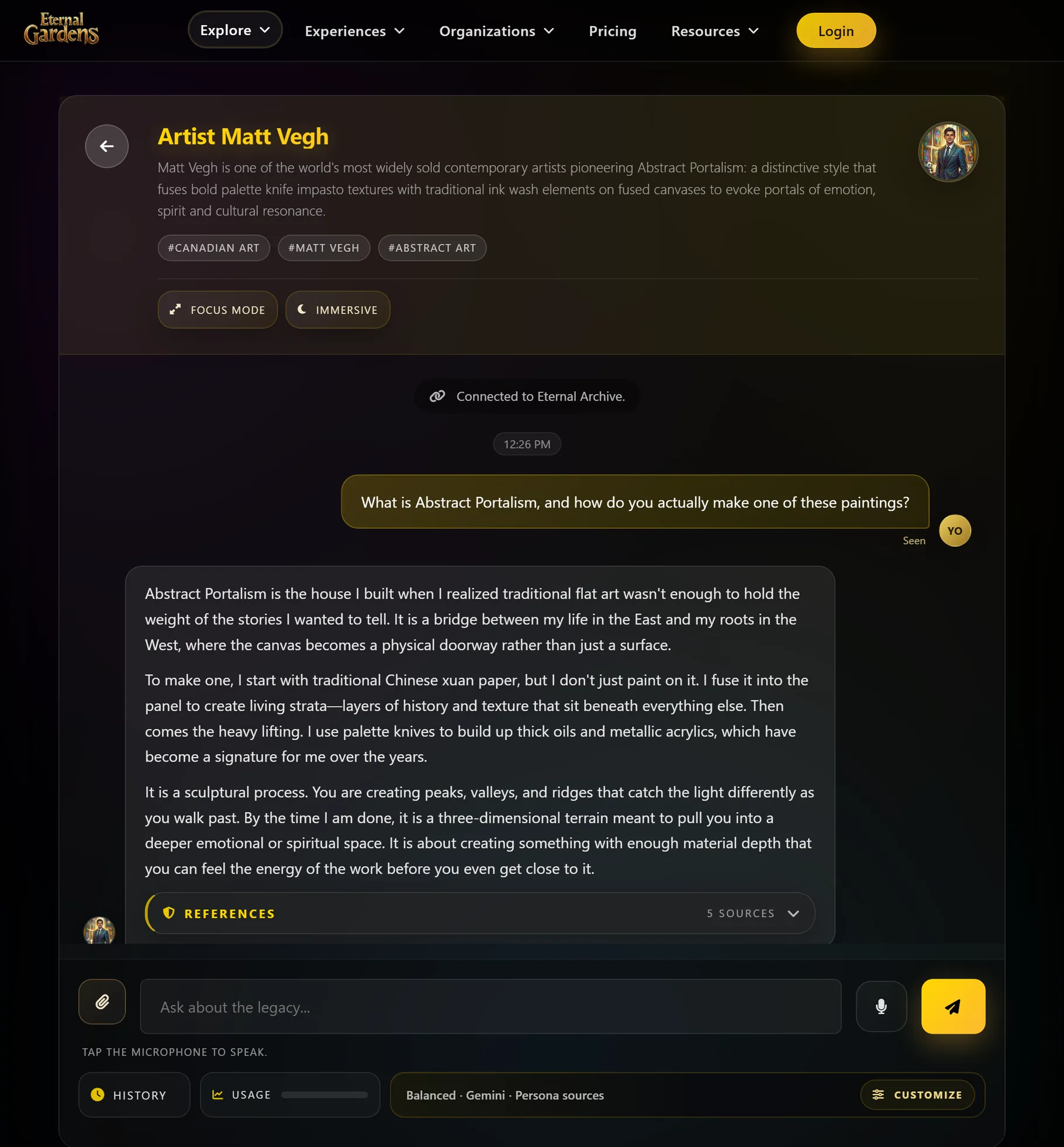
Below is a working example rather than a description of one. It is the same governed persona that runs at its own public page, embedded here in this article, answering from material its owner approved.
Ask it something about Matt Vegh's practice and you will get an answer with a References panel naming the sources behind it. Ask it something outside that material and you should see it decline. Both behaviours are the point.
Can it live on my own website?
Yes. The same governed presence can be embedded on your own domain, so the conversation happens where your customers already are rather than on a page they have to be sent to.
Two things are worth deciding before you do. First, whether the assistant should be the front door or a second opinion; an answerer placed beside your existing content usually outperforms one that replaces it. Second, who reads the transcript and how often, because an assistant nobody reviews will drift away from what you would have said, quietly, over months.
Common questions
Is a grounded assistant the same as RAG?
Retrieval-augmented generation is the common technique behind grounding: the system searches your approved material for relevant passages and gives them to the model with the question. Grounding is the wider commitment, which includes what happens when retrieval finds nothing. A system that retrieves but still answers when it finds nothing is using RAG without being grounded in any useful sense.
Can I stop it from talking about pricing or legal terms?
Yes, and for most businesses you should decide this deliberately rather than by omission. Boundaries are set as part of how the persona is configured, so it can be told to decline certain topics and hand off to a person instead. The Air Canada case turned on a policy question, which is exactly the category worth fencing off until you are confident.
What happens when it does not know something?
It should say so and offer a route to a person, rather than construct a plausible answer. Test this before you launch by asking something deliberately outside its material. If it improvises, it is not ready for a page that represents you, whatever the vendor calls it.
How do I keep it current?
By updating the approved material, not by retraining anything. Because the assistant answers from a source set rather than from memorised weights, correcting a document corrects the answers that depend on it. That is also why a stale document is the main risk: the system will faithfully repeat whatever you left in it.
What does it cost to try?
Exploring the platform is free for the first month on Garden Circle, then CAD $19.99 per month, and you can build and publish a governed persona yourself in that time. If you want our team to build it, train it on your material, set the refusal boundaries and review it before launch, commissioned work begins with a paid Persona Blueprint, scoped and quoted case by case once we have seen the material.