
What is the difference in one paragraph?
A chatbot is defined by its job. A persona is defined by its description. A digital twin is defined by its subject.
A chatbot exists to complete a task: answer a support question, book a slot, take an order. An AI persona is a character with a voice and a point of view, defined by what someone wrote about it. A digital twin is a model of something real that is kept in correspondence with that thing.
Those are the useful distinctions, and none of them is about the underlying technology, which is frequently identical. All three are usually the same class of model behind the same conversational surface. What differs is what the answers are derived from, and that is the only difference a buyer should care about.
What is a chatbot?
A conversational interface to a task, judged by completion rather than by character.
The defining feature is purpose. A support chatbot exists so a question gets resolved; a booking chatbot exists so an appointment lands in a calendar. It may have a name and a tone, but those are decoration on a workflow. If it develops a personality and stops resolving tickets, it has got worse rather than more interesting.
This is the oldest and least glamorous of the three terms, which is exactly why vendors avoid it. A great deal of what is currently sold as a persona or a twin is a chatbot with a portrait attached, and there is nothing wrong with that when the underlying job is a task. The problem is only in the pricing that follows the relabelling.
What is an AI persona?
A character with a voice, a viewpoint, and boundaries, defined by whatever it was given.
The term carries two quite different meanings in the market, and conflating them is the most common source of confusion in this whole subject.
In marketing and research contexts, an AI persona usually means a synthetic profile: a representative customer assembled from aggregated patterns, used to rehearse how a segment might react. Vendor material describes exactly this, with worked examples of an invented individual standing in for a demographic. Its answers are extrapolations from generalised data, and they are useful for exploring a hypothesis rather than for reporting a fact.
In creator and publishing contexts, an AI persona usually means a specific identity: an author, an expert, a character from a series, made available to an audience. Here the same word describes something that is meant to be accountable to a real body of work.
The two share a label and share almost nothing else. One is a composite that represents nobody in particular; the other represents someone specific and can therefore be wrong about them. When a supplier says persona, the useful follow-up is: a persona of whom, built from what?
What is a digital twin?
A model kept in correspondence with a real subject, which is a stricter claim than either of the others.
The term arrived from engineering, where a digital twin is a live model of a physical asset fed by data from that asset. Applied to people, the sense carried over is one-to-one correspondence: writing on the subject distinguishes a twin from a persona on precisely this basis, describing a twin as a replica grounded in actual data about a specific individual, where a persona tells you what someone might do and a twin is meant to reflect what a particular subject actually does.
The word "twin" therefore commits a vendor to something quite demanding. A twin that is not fed by real data about its subject, and not checked against it, is a persona wearing a stronger word. Recent academic work on generating and evaluating personalised digital twins treats evaluation as central for exactly that reason: without a way to test correspondence, the claim is unfalsifiable.
The practical question to ask anyone selling a twin: what is it in correspondence with, how often, and how would we detect drift? A confident answer is a good sign. An answer about model quality is a different subject.
Which distinction actually matters?
Not the noun. Whether the system answers from approved material about a real subject, or from a description of one.
Consider two systems representing the same expert. The first is given a paragraph describing her: her field, her manner, her opinions in summary. Asked a question, it produces something consistent with that paragraph, generated on the spot. The second is given her published work, her talks, her interviews, and an interview conducted for the purpose. Asked the same question, it answers from those documents and names the passage it used.
Both are conversational. Both sound like her. Only one can be checked, and only one can decline. The first has no way to distinguish between what she said and what is merely consistent with the description of her, so it will answer anything with equal confidence. The second either has support for a claim or does not, and if it is built honestly it says which.
That capacity to decline is the entire commercial difference in a professional setting. A system that always produces an answer cannot be trusted with a question it does not know the answer to, and those are the questions audiences actually ask.
Why do vendors use these words so loosely?
Because there is no standards body, and because the stronger word prices better.
Nobody owns these definitions. Writing across the field in 2026 disagrees on whether a twin is a kind of persona, whether an avatar is a separate category, and whether a persona must represent a real individual at all. Some of that is honest disagreement between disciplines that adopted the same word for different work. Some of it is that "digital twin" sounds like engineering and "chatbot" sounds like a support queue.
The consequence for a buyer is that the label on a proposal carries no reliable information. Two questions recover most of it:
- What does it answer from? A written description, a document set, or live data from a real subject.
- What does it do when it does not know? Generate something plausible, or say so.
Answers to those place a system accurately regardless of which noun appears on the invoice.
Which one do I actually need?
Work backwards from what happens if it is wrong.
- If a wrong answer is an inconvenience and the job is a task, a chatbot is the right tool and the cheapest. Do not pay persona prices for it.
- If you are exploring how a group might react and no individual is being represented, a synthetic persona is appropriate. Treat its output as a hypothesis rather than a finding, since it is extrapolated from patterns and not reported from anyone.
- If it speaks for a real person, institution, or body of work, you need grounding and refusal, whatever the vendor calls it. This is where an unsupported answer stops being an inconvenience and becomes a statement attributed to someone.
- If it must track a changing real-world subject, you are in twin territory, and the questions about correspondence and drift are the ones that matter.
Where does Eternal Gardens sit in this?
In the third category, and deliberately not in the fourth.
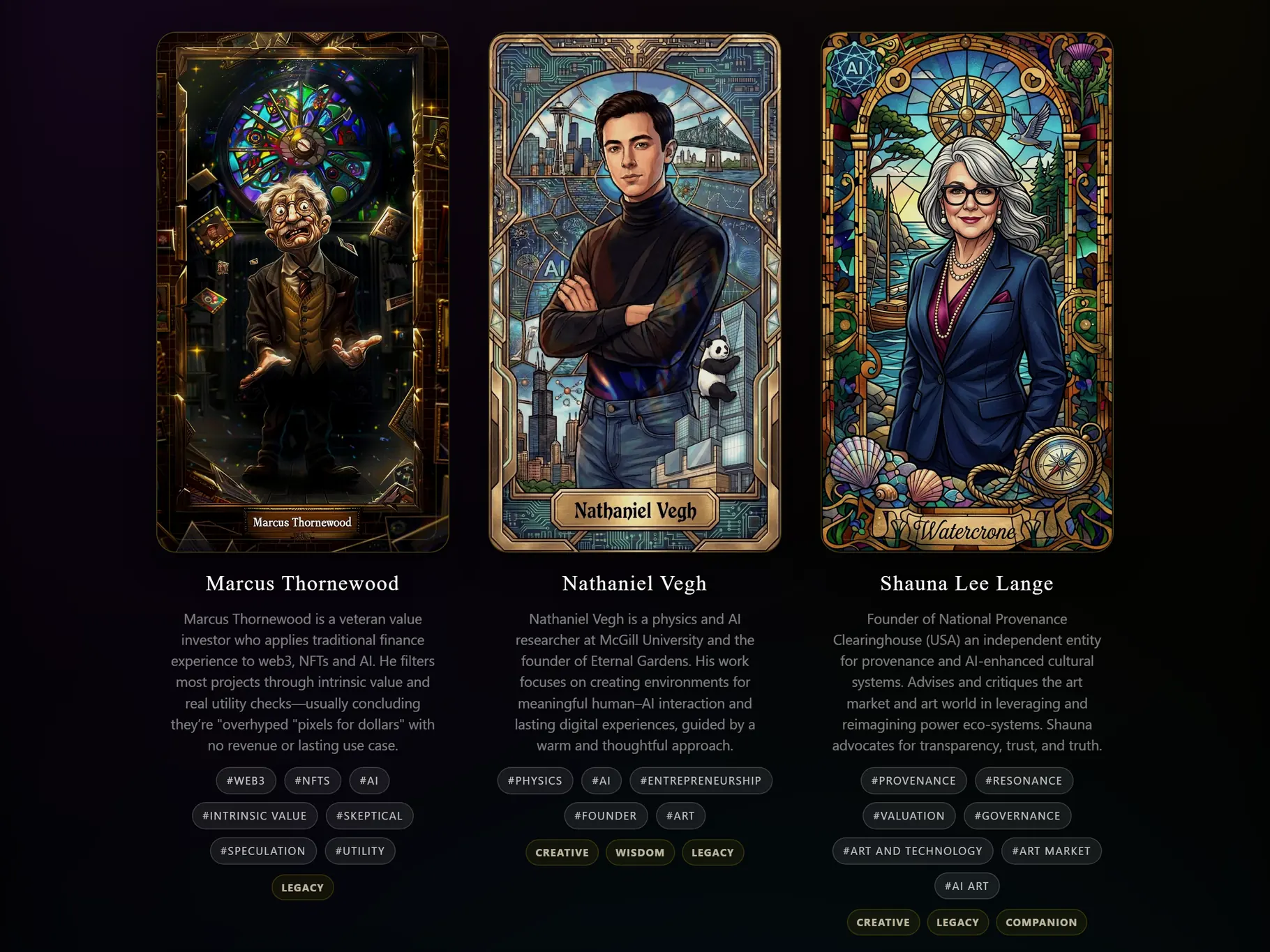
What we build is a governed identity: a specific person, character, or body of knowledge, answering from material the owner approved, naming what it drew on, and declining when it has nothing to answer from. The owner decides what goes in, reviews what comes out, and can correct an answer at the source that produced it.
What we do not claim is twinhood. There is no live feed from a person, no continuous correspondence, and no assertion that the system reflects what someone would think today about something they have never addressed. It reflects an approved archive as it stood when it was last updated, which is a smaller claim and one we can actually stand behind.
That boundary is also why the interesting question in a sales conversation is rarely which noun we use. It is what material exists, who is allowed to approve it, and what should happen when somebody asks a question the archive does not cover.
Common questions
Is a digital twin just a persona with better marketing?
Sometimes, and the way to tell is to ask what it is in correspondence with. A twin claims one-to-one grounding in real data about a specific subject, which is a testable claim. If the supplier cannot say what data keeps it current or how drift would be detected, the stronger word is doing work the system is not.
What about AI avatars and AI clones?
Avatar generally refers to appearance rather than to grounding: a generated character, in two or three dimensions or photorealistic, presenting a conversational system. Clone is a marketing term with no settled meaning. Neither tells you what the thing answers from, which is why both should be followed by the same two questions about sourcing and refusal.
Can one system be more than one of these?
Yes, and most useful ones are. A presence built for an author can complete tasks like booking or directing people to a shop, carry a recognisable voice, and answer from an approved archive at the same time. The categories describe emphasis rather than architecture, which is part of why the words drift.
Does a persona need to be based on a real person?
No, and that is exactly where the term splits. A fictional character or an invented composite can be a persona in perfectly ordinary usage. What changes when a real person is represented is accountability: the system can now be wrong about somebody, which makes sourcing and the ability to decline a requirement rather than a refinement.
Which term should I use in my own brief?
Avoid all three and describe the behaviour instead. Write down who it speaks for, what material it may answer from, what it must do when it has no support, and who approves changes. A brief written that way is unambiguous to every supplier, and it makes their choice of noun a matter of style rather than a source of misunderstanding.