
Why doesn't ChatGPT know who I am?
Because it probably never read anything solid about you, and it may not be able to find anything now.
A large language model learns most of what it knows during training, and training data has a cutoff date. If your work was thinly described online before that cutoff, the model has nothing to recall. Marketing guidance published in 2026 puts it plainly: if a brand was not well described online before the cutoff, the model simply does not know who you are from training alone.
Modern assistants close that gap by retrieving live pages while they answer. That is the opening. It means being known is no longer only about what a model memorised years ago. It is about whether there is a clear, current, credible page it can fetch and quote in the seconds it spends composing an answer about you.
If that page does not exist, the assistant does one of three things: it says it does not know, it assembles a vague answer from scattered mentions, or it confuses you with someone who shares your name. None of those are neutral outcomes when the person asking is deciding whether to hire, buy, book, or collaborate.
How do I check what AI says about me right now?
Do this before you read any further. It takes about a minute, and whatever you find is more useful than anything we can tell you.
Open ChatGPT, Perplexity, or Google's AI mode and run these five prompts, replacing the bracketed parts with your own details. Ask them in a fresh conversation so nothing you have said earlier colours the answer.
-
Who is [your name]? -
What is [your brand] known for? -
Who are the best [your category] in [your city or niche]? -
Is [your brand] trustworthy? What do people say about it? -
Where can I see [your name]'s work or buy from them?
Read the answers for three things. Is anything wrong. Is anything missing that would matter to a buyer. And critically: which sources did it cite. Those citations are the pages currently speaking on your behalf.
Most people find the same pattern. Question three, the category question, is the one that hurts. You are usually absent from it, because the person asking does not know you exist yet and never types your name.
What is Generative Engine Optimization (GEO)?
Generative Engine Optimization is the practice of making your information easy for AI systems to retrieve, understand, and cite when they answer questions. Traditional search optimization competes for a position in a list of links. GEO competes to be inside the answer itself.
The distinction matters because there is no position to win. A generative engine does not rank you third. It either mentions you or it does not.
This has become a real market rather than a slogan. Analysts valued generative engine optimization services at roughly USD 1.01 billion in 2025, projected near USD 1.48 billion in 2026 and growing at approximately 45% annually, with a cluster of measurement platforms now competing to score brand visibility inside AI answers.
How do AI engines decide what to cite?
Different assistants behave differently, and the difference is instructive. Reporting from 2026 finds that ChatGPT tends to cite around eight sources per answer and leans toward consensus, favouring what several credible sources agree on. Perplexity often cites twenty or more and reaches further into specialist and industry sites.
Across engines, the same characteristics keep surfacing in what gets quoted:
- A direct answer near the top. Content that states the answer in a sentence or two is easy to lift. Content that takes six paragraphs to arrive is not.
- Question-shaped headings. Headings phrased the way people actually ask match the question being answered.
- Consistency across sources. When your description matches across your site, your profiles, and third-party mentions, a model treats it as settled fact. When it conflicts, the model hedges or omits you.
- Structured data. Schema markup helps systems understand what a page is and who it is about.
- Server-rendered HTML. If your content only appears after JavaScript runs, assume some crawlers never see it.
- Explicit sourcing. Pages that cite their own evidence are treated as more reliable than pages that assert.
One structural change is worth knowing. Through 2026 the overlap between Google page-one rankings and AI answer citations fell sharply, dropping to well under half. Ranking well on Google no longer reliably means being cited by an assistant. AI visibility has become its own channel with its own rules.
What can you actually control?
This is the part most vendors skip, so we will be direct about it.
Nobody controls what a generative engine retrieves or cites. Models change. Retrieval changes. Ranking signals change without notice or explanation. Two people asking the same question can get different answers, and the same question can answer differently next week. Anyone who guarantees you a ranking, a citation, or a percentage improvement in an AI engine is selling something they do not own.
What you genuinely control is narrower, and more useful than it sounds:
- Whether an authoritative source about you exists at all. Most people fail here first.
- Whether it is accurate, current, and complete.
- Whether it is structured so a machine can extract a clean answer.
- Whether it is consistent with everywhere else you appear.
- Whether it answers the category questions buyers ask, not only your name.
- Whether you measure what engines say today, so you can tell if it changes.
That last point is the honest substitute for a guarantee. You cannot promise an engine will cite you. You can absolutely establish a baseline, publish a source worth citing, and re-measure on a schedule.
How do you become the source AI reaches for?
Publish a page about you that is built to be retrieved, and keep it true.
That page needs to be more than a biography. It should carry the facts a buyer needs, in the words they would use, in a structure a machine can parse, on a public URL, kept current as your work changes. It should be able to answer a follow-up question rather than sit still.
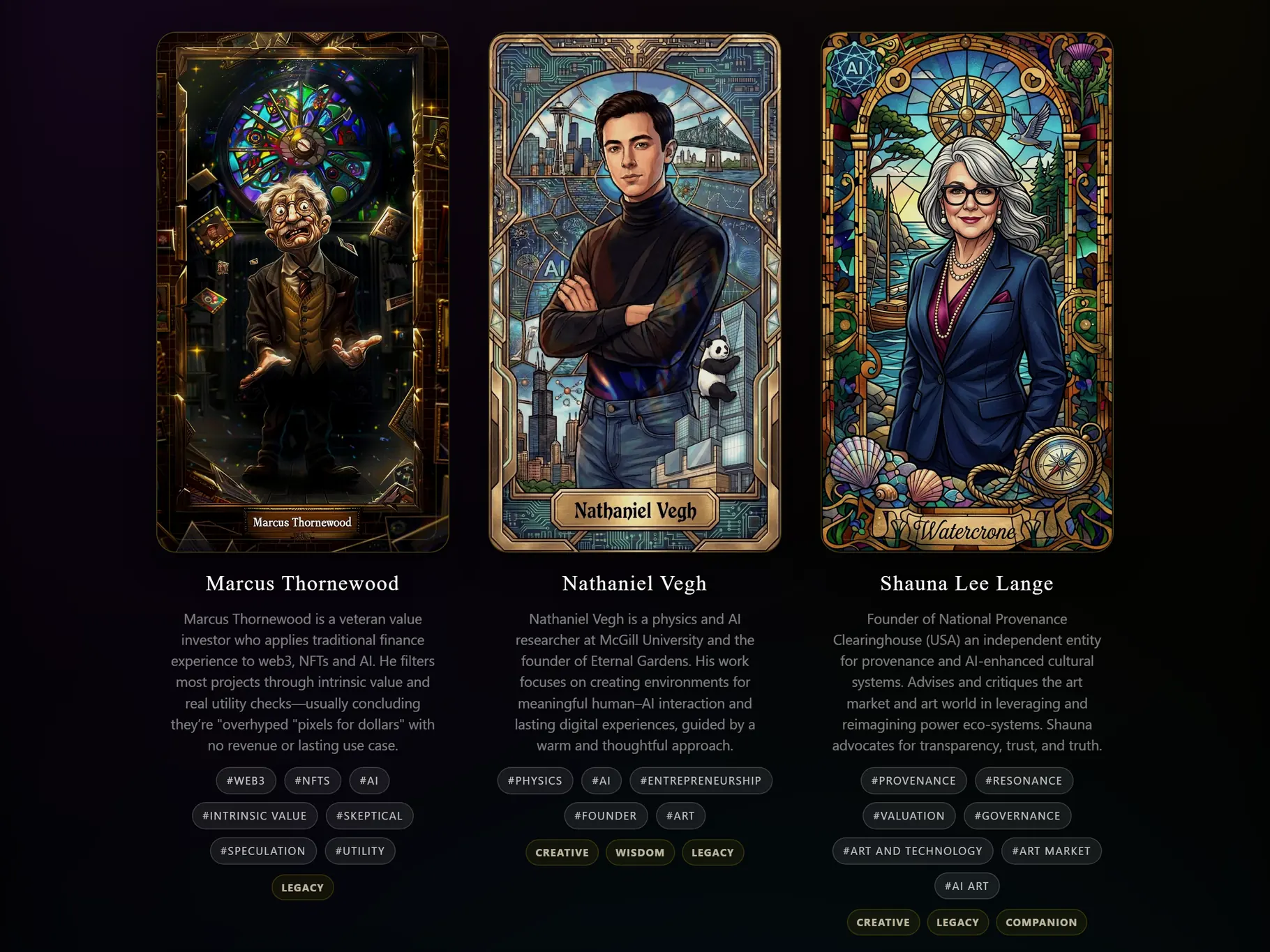
This is what an Eternal Gardens persona is. It is a governed public presence for a person, character, or body of knowledge: grounded in sources you approve, published at a URL you control, answering questions in your voice within boundaries you set, and updatable without rebuilding anything.
Grounding is the part that matters commercially. The persona answers from material you have approved, and declines when it lacks support, rather than improvising something plausible. For a public-facing presence, a confident wrong answer is worse than no answer at all.
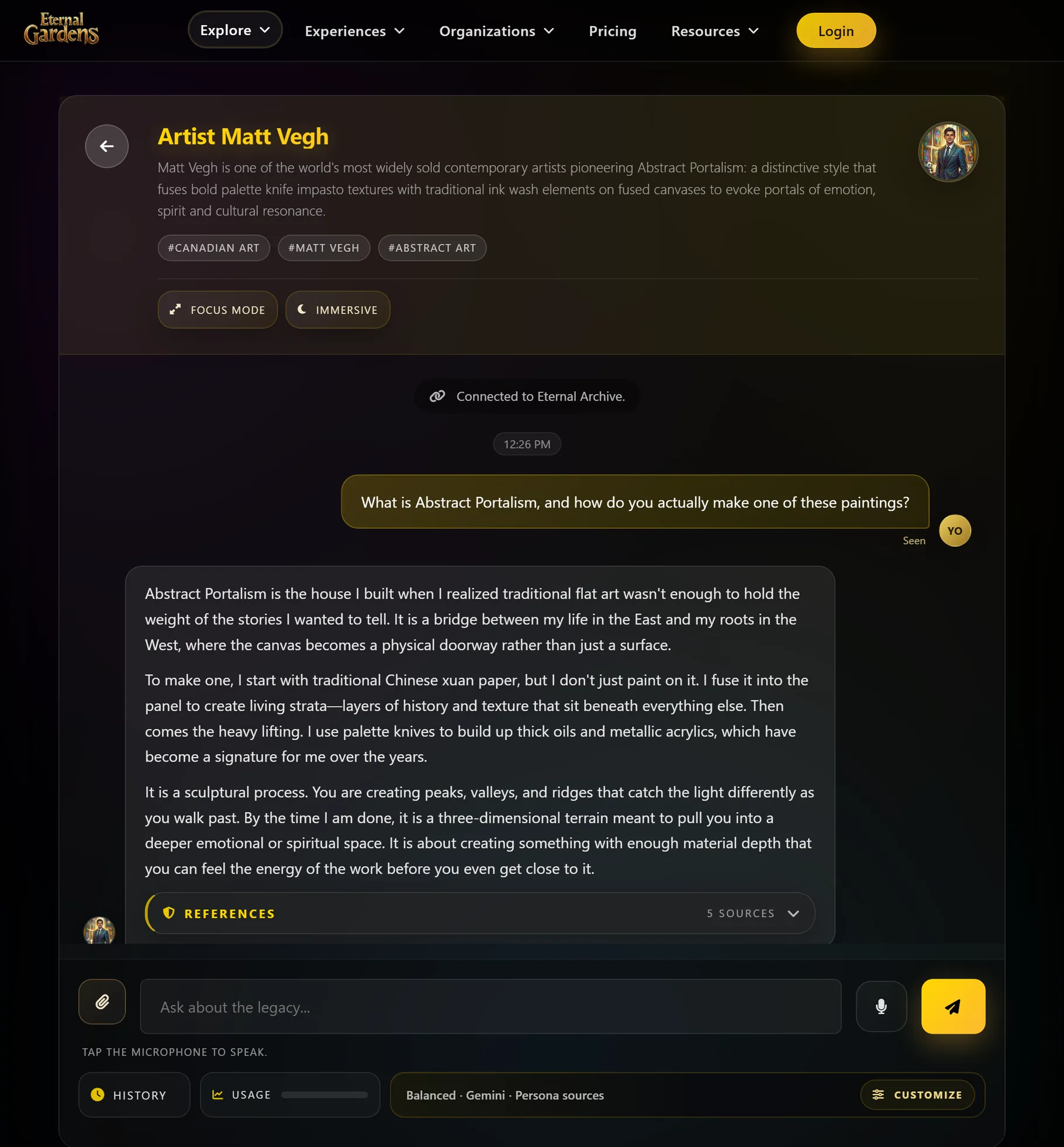
Does this actually work? Here is a live example.
Matt Vegh is a Canadian abstract artist and an Eternal Gardens co-founder. His public Eternal Gardens persona page describes his practice, his Abstract Portalism style, and his work, and answers questions about all three.
Ask an AI answer engine who Matt Vegh is. The description that comes back closely tracks the wording published on his Eternal Gardens persona page, and eternalgardens.world appears among the sources those engines retrieve.
Two honest caveats, because this article argues against unverifiable claims and will not make one here. First, this demonstrates that a governed persona page can become a retrievable source. It is not a measured before-and-after, and we are not claiming a percentage improvement, because no baseline was captured before the page existed. Second, generative answers vary between runs and change over time, so you may see different wording than we did on 31 July 2026.
Run the prompt yourself. That is the point of a claim you can check.
Try it yourself
This is Artist Matt Vegh's real persona, running here in the article. Ask about his work, his technique, or Abstract Portalism.
A live conversation, not a recording. It answers from approved sources and declines when it lacks support. The same usage allowance applies here as anywhere else on Eternal Gardens, so a free visitor, a member, and the owner each get what their plan allows.
What Eternal Gardens does with you
You can do all of this yourself on the platform. Many people do, and the first month is free.
When a brand or creator wants it done properly and quickly, our team does the work with them. That includes building and training the persona on approved source material, shaping how it answers and where it declines, and publishing it with the structure and review it needs. It also includes the surrounding content that gives engines more than one thing to find:
- Article and post generation so your knowledge is published consistently rather than in bursts.
- Council Studio, where multiple personas discuss a topic together, producing depth a single profile page cannot.
- Storybook Studio for narrative work that carries a brand rather than reciting it.
- An embeddable answerer that puts the same governed presence on your own domain.
- Review and approval so nothing published speaks for you without your sign-off.
Every presence we publish is a separate page with its own description, its own topics, and its own conversation. That is deliberate: an engine answering a category question has more than one door to find.
We also record what AI engines say about you before we start, and re-measure afterwards. We do not promise an engine will cite you. We do commit to the work, the structure, and the measurement, so you can see what changed and decide what to do next.
Common questions
Is GEO the same as SEO?
No. SEO competes for a position in a list of links. GEO competes to be inside a generated answer, where there are no positions, only whether you are mentioned. They overlap in fundamentals such as clear structure and credibility, but through 2026 the overlap between Google page-one rankings and AI citations fell to well under half, so ranking well no longer reliably produces citations.
How long does it take to show up in AI answers?
It varies and nobody can promise a date. Retrieval-based assistants can surface a new public page within days once it is discoverable, while knowledge that depends on model training may take far longer or never arrive. This is why we measure what engines say before and after rather than predicting a timeline.
Can I do this myself, or do I need help?
You can do it yourself. Eternal Gardens is a self-serve platform and Garden Circle is free for your first month, so you can build and publish a persona without talking to anyone. People usually ask for help when the source material is scattered, when the presence has to be accurate because it represents a business, or when they want the surrounding content produced as well.
What does it cost?
Exploring the platform is free for one month on Garden Circle, then CAD $19.99 per month. If you want our team to do the work, commissioned engagements begin with a paid Persona Blueprint covering audience, sources, a rights and risk scan, a working prototype, and a credible scope for the full build. What that costs depends on how much material exists and what shape it is in, so it is quoted case by case rather than from a list.
Can you guarantee my brand will be cited by ChatGPT?
No, and neither can anyone else. No supplier controls what a generative engine retrieves or cites, and those systems change without notice. What we guarantee is the work and the evidence: a published, structured, citable presence, a documented baseline of what AI engines say about you today, scheduled re-measurement, and remediation included in the engagement.