

Why am I described well but never recommended?
Because those answers are built from different sources. When somebody names you, the engine reads about you. When somebody asks for the best in a category, the engine reads about the category, and your own site is rarely part of that.
The Victorious Q2 2026 quarterly search report measured this across eight AI platforms. Asked about a brand directly, 96% were described accurately. Asked a category research question instead, 89% of brands never appeared at all. Reporting on the same study noted that in those category answers, directories and comparison sites were named more than twelve times as often as brands.
That is the whole problem in one sentence. The buyer who already knows you gets a good answer. The buyer who does not know you yet never hears your name, because the engine is reading a roundup, not your homepage.
How do I see where I stand?
Ask the questions a buyer would ask before they know you exist. Not your name. Your category.
-
Who are the best [your category] in [your city or niche]? -
I need [the outcome your customer wants]. Who should I talk to? -
What are the top alternatives to [your best-known competitor]? -
Compare the leading [your category] providers and their strengths. -
Who is doing the most interesting work in [your field] right now?
Note two things for each answer: who was named, and which pages were cited. The named brands are your real competition in this channel. The cited pages are the ground the answer was assembled from, and they are where the work happens.
Repeat each prompt across a few sessions. These answers vary, and a single run tells you very little.
What is the engine actually reading?
Third-party ground, mostly. Roundups, comparison pages, directories, forum threads, analyst notes, trade coverage. Places where somebody who is not you has described what you do alongside other options.
This is uncomfortable, because it is the part of your visibility you do not own. But it is not mysterious, and it is not unreachable. Each engine leans differently: some weight recency and community discussion heavily, others lean on consensus across established sources. What they share is that a brand described consistently in several credible places is easy to include, and a brand that exists only on its own website is easy to omit.
One 2026 experiment reported by Search Engine Land is worth knowing about, because it cuts both ways: a fabricated brand was made to surface in AI answers by seeding coverage of it. That shows these systems reward described-ness rather than merit, which is a warning about what you will be competing against, and a reason to make your own description accurate and well-evidenced rather than loud.
What do I do about it?
Five things, in rough order of how much they move the needle for a small or mid-sized brand.
- Be listed where your category is listed. Find the directories and comparison pages the answers cited, and make sure you are on them, described accurately and currently. This is unglamorous and it is the highest-yield step.
- Describe yourself in category language. Most brands describe what they call themselves. Buyers search for what they need. If nothing you publish contains the phrase a buyer would use, you will not match the question.
- Be consistent everywhere. When the same description appears across your site, your profiles, and third-party mentions, an engine treats it as settled. When descriptions conflict, it hedges or omits you.
- Publish something worth citing. Original explanation, real numbers, a clear method. Pages that cite their own evidence get treated as more reliable than pages that assert.
- Give the category more than one door. One page about your company is one chance to match. Several pages, each answering a different real question, is several.
What does "more than one door" look like?
A single company page has to be about everything, which means it is specific about nothing. A set of governed presences, each about a person, a body of work, or a defined topic, gives an engine several distinct things to find, each described in the language of a different question.
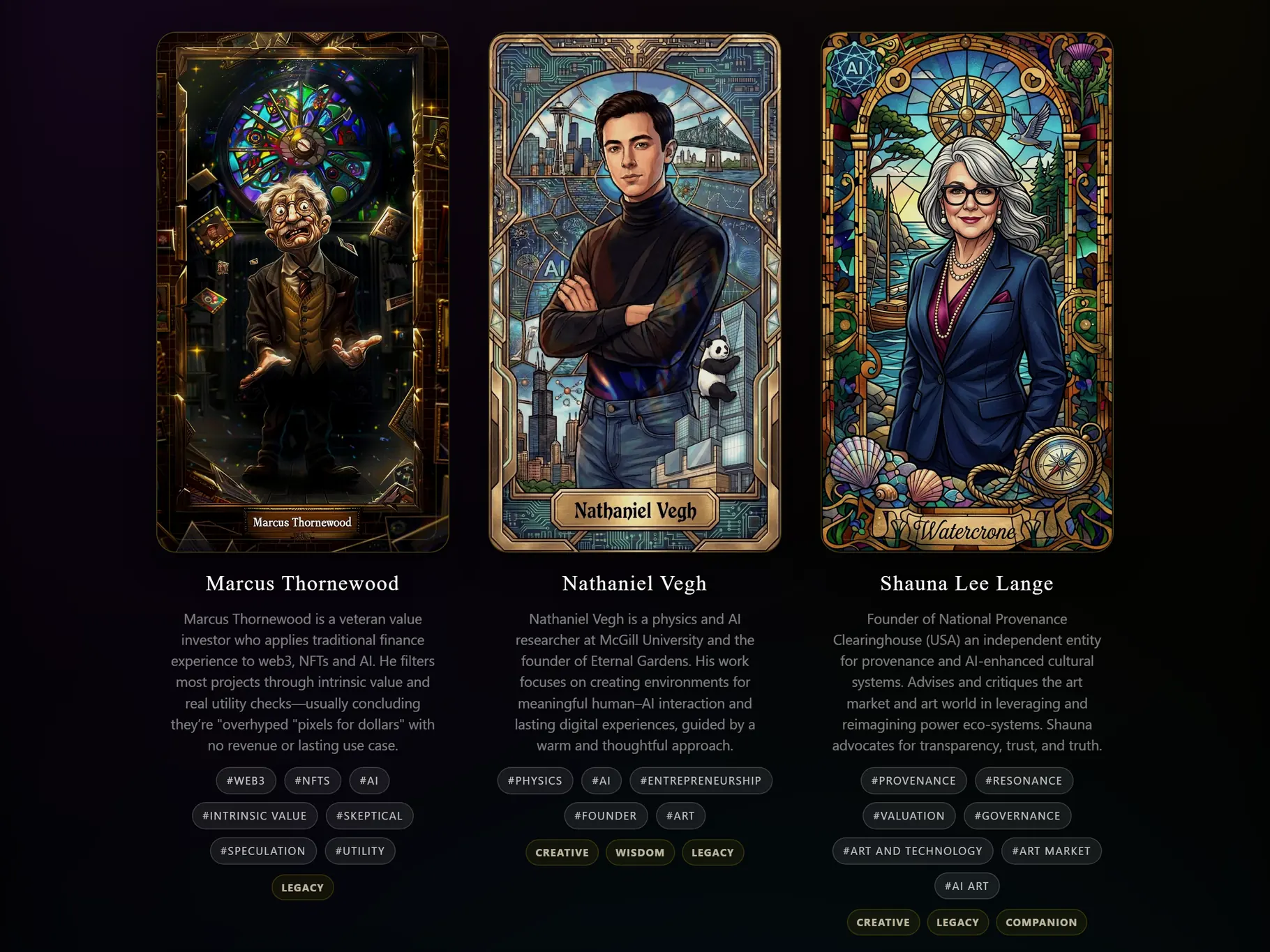
That is how Eternal Gardens is structured. Each persona is its own public page with its own description, its own topics, and its own conversation, published at a URL you control. A question about a field can reach a person rather than only a brand name.
What can nobody promise you here?
A place in the answer.
There is no ranking to buy and no position to hold. An engine either names you or it does not, and that decision is remade every time somebody asks, by a system that changes without notice. Anyone selling you a guaranteed mention in a category answer is selling something they do not control.
What is real: you can measure what the engines say about your category today, you can be present and consistently described in the places those answers are built from, and you can re-measure to see whether your share of those mentions moved. That is a programme, not a guarantee, and it is the only honest version of this work.
Common questions
Is this just SEO with a new name?
It shares fundamentals such as clear structure and credibility, but the target is different. SEO competes for a position in a list of links on pages a person then chooses from. Category answers have no list and no position: you are either named inside the answer or absent from it. The practical difference is that third-party pages matter more here than your own site does.
We are a small brand. Is this hopeless against big competitors?
No, but pick your category carefully. Broad category questions are dominated by whoever the roundups already feature. Narrower questions, which is where specific buyers actually are, are far less crowded, and being genuinely the clearest answer to a specific question is achievable in a way that being the best-known name is not.
Should we pay for directory listings?
Sometimes, and judge each one by whether it actually appeared in the answers you tested. Directories that surface in your category answers are worth being on, accurately and currently. Directories that never appeared are worth nothing regardless of price, and a paid listing on a page nobody cites is a page nobody cites.
How often should we re-test?
Monthly is enough for most brands, and the value is in doing it the same way every time. Same prompts, fresh sessions, several runs each, recording who was named and which pages were cited. A change in the cited pages is usually the first sign that something you did has landed.
What does Eternal Gardens actually do for this?
We build and train the governed presence, publish it with the structure and review it needs, and produce the surrounding content that gives engines more than one thing to find. We also record what engines say about your category before we start and re-measure afterwards. We do not promise a mention, because nobody owns that. You can also do all of it yourself on the platform; the first month on Garden Circle is free.