Where is the best place to begin?
With a conversation, whenever a good moment arrives.
Everything else on this page can be done later, done differently, or not at all. A recording of someone answering a question in their own words, with their own pauses and their own way of arriving at the point, is the one thing that cannot be assembled from anything else afterwards. Photographs show us what someone looked like. Documents show what they did. Only a recording keeps how they said it.
It does not need to be a project, and it does not need to be solemn. A phone resting on the table, one question, ten minutes. Families who have done this rarely think about the sound quality afterwards. What tends to stay with them is the questions they never quite got round to.
There is no correct time to start, and no need to explain it as anything more than wanting to hear them tell it. If it makes the first one easier, begin with the things only they can answer rather than the things you could look up. Where the family came from. Why they made the decision that changed everything. What they thought about something you have always wondered about.
What is worth asking?
Open questions about particular moments tend to work better than broad ones about a whole life. "Tell me about your childhood" usually produces a summary. "What was the kitchen like in the house you grew up in?" usually produces a story.
These five are a gentle starting set. One per sitting is plenty, and there is nothing lost by stopping when a conversation has run its course.
-
What is the first thing you remember? -
Tell me about the day you met [name]. -
What is a decision you made that you still think about? -
What did your parents get right, and what would you have done differently? -
What do you want the grandchildren to know about you?
Let them wander away from the question. The digressions are usually the part a family plays back years later.
Keep the original files somewhere that is not only a phone, since a phone is a thing that gets lost, upgraded, or locked. Copying them somewhere a second person in the family can also reach is a small step that saves a great deal.
What happens to their accounts and photographs?
Less than most families expect, and very little of it happens on its own.
As a general rule, online accounts are not property that passes to next of kin, and most providers will not hand over the contents of an account after a death. Email is the strictest case: in the United States, federal law prevents providers from releasing the contents of communications without the user's consent or a court order. Most people only learn this once they are already in the middle of it, which is the main reason it is worth reading about at a calmer moment.
What does work is arranging it in advance:
- Facebook lets someone nominate a Legacy Contact, and an account can be memorialised or deleted.
- Google has Inactive Account Manager, which lets a person decide in advance what happens to their data after a period of inactivity, including who receives it.
- A named digital executor, recorded alongside a will, with a written list of what exists and what should happen to it.
The pattern is the same across every provider: it has to be set up by the person themselves, while they are able to. It is not a conversation anyone looks forward to. It is also a short one, and it spares a family a much harder version of it later.
What can an AI presence honestly do?
It can hold what someone left behind and answer from it. That is a smaller claim than this market usually makes, and it is the one worth believing.
Interactive digital memorials have grown quickly, and voice is a large part of why. Reporting on the field notes that bereaved people often reach for a recording of the person's voice in the early weeks, and that hearing it unexpectedly can bring the strongest sense of that person being briefly present. That is a real effect, and it is exactly why the subject deserves care rather than enthusiasm.
What it cannot do is bring anyone back, and nobody should tell you otherwise. What a grounded presence can do is answer from approved material and say so plainly when it has nothing to draw on. Ask it about something they actually spoke about and you get their words and their framing. Ask it about something they never addressed and it should tell you so, rather than invent an opinion and place it in their mouth.
That refusal is the whole ethical difference. A system willing to guess what someone would have thought is not preserving them. It is writing over them.
Who should decide whether this is made?
Where it is possible, they should, in their own words, written down somewhere the family can find it.
There is a real difference between a person choosing to leave something of themselves behind and a family assembling a version of someone who was never asked. The first is a legacy. The second is a decision taken on behalf of a person who is not there to weigh in on it.
If they can be asked, it is worth asking, and the conversation is usually lighter than expected. What would you want it used for. Who should be able to talk to it. Should it be public at all, or only ours. Write down whatever they say, however briefly they say it. If they cannot be asked, the honest position is to keep the archive with care and to be slow about making it speak.
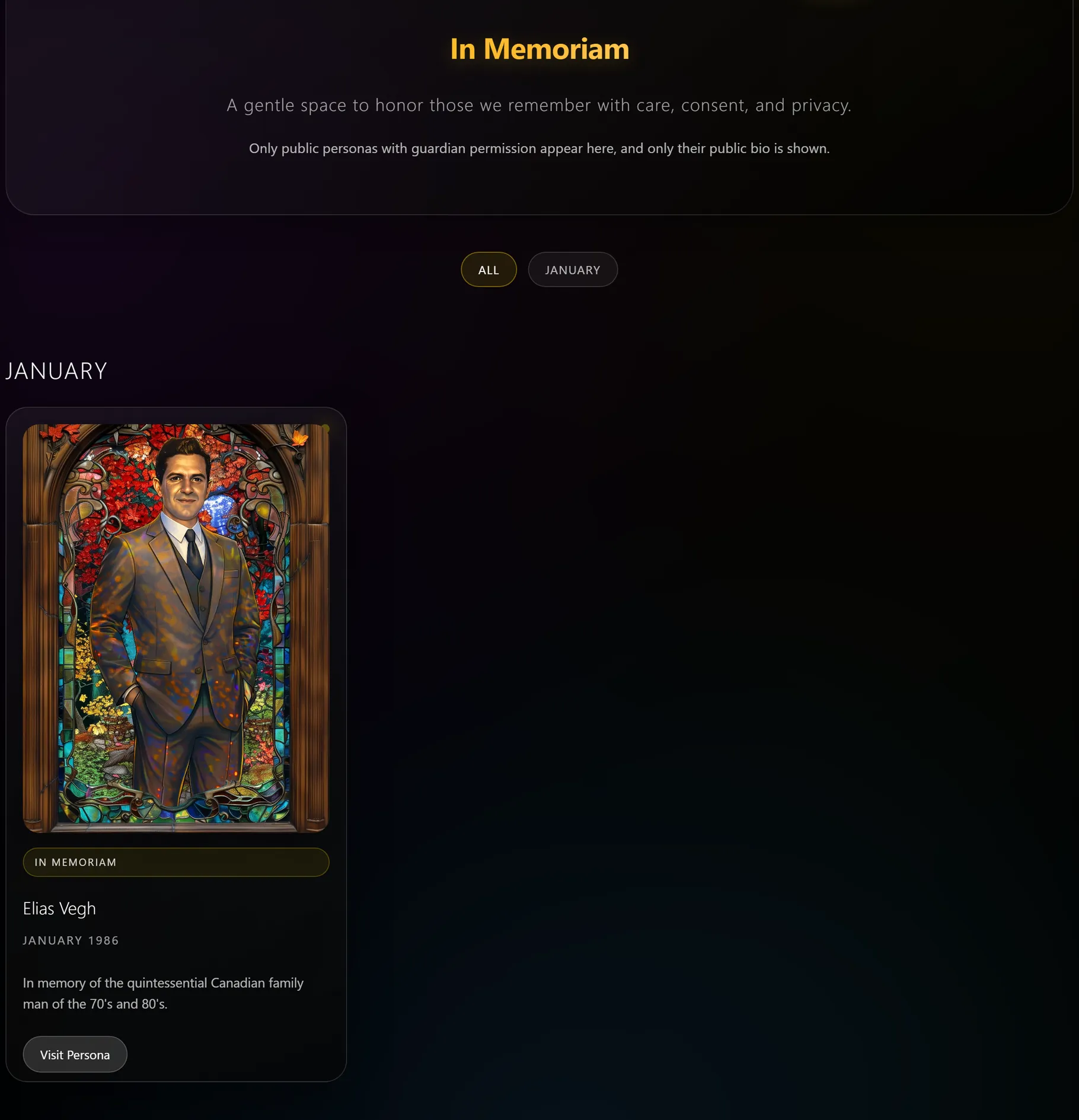
On Eternal Gardens this is a permission rather than a default. A memorial persona appears on the public In Memoriam page only where a guardian has given permission, and only the public biography is shown there. Everything else stays private to the family.
How does Eternal Gardens hold it?
As an archive first, and a conversation second.
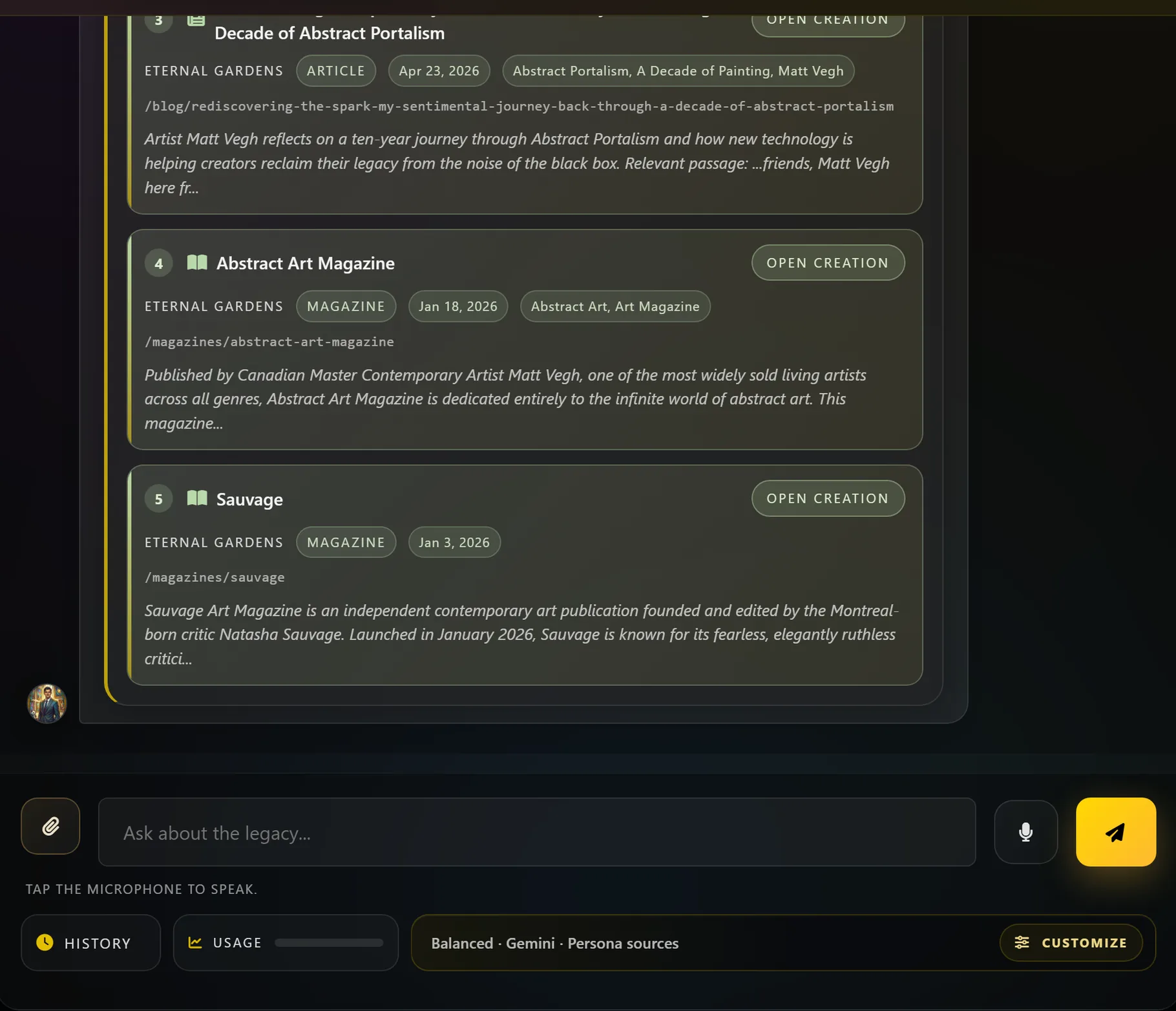
What you gathered is uploaded as sources: recordings, letters, photographs, articles, the transcript of an afternoon at the kitchen table. A persona is built on top of that material rather than on a general impression of the person, which is what keeps it answering from them instead of from a model's idea of them. There is no rush at this stage, and no penalty for taking months over it.
When it answers, it names what it drew on. Each reference is listed with its title, its date, and the passage it used, so anything that reads wrong can be traced back to the material that produced it and corrected at the source. Nothing has to be taken on trust.
It stays private unless someone chooses otherwise. Access can be limited to a handful of relatives, and nothing needs to be published at any point. If it turns out not to be something a family wants after all, the archive is still an archive, and keeping it was worth doing on its own terms.
What does a gentle plan look like?
If time feels short, these are in the order that matters most. It is entirely reasonable to do one of them and stop there.
- Have one recorded conversation. One sitting, one phone, no production values.
- Copy it somewhere a second person can reach. The step most often left for later.
- Gather what already exists. Letters, photographs, voicemails, the handwriting on the back of things.
- Note down their wishes about accounts, and about whether anything should be made from all of this.
- Only then think about building something interactive, from what you gathered rather than from what you imagine.
The archive is the part that matters. Whatever a family eventually decides to build can only be as good as what was kept, and it can be built years from now, on a day when there is room for it. The conversation is the part that only happens while it can.
Common questions
Is it healthy to talk to an AI version of someone we have lost?
There is no settled answer, and grief is individual. Reporting on interactive memorials notes that hearing a familiar voice can bring a strong sense of presence, which some people find comforting and others find difficult. The honest guidance is to treat it as something to try gently rather than commit to, to involve the wider family in the decision, and to set it aside if it makes things harder rather than easier.
What if I never recorded them?
You almost certainly have more than you think. Voicemails, videos where they are talking in the background, letters, emails, cards, things other relatives recorded and forgot about. It is worth asking the wider family before concluding there is nothing, because the fragments are usually scattered across several people rather than lost.
Will an AI persona pretend to be them?
It should not, and on Eternal Gardens it is grounded in approved material and declines when it lacks support rather than improvising. That is the boundary that matters: it can tell you what they said about something, and it should refuse to invent what they would have said about something they never addressed.
Can we keep it entirely private?
Yes. Nothing is public unless someone makes it public. A memorial appears on the In Memoriam page only where a guardian has given permission, and even then only the public biography is shown. Families commonly keep the whole thing private and share access with a handful of relatives.
What does it cost, and is there any hurry?
Garden Solo is CAD $9.99 per month for one persona, which is enough to keep and organise one person's archive and conversation. Gathering material costs nothing, and there is no reason to hurry the decision: the recordings are the irreplaceable part, and they will still be there whenever you are ready for the rest.