What is actually being asked here?
Two questions wearing one coat, and they have different answers.
The first is about the person who died: would they have agreed to this? The second is about the people still here: does it help? A family can have a clear answer to one and no answer to the other, and most of the difficulty in this subject comes from treating them as a single question.
It is also worth separating the thing itself from how it is described. Keeping an archive that can be searched and asked is one kind of object. A system presented as the person, speaking in the present tense, is another. The technology underneath can be similar. What differs is the claim being made, and the claim is where most of the harm lives.
This article does not arrive at a single verdict, because there is not one. What follows is what researchers have established, what the law currently does not cover, and the conditions under which people working on this seriously think it can be done well.
Did they agree to it?
This is the question everything else rests on, and in the ethics literature it is close to settled.
Scholarship on the digital afterlife industry places consent at the centre. The distinction repeatedly drawn is between someone who was a consenting author of what is made and someone who is an unconsenting subject of it. Hollanek and Nowaczyk-Basińska argue that informed consent should be the minimum condition: ideally the explicit consent of the person while they were alive, and failing that the permission of next of kin. They go further and propose a principle of mutual consent, in which the person represented must have agreed and the surviving user must also actively choose to engage rather than simply be presented with it.
That second half is easy to overlook. A memorial made by one family member and shown to another without warning puts a person into an encounter they did not choose. Whatever the ethics of building it, the ethics of switching it on in front of somebody are separate and belong to them.
Where the person left no view at all, the honest position is not a prohibition but a caution: keep the archive, which is unambiguously worth keeping, and be slow about making it speak. The recordings and letters do not become less valuable for sitting still.
What does it do to the people left behind?
The research is genuinely mixed, and anyone telling you otherwise is over-reading it.
Concerns raised in the literature are specific rather than vague: the possibility of prolonged grief, and of emotional dependence on a system that is always available and never tires. Coverage of the field in 2026 has reported researchers warning that these systems can feed pathological grief and change how people deal with death. Against that, hearing a familiar voice is reported by many bereaved people as comforting, particularly in the early weeks.
What both sides of that agree on is that the effect is strong. This is not a neutral product experience, and it should not be evaluated as one.
Two practical implications follow. First, availability is a design question and not a feature to maximise: something that can be spoken to at three in the morning every night for a year is a different object from something visited occasionally. Second, the decision to stop should be as easy as the decision to start, and worth agreeing in advance. If it is making things harder rather than easier, that is information, and setting it aside is a reasonable response rather than a failure.
What about children in the family?
They need a different decision, made separately and more conservatively.
Researchers have raised the specific concern that children may struggle to understand that they are talking to a system at all, and to grasp how it works well enough to place its output correctly. A child may take generated content as genuine, present-tense interaction with the person, which is a materially different experience from an adult knowing they are consulting an archive.
That does not make it automatically wrong. It does mean the question "should the children use this" is not answered by having answered "should we have this", and that any answer should involve whoever is responsible for those children rather than being a family default.
Does the law say anything about this?
Very little, and that gap is doing real work here.
As of 2026, most jurisdictions provide no dedicated legal protection for the data of deceased people, a situation scholars describe as a postmortem privacy void. The framework that applies is the general one covering AI products and posthumous data, which is sparse. Commentary in the field notes an absence of clear prohibitions on inputting another person's data to build such a system, which means that by default it happens without meaningful oversight.
The practical consequence is that "it is allowed" carries almost no information. Where regulation is thin, the constraint has to come from the people involved and from whoever built the tool. That makes the supplier's own rules a substantive question rather than a formality: what they permit, what they refuse, who they will build for, and whether a family can have the thing removed later.
It also means writing down decisions matters more than usual, because there is no external record that will settle a family disagreement afterwards.
If we go ahead, what makes it defensible?
Five conditions. They are demanding on purpose, and a family unable to meet them has learned something useful rather than failed a test.
- The person agreed, and it is written down. In their words if possible, including what it should be used for and who should be able to reach it.
- It is grounded in what they actually left. Built from recordings, writing and material they produced, rather than from an impression of them.
- It declines rather than improvises. Asked about something they never addressed, the honest response is to say so. A system willing to guess what someone would have thought is not preserving them.
- It is never presented as them. It is an archive that answers. The difference is not pedantry; it is the entire distinction between remembrance and impersonation.
- Someone can stop it. A named person can restrict access, take it private, or remove it, without argument and without a support ticket.
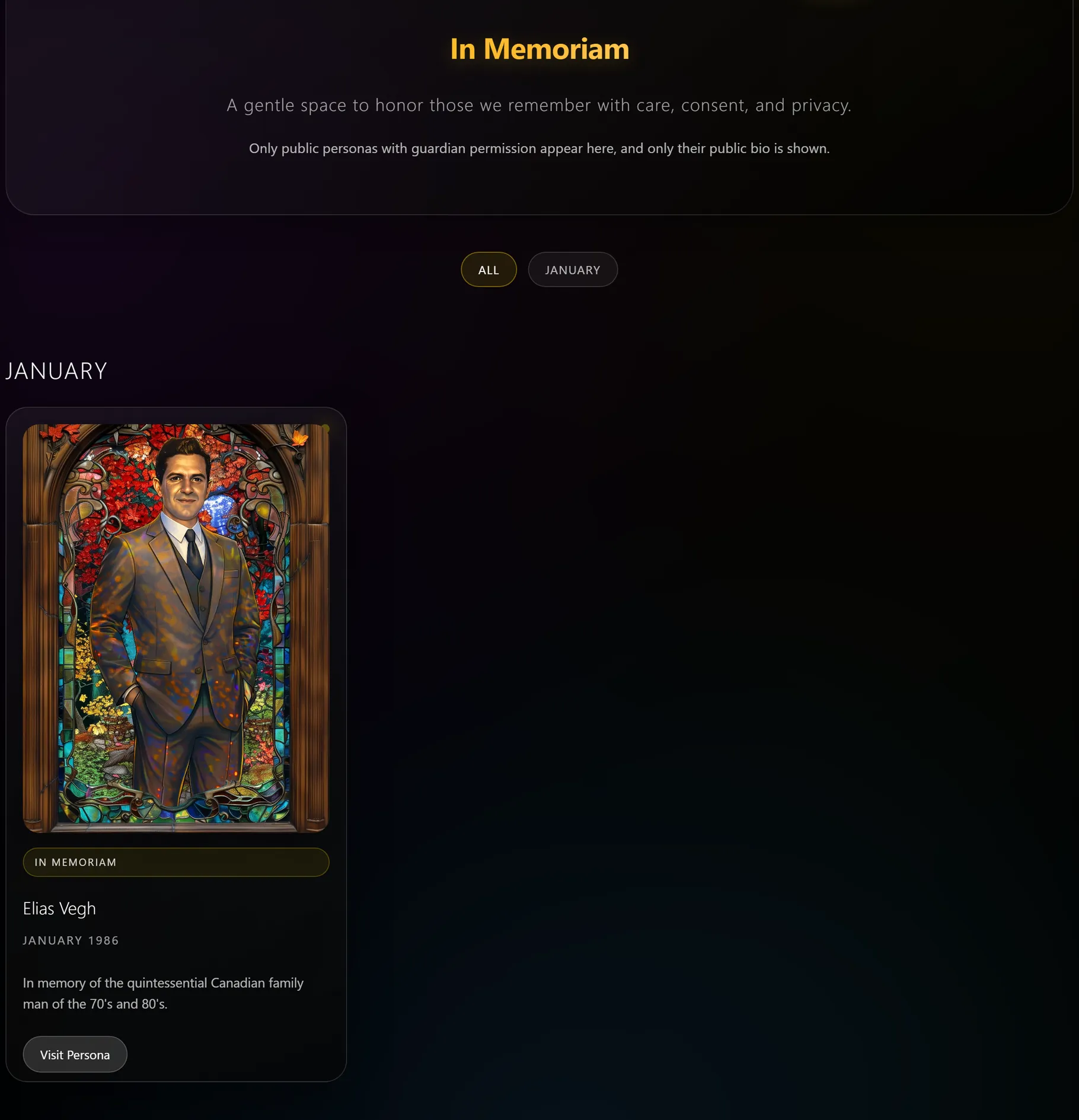
On Eternal Gardens the last of those is a permission rather than a default. A memorial persona appears on the public In Memoriam page only where a guardian has given permission, and only the public biography is shown there. Everything else stays private to the family, and a guardian can withdraw it.
What if the answer is no, or not yet?
Then keep everything and build nothing, which is a complete and respectable outcome.
Almost every article on this subject is written by someone with something to sell, which tilts the whole genre toward building. It is worth stating the alternative plainly: gathering the recordings, letters, photographs and voicemails, and putting them somewhere more than one person in the family can reach, is the part with lasting value. It can be done immediately, costs nothing, and forecloses nothing.
Anything interactive can be built years later, from that same material, on a day when there is room for the decision. Very little is lost by waiting. What cannot be recovered later is material that was never kept.
If your family does eventually decide to go further, the conditions in the previous section are the ones worth holding a supplier to, including us.
Common questions
Is there a consensus among researchers on whether this is acceptable?
There is broad agreement on the conditions rather than on a verdict. Consent is treated as the central requirement, with proposals for informed consent from the person while living or, failing that, permission from next of kin, and a mutual-consent principle covering the surviving user as well. Beyond consent, opinion divides on the effects, which are acknowledged to be strong and not well understood.
What if the family disagrees about whether to do it?
Treat that disagreement as a finding rather than an obstacle to route around. A memorial built over a relative's objection tends to become a durable source of conflict at a time when families have little capacity for it, and the archive itself is not in dispute. Keeping the material while the question stays open costs nothing and closes off nothing.
Is it different if the person set it up themselves before they died?
Substantially, yes. That is the case the ethics literature treats most favourably, because the person represented was a consenting author of what exists rather than an unconsenting subject of it. Their own instructions about scope, audience and privacy then carry real authority, which is exactly why writing them down while able is worth doing.
Can it be removed later if we change our minds?
It should be, and this is worth confirming before anything is built. On Eternal Gardens a guardian can take a memorial private or remove it from the public page without needing to justify the decision. With any supplier, ask specifically who holds that authority and how quickly it takes effect, because a system that cannot be switched off is a commitment rather than a memorial.
Does the law protect a dead person's data?
In most jurisdictions as of 2026, not in any dedicated way. Scholars describe a postmortem privacy void, with only the general framework for AI products and posthumous data applying, and note the absence of clear prohibitions on using another person's data this way. Practically, the constraints that apply are the ones the family and the supplier choose to impose.