Why is the range so wide?
Because "AI persona" covers two different purchases, and only one of them is software.
At one end you configure something yourself on a subscription: you supply the material, you write the description, you publish it. At the other end somebody gathers scattered material, interviews the person, resolves the rights, designs the interaction, evaluates the answers, and launches it. The second is a project with people in it, and that is where the money goes.
Almost nobody says this plainly, so: the model is the cheap part. The cost is in preparing sources and reviewing what comes out. Two commissions using identical software can differ by a factor of five because one client had an organised archive and the other had forty years of material in boxes.
Which means any quote given before somebody has looked at your material is a guess. Reputable suppliers scope first, and it is reasonable to expect that scoping to be paid work rather than free sales effort.
What does the self-serve option cost?
Under twenty Canadian dollars a month, and for a great many people it is the right answer.
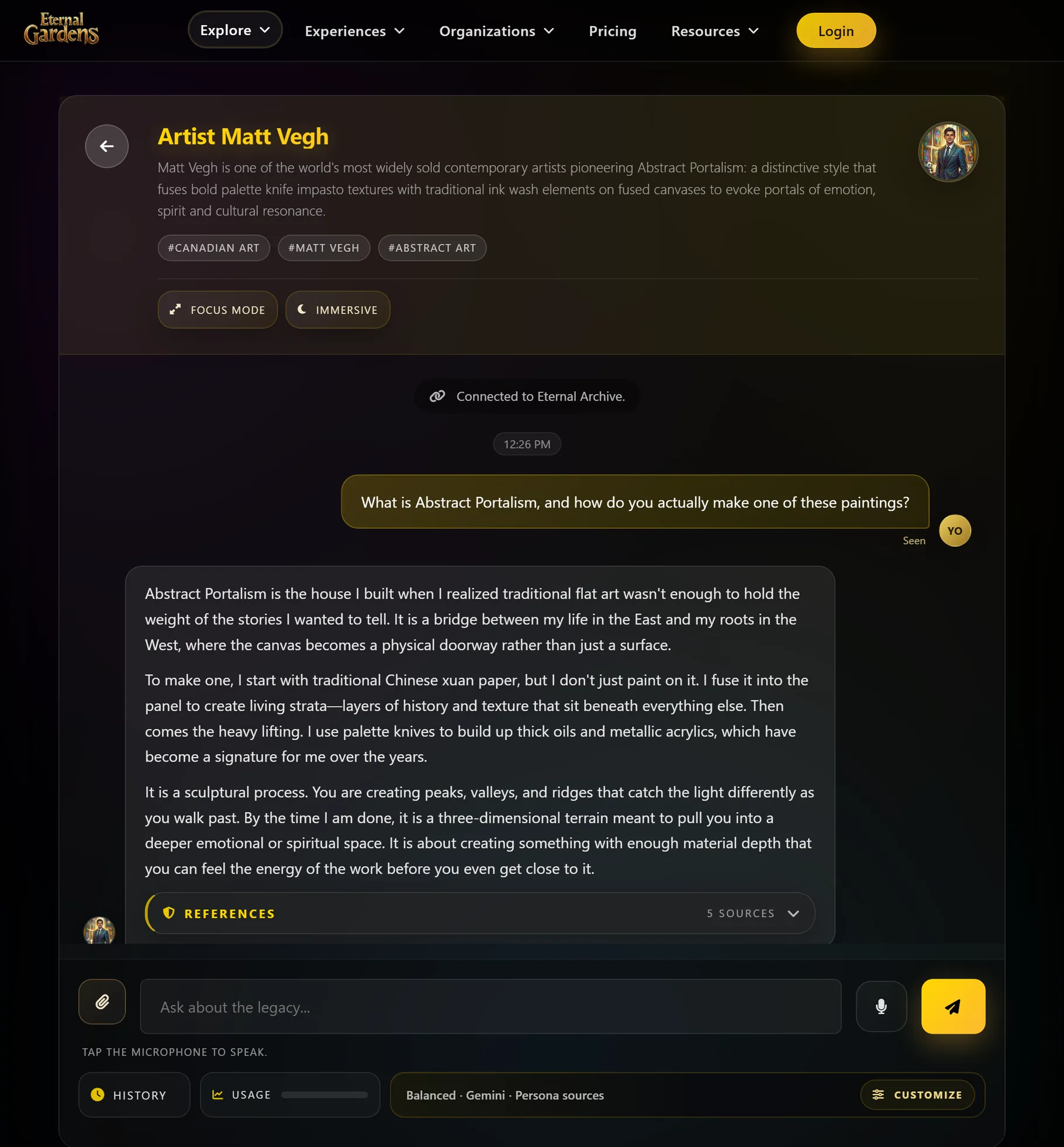
On Eternal Gardens, Garden Solo is CAD $9.99 per month for one persona, and Garden Circle is CAD $19.99 per month with the first month free for new members. That covers keeping and organising material and having a persona answer from it.
What you are supplying yourself: the sources, the description, the judgement about what should be public, and the time to review answers. That is real work, and it is the same work a commission pays somebody else to do.
This route suits you if the material is already gathered and reasonably tidy, if you can spend a few evenings on it, and if nobody's reputation depends on the first version being right. It suits you less if the material is scattered across decades, if the rights are unclear, or if the persona represents an institution rather than you.
What does a custom build cost?
It is quoted case by case, and we would rather say that than publish a number we would revise the moment we saw your material.
It begins with a paid Persona Blueprint: audience and use-case definition, a source-readiness assessment, a rights and risk scan, a small working prototype, and an evaluation and implementation plan. It is a deliverable in its own right and stays useful if the full project never happens.
We charge for that step rather than giving it away, for a reason worth stating: complex projects fail when the audience, sources, rights and review path stay vague, and free discovery is discovery nobody has time to do properly.
The full build is then quoted against source volume, rights, interviews, languages, voice, custom design, accessibility, integrations, hosting, and review complexity. Payment is normally half to begin and half at approved launch. For teams and institutions the same shape applies to a Knowledge Transfer covering one group or one defined project: source preparation, structured capture, the presence itself, a knowledge map, handover deliverables, evaluation, and ninety days of support afterwards.
Why no rate card: this is a young enough field that a fixed price is either padded to cover the worst case or wrong for anyone whose archive is unusual, and most archives are unusual. Tell us what you have and we will tell you what it would take, in writing, before you commit to anything.
What actually makes it more expensive?
Five things, roughly in order of how much they move a quote.
- The state of your material. Organised digital text is cheap. Scanned documents, handwriting, hours of unindexed video, and material spread across several people are not.
- Whether an interview is needed. If the important knowledge was never written down, somebody has to sit with the person and draw it out, then process what comes back.
- Rights. Third-party content, estate permissions, licensed images and contributor consent all take time to resolve, and occasionally they change the scope.
- Review burden. A persona representing an institution needs more approval than one representing you, and approval is calendar time as much as effort.
- Everything around the conversation. Custom design, voice, additional languages, integrations, accessibility commitments and procurement all add real work.
What barely moves it: the choice of model. That is a running cost measured in cents per conversation, not a line item that decides a project.
What are the ongoing costs?
Hosting, updates, and the time somebody spends keeping the sources honest.
The last one is the one people underestimate. A presence built from material that is never refreshed becomes gradually wrong, and the wrongness is invisible until someone asks the right question. Budget attention, not just money.
For comparison, the adjacent market gives a sense of scale. Published 2026 pricing for ongoing AI visibility work puts mid-market retainers roughly between $1,500 and $10,000 a month, with broader ranges reaching $25,000 depending on scope, and reports that under about $3,000 a month an engagement is usually a monitoring dashboard rather than a programme of work.
That is a different service from hosting a persona, and it is quoted here because the two are frequently sold together and it is worth knowing which one you are being charged for.
How do I know which one I need?
Three questions, and they are about consequences rather than budget.
- Who is answerable if it is wrong? If the answer is you personally, self-serve is fine. If it is an institution or an estate, you need review, approval and an audit trail, and that is commissioned work.
- Is the material gathered? If yes, start on a subscription this week and see what you learn. If it is scattered across decades or several people, the gathering is the project.
- Is there a deadline attached to something real? A launch, an exhibition, a retirement, a person whose time is limited. Deadlines are what justify paying somebody to do it faster than you can.
An honest recommendation against our own interest: if the material is tidy and nobody's reputation is on the line, start with the subscription. Ten dollars and a fortnight teaches you more about what you actually want than a discovery call will, and the work is not wasted if you commission something later.
Common questions
Why is discovery a paid step?
Because the questions it answers are the ones that sink projects, and free discovery is discovery nobody has time to do properly. The Blueprint produces a source-readiness assessment, a rights and risk scan, a working prototype and an implementation plan, which remain useful whether or not the full project proceeds, and the fee may be credited toward a project starting within thirty days.
Can I get a fixed price before you see my material?
Not a credible one. The largest cost driver is the state of your sources, so a number quoted before anyone has looked is a guess that will be revised. What you can get quickly is a range and the specific questions that would narrow it, which is usually enough to decide whether to proceed to scoping.
What is the cheapest way to try this properly?
A subscription and a fortnight of evenings. Gather what you already have, put it in as sources, and ask the persona questions you know the answers to. You will learn more about whether this is worth pursuing than from any amount of reading, and the material you organise is the same material a commission would start from.
Do you charge per conversation or per message?
Individual plans are a flat monthly subscription with usage allowances rather than per-message billing, so a visitor talking to your persona does not create a variable bill you have to watch. Commissioned engagements are quoted as project work, with hosting and ongoing support agreed as part of the scope rather than metered afterwards.
Is a cheaper supplier likely to be worse?
Not automatically, but ask what is missing rather than assuming efficiency. Source preparation, rights review, evaluation and a human approval path are the expensive parts, and a materially lower price usually means one of them is absent. That is fine if you are supplying it yourself, and a problem if you assumed it was included.