What does the will actually need to say?
An explicit authorisation. Silence is treated as refusal, not as permission.
In most of the United States the governing framework is the Revised Uniform Fiduciary Access to Digital Assets Act, adopted in 47 states and the District of Columbia as of 2026. California, Louisiana and Massachusetts have not adopted it in its standard form, each having equivalent or related legislation of their own.
The part that surprises families is the default. Under that framework, executors, trustees and agents acting under a power of attorney do not automatically get access to a person's digital accounts. Access has to be granted affirmatively, either in the estate documents or through a tool the platform itself provides. A will that says nothing about digital assets leaves an executor with no authority over them.
So the clause has to exist and it has to be explicit: authorising your executor, or a separately named digital executor, to access, control, distribute and dispose of your digital assets, including the content of electronic communications where you intend that.
That last part matters. Email content is treated more strictly than account access nearly everywhere, so general authority over "digital assets" may not reach it unless the document says so.
Why can a website override my will?
Because in the ordering the law sets out, the platform's own tool comes first.
Several providers offer a setting for exactly this: Apple's Legacy Contact, Google's Inactive Account Manager, Facebook's Legacy Contact. Where such a tool exists and the person used it, that instruction generally takes precedence over what the will says.
The practical consequence is that a will alone is not enough, and neither are the settings alone. A person who names one relative in an online tool and a different one in their will has created a conflict that surfaces at the worst possible time. The two have to agree.
Worth doing in one sitting: list the accounts that matter, check which of them offer a legacy setting, set them, and make sure the names match the will. It is an afternoon, and it is the single highest-value hour in this whole subject.
Should I put passwords in my will?
No. A will can become a public document through probate, and it is amended far less often than a password changes.
What belongs in the will is authority. What belongs elsewhere is access. Keep a separate inventory, stored securely, that the executor can reach when the time comes: which accounts exist, what each is for, and where the credentials are held. A password manager with an emergency access feature does this job well, and so does a sealed written list held with the person who would need it.
The inventory is also where you record what you want to happen to each thing, which the will rarely has room for. Memorialise this account, close that one, transfer the domain, cancel the subscriptions, leave the photographs to whoever wants them.
Keep it current. An inventory written once and never revisited becomes a list of accounts that no longer exist, and it will be read by someone with no way to tell which entries are stale.
Which accounts actually matter here?
More than most people list, and they fall into four groups worth separating.
- Things with monetary value. Domains, cryptocurrency, marketplace balances, monetised channels, unpaid royalties. These are property and they need naming.
- Things with sentimental value. Photographs, videos, letters, message archives. Usually the part a family actually wants, and usually the part with no plan attached.
- Things that cost money if forgotten. Subscriptions and recurring charges that continue billing quietly against a card that still works.
- Things that carry identity. Email, which is often the reset route into everything else, and social accounts that continue to appear as though nothing happened.
Cryptocurrency deserves its own line. If the keys are lost, the asset is gone, and no executor authority anywhere recovers it. It needs a specific, documented plan and someone who understands what they are being handed.
Should I name a separate digital executor?
Often yes, and it is a practical decision rather than a legal necessity.
The person best placed to handle a house and a bank account is not always the person who can manage a domain transfer, a hardware wallet, or a creative archive. Naming a digital executor, or a co-executor whose authority covers only digital property, lets each job go to someone equipped for it.
Two things make the difference between a name and a working arrangement. Tell them, before it matters, so it is not the first they hear of it. And give them the inventory, or tell them exactly where it is, because authority without access is a title rather than a capability.
Whoever it is should be someone comfortable saying "I do not know what this is" and asking, rather than guessing at something irreversible.
What about an archive or a persona I have made?
Treat it as a digital asset with an owner, an instruction, and a named successor, exactly like the rest.
If you have gathered recordings, letters and photographs into something, say who inherits it, who may reach it, and what should happen to it. If it is something interactive, say whether it should stay available, become private, or be removed, and who has the authority to decide.
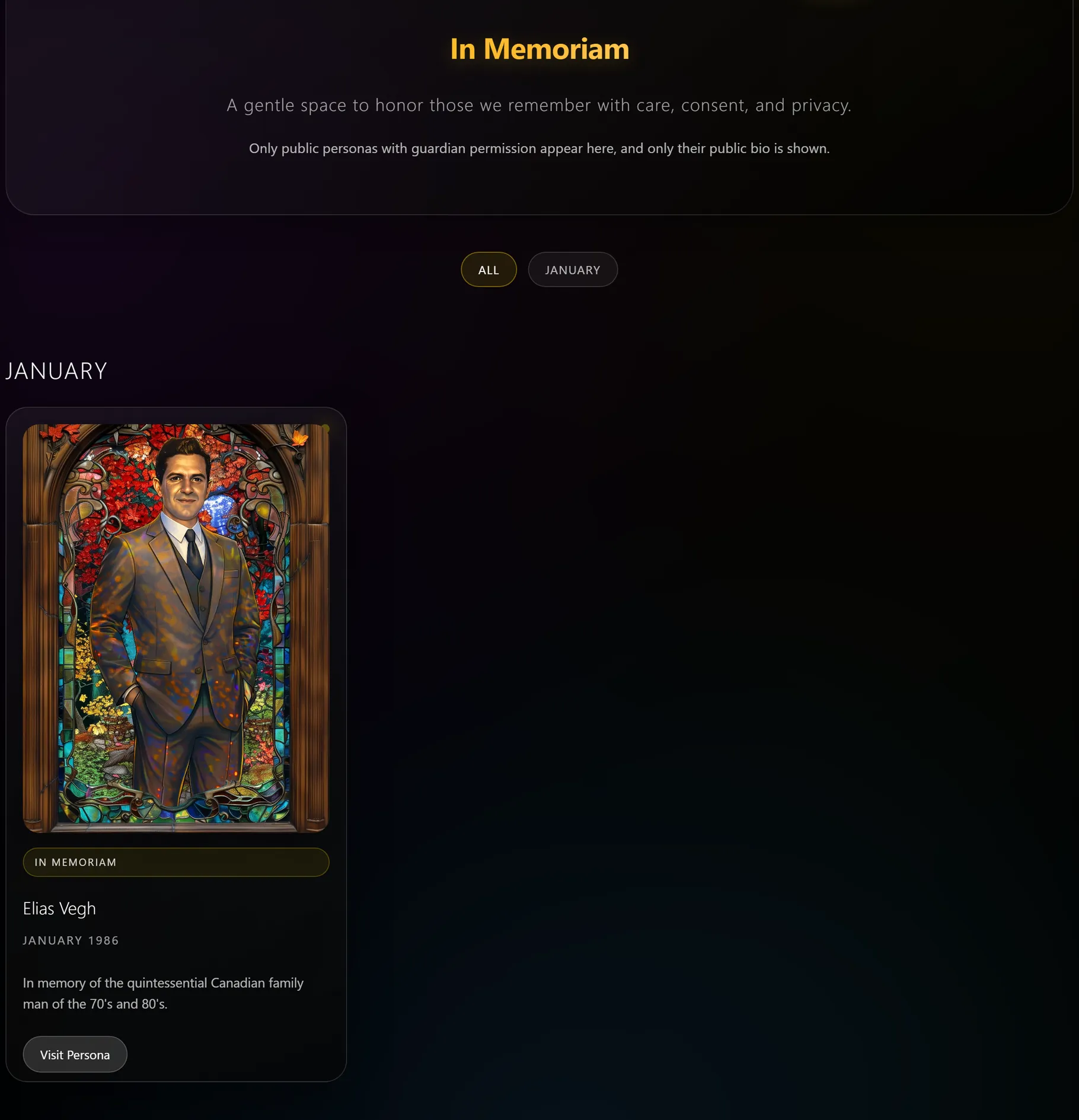
On Eternal Gardens that authority is a permission rather than a default. A memorial persona appears on the public In Memoriam page only where a guardian has given permission, and only the public biography is shown; a guardian can take it private or remove it. Recording who that guardian should be is a sentence in the inventory, and it saves a family a decision nobody wants to make on someone else's behalf.
Can I write this myself?
The inventory, yes. The will, no, and this article is not the place to pretend otherwise.
Digital asset provisions interact with the rest of an estate and with the law where you live, and the differences are real: the framework varies by state within the United States and differs again in other countries. A clause copied from the internet can fail in ways nobody discovers until it is needed.
What you can do before seeing anyone: build the inventory, set the platform legacy tools, decide who your digital executor should be, and write down what you want to happen to each thing. Arriving with that is most of the work, it costs nothing, and it makes the professional part shorter and cheaper.
None of it is urgent in the way that a deadline is urgent. It is only that it can be done now, and it cannot be done later.
Common questions
Does my executor automatically get into my accounts?
No. Under the framework adopted across most of the United States, fiduciaries have no automatic access to a person's digital accounts, and access must be granted affirmatively either in the estate documents or through a tool the platform provides. A will that is silent on digital assets leaves an executor without authority over them.
What happens if my will and my Google settings disagree?
The platform's own tool generally wins. Where a provider offers a setting such as Inactive Account Manager or a Legacy Contact and the person used it, that instruction typically takes precedence over the will. This is why the two need to name the same people rather than being arranged separately and years apart.
Is a list of passwords enough on its own?
It helps enormously in practice and it is not the same as legal authority, and it goes stale. Passwords change, accounts are added, and providers may treat use of someone else's credentials as a terms violation regardless of intent. Pair the practical access with the explicit authority in the will so the executor is both able and entitled to act.
What about accounts in other countries?
The position differs, sometimes considerably, and where you live is not always where the provider is. This is worth raising specifically with whoever drafts your will, particularly if you hold accounts, domains or assets under another jurisdiction, because a clause written for one framework does not automatically travel.
How often should I revisit this?
The inventory whenever something material changes, and at least once a year, because its failure mode is quietly going out of date. The will itself only when the substance changes, such as a different executor or a significant new asset. The platform legacy settings are worth rechecking occasionally too, since providers add and alter these tools over time.