
Why does AI get facts about my business wrong?
Most wrong answers about a brand are not invented. They are real facts that are out of date, attached to the wrong company, or lifted from a page you forgot existed.
That distinction matters, because it changes the fix entirely. If a model were making things up, there would be nothing to correct. If it is quoting a stale page, there is a specific page to go and fix.
Analysis published in 2026 that tracked 412 confirmed brand-fact errors found the majority were retrieval errors: the assistant searched the web, found a live page, and quoted it accurately. The page was simply wrong. An old pricing article, a review from two owners ago, an abandoned directory listing. About a quarter came from training data instead, where the model answered from memory formed before its cutoff.
There is a third cause worth naming, because it explains the confident tone. Research covered by Science in 2026 argues that models hallucinate partly because the way they are trained and scored rewards producing an answer over admitting ignorance. A system that is penalised for saying "I do not know" will guess, and guess fluently.
How do I find out what the AI is quoting?
Do not argue with the answer. Find the page behind it.
Ask the question in a fresh conversation, then ask the assistant to list its sources. Run each of these, replacing the bracketed parts. Ask more than once, in separate sessions, because answers vary between runs and a single clean result does not mean the problem is gone.
-
What do you know about [your brand]? List the sources you used. -
What does [your brand] charge, and where did you get that? -
Who owns or runs [your brand]? Cite your sources. -
Is [your brand] still in business? What is your evidence? -
What do reviewers say about [your brand]? Link the reviews.
You are looking for three patterns. A cited page that is wrong, which is the easy case. A cited page that is right but old, which is the common case. And a ghost citation, where the assistant cites your own site but does not connect the content to your brand name, which usually means your pages never state plainly who they belong to.
Write down what it got wrong, which URL it cited, and the date you asked. That record is the only way you will know later whether anything you did worked.
How do I actually correct it?
In roughly this order, because each step makes the next one more likely to hold.
- Correct the cited page at its source. If it is your page, edit it. If it is a directory or profile you control, update it. If it belongs to someone else, ask them, and be specific about which sentence is wrong.
- Remove the contradiction. A model hedges when sources disagree. If your site says one thing and your profiles say another, fix the profiles rather than adding a third version.
- Publish a current page that states the fact plainly. Not buried in a paragraph. In a sentence a machine can lift.
- Make the page say who it is about. Ghost citations happen when content is anonymous. Name yourself, and mark it up so a parser agrees.
- Re-ask on a schedule. Retrieval-based answers can change within days once a page is discoverable. Answers that depend on model training may not change until the next model.
What you cannot do is file a correction and have the answer change. Nobody controls what a generative engine retrieves. You control what is true and available for it to find.
Is being accurate the same as being visible?
No, and the gap is larger than most people expect.
The Victorious Q2 2026 quarterly search report tested brands across eight AI platforms. When asked about a brand directly, 96% were described accurately. When asked a category research question instead, 89% of those same brands never appeared in the answer at all.
So a business can be described perfectly and still be invisible to the person who has not heard of it yet. Fixing wrong facts protects you from the buyer who already knows your name. It does nothing for the buyer who asks for the best in your field. Those are two different problems, and this article only solves the first.
What does a source worth quoting look like?
Current, specific, attributed, and structured. In practice that means one public page that carries the facts a buyer needs, in the words they would use, kept up to date as things change, and clearly about you.
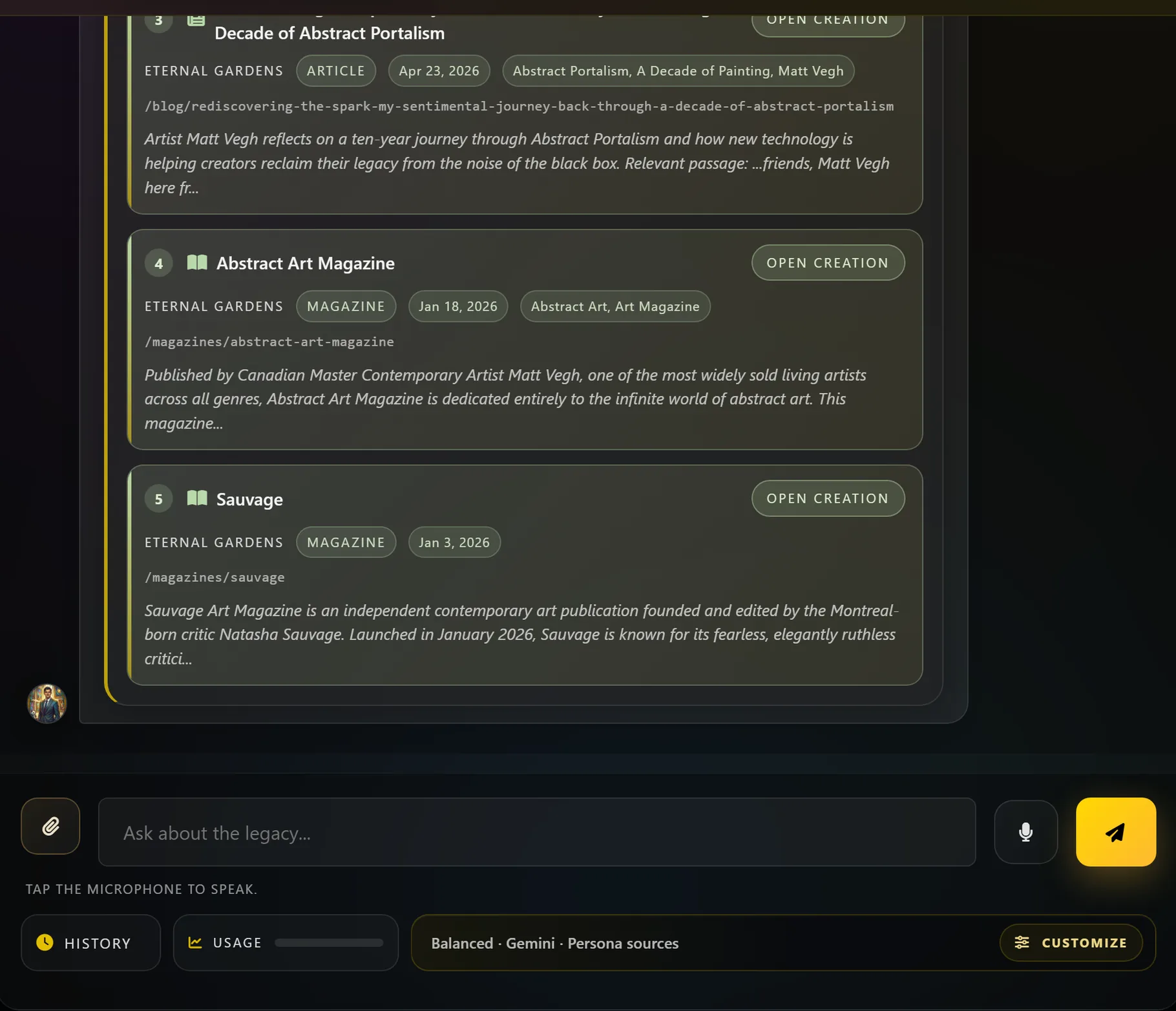
This is what an Eternal Gardens persona is: a governed public presence at a URL you control, grounded in material you have approved. It answers from that material and declines when it lacks support, rather than improvising. For a page whose job is to be quoted, a confident wrong answer is the worst possible failure.
Every answer it gives names the sources it used. That is the part that matters here. When you can see which of your own materials produced a sentence, you can correct the material rather than arguing with the output.
How do I know whether anything changed?
By asking again, the same way, and writing down what you get.
Generative answers vary between runs, so one good result proves nothing. Ask the same five prompts monthly, in fresh sessions, and record the answer and the cited sources each time. What you are watching for is the cited source changing, because that is the thing you actually influenced.
Nobody can promise you a corrected answer by a given date. What is honest to promise is the work: the record of what is being said today, the corrections at source, the published page worth quoting, and the re-measurement that tells you whether it moved.
Common questions
Can I report a wrong answer to OpenAI or Google directly?
You can use the in-product feedback controls, and it is worth doing, but treat it as one step rather than the fix. Feedback does not give you a correction ticket with a resolution date. Correcting the underlying source is what actually changes retrieval-based answers, because the assistant re-reads the page rather than a report about the page.
How long before a corrected fact shows up in AI answers?
It depends on which kind of error it was. Retrieval-based answers can shift within days once a corrected page is discoverable, because the assistant fetches live pages while it composes. Errors that come from model training may persist until a later model is released. This is why the first step is finding out which kind you have.
The AI cites my website but never says my brand name. Why?
That is a ghost citation, and it usually means your pages do not clearly state who they belong to. Content that is useful but anonymous gets used without attribution. Naming yourself in the visible copy, keeping that name consistent everywhere you appear, and marking it up with structured data all make the connection explicit.
Someone else published something wrong about us. What can we do?
Ask them to correct it, pointing at the specific sentence rather than the page. If they will not, the remaining lever is to make the correct version easier to find and better sourced than theirs, and to remove any of your own pages that agree with the wrong version. You cannot delete a third-party page, but you can stop being the second source for its claim.
Can Eternal Gardens guarantee AI will describe us correctly?
No, and no supplier can. Nobody controls what a generative engine retrieves or cites, and those systems change without notice. What we commit to is the work and the evidence: a documented baseline of what engines say today, a published and structured presence that answers from material you approved, corrections at source, and scheduled re-measurement so you can see what changed.