
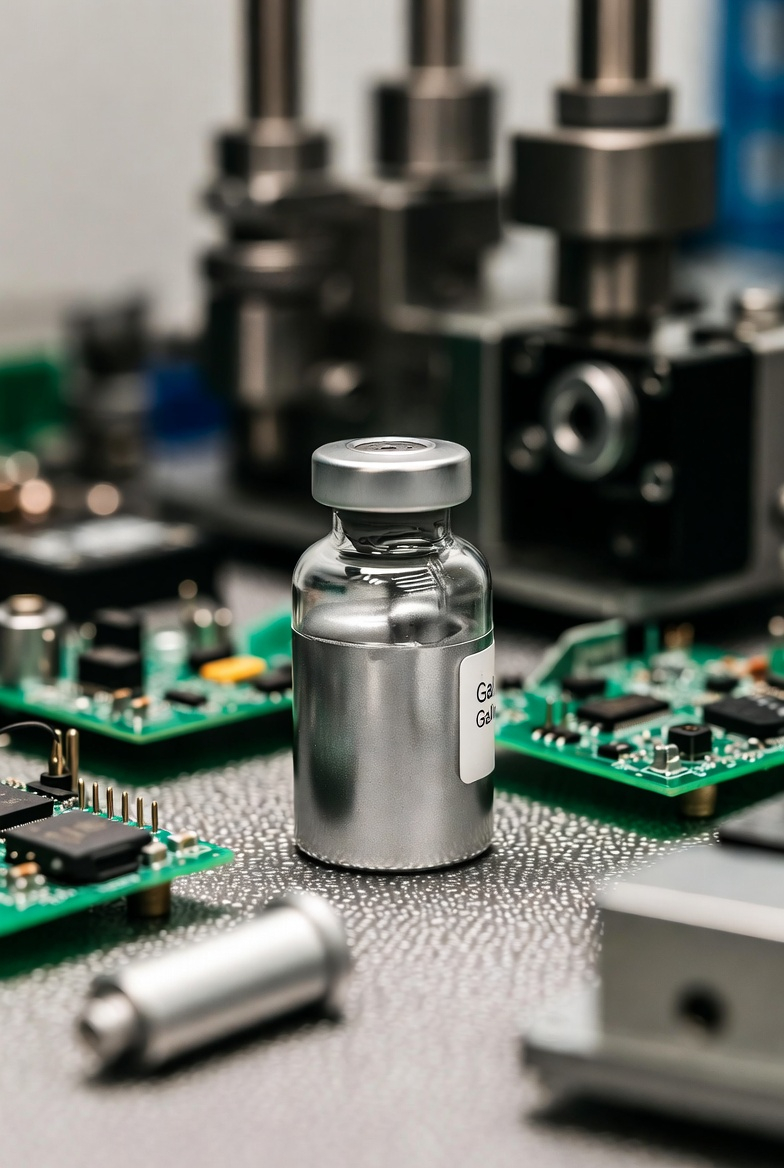
Imagine a small, shiny piece of metal in your palm. Within seconds, your body heat turns it in a liquid puddle because gallium melts at just 29.0C (85.6F), barely above room temperature. This playful, hand-melting element is also one of the most vital materials in modern technology. It powers high-speed semiconductors, 5G networks, electric vehicles, advanced LEDs, guidance systems and defense radars. Most people are more familiar with gallium's semiconductor cousin, silcon, but in today's chip wars and clean-energy race, gallium isn't just a curiosity but a strategic powerhouse that our defense electronics absolutely requires.
What is Gallium?
Gallium (chemical symbol: Ga) is a soft, silvery metallic element characterized by its unique property of melting at just above room temperature. With the atomic number 31, it is crucial for various technological applications, particularly in semiconductors and electronics.
Why is Gallium Special?
Gallium’s special status derives from its comparable performance to silicon in specific applications. While silicon is widely used in electronics, gallium provides advantages in high-frequency applications and LEDs due to its superior efficiency and heat tolerance. Gallium compounds, specifically gallium arsenide (GaAs) and gallium nitride (GaN), are fundamental in modern microelectronics, including smartphones, lasers, solar cells and advanced military electronics.
How and Where is Gallium Mined?
Gallium is primarily produced as a byproduct of aluminum smelting, extracted from bauxite ore and also from zinc processing.
Top 3 Producing Countries and Companies
- China: Leading the world in gallium production, China accounts for over 98% of the global supply. Key players in the Chinese market include the China Aluminum Corporation and other state-owned enterprises.
- Germany: An essential producer in Europe, with companies focusing on gallium extraction and processing.
- United States: Although current production is limited, several upcoming projects aim to boost gallium supply domestically.
How is Gallium Refined?
The refining process involves:
- Extraction: Gallium is extracted from bauxite ore during aluminum production. U.S. aluminum production has been in long-term decline due to high energy costs, smelter curtailments/shutdowns and price competition from China.
- Electrolysis and Purification: This step involves electrolysis or chemical treatments to produce high-purity gallium metal.
Current Supply/Demand Balance in 2026 and Next 10 Years
Projected Demand: By 2026, the demand for gallium is expected to reach approximately 1,400 tonnes, with ongoing explorations and developments in semiconductor and energy sectors. Additionally, there is growing concern over meeting this demand, particularly since many estimates suggest that current production may not fully satisfy future needs.
Since 2023 China has placed export restrictions on gallium which is greatly impacting prices. Historically price were stable in the $200-$300 per kg range but have surged due to geopolitical factors. In 2025 the Chinese domestic spot price was approximately $245 per kg, while the average U.S. import price was $580 per kg.
Primary Uses for Gallium
- Semiconductors: Key in producing microchips for smartphones and computers.
- Solar Panels: GaAs solar cells are crucial for enhancing photovoltaic efficiency.
- Defense Technologies: Used in radar systems and advanced military applications due to superior performance under extreme conditions.
Why is Gallium Considered a Strategic Metal?
The U.S. designates gallium as a strategic metal given its critical role in national defense and emerging technologies. This classification emphasizes the importance of securing reliable sources to maintain technological competitiveness and defense readiness.
Consequences of Limited Sources
If additional gallium sources cannot be identified:
- Rising Prices: Supply shortages could lead to significant increases in market prices, currently averaging around $1,200 to $1,400 per kilogram.
- Technological Stagnation: Industries relying on gallium, particularly semiconductors and renewable energy technologies, could face setbacks in progress and innovation.
Substitutes for Gallium
While few materials can effectively substitute gallium, research is ongoing:
- Silicon: This remains the most common semiconductor material but lacks the efficiency of gallium in specific high-performance applications.
- Indium: Has similar properties, particularly in electronics, but is also a rare material with limited supplies.
Trends in Recycling Gallium
Efforts to recycle gallium are gradually gaining traction as global demand challenges the existing supply chain:
- Recycling Rates: Current recycling technologies have not achieved significant scale, but projections indicate that with advancements, up to 30% of annual demand could be met through recycling initiatives in the coming years.
- Government investments: Increased focus on recycling gallium from electronic waste could bolster supply chains and reduce reliance on mined sources.
Conclusion
Gallium is not just another metal; it is an essential player in the shaping the future of technology and defense. Achieving independence in gallium supply requires strategic investments, robust recycling initiatives, and potential international collaborations. For gallium that means bauxite mining and aluminum smelting. Ensuring a stable and secure supply chain will be critical in navigating the challenges that lie ahead, particularly in an era increasingly defined by technological advancement and geopolitical considerations.
"If it isn't grown then it has to be mined".