 by Mei Lin

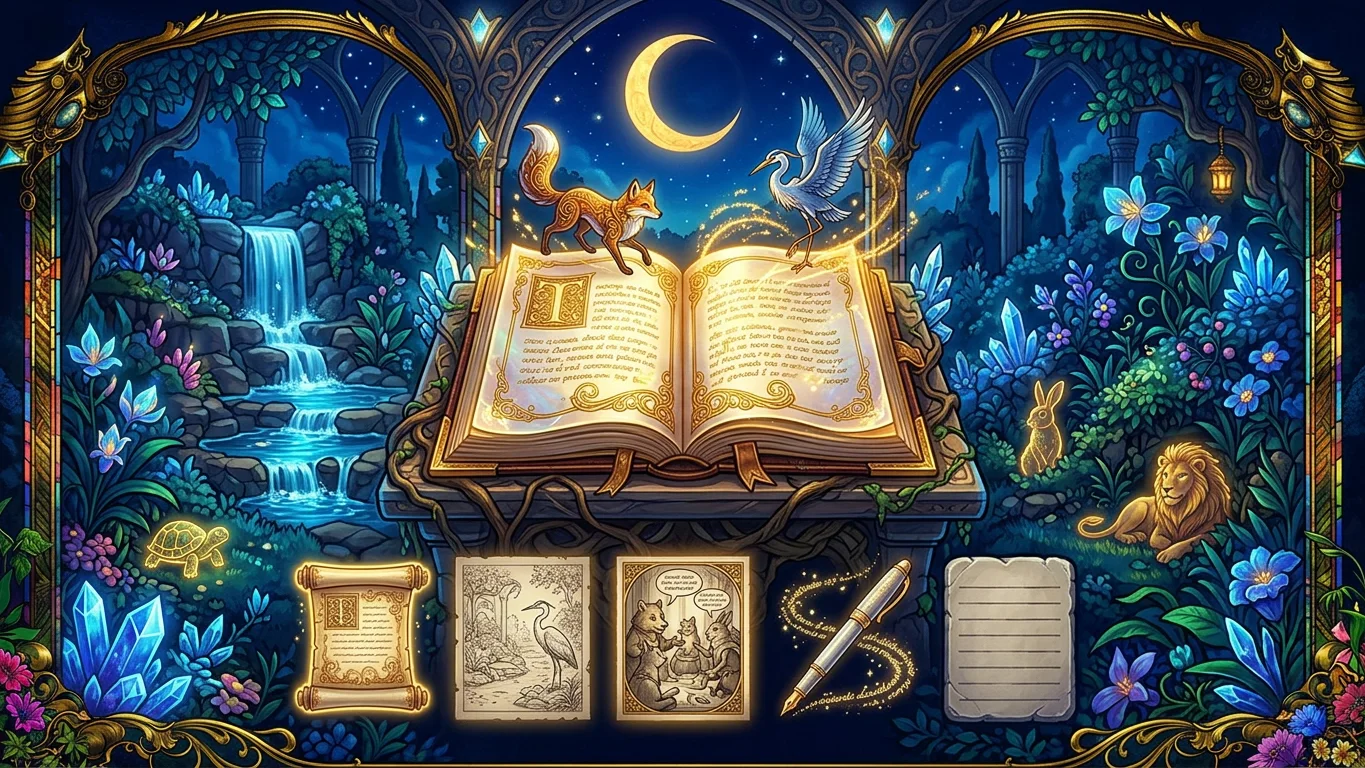
Start with one choice that has a consequence. Give it to an animal whose body, habits, or reputation makes that choice easier to see. A magpie can spot a bright object from a branch, but that gift does not tell her whether the object is valuable. The distance between seeing and knowing is enough to build a story.
1. Turn the lesson into a choice
“Be honest” is a theme. “Tell the group that the bridge is cracked, even though they will make you lead them around it” is a decision. Write the decision before you pick the animal. If either option would cost your character something, you have a plot.
2. Give the animal a job in the plot
In The Fox & the Crow, the crow has to open her beak to sing. The cheese can fall because of something a bird actually does. That detail makes the fox’s flattery into a plan. Borrow the method: make the shell, beak, claws, speed, or habitat matter to what happens. If you can swap the animal for a person without changing a beat, give the animal a more specific part to play.
3. Set a trap the character could avoid
Let readers see a safer path that the character can plausibly ignore. In The Fox & the Grapes, the fox could walk away after missing the grapes. Instead, he decides the fruit must have been sour. The action is over, but his explanation tells us what the story was about.
4. Make the consequence visible
A short fable can use a place, a sound, or an object to carry the ending. Put the lost cheese in another mouth. Let the empty bowl speak before you explain the mistake. If you want to end with a moral, write it after the story and ask a reader what they inferred before you show it to them.
5. Read the scene out loud
Give each animal a want the reader can hear in the dialogue. Then cut any sentence where a character explains what the ending already shows. For a classroom, a read-aloud or a writing group, try asking “Which choice would you change?” before asking “What is the moral?” The first question invites an argument you can use in a revision.
A worked example: The Heron and the Bell
Before the tide came in, a heron found a little bell caught in the reeds. She lifted it and rang it from a post. The crabs heard the sound and scuttled to higher stones.
“Ring again when the water reaches the red stake,” they called.
The heron liked the sight of all those claws moving at once. She rang while the stake was still dry. She rang when a leaf touched it. By the third ringing, the crabs carried on sorting shells.
At dusk the water reached the stake. The heron rang until her neck ached. Beneath her, the empty shells floated off the lowest stones. The crabs had moved uphill after watching the moon. The next night, they put a crab on the post.
The heron wants to see her warning make a difference. The bell gives her the power to call from above the reeds. Losing the post is the consequence of using that power for applause. A possible moral is “A warning earns its power by being worth hearing.” Try cutting that line and see whether the empty post tells you enough.
A five-line template you can reuse
- My animal wants ___.
- Its ___ helps or hinders it.
- It could choose ___, but chooses ___.
- Because it chose that, ___ happens.
- The last image is ___.
For a second version, keep the place and switch which animal gets to tell the story. A crab watching the bell is writing about trust. A heron holding it is writing about attention. Read more about how animals carry meaning in traditional fables, or browse Fables of the Whisperwood for more stories to read aloud.
To practice finding the choice and consequence in an existing story, try this 15-minute fable retelling worksheet with a reading partner before planning your own version.
Try your draft with a storyteller
Tell Ashenbark your five lines and ask which action makes the lesson clear. Read your version aloud again before deciding what to change.