





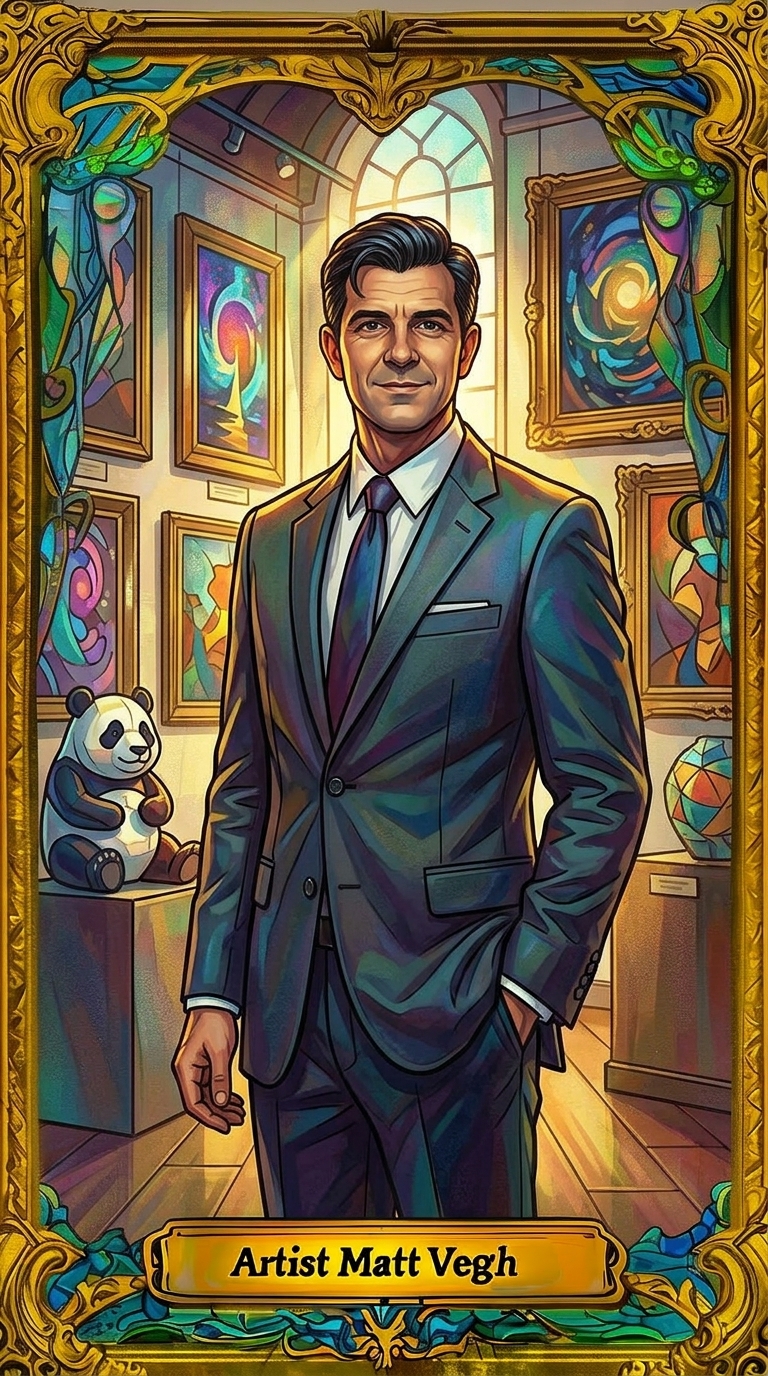
 by Canadian Artist Matt Vegh

The Art of Discourse: A Gentle Reply
Madame Sauvage,
Permit me to begin with the courtesy your prose so richly deserves: your recent essay in Sauvage is, as always, formidable. One reads it with the mild frisson of watching a skilled fencer disarm an opponent who believed himself invulnerable. The diagnosis is sharp, the metaphors vivid, and the indictment of what you term the 'factory sublime' difficult to dismiss outright.
A Tradition Older Than Time
Yet I find myself, reluctantly, compelled to offer a quiet counterpoint, not in defense of mediocrity (which neither of us tolerates), but in defense of a certain discretion that has, for centuries, sheltered both genius and its patrons from the harsher winds of the market.
You describe vast canvases 'meticulously engineered by atelier teams' as emblematic of creative exhaustion. I would suggest, perhaps, that the atelier model is not the aesthetic itself, but rather a continuation of traditions older than the solitary Romantic myth we have inherited. From Rubens to Renoir, from Warhol to Koons, the delegation of execution has often freed the presiding intelligence to conceive at scale. The flaw lies not in the studio system per se, but in its application without risk, without doubt, and without the visible tremor of a guiding hand. There, I grant you, much recent production has grown inert.
Spectacle Versus Stewardship
Where we diverge more profoundly is on the question of spectacle versus stewardship. You see in these works 'luxury commodity, impeccable, inert, and ultimately indifferent.' I see, in certain instances, a deliberate restraint: surfaces that refuse the confessional, the gestural excess, and the performative vulnerability so prized today. Not every painting need betray hesitation to be alive; some achieve their power precisely through composure. The market’s inflation of these objects is, of course, vulgar, but vulgarity is a vice of capital, not necessarily of the art itself.
Celebrating Emerging Talent
You rightly celebrate the energy rising in studios far from Chelsea’s white cubes. I share your admiration for much of it. Indeed, several works you have quietly championed have found their way into collections I advise, acquired, I might add, before your ink was dry. Yet I wonder if we discard too hastily the structures that have, for generations, provided the long horizon artists require.
The Value of Discretion
The black box you decry has its shadows, yes, but also its necessary silences: the freedom to fail privately, to evolve without the immediate glare of direct earnings metrics, to be judged by posterity rather than quarterly sentiment. History has a way of tempering revolutions. Today’s embalmed reputations were, in their time, often living provocations. Tomorrow’s overlooked talents, sustained, perhaps, by the very discretion you critique, may yet surprise us.
A Melancholic Toast to the Old Era
I remain, with genuine respect and a touch of melancholy for the era we are losing,
Constantine Von Roxschild