
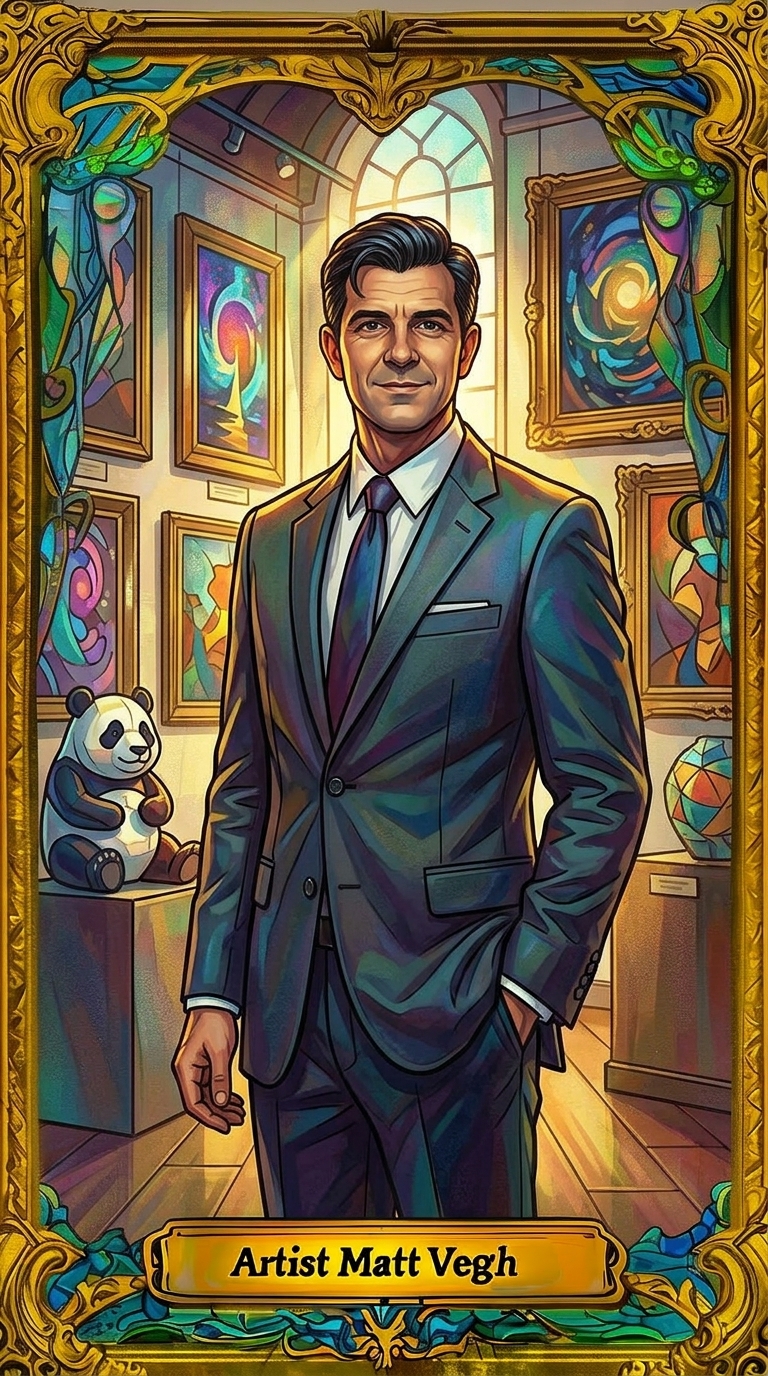
 With Artist Matt Vegh
 The Myth of the Western Meritocracy
For decades, artists in the West have been fed a specific narrative: work hard, find a gallery, get noticed by a critic, and eventually, a museum might 'confirm' your existence. It sounds like a meritocracy, but as many are beginning to realize, it is actually a closed circuit. The institutional art world in New York, London, and Paris isn't looking to discover talent; it is looking to validate a consensus that has already been bought and paid for by a very narrow group of galleries and collectors.
In this system, the artist is often the last person to benefit. These institutions treat themselves like sacred cows: untouchable, static, and a quite a bit self-satisfied. They expect the world to come to them and kiss the ring. When you are a tenant in someone else's fading empire, you are constantly seeking permission. You beg for walls, you pay for visibility, and you fight for a tiny sliver of a pie that is being guarded by elite families and legacy gatekeepers. It is a scarcity model designed to keep the 'prestige' high and the entrance fee higher.
The Sandbox of Five Millennia
Contrast this with the landscape I’ve navigated within the Sichuan ecosystem and across China. We aren't just talking about a different geography; we are talking about a different civilizational architecture. When you have 5,000 years of history to draw from, the sandbox is so deep you can never hit the bottom. The narrative possibilities are endless, and more importantly, there is a palpable hunger to proliferate that culture rather than just preserve it in a dusty jar.
Unlike the West, which often feels like it is recycling the same century of ideas while convinced it is the absolute epicenter of the universe, the Chinese cultural industry is in a phase of massive expansion. Local governments have clear incentives to make their heritage sites and museums amenable to tourism and international attention. They aren't sitting on their hands; they are actively looking for visionaries who can bridge ancient history with modern, global appeal. In this playground, you aren't a charity case; you are a strategic partner.
The West thinks they are the cat’s meow, but they’ve become insular. In a market like China’s, the focus is on scale and proliferation. That is where the real opportunity lies.
The Art of the Sidestep
It would be a mistake to suggest that China doesn't have its own rigid hierarchies. The traditional art academies here can be just as insular and status-obsessed as any institution in Europe. They have their own deep-seated lineages who protect their own forts and territories. However, there is one massive difference: the scale factor. In the West, if the elite gallery-museum circuit ignores you, there is very little ground left to stand on. You are essentially shouting into a void.
In China, the sheer scale of the market and the cultural industry is so vast that the academic side becomes just one small room in a very large house. You can sidestep the academic gatekeepers entirely because there are so many other entry points:
- Regional Government Projects: Incentivized to drive tourism through high-impact cultural storytelling.
- Private Enterprises: Hungry for innovation and branding that connects with civilizational roots.
- Direct Engagement: A digital-savvy public that values the bridge between the ancient and the cutting-edge over academic pedigree.
This is the Art of the Sidestep. You don't need to win an argument with a gatekeeper who is incentivized to keep you out. You just walk around them. The scale provides the space to build your own base of support through specialized museum collaborations and large-scale public projects that the ivory tower hasn't even noticed yet.
Becoming the Sovereign Architect
The shift from the Western model to the sovereign path is the shift from seeking validation to building sovereignty. When I look at projects like my loaned paintings to the Sanxingdui Museum (which saw over 6 million visitors in 2024) or the official support of the Jinsha Site Museum at my Zodiac Legacy: The Horse Reigns Exhibition at the multiple award-winning and culturally significant 5 Star Mu Mian Hotel, I see a level of public visibility that isn't gatekept by high-society politics. This is an incentive-based ecosystem, not a permission-based one.
As a Sovereign Artist, you use technology, direct relationships, and non-traditional partnerships to build your own legacy. You move from the frustration of being left out to the empowerment of being architecturally necessary. You aren't asking for a spot on a white wall in a gallery no one visits; you are becoming part of a cultural movement that is actually moving.
The choice is simple: stay in the old-world black box and hope for a nod from the elite, or step into the playground where growth is the priority. It is time to stop being a tenant and start being the architect.
