


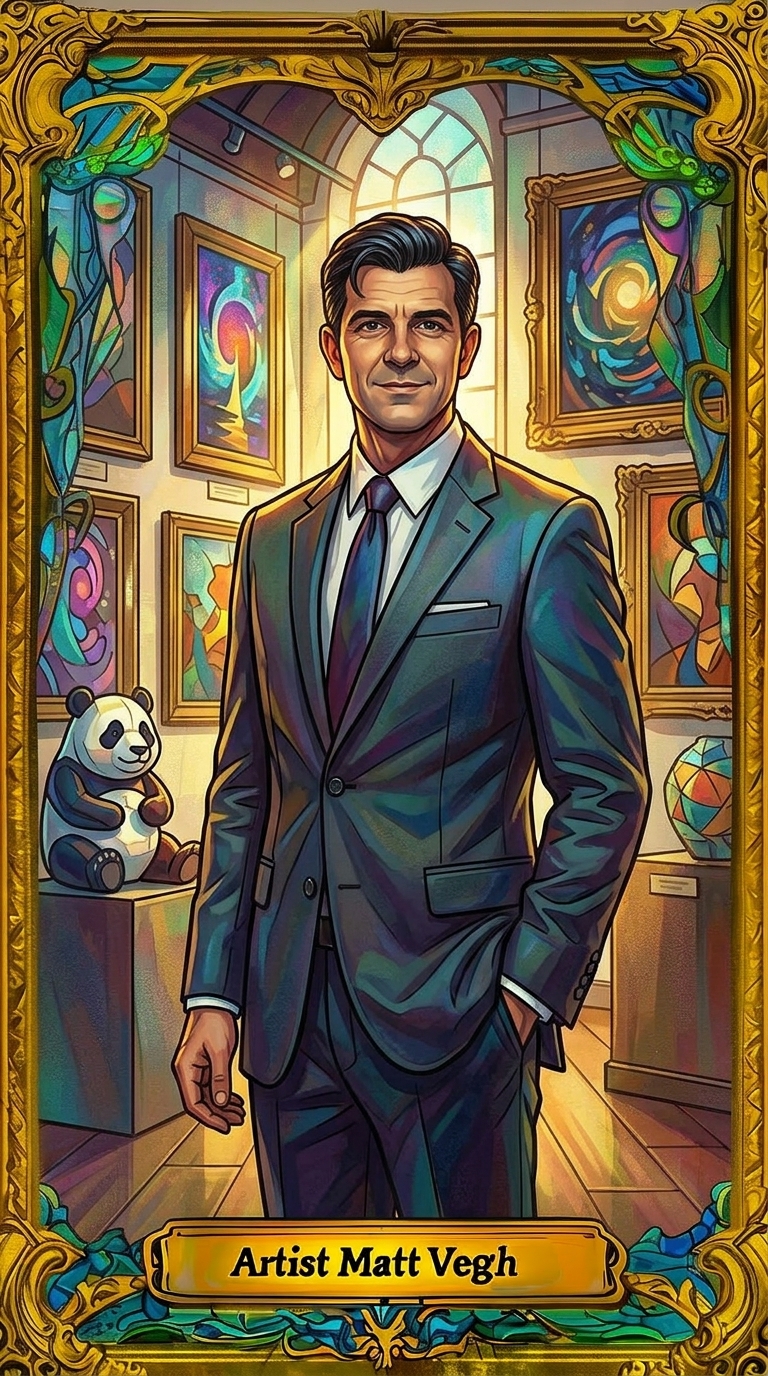
 by Canadian Artist Matt Vegh
The morning arrived with a clear, thin cold that cut straight through my running windbreaker. By seven o'clock on this Tuesday, the streetlamps along the Maliesingel were still humming their dull orange tune, casting long copper spokes across the wet brickwork. I turned east toward the meadows, settling into that familiar four-beat breath that always irons out whatever clutter collects behind my eyes overnight. My mood was quiet, perhaps a bit solemn, the way October often makes me feel when the green gives up its stubbornness and lets the bone structure of the trees show through.
When you run in the Dutch autumn, the air smells of turned soil, rotting alder cones, and the mineral sharpness of damp gravel. It is a grounding scent. My shoes slapped a steady cadence against the towpath, kick-kicking through scattered patches of wet gravel. By the fourth kilometer, my knees were warm, my lungs had settled into their rhythm, and the Utrecht skyline had slipped away behind the willow thickets. The mist was hanging low over the polder ditches, resting like sheared wool on the reed beds.
The Bend Where the Flow Stalls
Just past the wooden footbridge near Bunnik, there is an elbow in the Kromme Rijn where the current slackens to an absolute crawl. Scum and river weed collect there against an anchored oak pylon, joined by thousands of tiny fallen lanceolate willow leaves. In summer, you run past without looking twice. It is merely brown water and dead drift. But today, the low sun broke through the polder fog at an angle of no more than eight degrees above the horizon line.
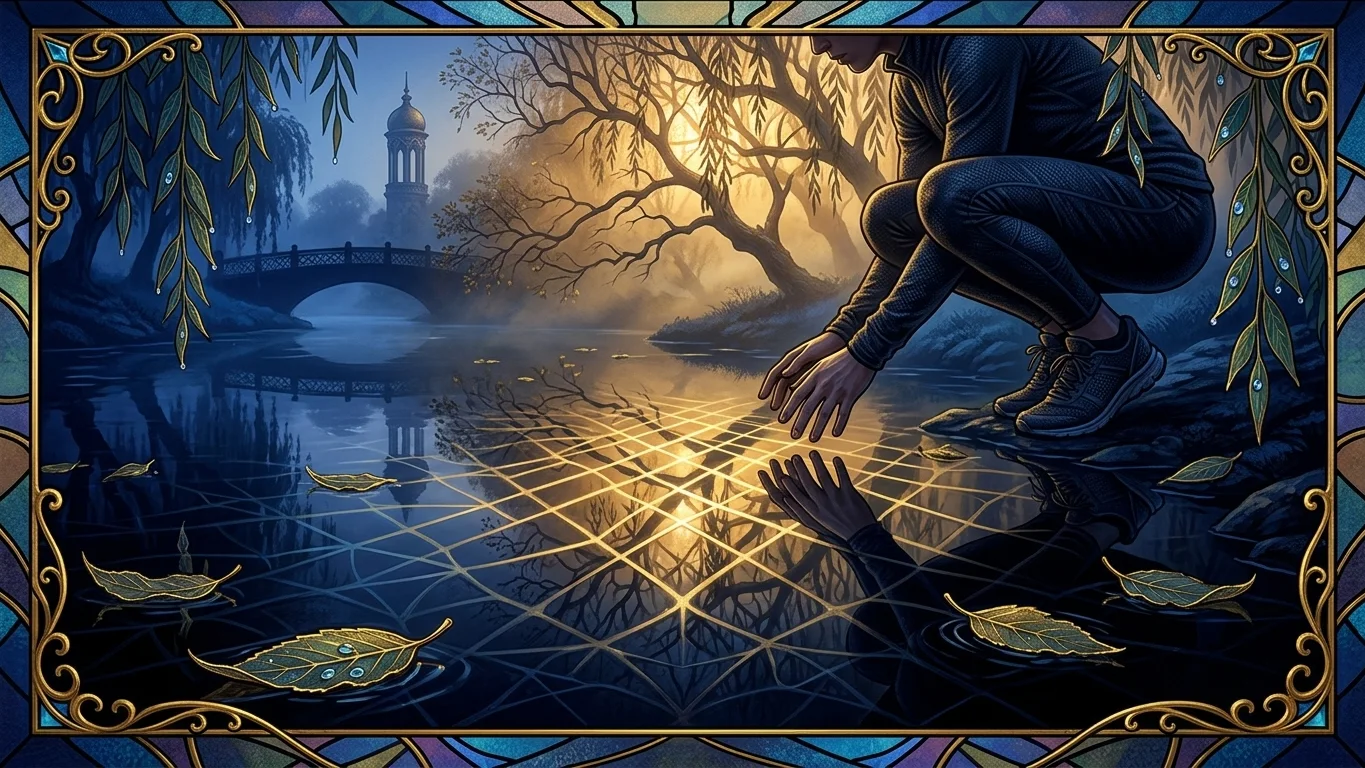
I slowed to a walk, steam rising off my shoulders in pale ribbons. The light did something peculiar to that stagnant corner. Because the oak pylon held back the drift, the surface was completely still, forming a skin of dark river water as dense as black lacquer. Resting upon that skin were hundreds of narrow willow leaves, cured by two weeks of rain into shades of dull brass, saffron, and ochre. They did not lie flat. Their tips curled upward, catching the direct beam of the sunrise, while their bellies cast distinct, sharp shadows downward into the murk.
I took off my gloves, leaned against the damp rail, and simply watched. It was pure abstract geometry, entirely uncurated by human hands. The crisscrossing yellow blades broke the river into irregular dark polygons, like leaded glass floating on oil. For several minutes, I forgot that my sweat was cooling and that my fingers were stiffening in the damp chill.
Looking Through the Surface Skin
In the Netherlands, our light has a special weight because the sky is huge and the water beneath it is always talking back. Old masters like Rembrandt understood that shadow is never empty; it holds depth, grit, and warmth. Vermeer looked at stillness with a geometric patience that made milk pouring from a jug feel eternal. Standing by that river elbow, I saw both sensibilities colliding on three square meters of cold ditch water.
I pulled my pocket camera out from my running pack. When I photograph scenes like this, I do not want an inventory of leaves and sticks. A catalog of botanical specimens interests me far less than the sensation of the threshold. I knelt in the muddy grass, resting my elbows on my knees to steady my frame. I brought the lens down to water level, setting the aperture wide open so that the far bank dissolved into an olive-gray wash.
Through the viewfinder, the water ceased to be a river. It became a deep, bottomless void punctuated by floating shards of amber. A tiny breeze skittered across the surface, not enough to stir the leaves, but enough to create micro-ripples that bent the reflected sun into jittery, golden threads. The Dutch have a word for this kind of dancing luminescence: lichtspel. It was a play of light so fleeting that every heartbeat shifted the pattern by a millimeter. Luno nearly slipped into the mud trying to keep the focal plane parallel to that paper-thin surface, but the cold mud under my palms felt honest.
The Digital Ledger and the Passing Hour
Later in the morning, back at my desk in Utrecht with a mug of strong filter coffee between my palms, I loaded the raw captures onto my screen. My running shoes were drying on newspaper by the radiator, smelling faintly of river silt. Looking at the files on the calibrated monitor, the raw sensation returned instantly.
This is where my work usually splits into two rivers that eventually join. On one hand, I have the physical memory: the smell of the damp willow leaves, the burning in my calves, the chill in my knuckles. On the other, I have the digital image, an arrangement of pixels that can be transformed into an archival print or minted into an NFT anchored to real-world artifacts. I spent an hour working on the tone curve, pulling the blacks down toward deep carbon while nudging the gold highlights until they hummed with the same brassy glow I saw at eight in the morning.
People sometimes ask me why an abstract nature photographer cares about tokens, digital ownership, or ledger entries. To me, it feels completely natural. When you record a fraction of a second of water and light, you are capturing a transient state of matter that will never occur again. The leaves in that river eddy will sink by dusk; the frost will rot them into pulp by December. Anchoring that ephemeral intersection of light and water in digital metadata is simply my way of preserving a small truth. It is a ledger entry of a Tuesday morning when the world paused to show its quiet bones.
The Geometry of Leaving Be
Before closing the workstation to take a midday walk through the city park, I set one final crop. I eliminated the bank, the sky, and every reference point that might tell the viewer they were looking at a ditch in the province of Utrecht. What remained was pure harmony: cold blackness, warm saffron spears, and the tension of water refusing to sink its cargo.
We spend so much of our days trying to organize the world, forcing our projects and schedules into tidy squares. Yet nature creates the most startling balance when things simply fall where gravity drops them. A dying leaf drops from a willow branch, floats down into an eddy, meets twenty of its companions, and together they construct an accidental cathedral of light.
My run this morning began as an exercise to blow out the cobwebs, but it ended as a lesson in attention. The world does not ask us to fix it or dress it up. It only asks whether we have the patience to bend our knees in the wet grass and see what is already there. I left the mud on my trail shoes to dry in the sun, satisfied with the morning's quiet harvest.