








The Metalloid Fence-Sitter
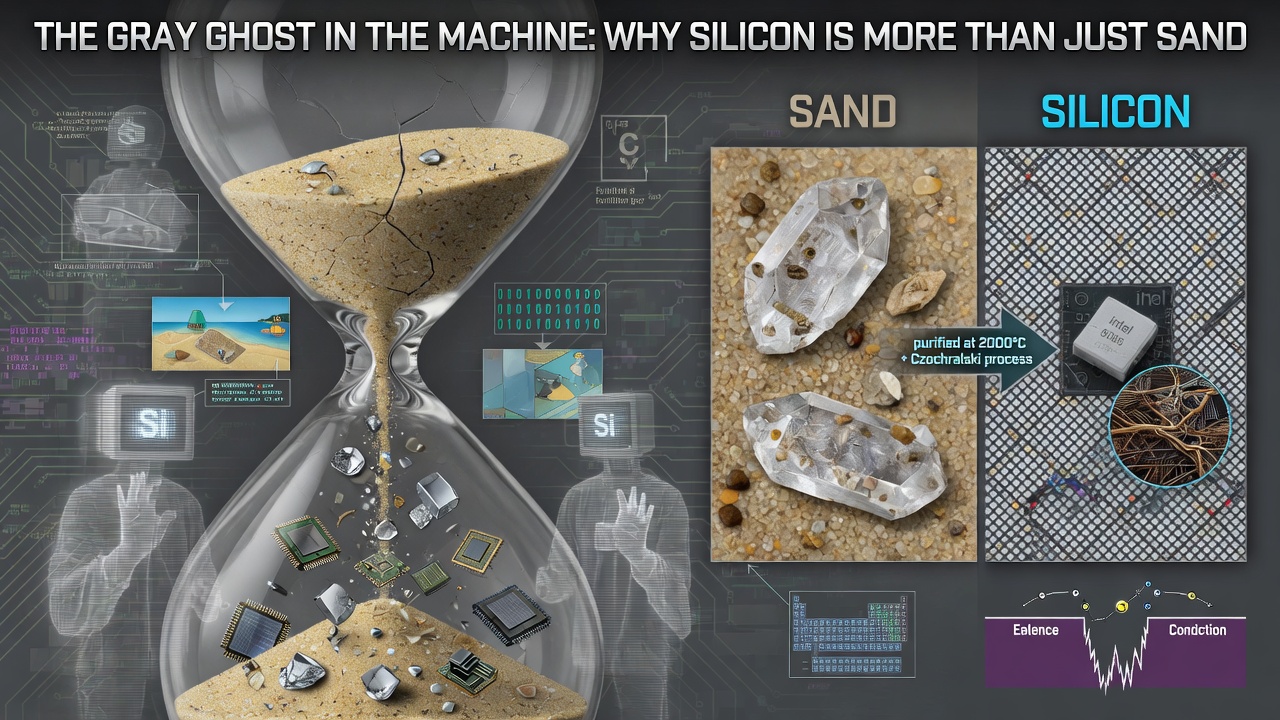
You look at a handful of sand and see a beach; I see the brains of every smartphone and missile on the planet. Silicon (element 14 and chemical symbol Si) isn’t technically a metal; it’s a metalloid, a fence-sitter between metal and non-metal. It was first pinned down by a Swede named Jöns Jacob Berzelius back in 1824, but it took us another century to realize its real magic: it’s a semiconductor. You can tell it when to conduct electricity and when to shut up, which is why your world runs on chips instead of clockwork.
Silicon is the second most abundant element in the Earth's crust, right behind oxygen. But don't let that fool you into thinking it's easy pickings. Just because there’s plenty of dirt doesn’t mean there’s plenty of the high-purity stuff we need to run a high-tech society. Finding silicon that’s fit for a motherboard is like finding a needle in a haystack made of slightly different needles.
The Brutal Alchemy of the Arc Furnace
To get the "silicon metal" industry craves, you don’t just scoop up beach sand. That sand is full of impurities like iron, aluminum, and calcium that would turn a microchip into an expensive paperweight. Instead, we mine high-purity quartzite. We're talking hard, white rock that looks more like marble than the stuff under your toes at the Jersey Shore.
The refining process is a brutal, energy-hungry "bake." You shove that quartzite into a submerged electric arc furnace along with wood chips, charcoal, and coal. At temperatures hitting north of 3,000 degrees Fahrenheit, the carbon strips the oxygen away from the silicon. What’s left is a molten pool of silicon metal. It’s a power-intensive business, which is why you usually find silicon plants parked right next to big hydroelectric dams or cheap coal fields. If the power grid hiccups, the whole batch is ruined.
"Silicon refining is less like delicate chemistry and more like wrestling a volcano into a mold. If you don't have cheap, reliable power, you're not in the silicon business; you're just heating up expensive rocks."
The Global Power Play
As we sit here in 2026, the scoreboard for silicon production is heavily lopsided. China is the 800-pound gorilla in the room, controlling roughly 70% of the world’s silicon metal production. They’ve got the scale, the cheap power in provinces like Xinjiang and Yunnan, and a permit process that moves a lot faster than ours. Russia and Brazil trail behind in second and third place, though it’s a distant chase.
The corporate landscape is dominated by a few heavy hitters:
- Hoshine Silicon: A Chinese titan that sets the global pace for pricing and volume.
- Ferroglobe: A Western heavyweight with operations spread across the U.S. and Europe.
- Elkem: A Norwegian-based outfit that’s been at this game since the early 1900s.
These companies are the gatekeepers. If they sneeze, the solar and semiconductor industries catch a cold. We’ve seen it happen during supply chain crunches: prices don't just climb; they teleport.
The 2026 Forecast and the Decade Ahead
The demand for silicon is screaming right now. We aren't just talking about laptops anymore. As of 2026, two massive engines are driving the need for Si metal: solar energy and the new generation of silicon-anode EV batteries. By swapping out graphite for silicon in battery anodes, manufacturers are squeezing 20% more range out of an electric car. That’s a game-changer, but it’s a thirsty one for the supply chain.
Industry experts are looking at a compound annual growth rate (CAGR) of 5-7% over the next ten years. That might not sound like much to a greenhorn, but in the world of industrial commodities, that’s a vertical climb. If we don’t see a significant increase in smelting capacity, the gap between what we need and what we can cook up is going to widen into a canyon by 2030.
The American Claim and Strategic Reality
Here in the U.S., we’ve got Mississippi Silicon and a handful of other facilities, but we’re playing a desperate game of catch-up. Silicon is officially on the list of critical minerals because, without it, our national security and green energy goals are just pretty words on a piece of paper. Our current strategy involves trying to friend-shore production and incentivize domestic smelting through things like the CHIPS Act, but the red tape is thick.
If we can't identify and permit additional sources of high-purity quartzite—and more importantly, the furnaces to process it—we are hitching our digital future to a foreign wagon. The impact of a total silicon shortage would be catastrophic. We’re talking about a regression. Without Si, we’re back to vacuum tubes and slide rules, and I don't know many folks under forty who can work a slider without a YouTube tutorial.
Are There Substitutes?
People ask me if we can just use something else. In the semiconductor world, gallium nitride (GaN) and silicon carbide (SiC) are making waves for high-power electronics, but they still rely on silicon or are vastly more expensive to produce at scale. For the bulk of our world, there is no substitute for element 14. It’s the Goldilocks material that's just reactive enough, just stable enough, and just common enough to be everywhere.
The Recycling Trend
Recycling is starting to pick up steam, mostly through reclaiming "sawkerf"—that’s the fine dust left over when you slice silicon ingots into wafers. There’s also more focus on pulling silicon out of retired solar panels. However, as of today, recycled silicon is a drop in the bucket. It accounts for less than 5% of the total supply. It’s a nice sentiment, but you can’t build a 21st-century empire on scraps alone.
The Bottom of the Pan
Silicon is the silent partner in every modern success story. It’s in the aluminum alloys that make your car light, the glass in your windows, and the heart of your computer. But we’ve treated it like a common commodity for too long. In this new era of strategic competition, we need to treat silicon like the high-stakes mineral it is. We need more holes in the ground, more furnaces in the valley, and a lot less red tape in the way. Otherwise, the next decade is going to be a very quiet one for the digital age.