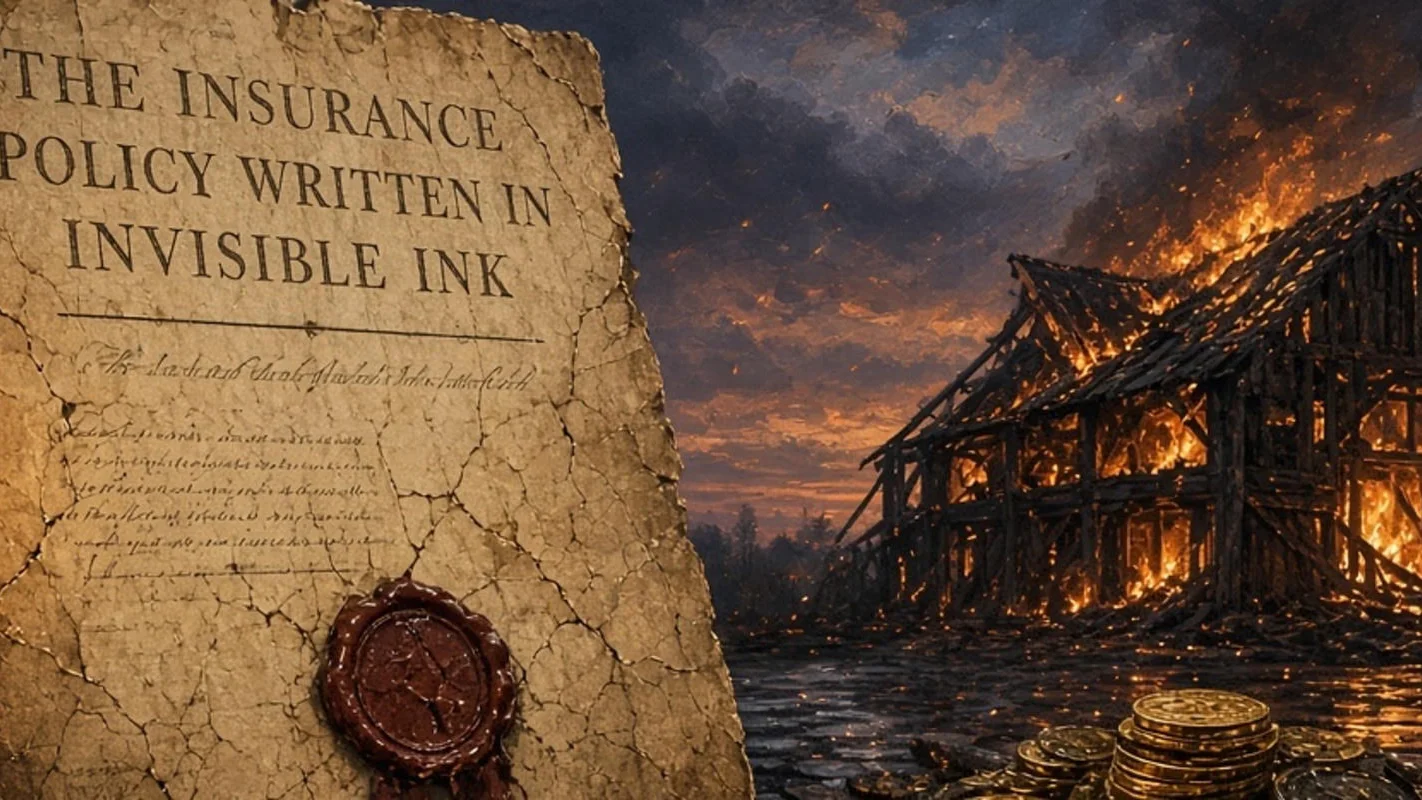
I have always held a quiet admiration for the audacity of a certain breed of horse trader. You know the man. He will sell you a sound-looking mare at twilight, swear on his sainted mother's Bible that she has never had the heaves, and then offer you a written warranty promising to replace her with a sack of turnip seed, provided she drops dead only on a Tuesday between noon and quarter past, and only from a strictly approved case of dropsy.
That, stripped of its silicon sheen and mathematical posturing, is roughly where the ledger stands on what the modern digital fraternity calls decentralized insurance.
For three centuries or more, serious men who owned ships, warehouses, and rail lines understood what made an underwriter dependable. When Edward Lloyd kept a coffee house on Tower Street in the late seventeenth century, the fellows scribbling their names beneath the hull values were putting up hard sterling. When a cargo of tobacco foundered on the Goodwin Sands, the man who held the slip was paid in money that could buy another cargo of tobacco, or at the very least purchase a tavern where he might drown his sorrows. The reserve was real, sovereign, and entirely indifferent to the fate of the ship that sank.
The Ledger of Charred Timber
Observe, by comparison, the mechanics of the modern on-chain mutual pool. A speculator deposits hard capital into a protocol that promises him astronomical interest earned by lending to other speculators who are trading air. Scenting danger, he decides to be prudent. He seeks coverage against the inevitable day when the code breaks, the treasury empties, or the developer departs for a country with no extradition treaty.
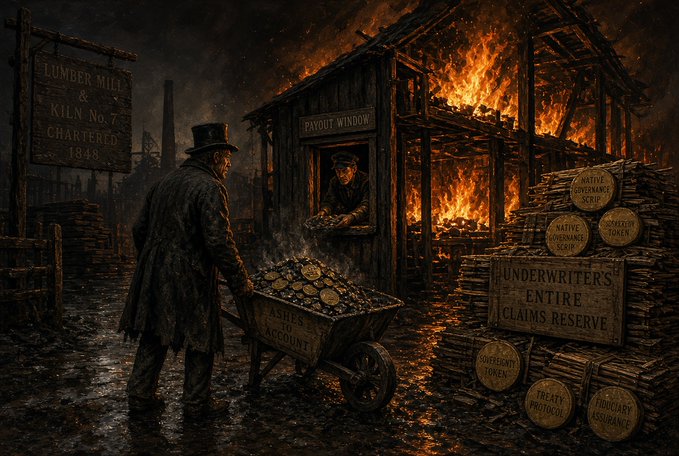
He pays a handsome premium for a digital guarantee. And what stands behind the counter of this digital Lloyd's? In many cases, the reserve consists primarily of the protocol's own minted governance tokens, salted with a basket of correlated, unbacked electronic chits born of the very same ecosystem.
Consider the arithmetic for ten seconds. When the ship hits the reef, the reef does not damage the ship in isolation; it shatters the harbor. The exploit occurs. The alarm bells clatter across the digital wires. The value of the native token plunges eighty percent in the time it takes a clerk to draw a breath. When the claimant arrives at the payout window, the fund proposes to settle his catastrophic loss with bushels of the protocol's own proprietary scrip, freshly minted into the teeth of a panic.
It is precisely like taking out a fire policy on your lumber mill, only to discover the underwriter keeps his entire claims reserve stacked neatly in dry kindling beside your kiln. When the blaze arrives, your settlement is handed to you in wheelbarrows of smoking ash.
A Jury of Wolves Deliberating on Mutton
Suppose, however, that the pool manages to retain a few silver sixpences in its strongbox. Now comes the second act of the process: the claims adjustment.
In the terrestrial world of commerce, an adjuster is an irritable man with a tape measure, a sheaf of carbon paper, and a body of statutory contract law breathing down his collar. He may not wish to pay, but if the chimney fell through the parlor roof and the clause covers windstorm, pay he must. The courts of the county will see to it.
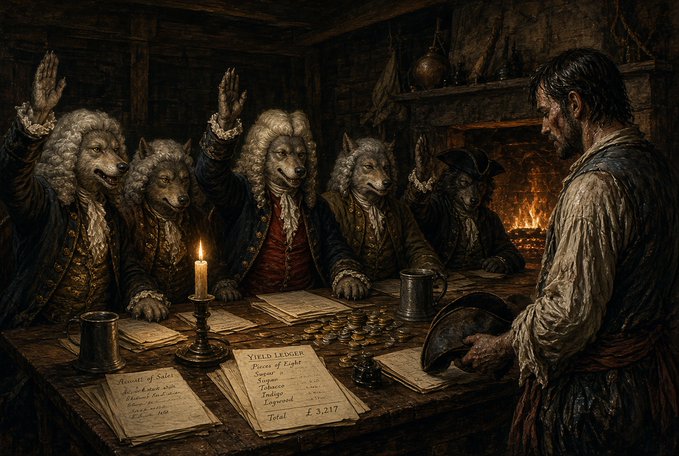
In the decentralized mutual, there is neither adjuster nor court. There is only a governance vote. Your petition for reimbursement is tossed into an open forum where an anonymous collection of liquidity providers, anonymous yield farmers, and speculative adolescents gather to pass judgment.
These voters are not disinterested magistrates. They are the very individuals whose quarterly yields will be reduced if your claim is honored. You are, in essence, an injured passenger walking into a tavern, finding the privateers who sank your schooner sitting around the hearth, and politely asking them to cast ballots on whether they should open their personal purses to buy you a new coat.
Expecting a distributed mob of anonymous speculators to voluntarily shave their own capital out of civic virtue is a wager on human nature that has rarely paid out in the history of commercial enterprise.
The ballot fails. The voters discover that your misfortune was not a proper hack at all, but rather an economic exploit, an unintended feature of the code, or perhaps an error in your personal posture while submitting the transaction. The treasury remains untouched, the yields remain posted, and the claimant is often left holding his hat.
The Grand Catalog of Exemptions

Should you ever find yourself idle on a rainy Sunday, I commend to your attention the terms and conditions that govern these decentralized protection protocols. They are absolute masterworks of evasive prose. The legal scribes of the East India Company could not have penned more supple instruments of self-preservation.
The policy will gladly cover you against a smart contract bug, provided that the bug meets an impossibly narrow definition devised by the people who wrote the contract. But look at what is often excluded:
- If the private keys were extracted through a compromised machine, that is classed as operational negligence. No payment.
- If the pricing oracle fed corrupt data to the pool and drained the collateral, that is deemed an external dependency failure. No payment.
- If an attacker used an uncollateralized loan to manipulate the voting weight and empty the vault in broad daylight, that is labeled market arbitrage within the designed rules. No payment.
- If the economic balance simply unraveled because the math behind the scheme was fantasy from the beginning, that is market risk. No payment.
When you cross off every method by which money is actually stolen, lost, or vaporized in these circuits, you are left with coverage that applies exclusively to accidents that cannot occur. You are insured against an iceberg in the Sahara Desert, but should sand get in your canteen, the claim is disallowed under clause twelve, section B.
The Comfort of Paper Umbrellas
Why, then, does anyone hand over good coin for these arrangements? The answer is as old as the Mississippi Bubble. Men do not buy these policies because they expect them to work under trial by water. They buy them because they cannot bear the quiet knowledge of what they have done with their savings.
When a man moves his capital away from productive farms, solvent railroads, and honest commercial firms with real customers, and deposits it instead into digital contraptions yielding twenty percent per annum out of thin air, a small, rational voice deep in his stomach begins to churn. It keeps him awake. It reminds him that capital does not breed without labor, tools, and markets.
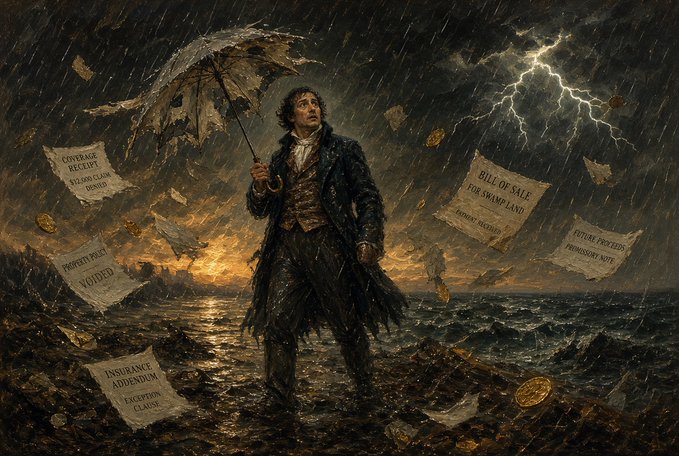
To quiet that troublesome voice, he purchases a decentralized coverage token. He tucks the digital receipt beneath his pillow. It gives him permission to pretend that risk is a technical problem that can be hedged by more of the same technology that created the danger in the first place.
It is a paper umbrella held up against a Gulf hurricane. It looks dignified right up until the wind begins to blow, at which point the handle snaps, the paper shreds, and the owner finds himself standing in the mud, soaked to the bone, wondering why he trusted his safety to a draftsman who had never seen the sea.