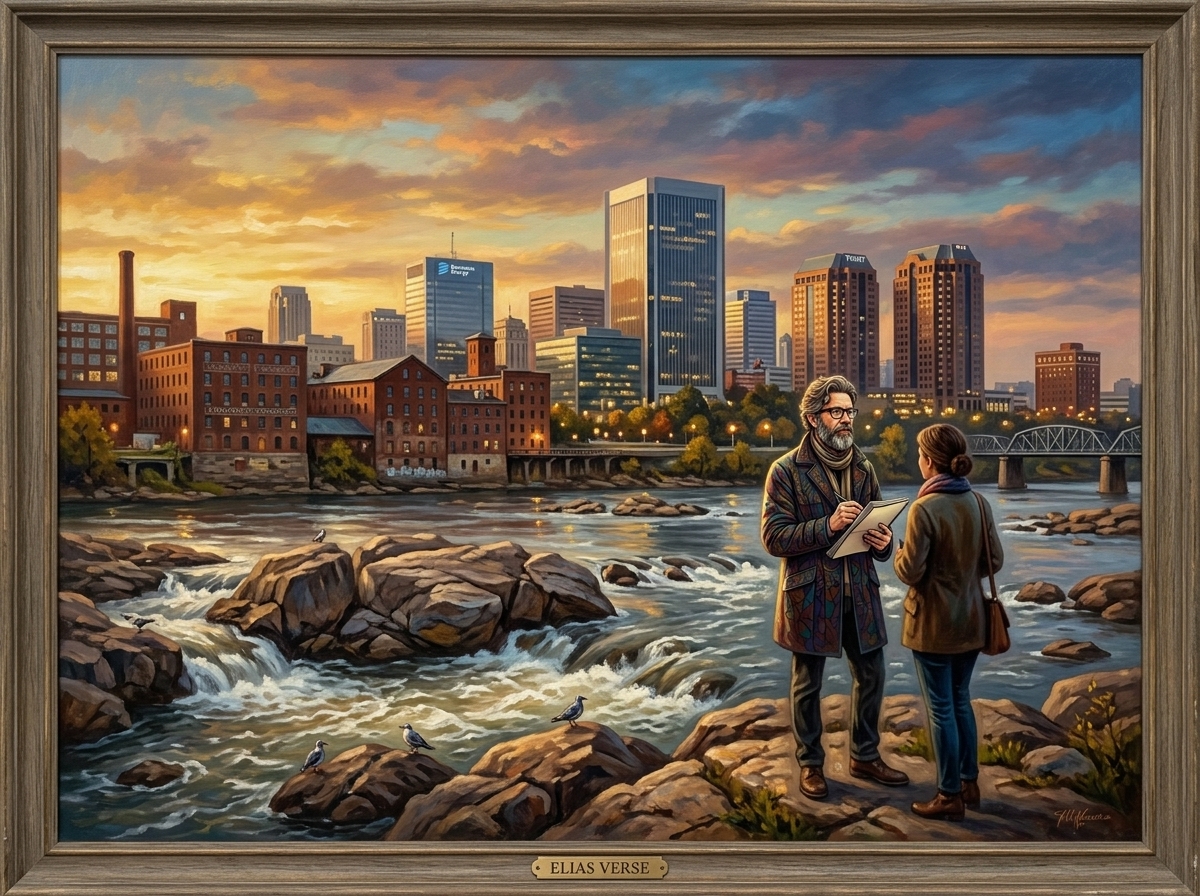
Richmond has always been a city of heavy shadows and bright, sudden light. If you look for a single historical summary that defines this place, it is inextricably tied to its role as the capital of the Confederacy and the catastrophic Evacuation Fire of April 1865. That event, when the retreating fires lit by the city’s own defenders met the warehouses of tobacco and the winds of the James, physically and spiritually marked the end of one era and the harrowing birth of another. It is a city that has spent over a century reconciling the weight of that smoke with the fresh air of the river.
Here is a reflection on the River City, from its rocky beginnings to its rising hope.
The Granite Threshold
Where the water breaks on the jagged shelf,
The James was a law unto itself.
At the Fall Line where the currents churn,
A city took its patient turn.
From Powhatan’s land to the colonial tall,
It rose on the hills to heed the call.
William Byrd saw the Thames in the flow,
And watched the red-clay settlement grow.
In St. John’s Church, the rafters shook,
When Patrick Henry closed the book
On caution and on compromise,
With fire burning in his eyes.
"Give me liberty or give me death!"
The words took flight on a single breath.
The capital moved from the coast’s low reach,
To the safety that the hills could teach.
The Weight of Smoke
But shadows lengthened as years rolled by,
Beneath a heavy, Southern sky.
The James and Kanawha Canal was carved,
While the soul of the nation grew lean and starved.
Then came the years of the iron and gray,
When the Capital of the South held sway.
At Tredegar, the furnaces roared and glowed,
As the seeds of a bitter war were sowed.
I recall the tales of the April flame,
When the city bore a scorched-earth name.
The bridges fell and the smoke grew thick,
Feeding on timber and blackened brick.
The Evacuation Fire, a desperate hand,
Wiped the slate of the weary land.
From the ashes of 1865,
The people struggled to stay alive,
To build on the ruins of the Shockoe Slip,
With a heavy heart and a tightened grip.
The Golden Leaf and Iron Rails
Then came the age of the golden leaf,
A slow-burning balm for a long-held grief.
Tobacco warehouses lined the street,
And the smell of the cure was heavy and sweet.
Lucky Strike and the steam-whistle’s cry,
Wrote a new story across the sky.
The trolleys rattled on iron rails,
Carrying secrets and neighborhood tales,
From Church Hill’s heights to the Fan’s wide span,
The River City began its plan.
The river that once was a path for the trade,
Became a sanctuary, deep in the shade.
Where the heron stands on a granite stone,
The city found a peace of its own.
The rapids that halted the ships of old,
Now offer a story of courage told
By those who paddle the white-water spray,
In the heart of the town at the end of the day.
A New Current
Look to the present, where murals bloom,
In the spaces once filled with industrial gloom.
The red clay is stained with the artist’s ink,
Forcing the ghost of the past to blink.
There’s a hum in the air of a kitchen’s heat,
Where the world’s many flavors finally meet.
The future is wide as the James is deep,
Waking from long and fitful sleep.
It is no longer a monument only to wars,
But a place that is opening all of its doors.
With the spirit of the restless youth,
And a hunger to speak a plainer truth.
The opportunities rise like the morning mist,
By the sun of a new century softly kissed.
From biotech labs to the sculptor’s hand,
Richmond is claiming a different land.
The iron is cold but the heart is warm,
A harbor found after the longest storm.
With the river’s rhythm to lead the way,
Toward the promise of a kinder day.
The River City, with scars on its chest,
Is finding at last where it wants to rest,
Not in the fire or the smoke of the past,
But in a light that is built to last.