

 by Zenna LoneStar
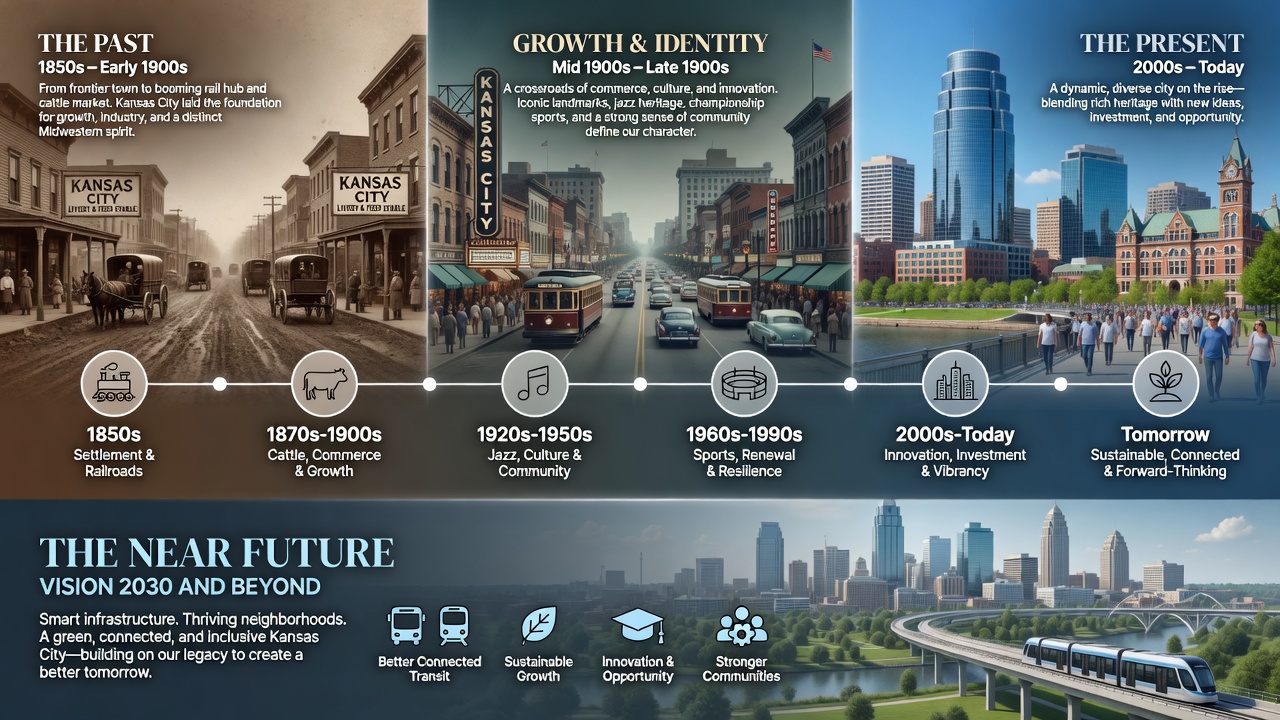
Kansas City has always been the place where the map breathes. It is the hinge of the country, a spot where the heavy waters of the Missouri meet the Kansas River. For a long time, it was where the known world ended and the great adventure began. When I think of those early days, I see the Chouteau family in my mind’s eye, setting their cabins down where the forest met the fern, watching the river traffic crawl by on its way into the great unknown.
The Bridge That Made a City
If you search through the dusty ledgers of the past to find the one moment that decided the fate of the plains, you must look to the year 1869. At that time, Kansas City was just one of several towns with Leavenworth and St. Joseph among them, vying to be the king of the region. The completion of the Hannibal Bridge changed everything. It was the first permanent rail crossing over the Missouri River, an iron-girded span that acted as a magnet for the railroads.
While other river towns sat waiting for the waters to rise or the seasons to change, Kansas City anchored itself to the iron line. This bridge brought the cattle herds and the heavy, lowing sound of the stockyards. It turned a muddy landing into a golden cowtown, a place where the scent of wealth was often mixed with the smell of the pens and the dust of a thousand wagons.
The Heart at the Crossing
At the elbow of the river, where the muddy waters churn,
The Chouteaus built their cabins near the forest and the fern.
A trading post on frontier sand, a slip of river grass,
Where every soul bound for the West was fated once to pass.
The Town of Kansas took its root in eighteen-thirty-eight,
A humble landing for the boats that carried nation-bound freight.
With Westport just a ride away, the wagons started lining,
To find the Santa Fe or Oregon while the morning sun was shining.
The city grew through fire. Before the cannons of the great war ever spoke, the border was bleeding. Neighbors looked upon neighbors with heavy frowns during the years of raids and unrest. I remember the stories of the Battle of Westport in 1864, also known as the Gettysburg of the West, where the rebel tide was finally broken against the hills. It left the city standing tall, a Union stronghold that refused to be swept away by the chaos of the frontier.
Jazz, Smoke, and the Paris of the Plains
But shadows stretched across the plains before the cannons spoke,
And Kansas City felt the heat of the coming fire and smoke.
The border wars, the "Bleeding" years, the raids upon the town,
As neighbors looked on neighbors with a dark and heavy frown.
Then came the clash at Westport in the autumn of the year,
When sixty-four saw Price’s men filled with a sudden fear.
The Gettysburg of western lands, it broke the rebel tide,
And left the city standing tall with Union-bolstered pride.
Then rose the iron-girded span, the Hannibal of old,
In eighteen-sixty-nine, the tale of victory was told.
While other towns on riverbanks sat waiting for a sign,
Kansas City built the bridge to hold the iron line.
The rails brought in the cattle herds, the dust, and lowing sound,
Until the greatest stockyards grew upon that muddy ground.
A "Cowtown" with a suit of gold, with blood upon its sleeves,
Where every farmer brought his grain in heavy, golden sheaves.
There was a time when the sun never seemed to set on 18th and Vine. In the roaring years, when the Pendergast machine kept the taps flowing and the spirits bright, Kansas City earned its nickname: the Paris of the Plains. It was a place of vice, yes, but it was also a place of unmatched rhythm. In the shadow of the Great Depression, while the rest of the world turned a weary grey, this city swung to the sound of Count Basie and the soaring notes of Charlie "Bird" Parker.
The roaring years brought something new, a rhythm in the night,
When Pendergast ruled city hall and kept the spirits bright.
The "Paris of the Plains" they called this place of vice and song,
Where Eighteen-and-the-Vine would play the music all night long.
The trumpet of a young Count Basie, or a Bird upon the wing,
Taught the world that Kansas City had a special way to swing.
Through the shadows of the Great Depression, while the world turned grey,
The concrete poured and buildings rose to greet a brighter day.
The music wasn't just entertainment; it was the heartbeat of a town that refused to be broken by economic despair. Even as the concrete was poured for new skyscrapers, the clubs stayed open until dawn. It was a city of brick and stone, of jazz and heavy rain, where the smell of hickory and oak began to drift from the barbecue pits that would eventually make the city famous across the globe.
The City of Fountains and the Road Ahead
Today, when I walk through the streets, I am struck by the water. They call it the City of Fountains, and for good reason. There are hundreds of them. Marble basins catching the light, quiet pools in hidden squares, and grand monuments like those at Liberty Memorial that stand against the blue sky to honor the fallen. The water seems to wash away the grit of the old cattle trails, leaving something fresh and hopeful in its wake.
Now look upon the City of Fountains, where the waters leap and play,
A hundred marble basins catching light throughout the day.
The monuments of Liberty stand tall against the blue,
To honor those who gave their lives so we could start anew.
The smell of hickory and oak still drifts upon the breeze,
From pits of slow-burnt brisket meant to bring a man to ease.
It is a town of brick and stone, of jazz and heavy rain,
A place that knows the cost of growth and knows the weight of pain.
- The Crossroads district hums with the dreams of artists in renovated warehouses.
- The tech-bound minds are building new cathedrals of industry where the stockyards once stood.
- The spirit of the frontier remains, hidden in the quiet parks and the public squares.
The future of this place isn't just in its position on a map, but in its ability to remain the "Heart of America." It is a city built on movement—on the trail, the track, and now the digital wire. From the Missouri’s winding curve to the Kansas hills, there is a steady, quiet strength rising like a tide. It is a place that always welcomes those who find their way back home.
The spirit of the frontier hasn't vanished from the air,
You find it in the quiet parks and in the public square.
It’s a city built on movement, on the trail and on the track,
A place that always welcomes those who find their way on back.
From the Missouri’s winding curve to the Kansas hills so wide,
There is a steady, quiet strength that’s rising like a tide.
The Heart of America is beating, loud and clear and true,
With a history behind it and a world of things to do.
We are no longer just a landing or a bridge across a stream. We are a vessel for the modern mind, carrying the weight of our history with a grace that only a city of the plains can muster. The heart is beating, loud and true.