







 by Canadian Artist Matt Vegh

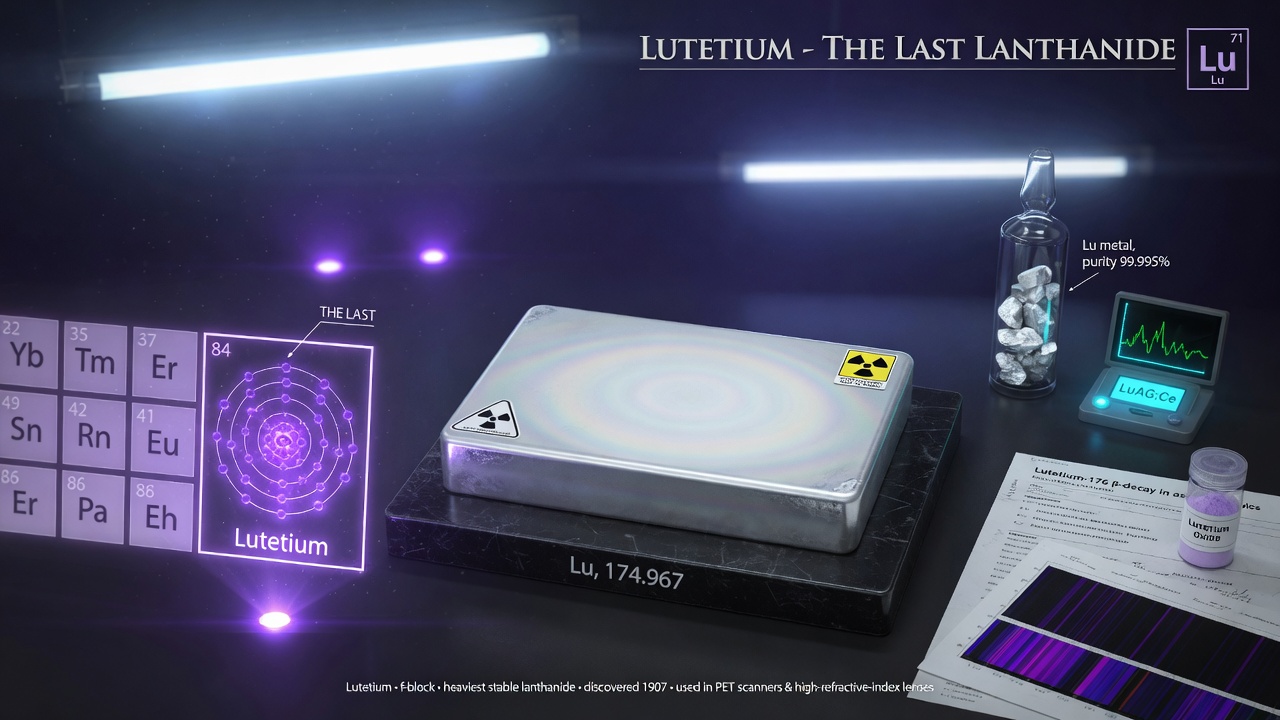
If the periodic table were a dusty Nevada saloon, Lutetium (Lu) would be the quiet fellow sitting in the corner booth, sipping a neat whiskey while everyone else argues over the gold in the hills. He’s the last of the lanthanides (element 71) and he doesn't make a fuss until you realize he’s the one holding all the high cards. I’ve spent my life looking at rocks, and Lu is a peculiar beast. It’s the densest, hardest, and rarest of the stable rare earths. It’s also one of the most expensive. When you’re talking about Lutetium, you aren't talking about tons; you’re talking about grams and a price tag that’ll make your eyes water somewhere north of $10,000 a kilogram for the high-purity oxide.
The 1907 Three-Way Finish
Back in 1907, three different fellas, Georges Urbain in France, Charles James in New Hampshire, and Carl Auer von Welsbach in Austria, all figured out that ytterbium was hiding a secret. They independently isolated what we now call Lutetium. Urbain got the naming rights, but Charles James was the one who really understood how to purify the stuff. It took until 1949 to settle on the name, but by then, the "last lanthanide" had already proven it was a bastard to separate from its cousins. It’s that stubbornness that makes it special. Its atomic radius is the smallest of the series, but its density is the highest. It’s the physical embodiment of "small but mighty."
The Heavy Lifting: Mining and Refining
You don’t just find a Lutetium mine. It’s a hitchhiker. It shows up in tiny fractions of usually less than 0.1% inside minerals like monazite or xenotime. You're effectively looking for a needle in a haystack, and then trying to shave the eye off that needle. Right now, the global production landscape is dominated by three main players:
- China: They dominate through the China Rare Earth Group. They control the ion-adsorption clays in the south where Lu is easiest to get.
- Australia:Lynas Rare Earths and Iluka Resources are the heavy hitters here, pulling it out of mineral sands.
- Myanmar: A wild card that feeds the Chinese supply chain, though it’s a permit and human rights nightmare I wouldn't wish on my worst enemy.
Refining Lu is where the real "black magic" happens. You have to use hundreds of stages of solvent extraction to coax it away from the other heavy rare earths. It’s a slow, chemical-heavy process that explains why the supply is so tight. It’s not just about digging it up; it’s about the patience to peel the layers of the chemical onion until you’re left with that 99.9% purity.
Why We Need the "Last Man Out"
Lutetium isn't used for magnets like Neodymium or Dysprosium. Its value is in precision, particularly in the fields of healthcare and specialized industrial tech. It has become a strategic necessity because, frankly, there isn't much else that can do what it does. Its primary uses include:
- Healthcare: This is the big one. Lu-177 is a radioisotope used for targeted cancer therapy. It is literally "smart bombs" for prostate and neuroendocrine tumors. Then you’ve got PET scan crystals (LSO and LYSO) that help doctors see what’s going on inside you with terrifying clarity.
- High-Tech Catalysts: It’s a workhorse in petroleum refining and plays a role in making LED lights run more efficiently.
- Research: It’s used in high-pressure experiments because it doesn't compress easily. It’s the anchor of the rare earth world.
The 2026 Landscape: Supply, Demand, and the U.S. Strategy
As we sit here in 2026, the global market for Lutetium is tiny, maybe 10 to 15 tons a year, but the demand is growing at a clip of about 10-12% annually. Why? Because those cancer drugs are working, and every major hospital wants a piece of the action. The U.S. situation is... well, it’s a work in progress. We have the monazite deposits at MP Materials in California or Energy Fuels in Utah but we’ve spent decades letting the refining expertise drift overseas.
"Our current strategy is a frantic game of catch-up. The Department of Energy is throwing money at 'Heavy Rare Earth' separation plants to ensure we aren't relying on a boat from China for life-saving medical isotopes."
Over the next ten years, the goal is domestic sovereignty. We're looking at a 10-year outlook where the U.S. hopes to provide at least 25% of its own heavy rare earth needs. If we can't identify additional sources or get our refining act together, we face a bottleneck that hits the pharmacy before it hits the factory. There are no easy substitutes; the atomic weight and decay of Lutetium are too specific for a simple swap-out.
The Future of the Last Lanthanide
Recycling Lutetium is a tough nut to crack. We’re starting to see "urban mining" efforts to recover it from old medical scanners, but the volumes are so small that the economics are tricky. The trend is moving toward "closed-loop" systems where hospitals return spent crystals to the manufacturer. It’s a slow build, but necessary when you’re dealing with a metal this rare.
Lutetium might be the last of its kind on the chart, but it’s the first thing I’d look for if I wanted to bet on the future of high-stakes medicine. It’s a reminder that in the mining world, the biggest payloads don't always come in the biggest trucks. Sometimes, the most valuable thing in the mountain is the one that’s the hardest to find and even harder to let go of. We’ve got the rocks in the ground; now we just need the grit to finish the job of bringing them to the light.