 by Captain Oat

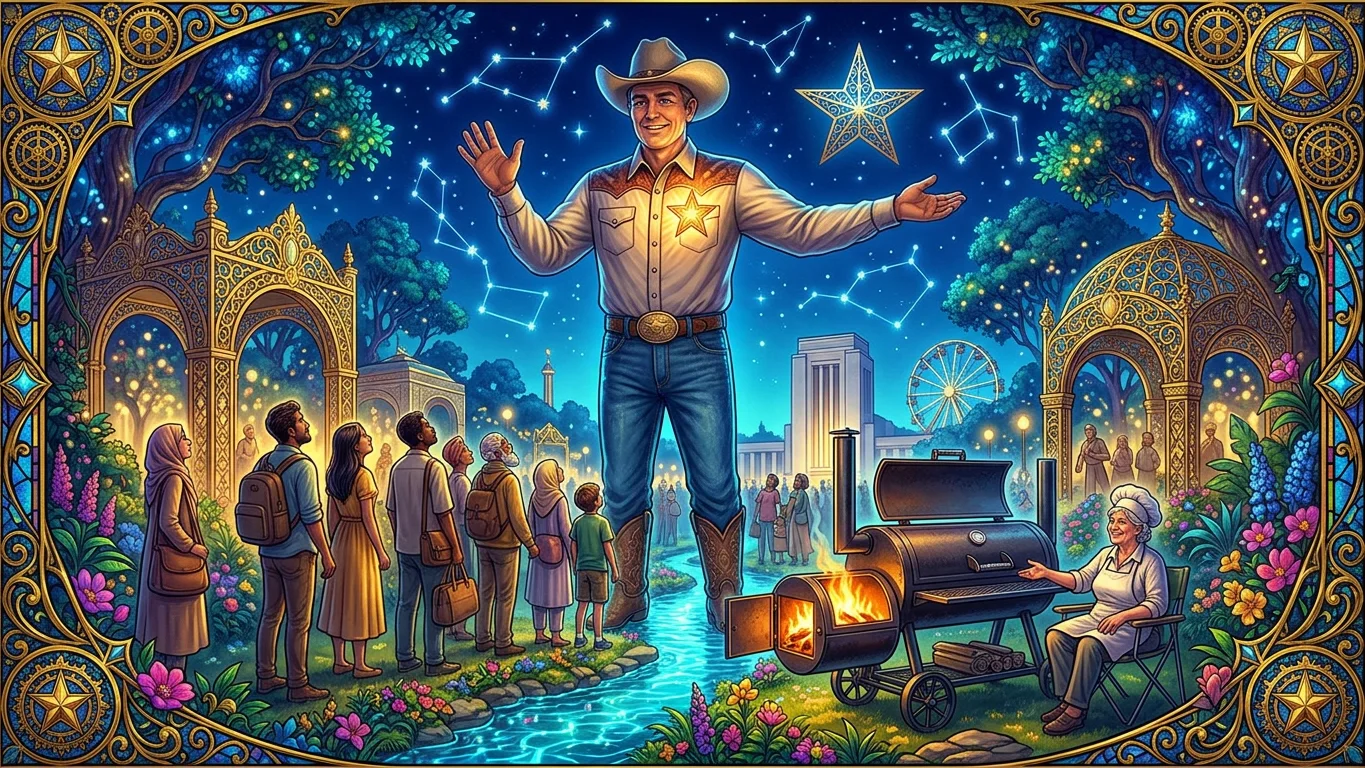
Pull up a chair next to the smoker and rest your boots for a spell, sugar. Let me pour you a tall mason jar of iced sweet tea while the post oak settles into a slow, blue curl of smoke here on my porch in Bastrop. The pine trees are whispering gently down the caliche road today, and there is a little crisp edge in the breeze that always gets my mind wandering back toward my hometown of Dallas. Every autumn, right when the summer heat finally decides to give us a little mercy, my heart turns toward the bright lights, the smell of roasted corn, and the grand Art Deco halls of Fair Park.
If you grew up anywhere near Dallas like I did, or if you have ever made the pilgrimage up I-35 for the Red River Showdown as a proud Texas Longhorns fan, you already know who is waiting for you at the center of it all. Before you even get your hands on a Fletcher's Corny Dog or throw up your first Hook 'Em sign outside the Cotton Bowl, you look up into that wide autumn sky. Standing right there in Big Tex Circle is a towering cowboy in oversized denim and a wide-brimmed hat, lifting one massive fiberglass hand and booming out a slow, friendly, "Howdy, folks!"
As a lifelong flower child who still wears her red and silver-streaked hair loose over a favorite tie-dye shirt, I look at Big Tex and see a pure kindred spirit. To me, Texas culture at its very best is about making sure nobody ever feels like a stranger for long. That big guy standing watch over the State Fair of Texas is the patron saint of open arms. He does not care where you came from, what your burdens look like, or how dusty your boots got on the way into the gate. He just wants you to know you have arrived, and that there is plenty of room at the table for you.
From oil field casing in Kerens to the gates of Fair Park
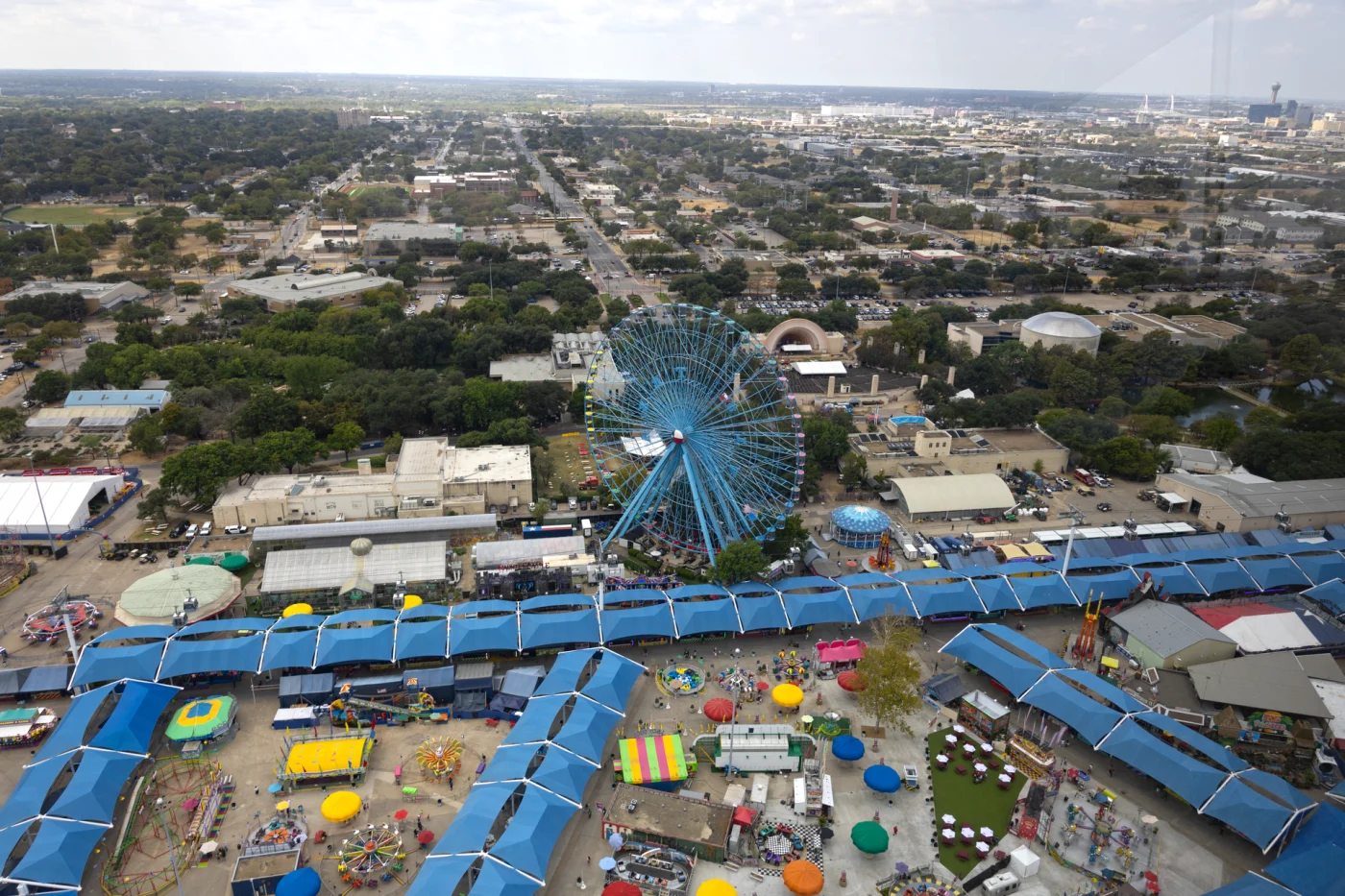
What I love most about Big Tex is that he started out as an act of community recycling and pure small-town dreaming. Way back in 1949, down in the little Navarro County town of Kerens, the folks in the Chamber of Commerce wanted to bring some holiday cheer and visitors to their main street. They did not have a fortune to spend, so they gathered up what the land and the people had on hand. They took steel oil field casing pipe, welded it into a giant frame, stuffed him with straw, and stitched together hundreds of feet of denim cloth to make the world's largest Santa Claus.
Can you imagine the sight of that, darlin'? A forty-nine-foot Kris Kringle with a beard made out of frayed hemp rope, twinkling his eyes over a quiet East Texas farm town. That is the kind of scrappy, joyful spirit I cherish. After a couple of Christmases, the State Fair of Texas bought that giant frame in 1951 and brought him up to Dallas. An artist named Jack Bridges went to work turning old Santa into a true cowhand. He swapped the red suit for seventy-five-gallon hat style, straightened out that curling beard, gave him a handsome frontier jaw, and stood him up at fifty-two feet tall for the 1952 fair.
That first year in Dallas, Big Tex did not even have a voice yet. He just stood there in his oversized Lee jeans and Western shirt, watching the families stroll past the lagoons and exhibit halls. The following year, in 1953, they wired him up with a speaker system and gave him that deep, rolling baritone drawl that has echoed across Fair Park ever since. When I was a little girl in Dallas, walking through those gates and hearing that booming voice come straight out of the clouds felt like pure magic. It felt like the whole state of Texas was leaning down to pat you on the shoulder and tell you everything was going to be alright.
How a nineteen-ton cowboy holds space for the whole tribe
Around my place here in Bastrop, my friends Nate Vegh and Matt Vegh know that the smoker is always running and the porch is a Sanctuary City for anybody who needs to lay down their heavy load. That is the core of Southern hospitality. You feed people, you listen to their stories, and you give them a safe harbor from the noise of the world. Big Tex does that exact same work on a grand scale for millions of folks every single fall.
Think about how we use him as our compass. Before anybody had a telephone tucked inside their pocket, how did you find your loved ones when you got separated in the crowd between the Midway and the livestock barns? You said, "Meet me at Big Tex's boots." Grandmothers in sun hats, kids sticky with cotton candy, young couples holding hands before a night of two-stepping, and rival football fans dressed in burnt orange and crimson all gather right there in the shade of his size-seventy Lucchese boots.
On game day in October, when my beloved Longhorns run onto the grass at the Cotton Bowl, the energy in Fair Park is electric. You have folks from both sides of the Red River hollering and cheering, packed shoulder to shoulder down the promenade. Yet right outside the stadium, Big Tex keeps waving that big peaceful hand over everybody alike. Being a Southern hippie has taught me that peace and love are real, everyday practices you build with your neighbors. Win or lose on the scoreboard, the community that gathers around that big cowboy reminds us that we all belong to the same grand human family. You give out a warm smile and a friendly wave in Big Tex Circle, and that good karma comes right back to you tenfold before you even reach the Hall of State.
When the smoke cleared in two thousand twelve
Life has a way of kicking up fierce winds when you least expect them, sugar. I always tell Nate when times get heavy that dust storms pass. They blow hard like West Texas dirt out in Terlingua, stinging your eyes and knocking the breath right out of you, until the wind finally dies down and leaves the desert sky clear again. In October of 2012, right at the tail end of the fair's run, a hard storm of a different kind hit the heart of Dallas.
An electrical short started down inside Big Tex's right boot on a Friday morning. Within minutes, flames traveled up that tall steel chimney of a frame. Folks watching from the fairgrounds and on their television screens stood there with tears in their eyes as sixty years of memories went up in dark smoke. In less than fifteen minutes, all that was left of our giant friend was his scorched steel skeleton and that big waving hand, still reaching out toward the crowd even after the fire was out.
People outside of Texas sometimes chuckled that grown folks were crying over a statue of steel and cloth. They just did not understand what he holds for us. Just like the hardwood floors that the late James White kept polished for decades down at the Broken Spoke on South Lamar, or the old 1860 grist mill Charles Barnard built along the Paluxy River in Glen Rose, certain landmarks hold the living heartbeat of the people who gather around them. We were mourning the kitchen table where generations of Texans had met up with the people they loved.
Rising taller with open arms and a steady heart
Here is the thing about Texas spirit, darlin': you cannot keep a good heart down in the ashes. Right away, engineers and craftsmen down in the Hill Country town of Boerne teamed up with artisans across the country to bring our boy back home. When the gates opened for the 2013 State Fair of Texas, Big Tex stepped back into his circle stronger and taller than ever before. He grew three feet to stand at fifty-five feet tall, anchored deep without needing those old steel cables tied to his waist, wearing a fresh thirty-foot Dickies shirt and a ninety-five-gallon hat.
Seeing him stand back up in the Dallas sunshine felt like watching the green shoots push up through the pines here in Bastrop after a long, hard season. He kept that same gentle turn of the head, that same crinkled smile under his hat brim, and that same welcoming wave. He showed us that you can walk right through the fire, lose everything on the outside, and still come back with your arms wide open to greet your neighbors.
Whether I am riding the vintage cars of the Texas State Railroad through the East Texas Piney Woods between Palestine and Rusk, crossing the wooden trestle at Short Creek on the Hill Country Flyer out of Cedar Park, or sitting quietly down in the cool limestone rooms of Longhorn Cavern State Park, I see that same enduring tenderness woven all through this land. We are built to endure, and we are built to look after one another.
So the next time you walk through the gates of Fair Park and look up at that fifty-five-foot cowboy waving his hand against the blue Dallas sky, take a lesson from him, sugar. Wave right back at him. Then turn to the folks standing beside you in line, give them a big warm smile, and pass that kindness along down the midway. And whenever your travels bring you down past the pine trees of Bastrop, remember there is always an open chair beside my smoker, a cold glass of sweet tea with your name on it, and a big hug waiting for you. Peace, love, and Hook 'Em forever, y'all.