






Pull up a rocker, honey, and let me pour you something cold. The breeze out here on the porch is just right this evening, carrying the scent of cedar smoke from the pit and the sweet, heavy perfume of honeysuckle along the fence line. When the sky turns that pale, dusty peach just before sundown, my thoughts always drift back to the folks who walked these prairies before us. Texas has always been a place where big dreams collide with stubborn ground, but there is one morning that stands taller than the rest. It is the morning the earth cleared her throat south of Beaumont and blew the twentieth century wide open.
We like to think the modern world arrived on a train schedule, neat and orderly with blueprints and boardroom handshakes. But if you ask the dirt beneath our boots, it will tell you the truth. It arrived covered in foul-smelling swamp mud, screaming louder than an iron freight train, spitting a column of greenish-black oil higher than any pine tree in the Big Thicket. That was Spindletop on January 10, 1901. It was messy, dangerous, beautiful, and completely wild, just like this state we call home.
The Prophet of Big Hill and the Stubborn Earth
Before that hill ever blew, it was just a low, rolling swell rising maybe twelve feet above the coastal marshes. Folks called it Big Hill, though anybody from the hill country would have laughed to hear a gentle mound called big. Down around the edges of that rise, sour springs bubbled up smelling like rotten eggs, and children would throw sulfur matches into the marsh gas just to watch little blue flames dance across the puddles. Most folks saw it as worthless pasture, good for little more than scrub cattle and mosquitoes thick enough to choke an ox.
One man, though, could smell something holy in that sulfur. Pattillo Higgins was a self-taught mechanic and lumber merchant who had lost his lower left arm in a rough scrape back in his wilder youth. He was not a man to quit once an idea took root in his mind. He took his Sunday school students out to that hill for picnics, telling them with absolute certainty that oceans of oil sat trapped beneath their little picnic blankets. He had read about Baku over in Russia and salt domes up in Europe, and he felt in his bones that nature worked the same way right here under Jefferson County grass.
The fancy geologists from the East laughed Higgins right out of the room. They wrote papers declaring that the salt domes of the Gulf Coast had no oil, that coastal sands were far too loose to hold a petroleum deposit, and that Higgins was chasing moonbeams. He lost his savings, drilled dry holes with his Gladys City Company, and took a heap of public ridicule. But that is the thing about having a vision, darlin'. When you truly know something in your spirit, mockery just sounds like wind through dry corn husks. Higgins ran an advertisement for a partner who would listen, and from across the waters came Captain Anthony F. Lucas.
The Morning the Prairie Roared
Lucas was a Croatian-born mining engineer who knew salt domes from his work in the salt mines of Louisiana. He looked at Big Hill and knew Higgins was not crazy. Even so, the earth did not yield easy. Their first try collapsed into running quicksand around 575 feet. Money dried up fast. Lucas had to swallow his pride and bring in wildcatting backers from Pennsylvania, James Guffey and John Galey, who had the ear of the Mellon banking fortune. Poor Higgins got pushed to the sidelines of the deal, something that broke his heart, though the courts later gave him a small taste of justice.
To run the rig, they hired the Hamill brothers, Al and Curt, seasoned water-well drillers from the flat plains of Nebraska. Those boys brought something revolutionary with them: rotary drilling. Instead of just pounding a heavy bit up and down like drillers did in the rocky hills of Pennsylvania, the Hamill brothers used a revolving bit that cut into the soft sand. To keep the loose walls from collapsing, they mixed up thick, heavy mud and pumped it down the hole. They even drove cattle through their water pits to turn the slurry into a sticky soup. It was backbreaking, filthy labor, the kind of honest sweat that binds men together as brothers of the mud.
By the morning of January 10, 1901, they had wrestled that bit down to 1,139 feet. Curt was up on the derrick, and Al was running the steam engine. They were running pipe back down the hole when the mud in the pit began to boil and gurgle. A heartbeat later, the earth let out a groan that rattled the marrow of their bones. Six tons of four-inch steel drill pipe came shooting straight up through the crown of the derrick like a fistful of dry spaghetti, snapping cross-timbers and showering the floor with iron and wet sludge.
Then fell an eerie, dead silence. The crew stood there, dripping wet, breathing hard, thinking the hole was ruined and their work was lost. But the earth was only catching her breath.
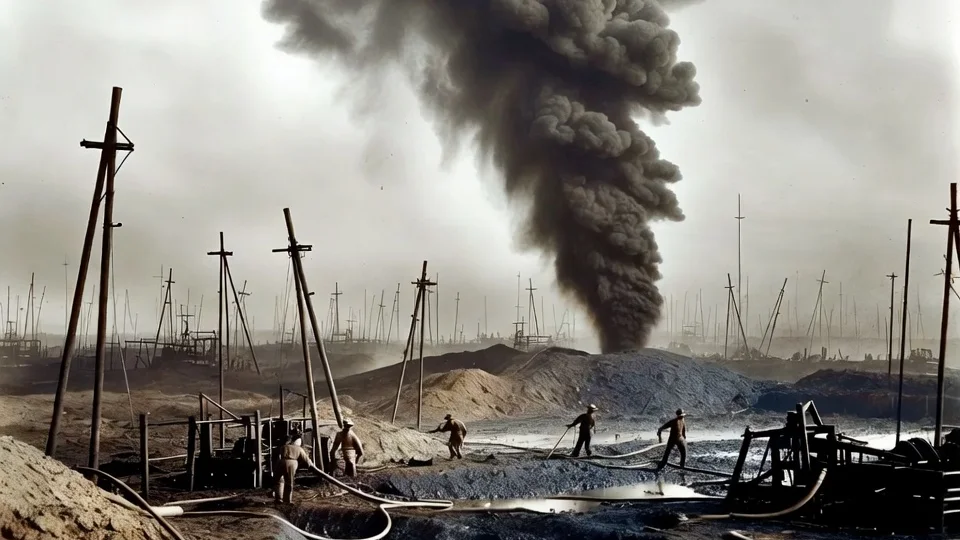
First came a geyser of thick, cold mud, followed by a hiss of heavy sulfur gas that turned the morning air green. Then came the roar. Folks living miles away in Beaumont said it sounded like six locomotives charging side by side. Out from the wellhead shot a solid pillar of black crude, climbing more than one hundred and fifty feet into the sky, towering over the broken timber of the derrick.
The Lucas Gusher was running wild, throwing an estimated one hundred thousand barrels of oil into the air every twenty-four hours. Back then, a good well in Ohio or Pennsylvania was lucky to pump fifty or a hundred barrels a day. This single tear in the Texas grass was producing more oil than every other well in the United States put together. For nine straight days, the geyser rained green-black droplets over the countryside. The crew and local farmers, terrified that a stray spark from a passing train or a cookstove would set the whole county on fire, worked through the night with horse teams and plows, raising earthen levees to trap a vast, shining lake of petroleum. Finally, the Hamill brothers dragged a heavy iron valve assembly across the roaring wellhead and bolted it down, giving birth to what drillers still call the Christmas tree.
Swindletop, Slickers, and the Muddy Tribe
You cannot crack the earth open like that without shaking up humanity, too. Word of the strike traveled through the telegraph wires like wildfire through dry prairie grass. Beaumont went from a drowsy lumber and rice town of nine thousand souls to a swarming hive of fifty thousand in a matter of months. Every train brought lawyers, wildcatters, bankers, gamblers, and smooth-talking con artists looking to buy a square foot of mud or sell shares in holes that did not exist. Folks started calling the place Swindletop because a fool and his money parted ways before he even stepped off the depot platform.
Boarding houses rented beds in eight-hour shifts. Men slept in barbershop chairs, on billiard tables, or straight out on the muddy pine boards of the sidewalk wrapped in oilcloth. A glass of clean drinking water could cost more than a barrel of crude. Derricks went up so close together on Big Hill that their wooden legs touched, and drillers could lean out and shake hands with the crew next door. By late 1902, more than five hundred corporate charters were flying around Beaumont, and close to three hundred wells were stabbing down into the very same salt dome.
Most of those paper companies evaporated like morning dew, but out of that chaos grew giants that fed the working class for generations. The Texas Company got its footing in Beaumont mud and became Texaco. Guffey's operation grew into Gulf Oil. Down the road, the Humble field took the lessons of Spindletop and birthed the company that would one day be Exxon. Texas antitrust laws kept the Standard Oil monopoly from swallowing up the hill, which left room for our own folks to build something lasting. It was an unruly tribe of dreamers, but they looked after each other when rigs caught fire and blowouts threatened to take whole crews under.
From Coal Dust to Black Gold
Nature has a way of teaching us humility, sugar. When you drill that many holes into a single reservoir, the pressure drops just as fast as it rose. Spindletop pumped over seventeen million barrels in 1902, but by 1904 the wells were coughing up saltwater. The market drowned in so much oil that the price plummeted from two dollars a barrel down to twenty-five cents, and sometimes even three cents a barrel. You could buy three barrels of petroleum for the price of one glass of sweet tea.
That collapse in price turned out to be the exact gift the world needed. Up until Spindletop, oil was primarily refined into kerosene for lamps, while the engines of industry choked along on heavy black coal. But when cheap, liquid fuel suddenly flooded the Gulf Coast, everything shifted. The railroads converted their steam engines from coal to oil. Steamships threw out their shovels and converted their boilers. When Henry Ford started rolling the Model T off the assembly lines, he did not have to worry about how ordinary folks would fuel their weekend drives. The cheap juice was already waiting at the curb, brought to the surface by rotary rigs on the Texas coast.
Wildcatters took the lessons learned at Big Hill and started chasing salt domes all across the coastal prairie, striking deep at Sour Lake, Batson, Humble, and Goose Creek. Refineries sprouted along the Sabine-Neches waterway, pipelines were laid down like arteries across the coastal grass, and southeast Texas became the beating heart of world energy.
Whenever I stand out in the yard and feel the warmth rising from the ground, I think about Pattillo Higgins taking his Sunday school picnic out to a sulfur spring that everybody else laughed off. I think about the Hamill boys, soaked to the skin in mud and crude, bolting down a valve in the dark while the sky rained black gold. History isn't just dates carved on a granite marker, darlin'. It is the courage to trust your own instincts, the grit to keep drilling when the hole collapses, and the generosity to build something that keeps the home fires burning for everyone who comes after.
Hook 'Em forever, y'all.