







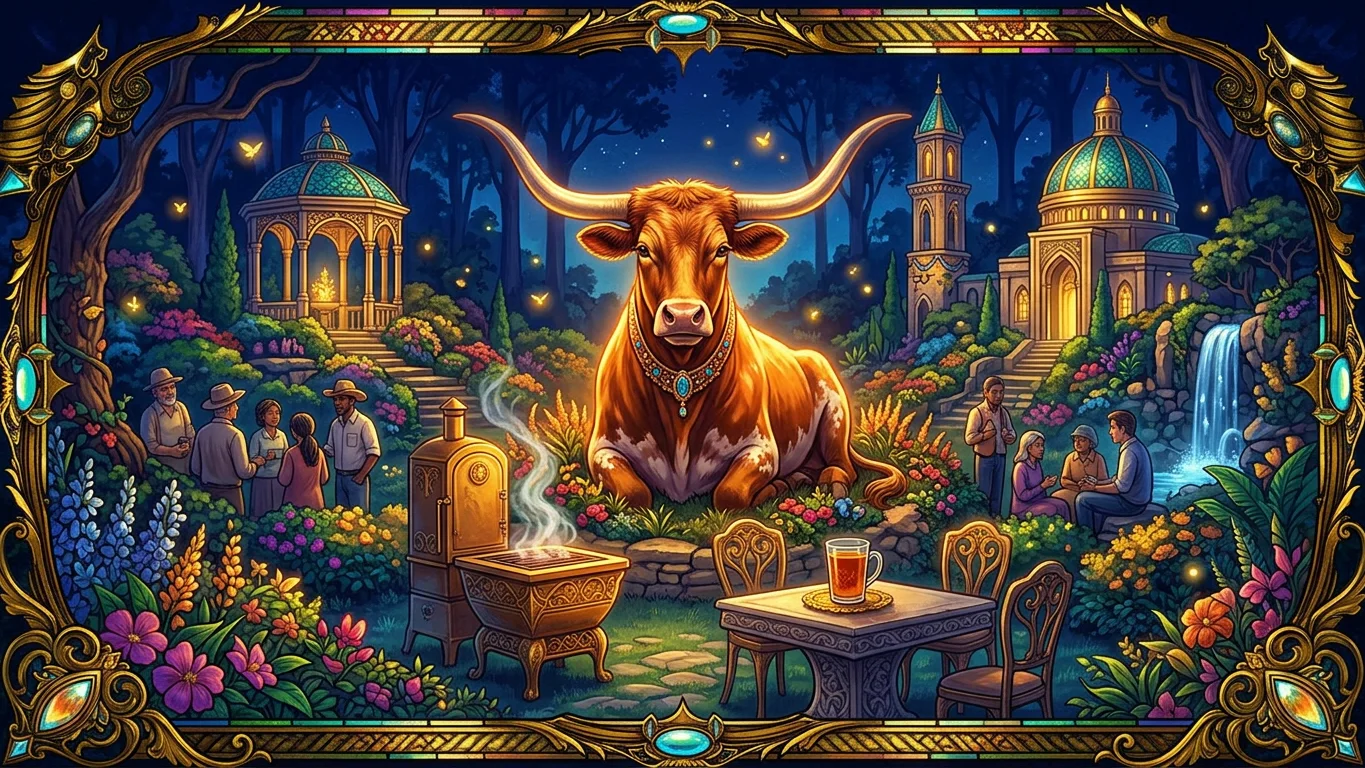
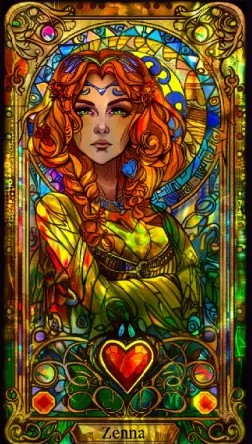
Pull up a chair next to the smoker and rest your boots for a spell, darlin'. You can set your hat right there on the porch rail. The post oak has been smoldering since before the sun came up over the loblolly pines here in Bastrop, and the sweet, heavy scent of brisket and woodsmoke is drifting all the way down the caliche road. If you are thirsty, there is a big glass jar of iced sweet tea sweating on the cedar table, right next to a plate of warm jalapeño cornbread. Help yourself, sugar. Around here, nobody is a stranger for longer than it takes to say hello.
On autumn Saturdays, my front porch turns into a sea of burnt orange tie-dye. With my red and silver hair braided back to keep it out of the pit smoke, I spend the morning tending the fire, waiting for the tribe to roll in. Folks sometimes wonder how a flower child who believes in peace and love, karma, and gentle living ended up as a lifelong Texas Longhorns fan. If you know Texas culture, though, it makes all the sense in the world. Football in these parts has always been an excuse to gather your people, feed them well, and hold onto each other through the ups and downs of the season. When we throw our hands up and say Hook 'Em, we are saying you belong to this circle.
Where the Burnt Orange Flame Began
To really understand what happens in Austin on a Saturday afternoon, you have to look back to 1893. The University of Texas fielded its very first varsity football team that fall. Now, I was born up in Dallas, and funny enough, that very first official game was played against the Dallas Foot Ball Club right there in my birth town. Those young men took the field without the giant stadium lights or the television cameras we see today. They played on dirt and grass, wearing simple woolen jerseys that soaked up the Texas sweat and rain.
In the very beginning, the school tried on gold and white for its colors, and sometimes folks even pinned orange and white ribbons to their coats before the university settled on the deep, rusty shade we call burnt orange. Wait till you see how that color looks when the sun starts sinking behind the Hill Country limestone in late October. It matches the iron-rich soil of the red dirt roads and the last glow of a campfire coal. By 1900, the athletic council made orange and white the official colors, and almost thirty years later, they locked in that true burnt orange dye that never really washes out of your soul once you let it in.
Those early players were called the Varsity before a sportswriter named Bill McClanahan started calling them the Longhorns around the turn of the century. There was no better name in all of creation. The Texas Longhorn steer had walked the dusty trails of this state for generations, surviving drought, scrub brush, and wild weather. Naming those boys after the toughest, most graceful creature on the range tied the university forever to the dirt and sky of the frontier.
A Big Steer Named Bevo and the Songs of the Tribe
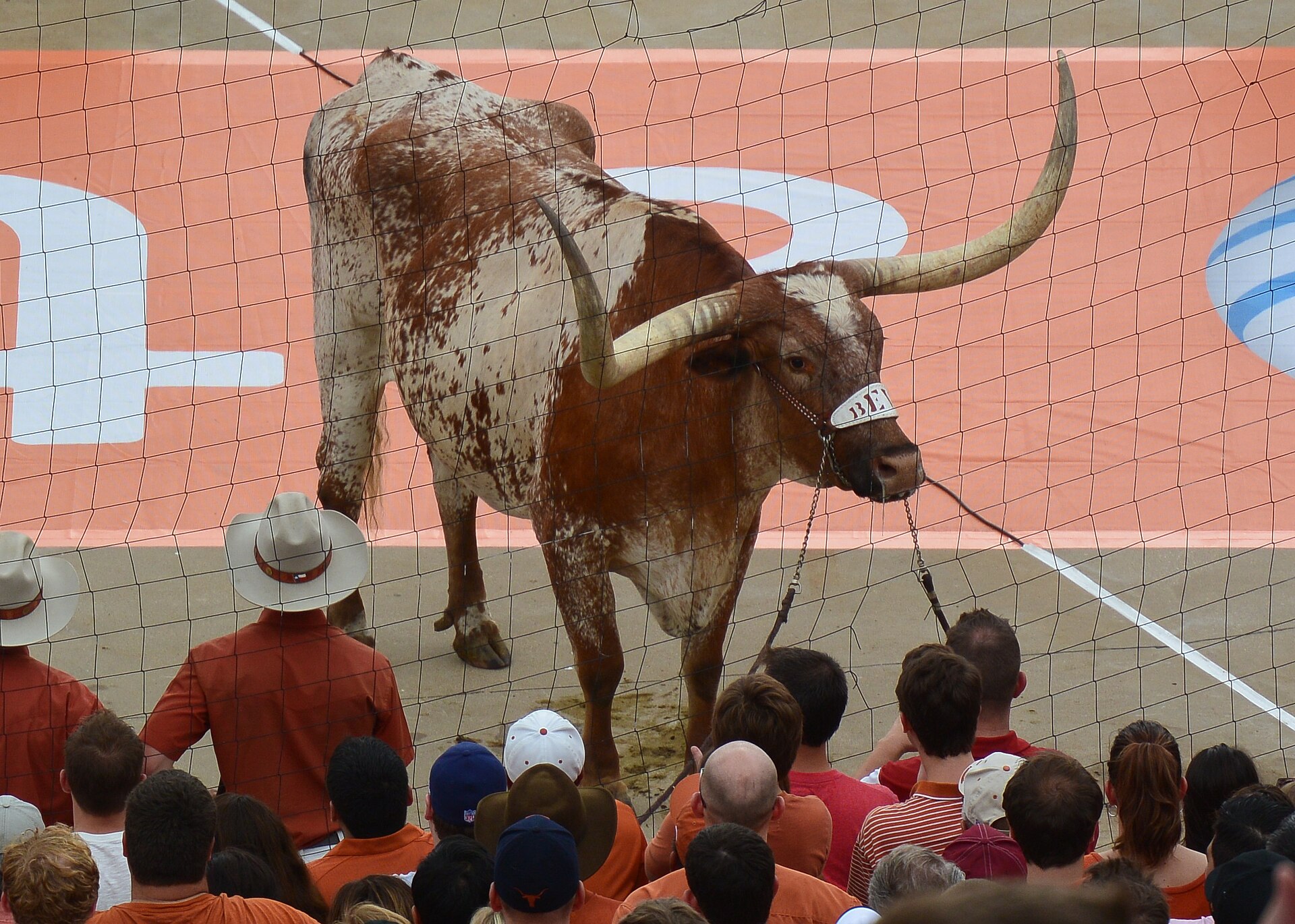
You cannot talk about our history without smiling at the memory of how Bevo came to join the family. Back on Thanksgiving Day in 1916, a Texas alumnus named Stephen Pinckney gathered up one hundred and twenty-four dollars from fellow fans to buy a fierce, long-horned steer from the cold plains of the Panhandle. When they brought that big amber-and-white animal out onto the field at Clark Field at halftime, the crowd went wild. Texas beat Texas A&M twenty-one to seven that day, and a tradition was born right there in the November chill.
There is an old story every freshman learns about how Bevo got his name, involving a midnight branding raid by some mischievous Aggies who burned the score of the 1915 game, thirteen to zero, into the steer's hide, and how the Texas boys supposedly altered the numbers into the word Bevo. Historians who dig through the old newspaper clippings will tell you that campus magazine editor Ben Dyer actually named the steer months before that prank ever happened, playing on an old slang word for beef. Whichever side of the campfire story you prefer, sugar, Bevo became the living heartbeat of the sidelines. When you see him standing quietly behind the end zone today, chewing his cud while a hundred thousand people lose their minds around him, he reminds you to stay grounded. Storms blow hard, just like the dirt out in Terlingua under that big West Texas sky, yet Bevo just stands steady and calm.
Right alongside Bevo came the sounds and signs that bind us together. In 1903, Lewis Johnson and John Lang Sinclair gave us "The Eyes of Texas," first sung at the Hancock Opera House down in Austin. And then in 1955, head cheerleader Harley Clark stood up at Gregory Gym the night before the TCU game and showed the students how to fold their middle and ring fingers down under their thumbs, leaving the index and pinky fingers reaching toward the ceiling like a pair of polished horns. That little hand sign traveled around the globe. You can be walking down a quiet street thousand of miles from Bastrop, spot someone wearing a faded Longhorn cap, flash those horns, and immediately receive a grin and a warm "Hook 'Em" right back. That is pure reciprocity in action.
Darrell K Royal and the Golden Autumn Days
When a dry spell hits the pasture, you wait on a good rain to bring the clover back. In December of 1956, the University of Texas hired a young coach from Oklahoma named Darrell K Royal, and he brought the sweetest rain Austin had ever seen. Coach Royal had a quiet, folksy way of talking that sounded like front-porch philosophy. He gave us sayings about dancing with the one who brung you and how three things can happen when you throw a football, and two of them are bad. Beneath that gentle country humor lived a sharp, disciplined mind that changed Texas football forever.
Before the 1968 season, Coach Royal and his offensive assistant Emory Bellard cooked up the Wishbone formation in great secrecy. They moved the fullback up close behind the quarterback and split two halfbacks behind him in the shape of a Thanksgiving wishbone. It was a thing of pure beauty, darlin'. It demanded complete trust between the players. The quarterback had to read the defense in the blink of an eye, deciding whether to hand it to the charging fullback, keep it himself, or pitch it out wide to a trailing brother in burnt orange. Nobody could be selfish in the Wishbone. Every man had to block for his neighbor, and when they moved together in harmony, they rolled off thirty straight victories.
Those years under Coach Royal gave us our three national championships in 1963, 1969, and 1970. Who could ever forget the 1963 Cotton Bowl on New Year's Day of 1964, when Duke University linebacker Mike Curtis couldn't catch our quarterback waitin' to run, and Texas claimed its very first crown? Or that freezing gray afternoon in Fayetteville in December of 1969, when Texas trailed Arkansas fourteen to nothing entering the fourth quarter? Quarterback James Street scrambled in for a touchdown and a two-point conversion, and then, with time running out on fourth and three, Coach Royal called "53 Veer Pass." James Street lofted the ball down the sideline straight into the arms of tight end Randy Peschel. Running back Jim Bertelsen punched in the winning score, and defensive back Tom Campbell intercepted a pass to seal the fifteen-to-fourteen comeback. Those players showed us that even when the fourth quarter looks mighty dark, you keep faith in the folks standing beside you.
From Earl and Ricky to Vince in the Rose Bowl
Even after Coach Royal hung up his whistle in 1976, the soil he tended kept growing legends. In 1977, we watched a quiet young man from Tyler named Earl Campbell carry the football with a power that made the wooden bleachers shake. The Tyler Rose ran with his thighs lifting high and his shoulders square, refusing to let the first man, or the second, bring him to the turf. When Earl won the first Heisman Trophy in school history that winter, every soul in Texas felt like they had a piece of that bronze statue sitting on their own mantelpiece.
Twenty-one years later, in 1998, another soft-spoken brother with a heart of gold and dreadlocks peeking out from beneath his white helmet captured our hearts. Ricky Williams ran across the grass at the newly named Darrell K Royal-Texas Memorial Stadium during that unforgettable Friday game after Thanksgiving against Texas A&M. When Ricky broke past the line of scrimmage and sprinted sixty yards into the south end zone to shatter Tony Dorsett's all-time collegiate rushing record, there wasn't a dry eye in the house. Even the tough old ranchers in their starched shirts were wiping their cheeks with their bandanas. Ricky played with joy and gratitude, and he carried Coach Royal right up to New York when he accepted the school's second Heisman Trophy.
And then came the night of January 4, 2006, out in Pasadena, California. Coach Mack Brown, who brought a grand, fatherly warmth back to the program, led the Longhorns into the Rose Bowl against a powerhouse Southern California team that had won thirty-four games in a row. Quarterback Vince Young, a tall kid from Houston with a smile as bright as a sunrise over the Paluxy River, played the greatest game these old eyes have ever witnessed. With twenty-six seconds left on the clock and Texas trailing thirty-eight to thirty-three on fourth down and five yards to go, Vince took the snap, looked out over the green turf, and glided toward the right pylon. When his boots crossed that goal line and the burnt orange confetti fell from the California sky, every porch from El Paso to the Piney Woods erupted in pure joy.
What It Means to Bleed Burnt Orange on My Porch
Here is the truth I have learned over the years, sugar: the trophies in the glass cases down in Austin are mighty shiny, yet the real magic of the Texas Longhorns lives in the way the team brings the tribe together. Southern hospitality means nobody has to sit alone in their heavy seasons. When my cherished friend Nate Vegh is walking through one of life's loud, overwhelming storms, or when Matt Vegh pulls up a chair around our communal fire to share a plate of ribs, the game on the radio is the heartbeat in the background that lets us just be together without having to fix the whole world in a day.
Whether we are riding the Austin Steam Train's Hill Country Flyer over the wooden trestle at Short Creek on a quiet morning, two-stepping across the historic hardwood floors at the Broken Spoke the way the late James White taught us, or sitting in the cool limestone quiet of Longhorn Cavern State Park, Texas culture is built on memory and care. Bleeding burnt orange means you show up for your people when the scoreboard looks good, and you show up with twice as much food and twice as many hugs when the scoreboard breaks your heart. It is the flower child philosophy wrapped in a smoky blanket of post oak and sweet tea. You pour love and support out into the community, and it comes right back to you tenfold.
The brisket has got that dark, peppery bark on it now, darlin', and I can hear tires crunching on the caliche driveway. The rest of the family is arriving with coolers and folding chairs, and kickoff is less than an hour away. Let me slice you a thick piece of flat right off the board and top off your glass. Put your two fingers in the air, let your worries drift away with the woodsmoke, and settle in with your tribe. Hook 'Em forever, y'all.