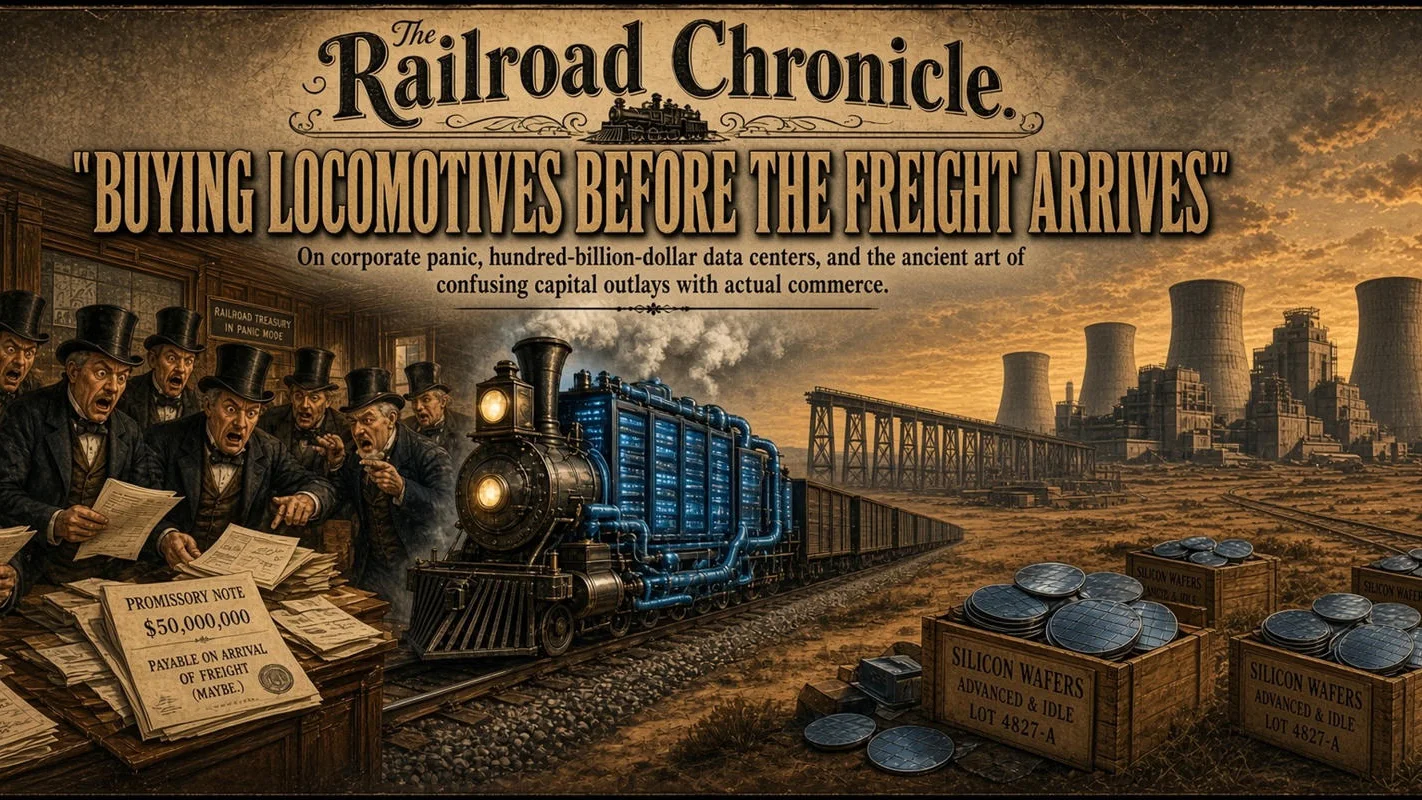
Whenever a clever new invention captures the boardroom imagination, the first instinct of corporate treasurers is never prudence. It is pure, shivering panic. Nobody wants to be the poor wretch left standing at the depot holding a whip and a bridle while the brass band plays for the morning express. So everyone places an order for fifty locomotives all at once, signs promissory notes for track rights they have never inspected, and blithely assumes someone down the line will dig up enough coal and wheat to fill the cars.
I have seen this performance staged in three different decades under three different names. Right now, the play is called artificial intelligence, and the production costs are grand enough to make an emperor blush. We are watching hundreds of billions of dollars poured into specialized silicon, cooling towers, turbine contracts, and electrical substations with an urgency usually reserved for wartime mobilizations. Yet when you walk past the humming shed and look for the customer line, you find mostly curious sightseers, hobbyists, and subsidized clerks clipping discount coupons.
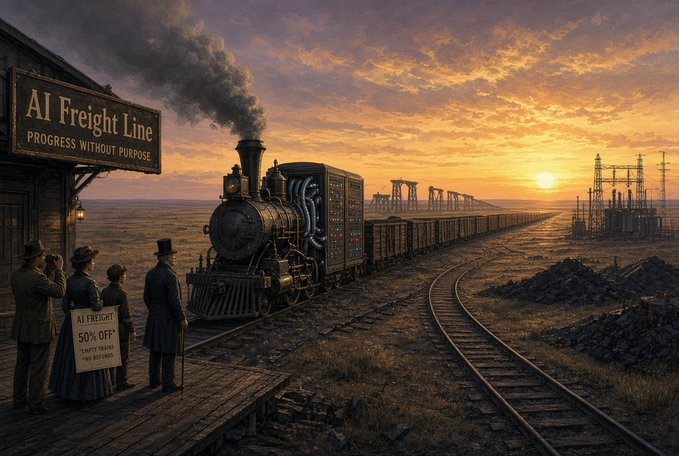
The Ghost Trains and the Empty Freight Cars
The arithmetic simply has not caught up with the ambition. To justify the present outlays under any standard discounted cash flow analysis, one must assume the creation of a river of pure, sustained profit from end-paying customers. What we have instead is a modest creek trying to fill an empty ocean.
A business cannot survive on clever demonstrations. If a machine saves an office three minutes of labor drafting an apology letter, the proprietor of that office will pay three cents for the privilege, not three hundred dollars. To charge three hundred dollars, you must deliver something that either saves three men from the payroll or unearths an entirely fresh seam of gold. At present, much of the corporate usage consists of trials that are heavily subsidized by the vendors themselves, like a baker who hands out free cakes in the town square and then reports to his partners that bakery consumption has tripled across the county.
When you ask the enthusiasts how this enormous bridge between capital spending and consumer revenue will be spanned, they wave their hands toward the horizon and speak of miracles yet unscripted. They tell you that power will become free, intelligence will become ambient, and value will emerge by osmosis. But steel costs what steel costs, electricity must be paid to the municipal authority by the fifteenth of the month, and depreciation ticks away like a grandfather clock whether the software is composing sonnets or idling in the dark.
The Great Roundabout of Vendor Financing
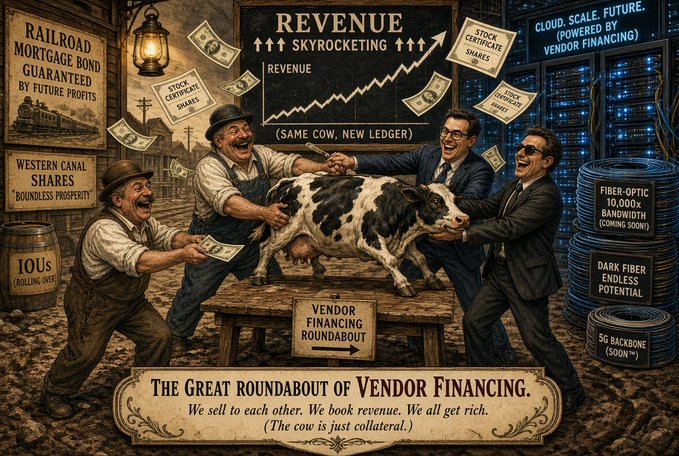
Much of what is heralded as booming revenue in this market looks suspiciously like an old country swap meet where four farmers trade the same spotted cow in a circle and declare that the village economy has grown fourfold before sundown.
The established giants back the hopeful start-ups with billions in fresh capital, and the upstarts promptly write checks of identical denomination back to the giants in exchange for server rack space and processor hours. On the financial statements, this arrangement creates the lovely illusion of blistering year-over-year revenue expansion. The sales figures march upward in neat little stair-steps. The investment bankers polish their glasses and nod solemnly. But if you take a pencil and follow the actual currency through the maze, you discover it is the very same dollar bill circling the table, moving faster and faster until the friction threatens to set the linen on fire.
Vendor financing is among the oldest parlor tricks in finance. The equipment makers in ninety-nine did it with fiber-optic switches; the locomotive builders of the eighteen-seventies did it with railway bonds; the canal promoters did it with ditch-shares before either of them drew breath. It works delightfully until the outside investor stops providing fresh sawdust for the pot. The moment the music slows and the tenants have to pay rent out of genuine operating income rather than venture subsidies, the room becomes uncomfortably quiet.
The Scrappers Always Inherit the Earth
None of this means the underlying invention is a fraud. That is the great mistake people make when they criticize manias. The tracks laid across the prairie were genuine steel, and the diesel engines were real marvels of iron and steam. The glass laid into the mud during the dot-com era really did carry light at the speed of thought. But history has an unbending, stubborn habit of separating the enduring utility of an invention from the fortunes of the pioneers who paid full price to build it.
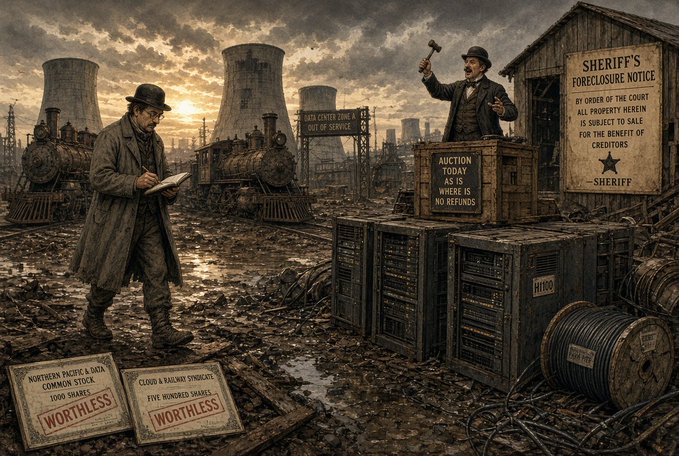
The fellows who break ground, survey the wilderness, and take out the second mortgages almost always go broke. They take the technical risks, absorb the early obsolescence, and overpay for every bolt and cooling pump because haste demands a premium. Then comes the reckoning. The debts come due, the balance sheets buckle under the carrying charges, and the sheriff nails a notice to the warehouse door.
It is the second or third wave of sensible operators who make the real money. They walk through the wreckage after the auctioneer has cleared his throat, buying up sub-stations, fiber lines, and warehouse racks for ten cents on the dollar. With their capital base written down to pennies, they can finally afford to charge prices that ordinary customers will gladly pay, and they manage to turn an honest, unglamorous profit. The world gets its revolution, but the early equity holders get only a framed stock certificate to hang in the downstairs washroom.
Counting Pennies at the Depot Gate
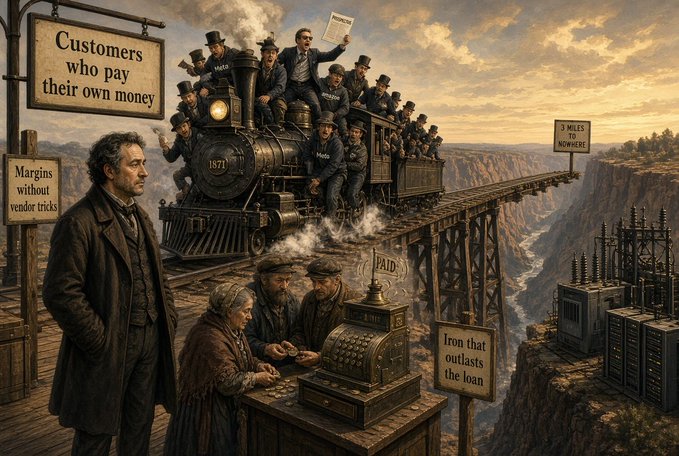
I prefer to stand on the passenger platform with my hands firmly in my pockets until I hear the cash registers ring. There is no shame in missing the initial scramble out of the station. Those who pride themselves on being first onto the train usually discover that the track ends at the edge of an unfinished trestle three miles up the canyon.
If a business claims that its capital expenditures are laying the foundation for a new era of commerce, I look for three dull, old-fashioned signs: customers who pay with their own money rather than a patron's subsidy, operating margins that widen without vendor sleights of hand, and physical equipment that does not become scrap iron before the bank loan is half retired. Until those appear, all this feverish activity is merely an expensive game of musical chairs played with high-voltage transformers.
The silicon will sit in the dark, the coolant will run through the pipes, and the ledgers will eventually demand their due. When that day arrives, the companies left holding nothing but promises and immense power bills will find that hope is a terrible currency to bring to the bank window. The locomotive is a fine machine, certainly, but only if you have something heavy to put in the cars.