
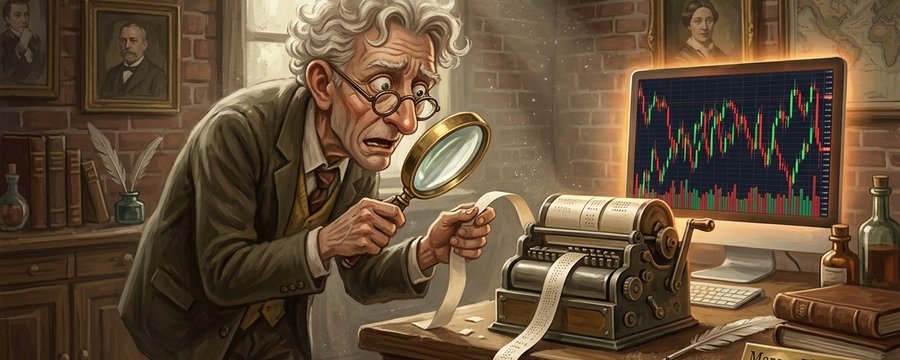
I have lived long enough to see the same ghost dressed in a dozen different bedsheets. In the late nineties, it was the magic of technical analysis software that promised to turn every suburban father into a titan of the trading floor. Before that, it was the secret formulas of the junk bond kings. Today, the ghost wears a silicon mask and calls itself an AI trading agent. The pitch is always the same: a secret edge, a digital crystal ball that lets you see the future five minutes before your neighbor does.
But there is a fundamental law of the market that no amount of processing power can override: an edge that everyone possesses is no edge at all. When the man on the street, the clerk at the grocery, and the institutional shark are all using the same large language models to scrape the same on-chain data, the result is not a market of geniuses. It is a room full of people reading from the exact same script, all waiting for the same cue to jump.
The Hall of Mirrors and Alpha Compression
In the old world, 'alpha' was the reward for knowing something others didn't, or for having the stomach to wait when others panicked. It was a lonely pursuit. Today, the pursuit is crowded. If ten thousand bots are all programmed to recognize the same liquidity shift or the same flicker of sentiment on a social media feed, the 'edge' does not just shrink. It evaporates before the trade even clears the mempool.
This leads to what I have often called alpha compression. The window of opportunity, once wide enough to drive a truck through, has narrowed to the width of a razor blade. These AI agents do not create value; they merely accelerate the stampede. They find a signal, and because they are all looking at the same data through the same algorithmic lens, they pounce simultaneously. They are not discovering hidden gems; they are fighting over the same copper penny until the friction of the trade costs more than the profit itself.
The trouble with a universal map is that it leads everyone to the same creek at the same time. By the time you arrive, the water is muddy and the gold is gone.
The Mirage of On-Chain Certainty
The advocates of these silicon advisors love to talk about on-chain data as if it were the holy grail of transparency. They believe that by counting every transaction and tracking every whale's wallet, they can decode the heartbeat of the market. But a machine can count the grains of sand on a beach without ever understanding the tides. In Digitally Deluded, I argued that the 'what' of a transaction is often a distraction from the 'why.'
An AI can tell you that a million tokens moved from one wallet to another. It cannot tell you if that move was driven by a genuine shift in utility, a back-room deal, or a simple case of fat-fingered vanity. When trading agents react purely to these digital breadcrumbs, they reinforce a cycle of mean-reversion. They buy because the data says others are buying, and they sell because the data says the momentum has stalled. They are not investing; they are participating in a high-speed game of musical chairs where the music is being played by the same conductor.
The Violence of the Exit
Perhaps the most dangerous aspect of this automated consensus is the exit. When a market is built on crowded trades—where everyone entered for the same reasons provided by the same AI—the exit becomes a narrow door in a smoke-filled room. At the first sign of a genuine price dislocation, every bot receives the same 'sell' signal at the same millisecond.
- The liquidity vanishes as everyone tries to sell at once.
- Volatility spikes to levels that traditional metrics cannot account for.
- The retail trader, thinking they have a 'super-intelligent' ally, finds themselves at the bottom of the pile.
The Value of the Un-Scrappable
True value is messy. It is found in the things that happen off the ledger—in the tangible utility of a product, the actual cash flow of a business, and the human decisions that no scraper can fully digest. If you want to keep your shirt on your back in this winter, you must look where the bots aren't looking. You must seek the un-scrappable realities of the world.
A machine can process a billion lines of code, but it will never understand the scent of a bubble or the weight of a bad reputation until it is too late. Sustainable success isn't about having the fastest bot; it's about having the sense to realize that when everyone is looking for an edge in the same digital haystack, the only thing being manufactured is more hay. Put down the crystal ball, step out of the stampede, and look for the ground that doesn't move when the algorithms start to scream.