
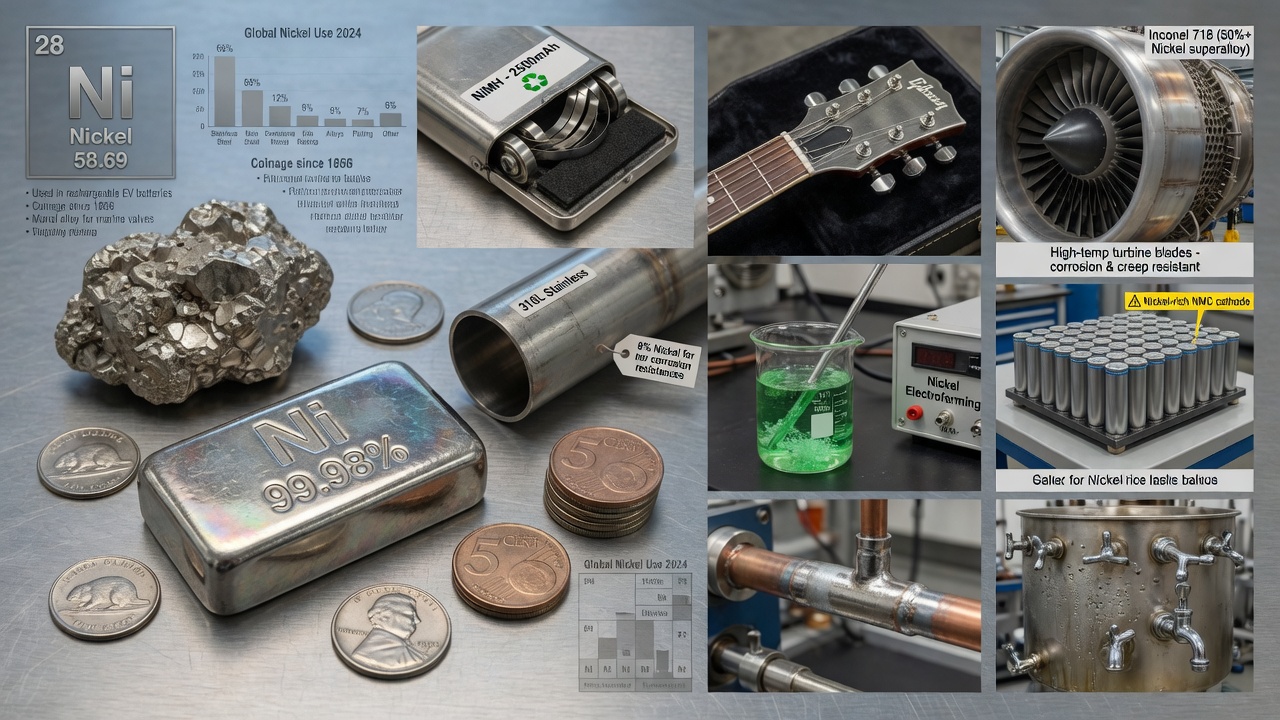
Now, pull up a stump and let me tell you about a metal that’s spent three centuries movin' from the scrap heap to the center of the world stage. Back in the day, German miners used to pull up this shiny, silvery-white ore that looked like copper but wouldn’t behave for the life of 'em. They called it Kupfernickel: the "devil's copper". They thought it was cursed. In 1751, a fella named Axel Fredrik Cronstedt finally figured out it wasn’t copper at all, but a whole new element. He shortened the name to Nickel (chemical symbol Ni), and for a long time, we used it for little more than keepin' our coins shiny and our steel from rustin'.
But today? That "cursed" metal is the crown jewel of the energy transition. If you’re lookin' to pack enough punch into a battery to drive a truck from Elko to Reno without stoppin' for a charge, you need nickel. It’s the king of energy density. While most folks are talkin' about lithium, it’s nickel that’s doin' the heavy liftin' under the hood. It’s tough, it handles the heat, and it’s become one of the most strategic pieces on the global chessboard.
The Global Kitchen: Who’s Cookin' the Ore?
Most of the nickel in the world comes from two kinds of dirt: sulfide ores and laterites. Sulfides are the easy stuff with the kind of lodes miners dream of, but they’re gettin' harder to find. Laterites are more common but a real bear to process. You’ve got to use somethin' called High-Pressure Acid Leaching (HPAL), which is basically a giant, high-tech pressure cooker that uses acid and heat to pull the metal out of the ground. It’s expensive, messy, and energy-hungry.
When it comes to pullin' this stuff out of the ground, three players own the field: Indonesia, the Philippines, and Russia. Indonesia is the undisputed heavyweight, accountin' for nearly half of the world's production. They’ve played a smart hand, too, bannin' the export of raw ore to force companies to build refineries, or what I call the "kitchens", right on their own soil. You’ve got giants like Vale, Glencore, and Tsingshan runnin' the show. Tsingshan, in particular, turned the market on its head by figurin' out how to turn low-grade nickel pig iron into battery-grade matte. It was a game-changer that kept the supply flowin', but it’s left the West lookin' over the fence at a party we weren’t invited to.
Supply and Demand: The 2026 Crunch
By 2026, the nickel market is lookin' tighter than a new pair of leather boots. We’re lookin' at a global demand forecast of roughly 3.5 million tonnes. For decades, about 70% of nickel went into stainless steel, but that’s shiftin' fast. The battery sector is growin' at a clip of 20% to 30% a year. If you want a high-performance EV with a long range, you’re lookin' at an NCM (Nickel-Cobalt-Manganese) or NCA (Nickel-Cobalt-Aluminum) chemistry. In those batteries, nickel is the star of the show. Over the next ten years, we’re goin' to need to find and permit more nickel mines than we’ve built in the last fifty just to keep pace with the automakers' promises.
The American Shore: A Lone Sentry in Michigan
Now, let’s talk about home. The U.S. situation is enough to make a prospector spit. We have exactly one primary nickel mine runnin' right now: the Eagle Mine in Michigan’s Upper Peninsula. It’s a high-grade sulfide operation, and the folks there do a hell of a job, but here’s the kicker: it’s slated to run out of ore in the next few years. When Eagle closes its gates, we’re lookin' at zero primary production on U.S. soil.
We’ve got folks like Talon Metals tryin' to get the Tamarack project movin' in Minnesota. They’ve even got a deal with Tesla to supply 'em. But they’re stuck in the same "permit circus" that’s killin' domestic minin' everywhere else. Between the lawsuits, the decade-long environmental reviews, and the red tape, we’re practically beggin' our adversaries to keep sellin' us the metal we need for our own national security. Our current "strategy" seems to be a mix of small grants and hopin' our allies in Canada and Australia can bail us out. That's "friend-shoring," and it's better than nothin', but it ain't self-sufficiency.
"Having the metal in your backyard don't mean a lick if you’ve forgotten how to cook it down to somethin' useful, or if you're too scared to stick a shovel in the ground."
Substitutes, Scraps, and the Road Ahead
Folks always ask me, "Hale, what happens if we run out?" Well, we won't run out of rocks, but we might run out of cheap options. If nickel stays too expensive or too hard to get, the industry shifts to LFP (Lithium Iron Phosphate) batteries. China loves 'em. They’re cheaper and they don’t use any nickel or cobalt. But there’s a trade-off: like swappin' a thoroughbred for a mule. You’ll get where you’re goin', but you won't get there fast, and you won't go as far on a single charge. For the heavy-duty trucks and long-haul trips we favor in the West, LFP just doesn't quite cut the mustard yet.
Then there’s recycling. Nickel is nearly 100% recyclable without losin' its quality. Right now, about 35% of the global supply comes from recycled scrap, mostly from the stainless steel industry. That’s a good start, but because most EV batteries are still in cars on the road, we don’t have a steady stream of "dead" batteries to feed the furnaces yet. It’ll be another decade or two before recycling can really dent the need for new mines.
The Bottom Line
Nickel is strategic because you can't have a modern military or a green economy without it. It’s in the turbines of jet engines, the hulls of our ships, and the batteries in our pockets. If we don’t get serious about domestic exploration and buildin' our own "kitchens" to process the ore, we’re just hirin' the wolf to guard the henhouse. We’ve got the geology, and we’ve got the grit. Now we just need the common sense to let miners do what they do best: dig in and find the vein. If we keep ditherin', we're gonna find ourselves flyin' blind in a world that’s movin' faster than we are.