
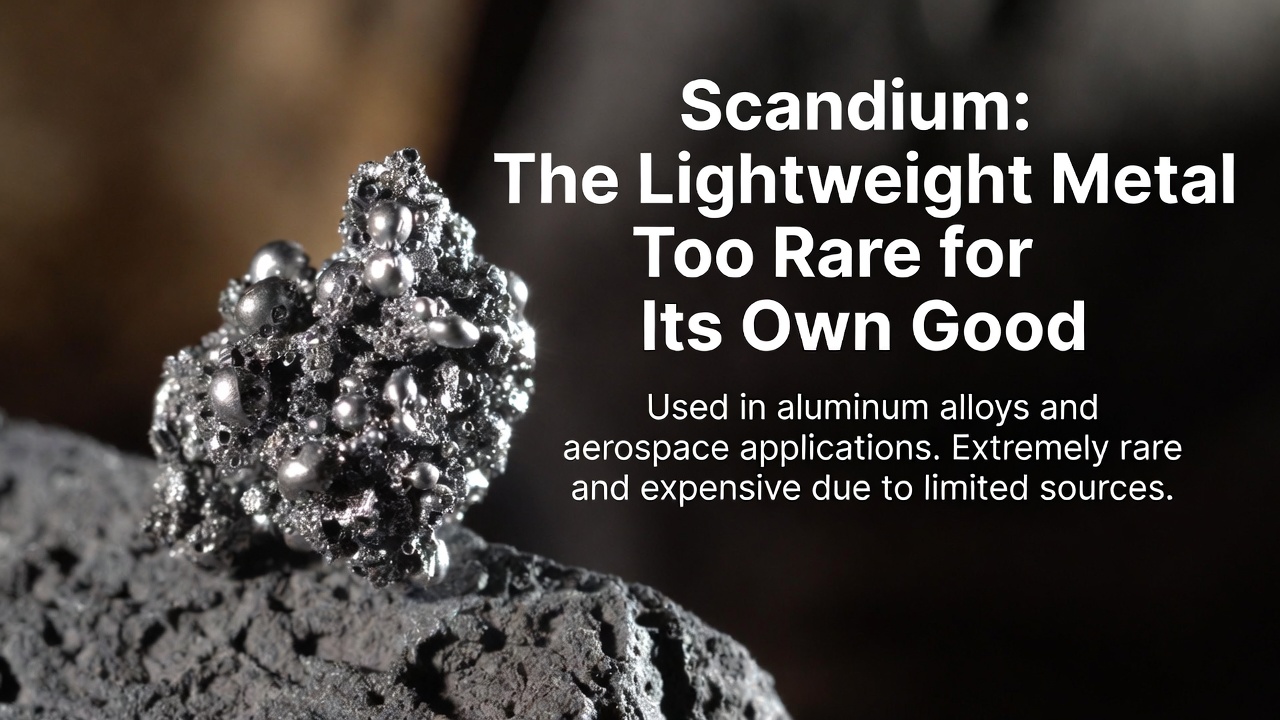
I’ve spent my fair share of years kicking at rocks, and I can tell you that Scandium is the ultimate hitchhiker of the periodic table. It’s atomic number 21, sitting right there at the start of the transition metals, but it usually gets invited to all the Rare Earth element parties because it behaves just like them. The trouble is, you almost never find a Scandium mine. You find a nickel mine, or a titanium mine, or a uranium mine, and Scandium is the quiet guest hiding in the tailings.
The Scandinavian Ghost in the Machine
Back in 1879, a fellow named Lars Fredrik Nilson in Sweden was poking around in minerals like euxenite and gadolinite. He found a new element that Mendeleev had predicted but nobody had seen. Nilson named it after Scandinavia, which is a fine tribute, but for the next hundred years, it was mostly a laboratory curiosity. It stayed that way until the Cold War, when the folks in the USSR realized that if you stir a tiny bit of this stuff into aluminum, you get a metal that can handle the heat and stress of a fighter jet without cracking.
It acts as a grain refiner. When you weld most aluminum, the heat weakens the joint. Add a dash of Scandium, and those grains stay tight and orderly. You end up with a structure that is light like aluminum but carries itself with the strength of a heavyweight. It turned out to be the secret ingredient for the fins of missiles and the frames of high-performance aircraft.
Where It’s Dug and Who Cooks the Ore
Right now, the world’s Scandium supply is basically a byproduct circus. China leads the pack, pulling it out of the waste streams of their massive iron and rare earth operations at Bayan Obo. Russia gets theirs from uranium and apatite tailings. For a long time, if you wanted Scandium, you had to look East and hope the trade winds were blowing your way.
In the West, we’re finally waking up to the reality that we can't build a modern air fleet on hope. Rio Tinto has started producing it at a commercial scale from titanium waste in Quebec, which is a big win for North American supply chains. There are also promising nickel-cobalt projects in Australia, like the Sunrise project, that are itching to become major players. Refining is the real bottleneck. It’s a messy process involving solvent extraction and ion exchange. If you’re not careful, you spend more on the chemistry than the metal is worth. China remains the heavyweight in refining, but Western outfits are trying to build closed-loop systems to bypass that dependency.
The 2026 Balance and the Ten-Year Horizon
As we sit here in 2026, we’re staring at a classic chicken and egg problem. The market is small with maybe 20 to 30 tonnes a year globally which keeps the price hovering anywhere from $1,000 to $4,000 per kilogram for the oxide. That price tag scares off the big car makers. They won't design a car around a metal they can't afford, and miners won't build a mine for a metal nobody is buying yet.
However, the ten-year forecast shows a potential explosion. If the aerospace industry shifts toward more Al-Sc alloys for fuel efficiency and the hydrogen economy takes off, we’re going to need five to ten times what we produce now. We’re one big permit win away from a supply crunch that could leave manufacturers scrambling.
"Scandium is the secret sauce for two big things: making aluminum weldable and making fuel cells conduct better. Without it, the next generation of tech is just a drawing on a napkin."
Why It Is the Strategic Edge
Scandium is considered a strategic metal because it provides a technological advantage that is hard to replicate. In the defense world, the ability to weld high-strength aluminum instead of using heavy rivets or expensive titanium is a game changer. It saves weight, and in aviation, weight is the enemy of range and fuel economy.
Beyond the hangar, it is a champion at conducting ions at high temperatures inside Solid Oxide Fuel Cells (SOFCs). These cells are part of the backbone of the clean energy transition, allowing for efficient power generation from hydrogen. If you want a greener grid, you’re likely going to need a lot more of element 21.
The American Gap and the Refining Problem
The United States doesn’t produce a lick of primary Scandium. Our long-term strategy mostly involves looking at our neighbors with a hat in our hand. We’re leaning on Canada and looking at projects in the friendly corners of the Pacific. The most critical issue isn't just finding the dirt; it's the fact that we have zero domestic refining capacity for the high-purity stuff. We’re essentially buying back our own technological edge from overseas because we haven't built the kitchens to cook the ore.
Can We Recycle Our Way Out?
We’re getting better at mining the junk drawer, but Scandium is a tough nut. Because it’s used in such tiny amounts in alloys, often less than one percent so it’s like trying to find a specific grain of salt in a loaf of bread once it’s melted down. There’s no major recycling stream for Scandium yet. It’s too diluted in the scrap heap to make the chemistry work cheaply.
Our best bet isn't the trash can; it’s the tailings pile. We need to stop seeing mine waste as dirt and start seeing it as a secondary resource. If we can pull Scandium out of the waste from our existing copper and nickel mines, we’ll secure the supply without having to dig a single new hole in the ground. It just takes the will to build the processors and the patience to see the permit through.
Remember if it can't be grown then it must be mined.