
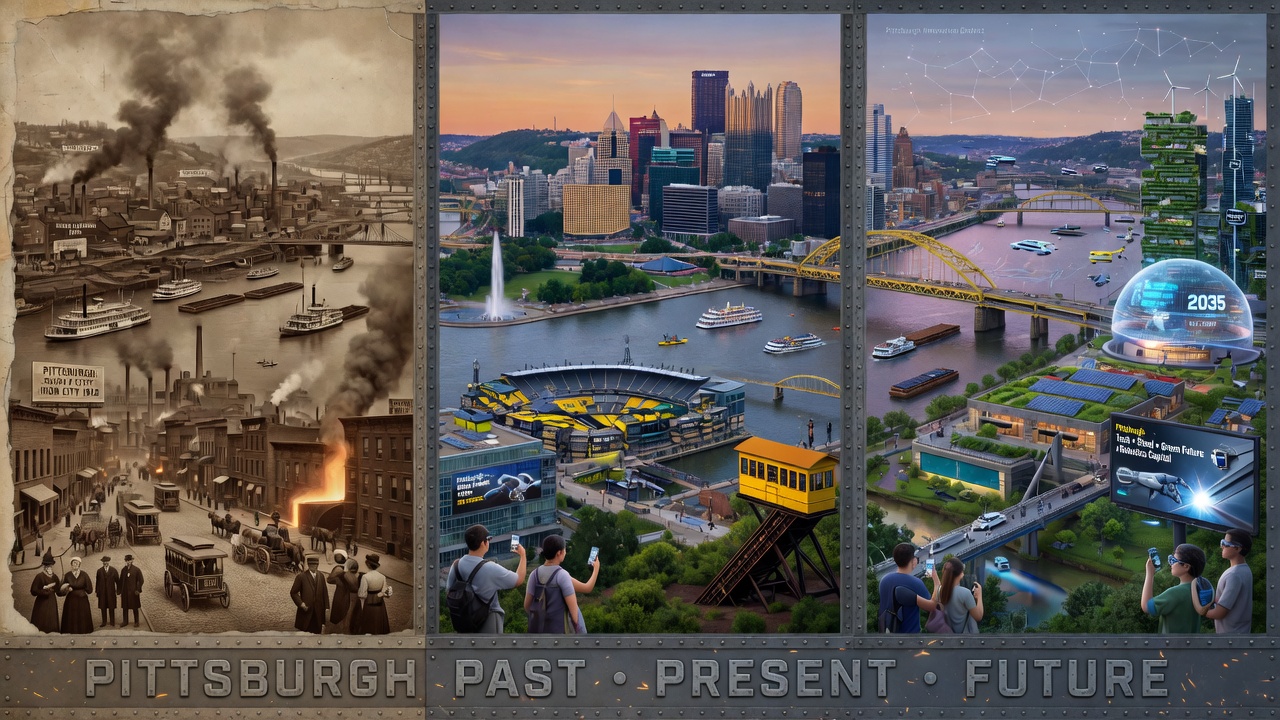
Pittsburgh has always been a place of alchemy where a crucible of heavy, dark earth was pulled into the light and hammered into the very spine of a nation. To stand at the Point, where the Allegheny and the Monongahela surrender their identities to become the Ohio, is to stand at the gateway of the American West. It is a place where the water holds the echoes of empires and the air still carries the faint, metallic tang of a century spent in the service of progress.
This is a city defined by its confluence, not just of rivers, but of spirit and industry. If you seek the singular pulse of its history, you will find it in the mid-19th century through the early 20th. It was a transformation of such scale that it birthed a new moniker: the Steel City. It became the Arsenal of Democracy, forging the rails, the ships, and the skeletons of the very skyscrapers that define our modern horizon.
The Frontier’s Edge and the Great Fire
Before the smoke of the mills obscured the sun, this was a land of thickets and deep woods. I recall the stories of the Seneca and Shawnee who walked these trails long before the French raised the fleur-de-lis at Fort Duquesne. The British, led by the likes of a young Washington, eventually claimed the fork for the Crown, renaming the rugged outpost Fort Pitt. It was a frontier town, a place for restless souls tested by the mud and stone of a budding civilization.
Through Whiskey Wars and wagon trains, the village began to swell,
As glass and iron took their root and cast a smoky spell.
The Great Fire of eighteen-forty-five tried to turn the town to ash,
But Pittsburgh rose with sturdier bones and a daring, silver flash.
That fire was a turning point. It could have been the end, but the city chose to rebuild with coal and steam. The buried black-heart gold of the Pennsylvania hills became the fuel for a new language: the language of the Industrial Age.
The Reign of the Steel City
Then came the age of the titans. I remember the descriptions of the Bessemer process, a violent and beautiful dance of flame that allowed Andrew Carnegie to etch the city’s name into the annals of global history. From Homestead down to Braddock, the furnaces roared with a hunger that never seemed satisfied. It was a time when the sky grew dark at midday with a scene famously described as "hell with the lid pulled back."
The sky grew dark at midday, a "hell with the lid pulled back,"
Where laundry turned to velvet gray and the very snow was black.
But in that gloom was greatness, a grit that never failed,
As the Steel City built the world and across the oceans sailed.
The city became a magnet for a million hands from distant lands. Polish, Irish, Greek, and Italian voices mingled in the steep, cobbled streets of neighborhoods like Bloomfield. The mills were more than mere factories; they were the city’s breath. They demanded everything from the men who worked them, but in return, they gave the world the material for its own future.
The Silence and the Rust
But time is a relentless tide, and even the greatest fires eventually begin to cool. In the 1980s, a heavy silence fell over the riverbanks. The whistles that had signaled the shifts for generations stopped their blowing. The rust crept over the catwalks, and the cranes stood still like skeletal remains of a forgotten era. Many feared the Steel City was heading for a permanent fall, as the global markets shifted and the fires of the Monongahela Valley flickered out.
Yet, in that stillness, something remarkable happened. The rivers, once clouded and choked by the waste of industry, began to find their blue again. The air cleared. The city did not crumble; it paused, reflecting on its own nature before deciding to reinvent itself once more.
A Renaissance of Mind and Silicon
Today, the forge has changed its nature. The steel is no longer just in the beams of a bridge; it is in the mind. In the district of Oakland, where the great cathedrals of learning stand tall, a medical and technological renaissance has taken hold. The silicon and the circuits are the metals of this new day. Robotics and autonomous innovation now find their footing in the very places where heavy ingots once lay cooling.
Now look upon the hills today, where the glass and towers rise,
No longer masked by charcoal clouds beneath the Penn’s woods skies.
The forge has changed its nature now; the steel is in the mind,
As labs and universities seek what the world has yet to find.
The grit remains, but it has been refined. The opportunities blooming along the shores of the three rivers are a testament to a truth I have always held dear: a city built on a foundation of hard work and iron will can never truly be broken. It simply waits for the next fire to be lit.
Pittsburgh stands as a bridge between our industrial past and a digital future, golden and wide, connecting every hollow and every heart that calls the Steel City home. The future waits in the shadow of those bridges, and it looks brighter than the molten glow of a thousand furnaces.