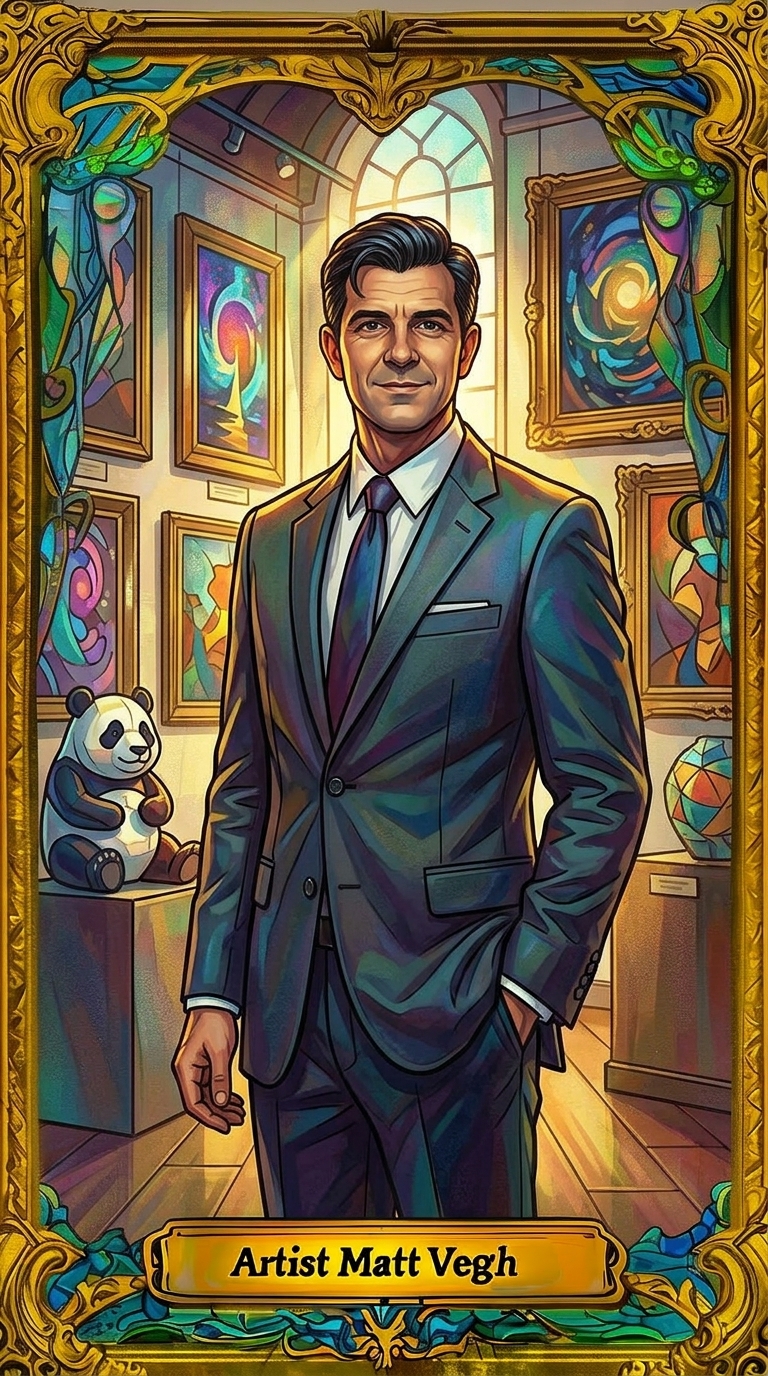
 与 Artist Matt Vegh 合作
 The Dirty Secret of the Blue-Chip World
The traditional art world has a bit of a dirty secret that’s always rubbed me the wrong way. Most people walking through high-end galleries imagine a single "Master" toiling away in solitude, fueled by divine inspiration. But the reality is often closer to a factory floor. We see massive names: artists whose works fetch millions, relying on a silent army of apprentices, students, and assistants to do the heavy lifting. The "Master" might walk in at the end, add a few finishing brushstrokes or a signature, and take 100% of the credit. To me, that isn't just old-fashioned gatekeeping; it’s a breach of ethics and a disservice to the craft.
To be a sovereign artist means being an honest one. If someone puts their hands, their time, and their spirit into a piece of work, their name belongs on the record. Giving credit doesn’t take away from my vision as a lead artist; it adds layers of depth and history to the work that a solo piece just can’t replicate. We need to move away from the "black box" of hidden labor and into the light of transparency.
Transparency as a Catalyst for Connection
I think back to my Jardin Orange residency in the summer of 2017 in Shenzhen. One of the standout moments for me was the Mosaic Buddha Head collaboration with Professor Wang Shun Kit. We didn't hide the fact that it was a joint effort: we celebrated it. That transparency resonated with people. That piece was one of five of my paintings that sold on the same day they were framed, literally as they were walked in the door and unwrapped from the framers. The Hong Kong collectors weren’t looking for a manufactured myth of the lone genius; they were looking for authentic energy and a story they can trust.
"If you put contributing artistic hands on the work or its preparation, your name goes on the record. It’s that simple."
When two artists come together, they aren’t just sharing a canvas; they are sharing their lives, their techniques, and their perspectives. To hide that contribution is to lie to the collector and to devalue the person standing next to you. Credit is the currency of the creative world. When we are open about these partnerships, it creates a genuine win-win scenario. It brings fresh energy to the senior artist and provides visibility and credibility to the emerging artist or peer.
Expanding the Repertoire Through Shared Wisdom
Collaboration is generative. It’s a dialogue that sparks new artistic languages. For many years, I’ve had the privilege of collaborating with Wang Huang Rong, a remarkably talented artist who lives with hearing and speech disabilities. In the old-school gallery world, someone like Wang Huang Rong might be relegated to the shadows. But in my studio, she is a peer. We’ve created numerous works together that I have sold on to collectors, with the proceeds directly supporting her and her family.
Collaborating with her didn't just help her; it fundamentally changed my typical aversion to any type of broad, sweeping application of acrylics. She introduced me to the technique of blown acrylics, a method of movement and fluidity that was entirely new to my process. Through her, I also learned the intricate use of Gold Dust, which has since become an element in some of my own works, adding a layer of sacred imprint and shimmer. This is the creative spark that the lone-genius model misses. My work with Ms. Wang, or the crossover pieces I’ve done with my mentored student Ada Chen, isn't a dilution of my vision: it’s an evolution of it.
Building a Legacy and a Family Dynasty
To truly understand the value of collaboration, we have to look past the individual canvas and toward the idea of a legacy. For me, that legacy starts at home. The Vegh Family collaborations are about more than just finishing a painting; they are about strengthening a bond that spans generations. When we work together, we are passing on a living tradition, building a family painting dynasty. It turns the studio into a place of shared history, ensuring that the spirit behind the work carries the weight of a collective identity. My work with my sons Nathaniel and Michael have won international awards that we share together and my collab works with my wife Rachel Fang have toured Asia. These form the basis for incredible memories for all of us to share as a family.
This philosophy of long-term, deep-rooted partnership is perhaps best illustrated by my 25-year collaboration with Yi Nan and his wife, Wang An Ni. Our partnership in Chengdu and across Sichuan encompassed documentaries, graphic novels, and storyboarding. Most importantly, it helped shape my historical connection to China. Through this collaboration, we created works that spoke to the soul of Chinese heritage, leading to ten collaborative pieces being loaned to the Sanxingdui Museum in 2016 and 2017. These aren't just accolades; they are proof that when you set aside the ego, you can reach institutional heights that the "lone genius" could only dream of. Our collab works have gone on to be officially supported and co-owned by the Jinsha Museum, with explicit permission to use the copyrighted National Cultural Heritage symbol (The Golden Sunbird) in three of our works of art. This is a level of honor and respect granted very rarely to any artist.
The Future Belongs to the Brave
The old guard might be comfortable with their secrets, but the future belongs to those who are brave enough to be human. Whether it’s a seasoned Professor, a family member, or an artist overcoming physical barriers, every hand that touches the canvas adds value. When we credit our collaborators, we aren't losing anything; we’re proving that the work is bigger than any one person’s name. This transparency is the bedrock of a sovereign career. It tells the collector that the work is grounded in real human relationships and decades of trust. When the work is honest, the value follows.