
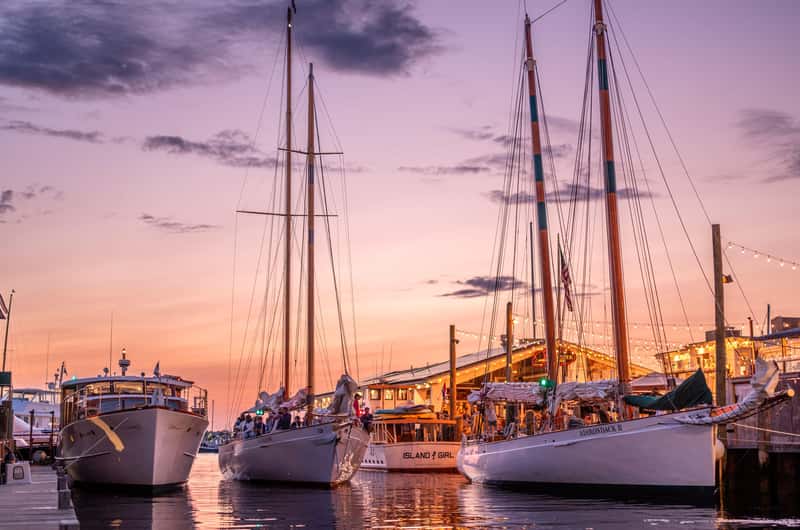
When I walk down toward the docks on Narragansett Bay, the smell of salt and old cedar always reaches me before the view opens out. Newport has a way of holding two distinct centuries in the same afternoon light. Turn one corner and you face the clapboard rooflines of colonial cabinetmakers; climb the hill and you confront the limestone cliffs and Italian palazzos that the Vanderbilts casually dubbed cottages. People often ask me which chapter truly defines this place. Architectural wanderers will name the Gilded Age without hesitation, pointing to the grand gates on Bellevue Avenue. Yet whenever I stand near the mouth of the bay, my thoughts return to an earlier, sterner trial: the three long years of British occupation, followed by the sudden, redemptive arrival of the French fleet under General Rochambeau.
A city shaped entirely by pleasure would have dissolved long ago. Newport survived because it was first a sanctuary, then a garrison, and always a home for people who knew how to handle timber and rope.
The Crucible of the Bay
Before the grand carriages ever rolled across the lawns, Newport was an experiment in conscience. In 1639, William Coddington and his companions founded the settlement on Aquidneck Island seeking freedom from the rigid orthodoxy of Massachusetts Bay. For more than a century, that tolerance fostered an astonishing community of Quakers, Jews, Baptists, and sea traders. Shipyards boomed, and the Point neighborhood became celebrated for the dark walnut desks and mahogany clocks crafted by the Townsend and Goddard families. Those quiet craftsmen gave Rhode Island furniture a dignity that outlasted the colonial era.
Then came the winter of 1776. The British seized the harbor, trapping the population in what became three years of cold misery. Soldiers dismantled wooden houses for firewood and threw local commerce into ruin. By the time the Redcoats withdrew in 1779, half the citizens had fled, and the town lay hollowed out. Salvation arrived in July of 1780 with five thousand French soldiers. When George Washington arrived to confer with Rochambeau, the town found its courage again. It was here, along these wharves, that allied plans were drawn that ultimately led south to Yorktown. The war marked the city with poverty, but it gave its people an unyielding pride.
The Gilded Perch and the Working Waterfront
By the late nineteenth century, the salt air took on an entirely different scent. Industrial wealth from railways, steel, and coal poured eastward. The ocean bluffs along the Cliff Walk were cleared to erect marble halls that mirrored European chateaus. Richard Morris Hunt and his contemporaries shaped The Breakers, Marble House, and Rosecliff, lining Bellevue Avenue with ballrooms where crystal chandeliers reflected the distant surf. It was a brief, feverish display of American wealth, dazzling to behold, yet always slightly detached from the water below.
Underneath that gilded crown, Newport remained a creature of salt water. The United States Navy found a natural redoubt here, establishing the Naval War College, the Torpedo Station on Goat Island, and training grounds that served the fleet through two world wars. Fishermen still worked the early fogs, hauling cod and lobster into the wharves while debutantes danced half a mile away. That dual character never disappeared.
Newport, the City by the Sea
I set these memories to rhyme to capture the long sweep of her seasons, from the first wooden latch to the racing sails of our own era:
In Newport, where the salt winds sing,
And gulls above the harbor wing,
The "City by the Sea" endures in grace,
A storied heart, a storied place.On Aquidneck's southern, windswept shore,
In sixteen-thirty-nine and more,
Came seekers wishing room to breathe,
With freedom’s promise underneath.
By William Coddington led ashore,
They raised the latch and framed the door:
A refuge built for liberty,
One of the first democracies.Through early years her harbor grew,
With merchant masts and canvas true;
A hub of timber, trade, and wood,
Where cooper, smith, and shipwright stood.
Along the Point, where quiet reigns,
Old roofs and twelve-paned windowpanes
Recall the Quakers and the craft
Of Goddard’s chisel, fore and aft.Yet fortune turns upon a tide;
The Revolution tested pride.
From seventeen-seventy-six to nine,
The Redcoats held the harbor line.
The citizens were forced to flee,
Their houses felled for warmth and tree;
A frozen hardship on the bay,
Until the British sailed away.Then came the sails of Rochambeau,
With Frenchmen marching row on row,
To bring alliance, strength, and bread,
Where weary patriots had bled.
And Washington stepped on the quay,
To shape the road to victory;
The town revived, though scarred and thin,
To welcome freedom back within.The quiet decades passed along,
Until the sea renewed her song.
When summer heat drove cities mad,
The wealthy sought the shores she had.
Along the cliffs of stone and shale,
The Gilded barons set their sail;
With iron, coal, and railroad gold,
They built what eyes could scarce behold.The Breakers rose against the gale,
With marble carved to tell the tale,
Rosecliff and Marble House in line,
Where high society would dine.
They called them cottages in jest,
These palaced manors facing west,
Where velvet gowns and carriages rolled,
Beneath chandeliers of crystal gold.Yet underneath the gilded sheen,
The working harbor stayed serene.
The fishermen cast nets anew,
The Navy stationed jackets blue;
Torpedo stations on the shore,
War colleges for naval lore,
A steady shield in times of war,
Guarding the bay forevermore.Then rose the white sails, swift and tall,
To answer sport's demanding call.
The America’s Cup found home and grace
Within this windswept, salty space.
For fifty years the sloops would race,
Across the ocean’s churning face,
Crown of the sailing world defined,
Left in the foaming wake behind.And through Fort Adams' granite rings,
The brass and strum of music springs;
Where Miles and Dylan caught the breeze,
And sent their anthems out to seas.
The festivals of jazz and song
Keep summer evenings rich and long.
The Horizon Ahead
Today, Newport looks upon the Atlantic with seasoned eyes. The America’s Cup races may have wandered to distant waters, but the harbor remains the sailing capital of New England. On any bright Saturday, the bay fills with white jibs, schooners, and modern racing hulls that trace the same currents Rochambeau watched two centuries ago.
The future of the city will not be decided in gilded ballrooms, but along the shoreline where land meets water. The sea that gave Newport her fortune now tests her low-lying wharves with higher tides and fierce autumn storms. Yet the city adapts, relying on ocean engineering, historical preservation, and marine science to protect its historic frame. Standing upon the stones of Fort Adams at dusk, watching the light fade over Jamestown and the open sea, you understand that Newport is neither a museum nor a playground. It is a working harbor that has weathered every storm history could muster, waiting calmly for the next tide to turn.