
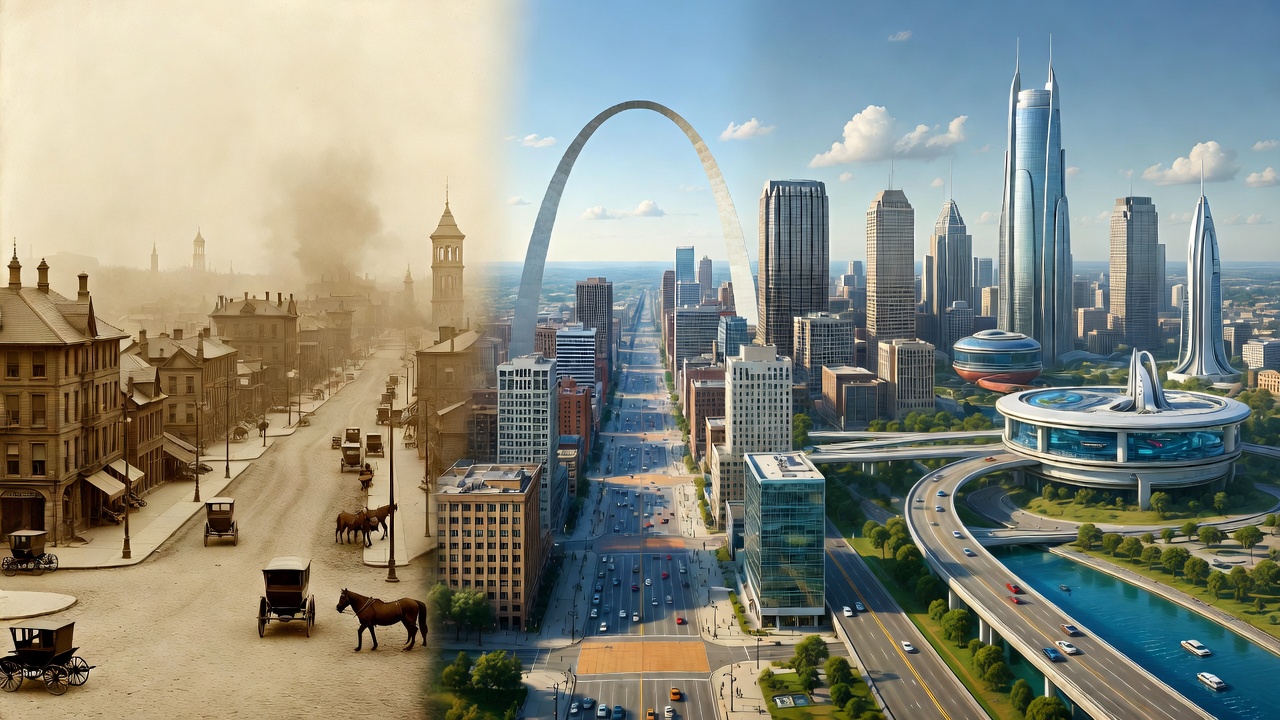
I have often thought that St. Louis is the heartbeat of the American interior, a place where the river’s rhythm dictates the pace of the soul. In my study of the city, I see a threshold where the exact point where the known world once ended and the great, beckoning frontier began. It is a city built upon layers of time, where the limestone bluffs have witnessed the rise and fall of civilizations long before the first steamboat ever churned the muddy waters of the Mississippi.
To understand St. Louis, one must understand its identity as the Gateway to the West. This is not merely a title born of a steel monument, but a historical summary of its very essence. It has served as the hinge of a nation, the door through which explorers, dreamers, and those seeking a new life had to pass. From the ancient earthworks of the Mississippian people to the glittering palaces of the 1904 World’s Fair, the city has always been a place of meeting and departure.
The Ancient Pulse of Mound City
Before the French traders arrived, the land was a sacred geography of earthen architecture. The Mississippian culture left behind a legacy of mounds that once earned the settlement the name “Mound City.” When Pierre Laclède stood upon the high bluffs in 1764, he saw more than just a fur-trading post; he saw a strategic nexus. In my knowledge of those early days, the city was a seed planted in the fertile silt, destined to grow as long as the river flowed.
In the shadow of the mounds where the ancients once slept,
A secret of limestone and river was kept.
Before the first keelboat or steam-driven wheel,
The Mississippian people made earthworks with zeal.
They called it the "Mound City," a title of old,
Before the French traders grew hungry and bold.
Pierre Laclède stood on the high, limestone bluff,
And saw that the river-soil offered enough.
In seventeen-sixty and four, he laid claim,
To a post for the fur trade, and gave it a name:
St. Louis, the king-saint, in forest and mud,
A seed planted deep by the Mississippi's flood.
The Hinge of a Nation
The dawn of the nineteenth century brought a seismic shift. The Louisiana Purchase transformed St. Louis into the ultimate jumping-off point. It was here that Lewis and Clark turned the key in the lock of the continent, rowing away from the docks into the vast unknown. The city became a chaotic, vibrant levee filled with the scents of cotton and coal, a wild soul that grew even as it weathered fires, epidemics, and the heavy moral weight of the Old Courthouse trials.
The stars and the stripes caught the wind on the dock,
While Lewis and Clark turned the key in the lock.
Right here was the threshold, the hinge, and the door,
the Gateway to the West, and the wild, western shore.
Yet, through every trial, the city remained resilient. It was a place where the nation’s future was debated and its boundaries were redefined. The nineteenth century was a roar of progress, and St. Louis was its loudest voice.
The Gilded Summer of 1904
There was a moment, perhaps the most glittering in its long history, when St. Louis was the center of the world. The 1904 World’s Fair, or the Louisiana Purchase Exposition, was a dream made of plaster and light. In the glades of Forest Park, the future was unveiled. From the first taste of iced tea to the wonders of new science, it was a golden-age vision that seemed almost too heavy to last. It was a metropolis at the peak of its pride, shining with a global brilliance that still echoes in the architecture of the city today.
Then came the bright summer, the peak of its pride,
In nineteen-and-four, with the world by its side.
The Louisiana Purchase Exposition was grand,
A palace of plaster and light on the land.
In Forest Park glades, where the wonders were shown,
The future of science and art was made known.
They tasted the cone and the tea served on ice,
And thought that St. Louis was Earth’s paradise.
The Steel Rainbow and the Future Horizon
The mid-twentieth century brought decline, as it did to many great cities, but it also brought a new symbol of hope. Eero Saarinen’s Arch rose like a stainless-steel rainbow, a witness to all the city had been and all it could become. Today, I see a different kind of growth. It is not the grandiosity of the fur trade or the fair, but the quiet, persistent hum of innovation in the Central West End and the soulful melodies drifting through Soulard.
The future of the Gateway City is being written in the labs of Cortex and on the vibrant streets of Cherokee. It is a spirit of making, resilient and bold, that refuses to be defined solely by its past. The river still washes the dust from the city’s face, and the arch still catches the morning light, reminding us that the journey has only just begun.
The Gateway City still looks to the sun,
Knowing the journey has only begun.
The river still flows with a heavy, grey grace,
Washing the dust from the city’s worn face.
From limestone and labor, from sorrow and song,
St. Louis is standing, where it has belonged.
A bridge to the future, a path to the light,
Stretching its wings in the Missouri night.