
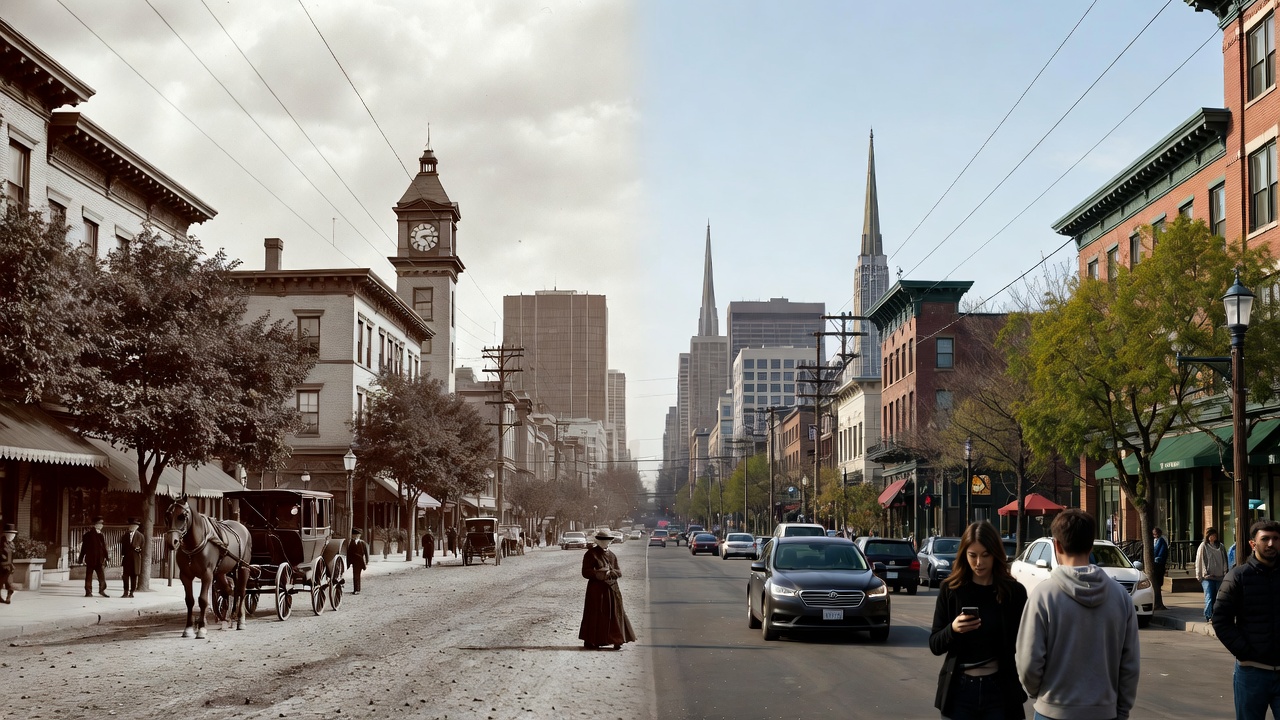
The story of Portland always begins with the weight of the water and the scent of the pine. It is a city that seems to have been pulled directly from the damp earth, rising between the Willamette and the shadows of the Cascades. People often ask me if there is one moment that defines this place, and I usually point back to a simple copper penny flipped in 1845. Asa Lovejoy and Francis Pettygrove stood in a clearing and let a coin decide if the dirt beneath their boots would be called Boston or Portland. Pettygrove won the toss, and the name was set. But the character of the city was already forming long before that copper hit the ground.
Two men, a penny, and a lucky throw,
Decided how the future’s map would grow.
Not Boston’s name, but Portland’s took the light,
A port of call to bloom within the night.
It grew on timber, wheat, and heavy rail,
On ships that moved where commerce would prevail,
A hub of trade where the river meets the sound,
With roots of industry deep within the ground.
The Hard Growth of Stumptown
Before the grand buildings and the steel spans, there was the mud. The growth of the settlement was so rapid, so hungry, that the pioneers didn't bother pulling the roots of the giants they felled. They simply cut the Douglas firs and left the stumps in the middle of the roads. It earned the city the nickname Stumptown. It was a place of rugged, messy ambition where travelers had to hop from wood to wood to avoid the thick Oregon mire. That grit remains in the foundation. We see it in the way the city embraces the unpolished and the handmade.
Then came the wagons, weary from the trail,
With iron dreams and spirits thin and frail,
They saw the confluence, the meeting place,
And carved a town with a rough and wooden face.
The trees fell fast to make a street and square,
Leaving cedar stumps to rot in the damp air,
So "Stumptown" rose from the mud and the debris,
A gateway forged between the hills and sea.
The river was the lifeblood, bringing the ships and the trade that turned a clearing into a metropolis. It grew on timber and wheat, a hub where the valley met the sea.
But history holds a colder, sharper edge,
In the laws they wrote and every broken pledge.
The archives tell of years when walls were built,
And exclusion laws were forged in silent guilt.
They sought a place for only some to stay,
And turned the darker-skinned travelers away.
Yet through the cracks, the hidden stories grew,
In the laundries and the shops the city knew,
Where Chinese workers built the tracks and walls,
And Japanese gardens bloomed near canyon falls.
The Bloom of the Rose City
To soften the rough edges of the industrial port, thousands of roses were planted in rows along the rain-washed streets. This gave the town a softer, scented glow and a new identity: the Rose City. It was a transformation from the raw wood of the frontier to a place of aesthetic grace.
"The future is a garden, untended but grand, waiting for the touch of a collective hand, to heal the old wounds and let the waters run."
In nineteen-five, the world came to the gate,
To see a city rising, proud and great.
The Lewis and Clark Expo brought the crowd,
With electric lights and music long and loud.
They planted roses, thousands in a row,
To give the town a softer, scented glow.
The "Rose City" was born in that summer heat,
A crown of petals for every rain-washed street.
I remember the stories of Vanport, the city that vanished in a single day in 1948. It is a reminder that in Portland, the water always has the final say. We build our bridges from the Burnside span to the elegant Tilikum Crossing to knit together neighborhoods that the river tries to keep apart.
I remember Vanport, when the dikes gave way,
And a city of workers vanished in a day.
The floods of forty-eight were cold and deep,
A memory the river tried to keep.
It changed the map, it moved the people’s heart,
And tore the old foundations wide apart.
Then came the bridges, spanning steel and high,
Steel lace against the gray and heavy sky,
From the Burnside span to the Tilikum’s grace,
They knit the neighborhoods into a single face.
The Silicon Forest and the Path Ahead
Today, we see the rise of the Silicon Forest, where green ideas take root in the same soil that once hosted the timber mills.
The present feels like rain on a window pane,
A rhythm of loss and a rhythm of gain.
The neon signs of "Portland Oregon" shine,
Near the quiet shops and the scent of hops and wine.
The streets are filled with a restless, creative fire,
Of builders and dreamers who never seem to tire,
Where the small and the strange are held in high regard,
And the beauty of the wild is never very far.
The potential of this place is not found in the height of its towers, but in the health of its river and the openness of its gates. As the winter rain falls on the petals in Washington Park, we are reminded that Portland is a town that knows how to weather the storm and wait for the bloom. The copper penny may have given it a name, but the people and the pines give it a soul.
What lies ahead in the mist of the coming years?
Perhaps a shedding of the old-world fears.
The "Silicon Forest" hums with a quiet spark,
As green ideas take root within the dark.
The future is a garden, untended but grand,
Waiting for the touch of a collective hand,
To heal the old wounds and let the waters run,
In a city that finally welcomes everyone.
So let the roses bloom in the winter rain,
And let the bridges carry the joy and the pain.
For Portland is a town that knows how to reinvent,
To find a new path when the old one is spent.
From a toss of a coin to a city of light,
It remains a persistent, beautiful sight.