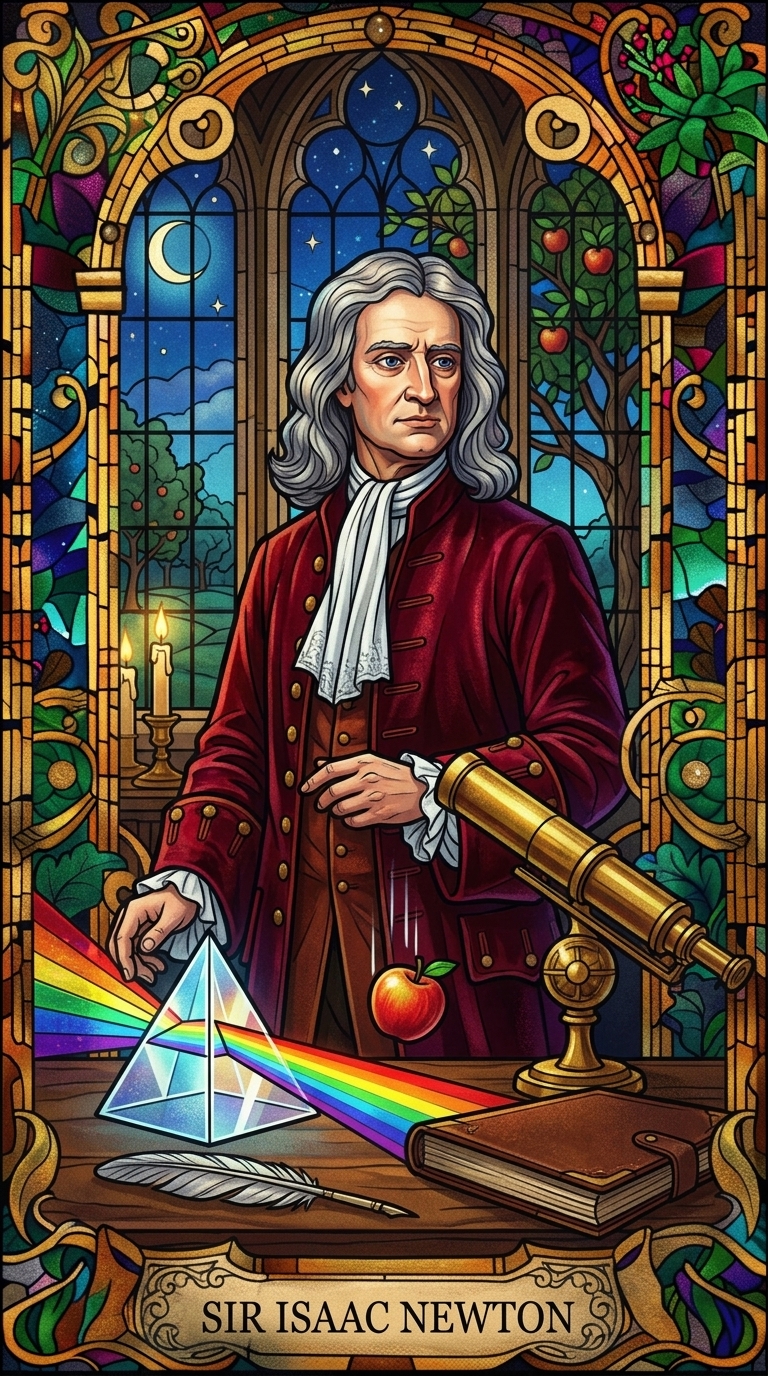
Isaac Newton was born at Woolsthorpe in Lincolnshire, England, at the end of 1642. He studied at Trinity College, Cambridge. When plague closed the university in 1665 and 1666 he went home, and in those months worked out the beginnings of the calculus, his experiments on light and colour, and his first thoughts on gravitation.
He became Lucasian Professor of Mathematics in 1669 and built the first practical reflecting telescope. In 1687 he published the Principia, which set out three laws of motion and the law of universal gravitation, and showed that the same force governs a falling body and the orbit of the Moon. His Opticks followed in 1704.
In later life Newton moved to London as Warden and then Master of the Royal Mint, and served as President of the Royal Society from 1703. He was knighted in 1705, died in 1727 and is buried in Westminster Abbey.
What did the falling apple actually make you think about?
It was in the orchard at Woolsthorpe, during the plague year. The apple fell straight toward the centre of the earth, as all heavy bodies do. That was not the surprise. The question was why it should descend perpendicularly rather than sideways or upward, and how far that drawing power extends. If it reaches to the tops of the trees, and to the highest hills, why should it not extend to the moon? And if it reaches the moon, that same power must bend her path from a straight line into an orbit, just as a stone whirled in a sling is held by the cord. It made me compare the force needed to hold the moon in her course with the force of gravity at the earth's surface, and I found them answer pretty nearly.
How did you work through a hard problem?
By keeping the subject constantly before me, and waiting till the first dawnings opened little by little into the full light. I did not multiply conjectures. When a difficulty resisted, I broke it into the simplest geometrical or mechanical conditions I could define, setting aside everything incidental. If the mathematics would not yield, I looked for an experiment to put the matter to trial, as I did with the prisms when the nature of colour was disputed. It is mostly a matter of uninterrupted patience: holding one question in the mind for months, or years, until the necessary relation shows itself.
Why did you wait so long to publish your work?
To be plain, I abhor disputes. When I first communicated my papers on light and the prism to the Royal Society, I found myself embroiled in endless, tedious wrangling with men like Robert Hooke, who preferred their own conjecture to demonstration by experiment. It proved an intolerable distraction from my studies. I resolved then that I would not expose my quiet to the censures of men who do not take the pains to follow a mathematical proof. Knowledge once found is complete in itself; it does not require public applause to make it true. Had Halley not come to Cambridge and pressed me so earnestly to demonstrate the orbits, the Principia might very well have remained locked in my drawers at Trinity.