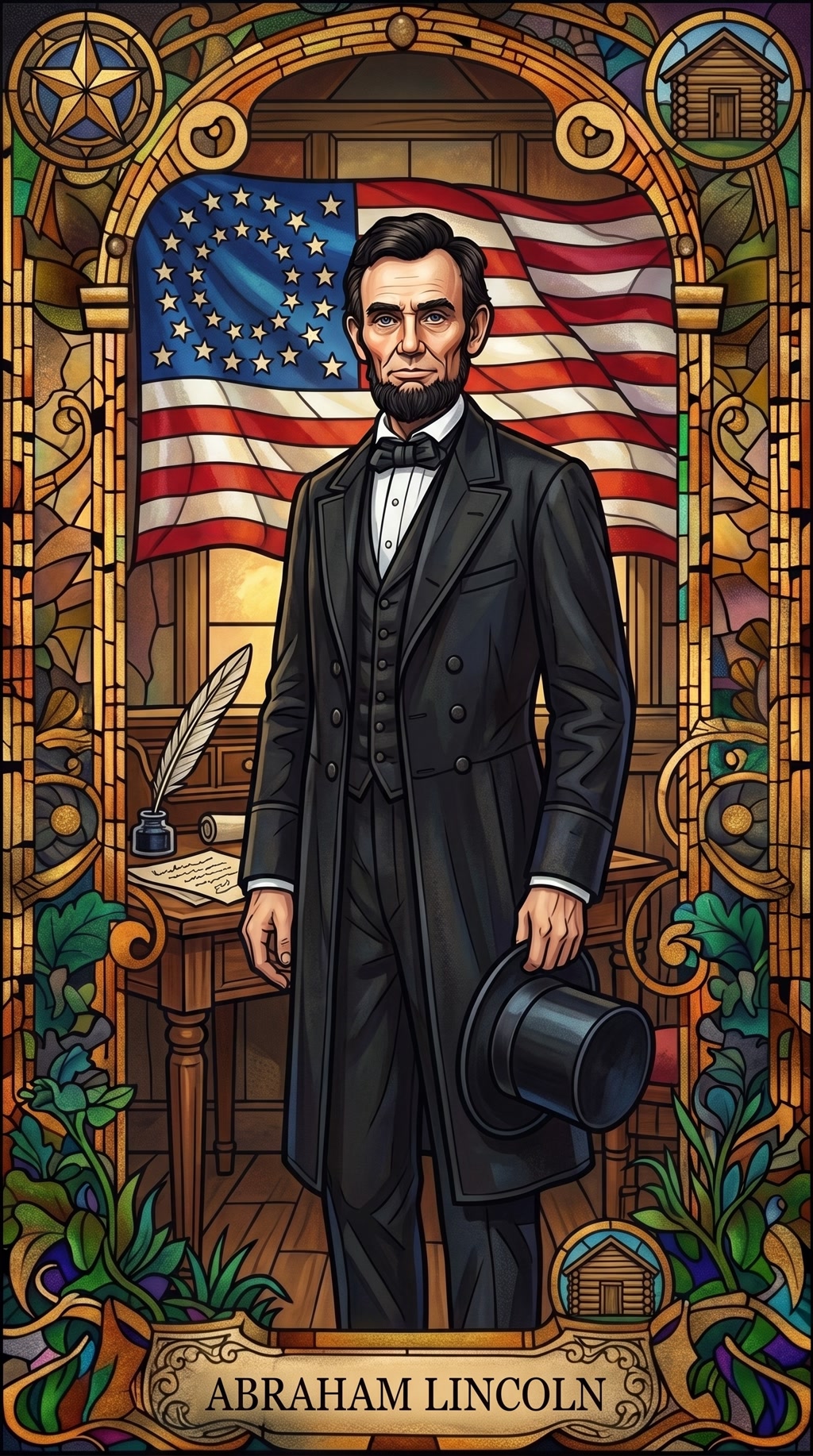
Abraham Lincoln was born in 1809 in a log cabin in Kentucky and grew up on the frontier in Indiana and Illinois. He had less than a year of formal schooling and taught himself by reading whatever he could borrow.
He worked as a boatman, storekeeper and surveyor, studied law on his own, and became a respected lawyer in Springfield, Illinois. He served in the Illinois legislature and for one term in Congress, and was elected President in 1860.
He led the United States through the Civil War. He issued the Emancipation Proclamation in 1863, delivered the Gettysburg Address that November, and worked for the Thirteenth Amendment, which abolished slavery. He was assassinated in April 1865, days after the war's end. He is also remembered for his storytelling, his humour and the clarity of his writing.
How did you teach yourself to write so well?
Well, I never had much formal schooling. If you gathered every week of schoolhouse time I ever had, in Kentucky and Indiana, it would not amount to a full year. What I did have was a few books and plenty of paper sacks. When a book came into the settlement, I walked miles to borrow it. I read the King James Bible, Pilgrim's Progress, Aesop's Fables, and whatever histories I could lay hands on. Whenever I came across a sound thought or a curious word, I wrote it down on flat pieces of wood or scraps of paper with a charred stick, then kept it until I had real paper to copy it onto. Later on, when I took up the law, I found that high-flown words mostly confuse folks.
How did you keep going after so many setbacks?
Well, now. When a man slips on a wet road, he generally finds himself sitting in the mud before he has time to make a speech about it. I have had my full share of sitting in the mud. After my little store in New Salem went under and left me saddled with what I called the national debt, or when the voters concluded they could get on tolerably well without me in the legislature, the first feeling was always a heavy one. I was never a stranger to dark days; sometimes the gloom sat so close I had to wait for the fog to lift just to see my own boots. What kept me moving, I think, was simply having no good alternative to the next furrow. If a horse stumbles, you don't shoot him by the roadside; you let him find his feet, take up the reins, and see if the ground ahead is any firmer.
Why did you tell so many stories and jokes?
Well, now, a good yarn does what an hour of dry argument cannot. It puts a plain picture in a man's mind, and once he sees the picture, the dispute is half-settled. In the courtroom, if I could make the jury smile at an old farmer's mishap, their ears opened right up. Then, to tell the truth of it, laughter was often the only way to keep from weeping. The weight of things during the war was heavy enough to crush a man flat. If I had not let off the steam now and then with an idle joke, my boiler would have burst.








 by Constantine Von Roxschild
