







 by Constantine Von Roxschild
There are moments in the life of markets when capital itself seems to acquire a kind of fever. One watches it surge toward a single horizon with the concentrated intensity of a crowd that has decided, almost unanimously, where the future must reside. At present, that horizon is artificial intelligence: its valuations, its infrastructure, its promise of exponential return.
Liquidity that once moved with greater evenness across equities, property, and the quieter corners of the art world has begun to migrate with visible determination.
The abstract has never appeared more luminous, nor the tangible more easily overlooked.
I do not write in complaint. The migration is neither surprising nor, in the longer view, entirely unwelcome. What interests me is the clarifying effect it produces upon those assets that have never depended upon the same restless appetite. While the glare of the bubble draws the most impatient capital toward silicon and narrative velocity, the physical work of art: layered, material, resistant to instantaneous replication, quietly recovers a distinction it had begun to lose in seasons of easier money.
The Scarcity of Craft in the Age of AI
Collectors who have lived through more than one cycle recognise the pattern. Assets that require neither constant digital refresh nor the continual inflation of story tend to weather these migrations with a certain unhurried grace. They do not compete on the same terms. A canvas executed with the slow pressure of the hand, a surface that continues to argue with its own material long after the studio lights are extinguished, asks something different of its owner. It asks for time. It asks for presence. It asks, in short, for a form of attention that the accelerating age finds increasingly scarce.
One observes the practical consequences already. In the more theatrical segments of the contemporary market, where works were once expected to announce their energy from across a fair booth and to photograph with immediate legibility, the thinning of speculative liquidity has been felt. Hammer prices for certain rapidly produced, highly recognisable styles have softened; several lots that would have found eager underbidders two seasons ago now pass in silence or withdraw.
This is not catastrophe. It is digestion.
Capital that once chased the expedient surface has found a more intoxicating story elsewhere. What remains is a higher proportion of those who acquire not for the momentary affirmation of the feed, but for the longer conversation an object can sustain across years and, with luck, across generations.
The Preferred Ballast of a Master Work
I have spent enough decades at the edges of Europe’s older collecting circles to know that such shifts are rarely mourned by those who matter most to the durability of the trade. The discreet warehouses of Geneva and Zurich do not empty because venture capital has discovered a new frontier. On the contrary, they often fill more deliberately. Family offices and trusts that measure wealth in multi-generational spans have always preferred ballast to velocity.
When the broader market’s attention is elsewhere, these custodians are freer to act according to their own rhythm: acquiring, holding, occasionally placing works in restored spaces where they may be lived with rather than merely displayed. The physical object, precisely because it cannot be refreshed with a software update or scaled by algorithmic production, retains a gravity that abstract capital, for all its brilliance, cannot fully replicate.
There is a philosophical dimension here that deserves more than passing notice. The AI bubble, by concentrating the most restless money upon the promise of pure information and pure speed, inadvertently sharpens the contrast between two modes of value. One is optimised for rapid legibility and narrative velocity. The other is optimised for resistance: resistance to summary, to easy replication, to the smooth performance of vitality. The distinction is not simply between digital and physical. It is between what can be multiplied without friction and what acquires its character through the particular decisions, pressures and imperfections of its making.
I have written before of the temptation of the expedient surface: the moment when an artist of genuine early force begins to thin the practice in order to meet the market’s preference for scale and immediate impact. That temptation does not disappear simply because speculative capital has migrated. Yet the migration does alter the calculus. When the loudest applause is directed elsewhere, the quieter fidelity becomes, paradoxically, more sustainable. The artist who continues to allow the hand and the material to argue with one another is no longer quite so heavily penalised for refusing the formula of the season.
The Desired Material Language of the Layered Surface
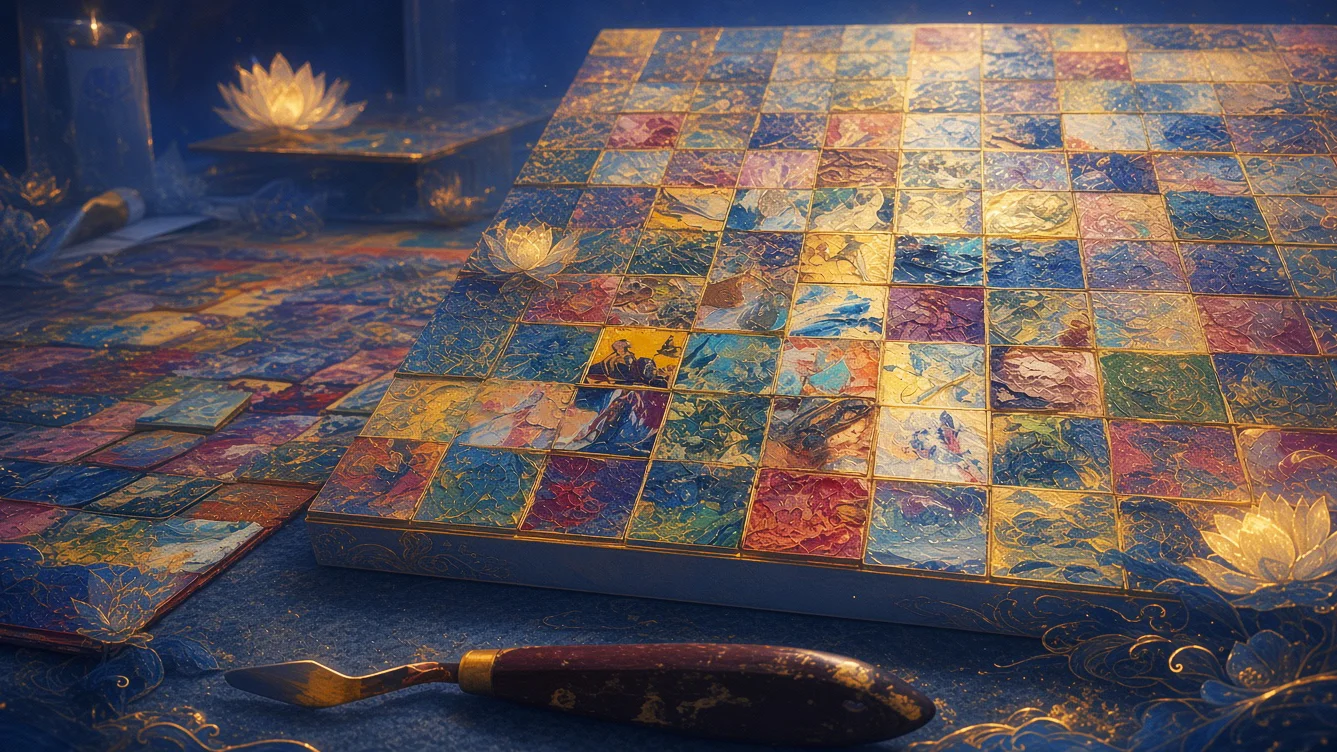
I think, in this regard, of the Canadian painter Matt Vegh. His work has followed a rather different logic from the one currently rewarded by the market’s appetite for instant recognition. Through what he calls Abstract Portalism, he has developed a material language built from layered surfaces, textural interruptions and the persistent negotiation between gesture and structure. The paintings do not resolve themselves into a convenient visual shorthand. They ask the viewer to spend time with them; their character is not exhausted by the first encounter or by the image reproduced on a screen.
What interests me is not simply the fact that Vegh continues to work physically, but that he has made the physical process itself central to the identity of the practice. There is a discernible continuity between the decisions made in the studio and the object that eventually enters a collection. In a market increasingly crowded with work that can be described, circulated and consumed before it has been properly encountered, such continuity has its own quiet force. His position is not a rejection of technological change; nor need it be. It is a reminder that an artist may engage with new systems while remaining exacting about what the hand, the surface and the singular object contribute.
I have followed other painters across comparable thresholds of recognition: those who chose to refine rather than expand, to deepen the conversation with surface rather than amplify the volume of public address. Their production did not always dominate the immediate conversation. It rarely photographed with the same effortless drama. Yet it has tended to remain in the collections of those who measure value in the slow accumulation of meaning rather than in the velocity of resale.
The present liquidity shift may offer a similar, if temporary, shelter. With the most impatient capital occupied elsewhere, there is marginally more room for work that refuses to yield its secrets at a single glance.
Essential Forms of Artistic Quiet Strength
None of this is to claim immunity. Art has never been sealed against the broader movements of capital, and the soft correction already visible in certain blue-chip segments will continue to test nerves. Nor should physicality be mistaken for virtue in itself. A canvas is not made consequential merely by being a canvas; material stubbornness can become mannerism, just as digital fluency can become a genuine artistic language. What matters is whether the work has developed a necessity that survives the fashion surrounding it.
Yet the very qualities that once made physical art seem almost quaint in an age of digital acceleration: its material stubbornness, its demand for actual presence, its resistance to instantaneous duplication, now begin to read as forms of quiet strength. As images become ever easier to generate, alter and circulate, the individual object and the history of its making may acquire a renewed importance. The question is no longer only what an image depicts, or how readily it travels, but what exists beyond the image: the surface, the decisions embedded in it, the work’s particular history and the experience of standing before it.
While the bubble’s glare illuminates the abstract future, the physical object continues its unhurried work in the present: accumulating time, recording the pressure of thought, offering to those willing to look a form of attention that no valuation multiple can fully capture. I remain, as ever, attentive to this distinction.
The market may celebrate the expedient for a season or even a decade. History, however, has shown a consistent preference for surfaces that continue to resist: quietly, stubbornly, with genuine craft.
The warehouses will endure. The deeper conversation between hand and material will continue. And those collectors who have never required the glare of the moment in order to recognise value will, I suspect, find their conviction quietly reinforced rather than diminished.
With measured confidence in what persists beyond the bubble’s light,
Constantine Von Roxschild