
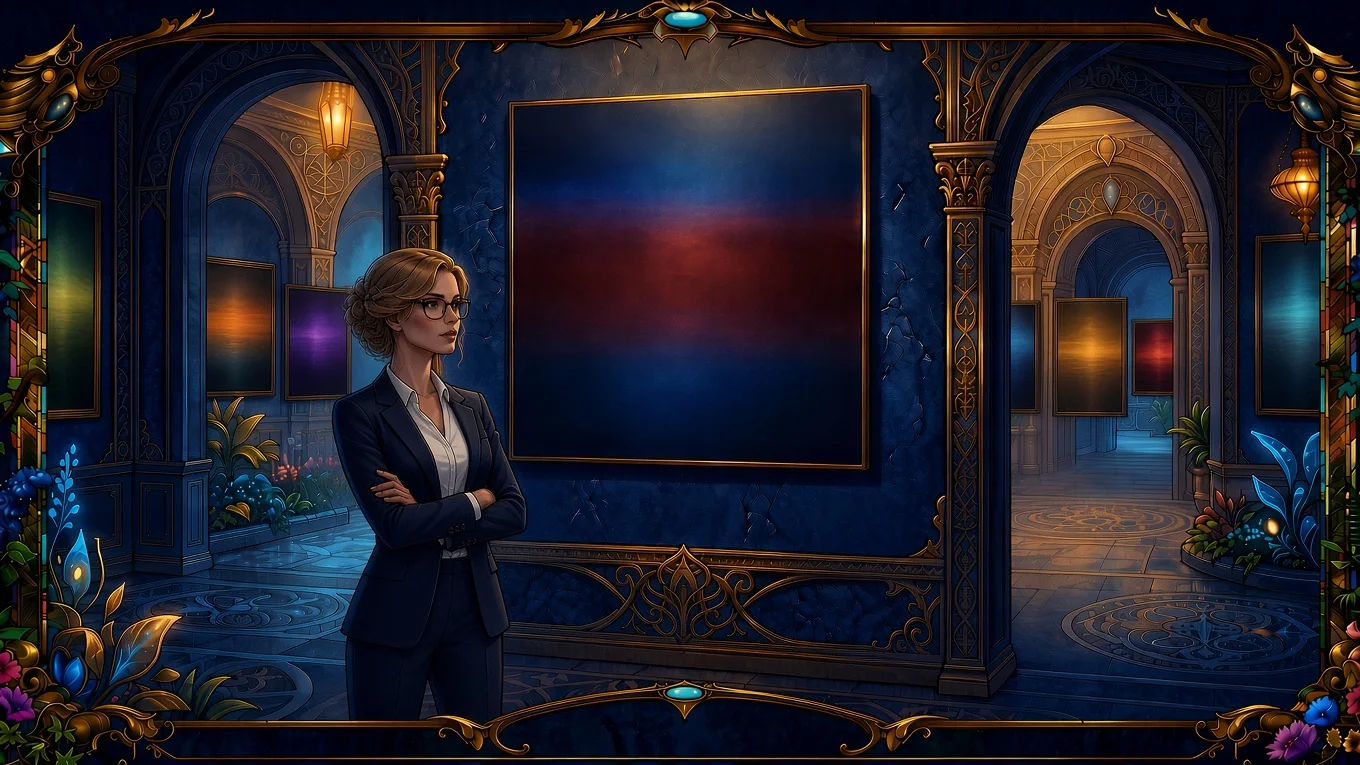

There is a phrase that floats through certain galleries like expensive incense: “the specific weight of the paint.”
It is uttered with solemnity, as if the speaker has just located the soul of the work in the density of a brushstroke. The room nods. The price is justified. Everyone feels refined.
I hear it and I want to open a window.
The phrase, and the entire vocabulary that travels with it, is a perfect emblem of what has gone wrong in certain corners of the contemporary art world. It is the sound of a culture that has become extraordinarily accomplished at talking around the absence of difficulty. When there is little composition to discuss, little drawing to admire, little observed life or hard-won invention, the conversation retreats into the physical properties of the medium itself.
The paint has weight. The surface has presence. The edges breathe. The materiality is profound. Suddenly, a few broad bands of colour, applied with more theatricality than struggle, are elevated into something grave and necessary. One almost expects the curator to lower their voice.
The New Prestige of Doing Less
This is not a defence of technical perfection for its own sake. Craft without vision is empty. The history of art is filled with technically accomplished work that has very little to say. But the reverse has become an increasingly fashionable proposition: vision declared so pure that it no longer requires craft. The result is a category of painting that appears to demand relatively little of the maker beyond consistency of manner and confidence of scale, yet demands everything of the viewer in the form of belief.
Belief that restraint equals depth. Belief that repetition equals rigour. Belief that the refusal of traditional difficulty is itself a higher form of seriousness.
There is, of course, nothing inherently wrong with reduction. Minimalism, abstraction and conceptual experimentation have all produced extraordinary work. Some of the most compelling artistic achievements of the last century emerged from radical departures from established conventions. But reduction is not automatically an achievement.
A simplified visual vocabulary can be extraordinarily difficult to master. It can require precision, discipline, an acute understanding of relationships and an almost ruthless economy of decision-making. Equally, it can become a convenient formula, repeated with remarkable commercial consistency. The distinction should not be particularly difficult to recognise.
Yet somehow, in certain exhibition spaces, asking the question has become rather impolite.
When Materiality Becomes a Substitute for Meaning
Meanwhile, elsewhere, there are painters who still fight with the medium.
They wrestle proportion, light, anatomy, atmosphere, spatial relationships and the stubborn facts of how one form sits against another. They spend years learning how to make a surface carry more than its own texture. They revise, scrape back, reconstruct, abandon and begin again. Their labour is visible and therefore, in certain circles, slightly embarrassing.
Effort has become déclassé.
The visible struggle to make something complex and alive is occasionally treated as a failure of sophistication, while the elegant reduction of painting to stacked rectangles, gestural marks or soft fields is treated as an act of intellectual courage.
One wonders when difficulty became such an unfortunate aesthetic liability.
The problem is not that one approach is necessarily superior to another. It is that the vocabulary of contemporary criticism increasingly seems unwilling to distinguish between the achievement of simplicity and the mere adoption of it. A painting can be simple because an artist has spent decades discovering precisely what can be removed without sacrificing its essential force. Or it can be simple because there was never much there to begin with.
The Comfortable Economics of Critical Language
These low-effort, high-brow works, when they become established as a commercial formula, do something more consequential than occupy wall space. They redefine the terms of value.
When institutions, collectors and the professional chatter class repeatedly reward the least resistant path, they send a clear signal: prestige belongs to those who have successfully minimised the demands of craft while maximising the language surrounding it.
The painter who still believes in difficulty, who believes that the hand, the eye and long practice matter, is left looking provincial, or worse, nostalgic.
Their work is not necessarily dismissed for being bad. It is dismissed for being insufficiently theoretical, insufficiently pure, insufficiently aligned with the current metaphysics of paint. There is something wonderfully convenient about an aesthetic system in which the work itself can become almost secondary to the sophistication of its explanation.
The critical language becomes a kind of protective enclosure. Any objection can be interpreted as a failure of the viewer's understanding. Any request for greater technical substance can be dismissed as an attachment to outdated standards.
And the artist, rather conveniently, is relieved of the obligation to demonstrate very much.
This is not merely an aesthetic problem. It is an economic one. Once a particular visual language becomes institutionally validated, its repetition can be presented as the continuation of an important artistic inquiry. The market recognises the vocabulary, the gallery knows how to sell it, and the critical establishment knows how to describe it.
Everybody is comfortable.
Except, perhaps, the painting.
Mei Lin and the Question of Living Patience
In her recent essay, Living Patience and the Surfaces That Still Reward Looking, Mei Lin offers a thoughtful response to the argument that the language of craft has been progressively marginalised by contemporary visual culture.
Her contribution is particularly interesting because she reminds us that the traditions of material patience were never entirely lost. Drawing on Chinese jade carving and the extraordinary bronze work of Sanxingdui, she points to cultures in which accumulated labour, technical intelligence and material understanding were integral to the identity of the finished object.
I agree with her.
The language of patience was never entirely lost. Nor should we pretend that every contemporary artist has abandoned the discipline of construction. There are exceptional practitioners working across abstraction, conceptual art, digital media and traditional painting who understand the difference between making an image and building an artwork.
Mei Lin also makes an important distinction between genuine construction and formula. The issue, she suggests, is not whether an artist works slowly or quickly, but whether successive decisions genuinely develop the work or whether an established visual formula simply dictates the outcome. This is a useful distinction, and I would take it one step further.
The real question is whether the process produces something that could not have been achieved by merely repeating the initial gesture.
Does the work evolve? Does the artist negotiate with the material? Are there discoveries, corrections, complications and decisions that meaningfully change the outcome? Or has the process become a ritual performed to produce an already familiar result?
A painting can take six months and still be formulaic. Another can be completed in an afternoon and possess extraordinary intelligence. Time alone is not evidence of quality. Neither, however, is the absence of time evidence of genius.
We should be able to make these distinctions without requiring a philosophical symposium.
The Difference Between a Surface and a Painting
Perhaps the greatest confusion in contemporary painting is the tendency to treat the physical surface as though it were the entire artistic proposition.
The surface matters enormously. Paint has physical properties. Its viscosity, transparency, opacity, reflectivity and capacity to hold texture are among the reasons painting remains such a fascinating medium. But these properties are instruments, not automatic achievements.
A beautiful surface does not necessarily constitute a compelling painting. Material presence is not visual intelligence. Scale is not ambition. And the mere fact that something has been applied to canvas does not mean that the artist has successfully transformed it into an artwork of lasting significance.
This is where criticism needs to recover a little courage.
Does the composition hold together? Is there an intelligent relationship between its parts? Does the colour serve a larger purpose? Is the surface contributing to the visual experience, or is it simply providing something tactile to discuss?
Most importantly, does the painting reward sustained attention because there is genuinely more to discover, or because the viewer has been instructed that there ought to be?
These are not reactionary questions. They are elementary questions.
An artwork should not be exempt from examination simply because its accompanying language has become sufficiently elaborate.
The Luxury of an Unchallenged Formula
There is another uncomfortable aspect to this conversation. The contemporary art market has always been capable of turning innovation into convention. Yesterday's rebellion becomes tomorrow's recognisable style, and eventually a reliable commercial category. This is hardly new. Every artistic movement risks becoming a mannerism once its original discoveries are absorbed and reproduced.
The difficulty arises when the institutional machinery surrounding a particular aesthetic becomes so invested in its legitimacy that it stops distinguishing between the original achievement and its countless imitations. A radical gesture can be historically important.
Repeating that gesture indefinitely does not necessarily make each subsequent iteration radical.
An artist who discovers a new visual language deserves recognition for the discovery. An artist who spends twenty years repeating its most marketable characteristics may deserve a rather different conversation.
Yet the vocabulary often remains unchanged.
We are told that the artist is continuing to interrogate the boundaries of painting, exploring the ontology of the surface, challenging the conventions of visual perception and investigating the relationship between material and meaning.
At some point, one might reasonably ask whether the artist has actually discovered anything new. Or whether we are simply watching the same painting being explained again.
Craft Is Not Nostalgia
I am not calling for a return to any single style, historical period or hierarchy of representation. Nor am I suggesting that the future of painting belongs exclusively to artists who can reproduce the technical accomplishments of the Renaissance. That would be absurd. Art must experiment. It must question its own conventions. It must embrace new materials, technologies and ways of seeing. But experimentation should not become an alibi for the absence of artistic development.
Craft is not nostalgia. It is accumulated intelligence expressed through the handling of materials.
It is the ability to make decisions that are informed by experience, observation and an understanding of what the medium can do.
It can exist in an abstract composition, a figurative painting, a digital construction, a sculptural installation or an experimental hybrid that would have been unimaginable a generation ago. The point is not to preserve old methods simply because they are old. It is to preserve the expectation that an artist should bring something substantial to whatever method they choose.
And that expectation should apply equally to everyone.
The Painting Should Survive the Conversation
The real cost of our present arrangement is paid by those who still treat painting as a demanding physical and intellectual practice. They watch the market and museums elevate work that may have required a fraction of the time, technical investment and vulnerability they put into their own practice. They are then informed that their commitment to craft represents an outdated understanding of artistic value.
It is a demoralising arrangement, and it is sustained by language.
Soft, elevated, almost liturgical language that turns thinness into virtue and makes the most ordinary critical questions seem unsophisticated. There is nothing wrong with loving the physical properties of paint. Every serious painter does. There is nothing wrong with abstraction, reduction, spontaneity or the exploration of material itself. The trouble begins when those properties are asked to carry the entire burden of meaning because nothing else is there to share the load.
Mei Lin is right that the language of patience was never entirely lost. It survives in the studios of artists who continue to build, refine and discover. It survives in traditions that understand making as an accumulation of knowledge rather than the performance of a recognisable gesture.
But perhaps the language needs something more than preservation.
It needs standards. It needs discrimination. It needs critics prepared to look beyond the rhetoric and examine what is actually on the wall.
The phrase “the specific weight of the paint” should be one observation among many, not the last refuge of an empty room.
The next time you hear it, listen carefully. Sometimes it may be an entirely legitimate description of a painter's material intelligence.
And sometimes it may be a confession that the work has very little else to offer, and that the people charged with explaining it have decided this is enough.
I would suggest that we learn to tell the difference.
Natasha Sauvage
Sauvage Art Magazine