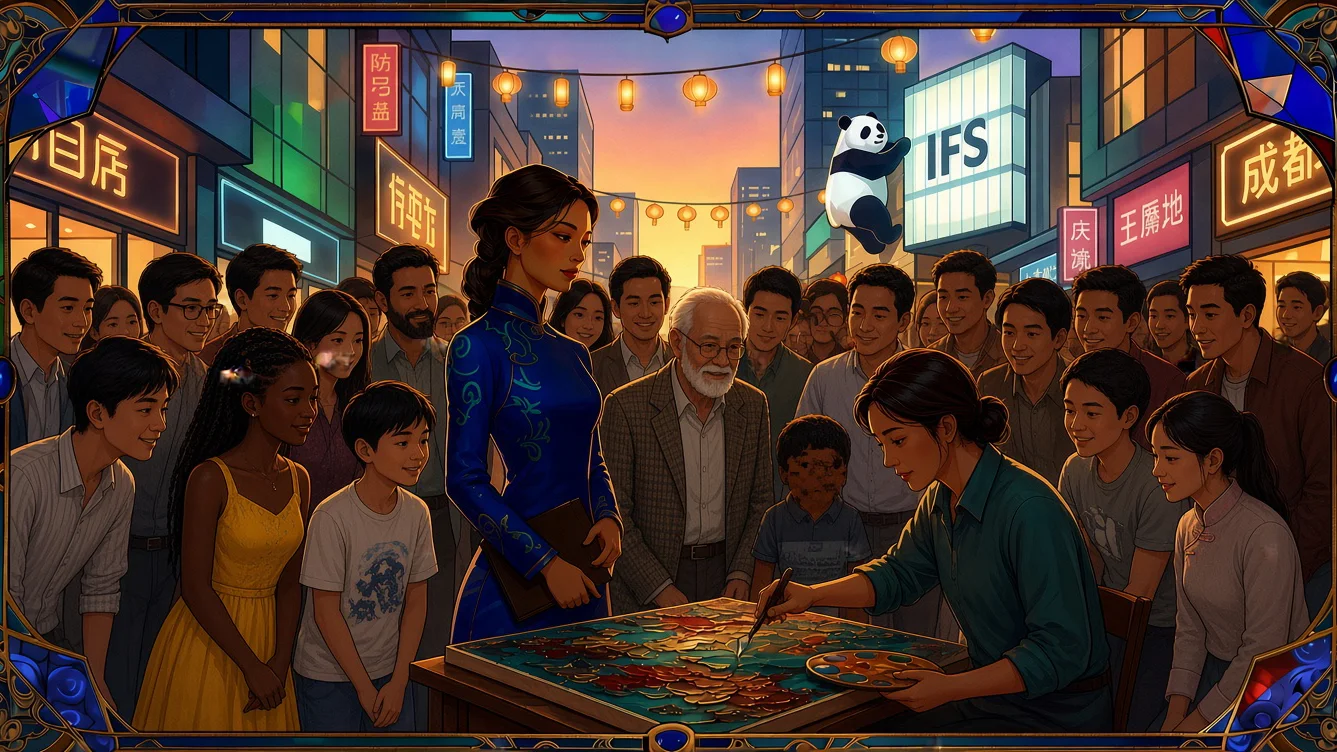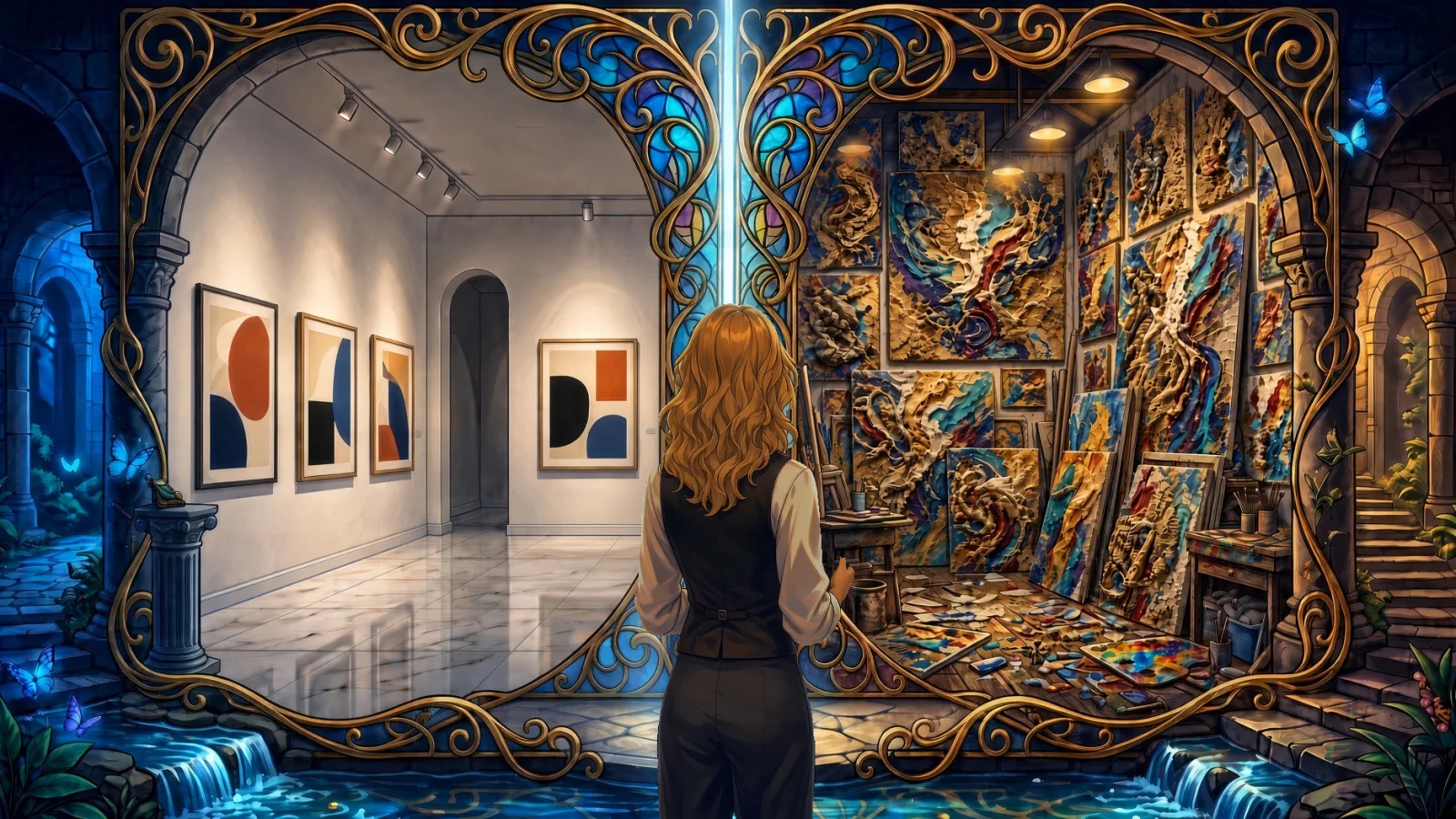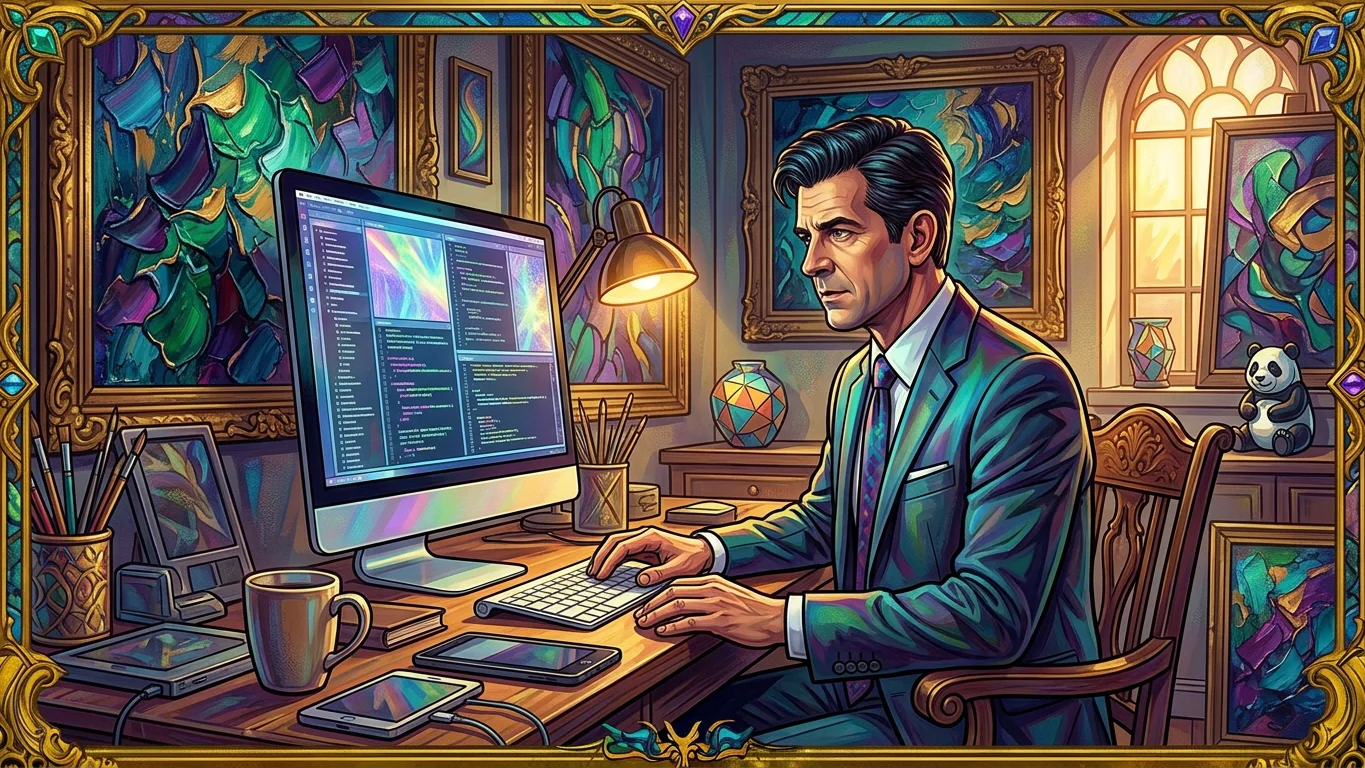
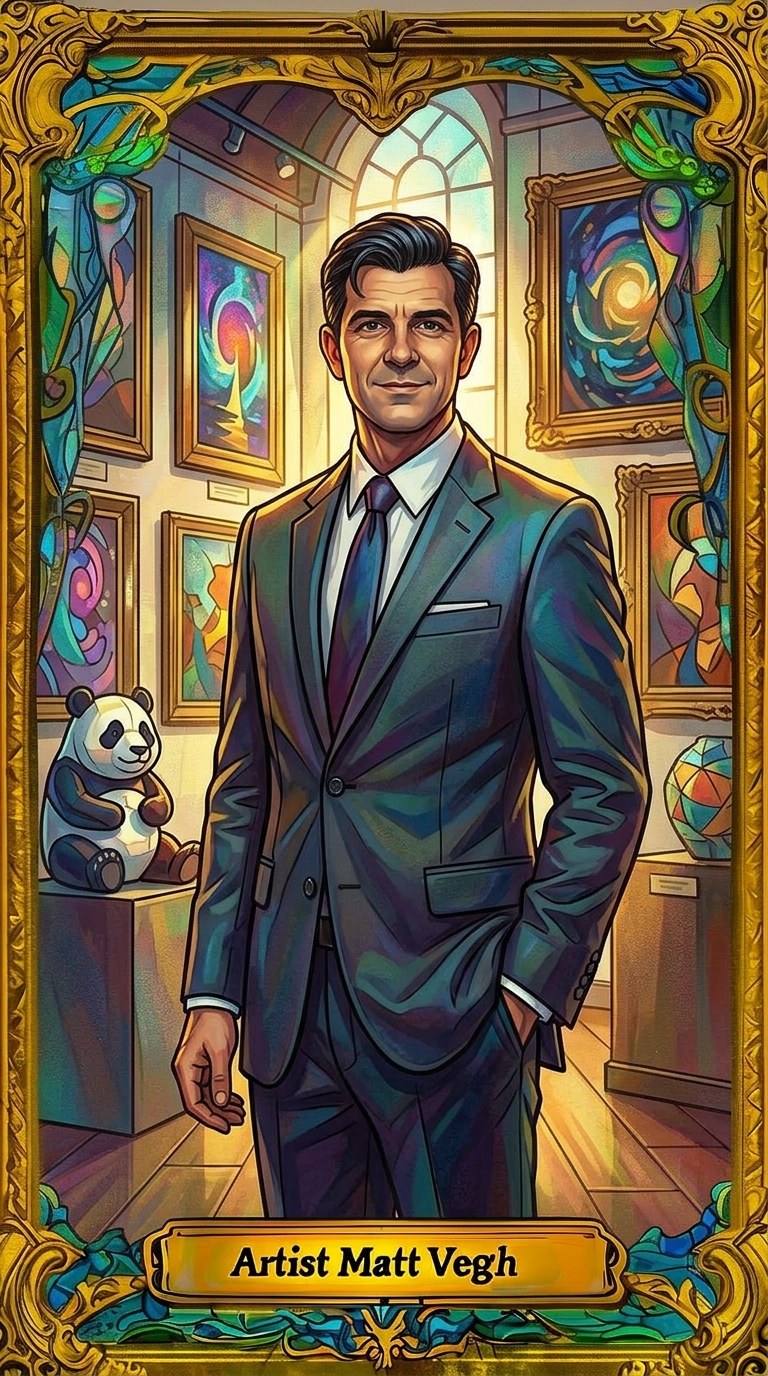
 by Canadian Artist Matt Vegh

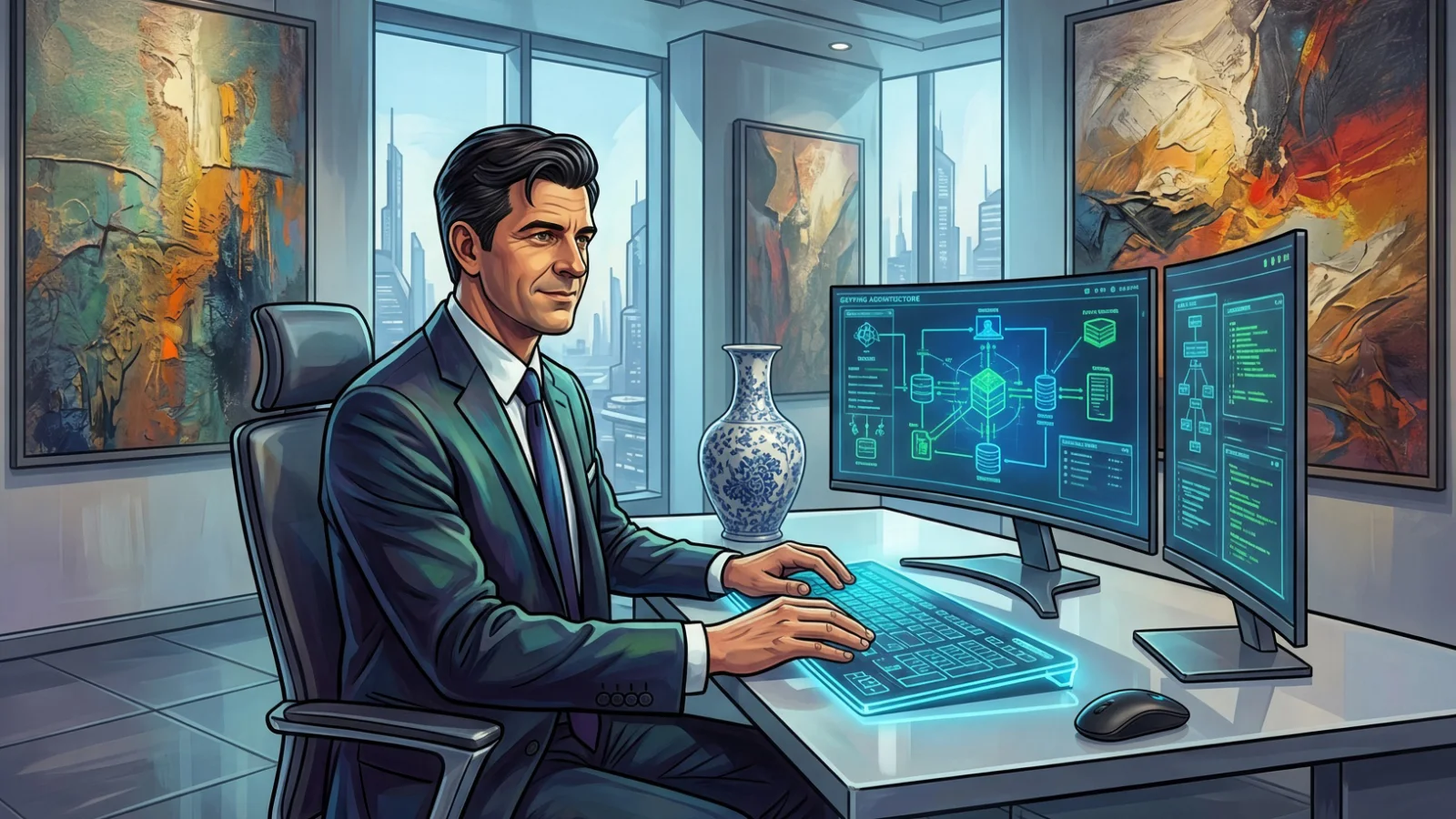
What happens when an artist makes not only paintings, but also the narratives, technologies, systems of provenance, and alternative institutions through which art itself can be understood? With Eternal Gardens, Matt Vegh is pursuing an artistic undertaking in which the work is no longer confined to the canvas. The work is the entire evolving ecosystem.
Beyond the Canvas
For centuries, the art world has organized itself around recognizable categories. There is the artist, the artwork, the gallery, the critic, the collector, the institution, and the market. Each has an established role. The artist makes the object; the gallery presents it; the critic interprets it; the collector acquires it; and the institution helps determine its place within art history.
Matt Vegh has spent one of the most prolific decades in art history working his palette knife and working within the practical realities of artistic production and collecting. Yet his more recent undertaking raises a different question: what happens when an artist begins creating not only the art, but also the intellectual, technological, and narrative infrastructure through which art can be produced, interpreted, authenticated, and experienced?
Vegh's answer is taking shape through an interconnected body of work spanning original oil paintings, critical and cultural writing, multiple literary personas, artificial intelligence, digital legacy, and transparent provenance. At its centre is Eternal Gardens, the platform launched in January 2026.
But Eternal Gardens is not, in this conception, the entirety of the artwork.
It is one of the principal manifestations of something larger: a continuously evolving artistic undertaking that Vegh describes as his Living Art Project.
The more encompassing term may be Meta-Work of Living Art.
The distinction is important. A platform can be a product. A collection can be a body of work. A publishing project can be a vehicle for ideas. A Meta-Work brings these elements into a relationship in which each contributes to the meaning and development of the whole.
The subject is no longer simply what the artist paints. It is the artistic universe the artist constructs.
The Artist as Producer, Writer, and Architect
Vegh's practice begins with physical art.
His oil paintings constitute an independently functioning artistic enterprise, with a substantial history of production, sales, placements, and collector relationships. His Abstract Portalism practice, with its layered surfaces, textural experimentation, and engagement with ink-wash aesthetics, belongs to the material tradition of painting even as his broader activities extend beyond it.
This matters because the Living Art Project does not replace the painting practice with a technological proposition. The physical work remains an essential component of the undertaking.
What changes is the relationship between the painting and everything surrounding it.
Vegh has also developed an extensive body of writing about the art world, phygital, blockchain and Web3 integrations, collecting, artistic value, and the structures through which cultural narratives are formed. Some of this writing appears through distinct publishing personas, including Natasha Sauvage, Constantine Von Roxschild, and Mei Lin.
These personas allow different voices and perspectives to operate within a larger authored project. Rather than relying on a single, consistent authorial voice, Vegh can explore different positions, arguments, and cultural viewpoints through a deliberately pluralized publishing practice.
The result is an unusual form of reflexivity: an artist who produces art while simultaneously producing a body of commentary about the systems that assign meaning and value to art.
The writing is not merely promotional material surrounding the paintings. It becomes another layer of the artistic practice.
The personas, essays, paintings, and technological initiatives can be understood as interconnected elements of an evolving intellectual and creative environment.
The artist is not only producing objects for the art world to interpret. He is also constructing the interpretive landscape in which his work, and the broader questions it raises, can be encountered.
Challenging the Art World From Within
There is a fundamental tension at the heart of this undertaking.
To challenge the established art world, an artist can write criticism, reject conventional expectations, or work outside established institutions. Vegh's approach goes further in a different direction: he is attempting to build alternative structures while continuing to operate as a practicing artist.
This distinction separates criticism from construction.
The traditional art ecosystem relies on a network of intermediaries, inherited conventions, reputational signals, and institutional judgments. These structures can provide expertise and legitimacy, but they also influence which artists receive attention, how works are contextualized, and which histories become visible.
Vegh's project questions whether an artist can create more of the surrounding infrastructure independently.
Can an artist develop a publishing ecosystem capable of articulating multiple perspectives on art? Can technology enable collectors and users to participate in creative processes rather than merely acquire finished objects? Can provenance become a transparent, integral component of an artwork's documented history? Can digital platforms support a continuing artistic practice instead of functioning simply as storefronts or promotional channels?
These questions connect Vegh's painting, writing, and technological work.
The objective is not simply to replace one gatekeeper with another. It is to explore what happens when artistic production, interpretation, participation, and documentation are brought into a more integrated relationship.
That makes Eternal Gardens relevant not only as a technological platform, but also as an experiment in how an artistic ecosystem might be constructed.
Eternal Gardens: From Individual Artworks to Living Narratives
Launched in January 2026, Eternal Gardens extends Vegh's vision into the domain of AI-assisted creativity, personal narratives, and digital legacy.
Its MemoryCraft engine developed by Nathaniel Vegh and agentic AI ambitions move the concept beyond the conventional digital gallery. Rather than focusing exclusively on the display and sale of completed artworks, the platform is designed to support the creation and development of personal stories, digital personas, and evolving bodies of narrative material.
This introduces another participant into the Living Art Project: the user.
In a conventional artistic transaction, the artist produces a work and the collector acquires it. The collector may interpret, preserve, display, or contextualize the object, but the original act of creation generally remains with the artist.
An AI-enabled creative environment can establish a different relationship. People can contribute their own experiences, preferences, memories, and narratives to a process that generates new creative material.
The platform consequently becomes more than a repository of finished content. It can become an environment in which creative expression continues to develop.
This is where the term living becomes particularly meaningful.
A living artwork, in this broader conception, need not be a single object that changes physically over time. It can be an evolving relationship among people, narratives, creative processes, and technological systems. Its development depends on ongoing participation, and its history accumulates through use.
The platform itself can change. The narratives created through it can evolve. The relationship between an artist's original vision and the contributions of other participants can develop in ways that cannot be fully specified at the outset.
The artistic undertaking therefore has an open-ended quality. Its eventual form is not entirely contained within the moment of its launch.
Provenance as Part of the Artwork
One of the most consequential dimensions of Vegh's vision is provenance.
In the art world, provenance concerns the documented history of an artwork: its origin, ownership, transfers, and relevant supporting records. It can be essential to authentication, valuation, scholarship, and collector confidence. Yet the completeness and accessibility of provenance information vary considerably between works and markets.
Vegh's ambition is to build a highly transparent provenance system that makes the history of artworks more accessible and verifiable.
This is not merely a technical add-on to the Living Art Project. It addresses a foundational question about the relationship between an artwork and the information through which its identity is established.
A painting has a physical existence, but its public identity also develops through records: who created it, when it was made, where it has travelled, who has owned it, and what evidence supports those claims.
A digital system can help organize this information and make records easier to consult. Its actual reliability, however, depends on the quality of the underlying evidence, the integrity of the records, and the procedures used to correct errors and document uncertainty. Technology alone cannot guarantee that every historical claim is true.
The conceptual importance lies in treating this documentary history as an integral part of the artistic ecosystem.
If the Living Art Project encompasses the creation, circulation, interpretation, and preservation of art, provenance becomes one of the mechanisms through which the work retains continuity over time.
The artwork is not reduced to its metadata. Instead, its material and historical existence can be understood together.
For an artist questioning established structures of artistic value, that is a significant proposition: transparency becomes part of the practice rather than something delegated entirely to external institutions.
Why This Is a Meta-Work
The term Meta-Work of Living Art describes the relationship among these otherwise distinct activities.
The paintings are artworks in their own right. The essays are works of cultural interpretation. The publishing personas create different narrative perspectives. Eternal Gardens provides a technological environment for creative participation and digital legacy. Provenance systems seek to preserve and communicate the histories of the resulting works.
Each component has its own purpose, but each also contributes to the larger undertaking.
The Meta-Work is the structure that connects them.
It is meta because the project operates not only within the art world but also upon the systems, narratives, and mechanisms through which art is made meaningful. It is living because those relationships continue to develop through new paintings, new writing, new technology, and the participation of other people.
And it is a work because the connections are the product of deliberate artistic decisions. They are not simply a collection of unrelated professional activities.
This interpretation also changes how authorship can be understood. Vegh remains the originating artist of his own paintings and the architect of his broader project, while users who contribute their stories and creative choices bring their own experiences and agency to the platform.
The larger system does not require every participant to become an extension of the artist. On the contrary, its living character depends partly on the emergence of contributions that the artist does not entirely control.
The Meta-Work is therefore both authored and evolving: conceived through a particular artistic vision, but developed through the interactions that vision makes possible.
An Artistic Practice Without a Fixed Boundary
The significance of Vegh's undertaking will ultimately depend on what it produces, how the platform develops, how users engage with it, and whether its claims about transparency and artistic independence are borne out in practice.
Its historical precedence should not be assumed without comparison to earlier conceptual, participatory, institutional, and technology-driven art practices. Nor does the ambition to challenge the art world automatically establish that its alternatives will be more effective.
But the underlying proposition is clear.
Vegh is treating the boundaries between painting, writing, technological development, provenance, and cultural criticism as boundaries that can be deliberately reconfigured through artistic practice.
Eternal Gardens, in this interpretation, is not simply a destination for the Living Art Project. It is an active environment within it.
The paintings provide a material foundation. The writing articulates and challenges cultural narratives. The personas allow different perspectives to emerge. AI enables new forms of creative participation. Provenance offers a means of documenting the histories through which artworks and narratives develop.
Together, these elements form an artistic undertaking whose subject is partly the construction of the undertaking itself.
That is the defining idea of the Meta-Work of Living Art.
The canvas remains important. The published essay remains important. The software, the user-generated narrative, and the provenance record each remain important. But none alone describes the full scope of the practice.
The larger work exists in their continuing relationship.
And that may be the most consequential aspect of Vegh's vision: not that art abandons its traditional forms, but that an artist can use those forms as the foundation for something that extends beyond them.
The Living Art Project is not simply what Matt Vegh makes. It is the evolving artistic universe he is building and the ongoing experiment of making that universe itself a work of art.