






When I first began my apprenticeship ten years ago, learning to weigh the quiet gravity of a canvas, I was taught a simple rule for studio visits. First, stand ten paces back. Then, approach until your eyelashes nearly graze the varnish. Most contemporary paintings survive only one of these distances. A work built for the grand sweep of a hall often dissolves into careless gesture up close, while a work of obsessive miniature detail frequently loses its spine when viewed across a room.
The first time I stood before a painting by Canadian Artist Matt Vegh, I found myself walking back and forth across the floorboards for nearly an hour. From across the gallery, the canvas held together with the calm, unified authority of classical abstraction. Yet as I stepped closer, the unified field began to fracture and breathe. What had appeared from a distance as a single ridge of pigment resolved into a series of distinct, intimate micro-worlds. Within the valleys of oil and the translucent skins of paper, small chambers of light and shadow opened inward.
In the early phases of his practice, Vegh referred to these emergent works as "spirit paintings." Over time, as his structural vocabulary matured and the methodology grew more deliberate, this approach crystallized into the movement he pioneers today: Abstract Portalism. At Eternal Gardens, where we often seek to place Western voices in unforced conversation with Eastern sensibilities, Vegh’s work occupies a singular place. Collectors who visit these rooms directly, often spending long afternoons moving from the garden light into the gallery quiet, respond to his canvases with an immediacy that requires very little curatorial prompting. They recognize that they are looking at an object built with the patience of a mason and the touch of a calligrapher.
The Two Distances of the Portal
To understand Abstract Portalism, one must abandon the idea of the canvas as a flat window and accept it instead as an excavation site. The word "portal" can sometimes invite mystical vagueness in art writing, yet in Vegh’s studio, a portal is first and foremost a physical fact. It is a specific, bounded territory within a larger painting where the material strata part to reveal an interior space, a fleeting figure, or a geological memory.
When a gallery hangs a piece from his Golden Panda award-winning Four Seasons or Floral Abstracts series, the initial impression is one of seasonal atmosphere. You feel the weight of late autumn dampness or the sharp break of spring thaw through pure chromatic rhythm. Step within arm's reach, however, and the botanical or atmospheric impression gives way to dozens of self-contained thresholds. A single square inch of the canvas might contain a sheer cliff of warm grey, a recessed pool of raw sienna, and a semi-transparent veil of fiber floating over dried gold dust. The eye does not merely scan the surface; it drops into it.
This dual existence explains why collectors live with these works for years without exhausting them. In a private residence, a painting is seen in passing a hundred times a week from the doorway, where it must anchor the room's architecture. Then, on a quiet evening, the collector stops beside it, and the micro-worlds take over. Because these interior passages are born from the physical collision of materials rather than illustrative drawing, the viewer’s own memory completes the image. A ridge of sand and crimson pigment becomes a canyon wall on Tuesday and the fold of a ceremonial garment on Friday.
Palette Knife, and the Memory of Xuan Paper
Throughout my years scouting international talent and vetting portfolios with our foundation team, I have noticed that the most compelling cross-cultural dialogues happen at the level of material craft rather than surface iconography. Anyone can paint an Eastern motif with Western brushes. It is a far rarer thing to fuse the structural physics of two distinct traditions until neither can be separated from the other.
Vegh’s surfaces begin with a physical command of heavy medium that owes a debt to the practical trades of his youth; drawing on his past real-world control of plaster and drywall, he approaches the substrate with palette knives, laying down dense, structural banks of oil paint, metallic acrylics, natural sand, and gold dust. There is an honest, muscular economy to how he pulls a blade across a wet field. He understands the drag of aggregate, the exact moment a heavy paste begins to skin over, and how pressure along the steel edge leaves a sheared terrace of pigment. Left alone, this would produce forceful Western impasto in the lineage of post-war matter painting.
He then introduces traditional Chinese ink-wash paper, known as Xuan paper, directly into this heavy wet topography. Anyone who has handled raw Xuan paper in an Anhui workshop or a Beijing studio knows its paradoxical nature. It is gossamer thin and yields instantly to water, yet its long bark fibers give it remarkable tensile resilience. Vegh presses, folds, and fuses sheets of this paper into the wet oils and metallic strata, at times for texturization and at times for multi-layered structure. As the binding mediums cure, the Xuan paper drinks in the surrounding oils and pigments, turning into a semi-transparent membrane.
The result is an extraordinary visual tension. The heavy knife work provides geological bone and theatrical relief, while the fused Xuan paper introduces a milky, subterranean depth. Light travels through the semi-transparent paper skins, hits the gold dust or metallic acrylic beneath, and scatters back up through the tooth of the fiber. Where the knife creates sharp, decisive ridges, the ink-wash paper creates soft, capillary bleeds and delicate crinkles that no brush could ever imitate. It is a marriage of masonwork and mist.
The Mother Canvas and the Discipline of the Tile
During studio visits, I am always drawn to the working methods that reveal how an artist thinks about time and lineage. In Vegh’s practice, paintings rarely exist as isolated islands. Instead, they belong to a physical genealogy governed by what he terms the "mother canvas" workflow.
While a primary canvas is still wet and heavy with pigment, gold, and medium, Vegh frequently presses secondary substrates or absorbent sheets against its surface. This contact pulls a wet impression directly from the mother canvas, capturing an inverted ghost of its ridges, valleys, and chromatic veins. That impression then becomes the foundational stratum for an entirely new painting. The child work carries the literal DNA of its predecessor, even as Vegh goes on to build new layers of impasto and Xuan paper over it. For a collector, acquiring a piece from such a lineage means holding a fragment of a larger, continuous studio organism.
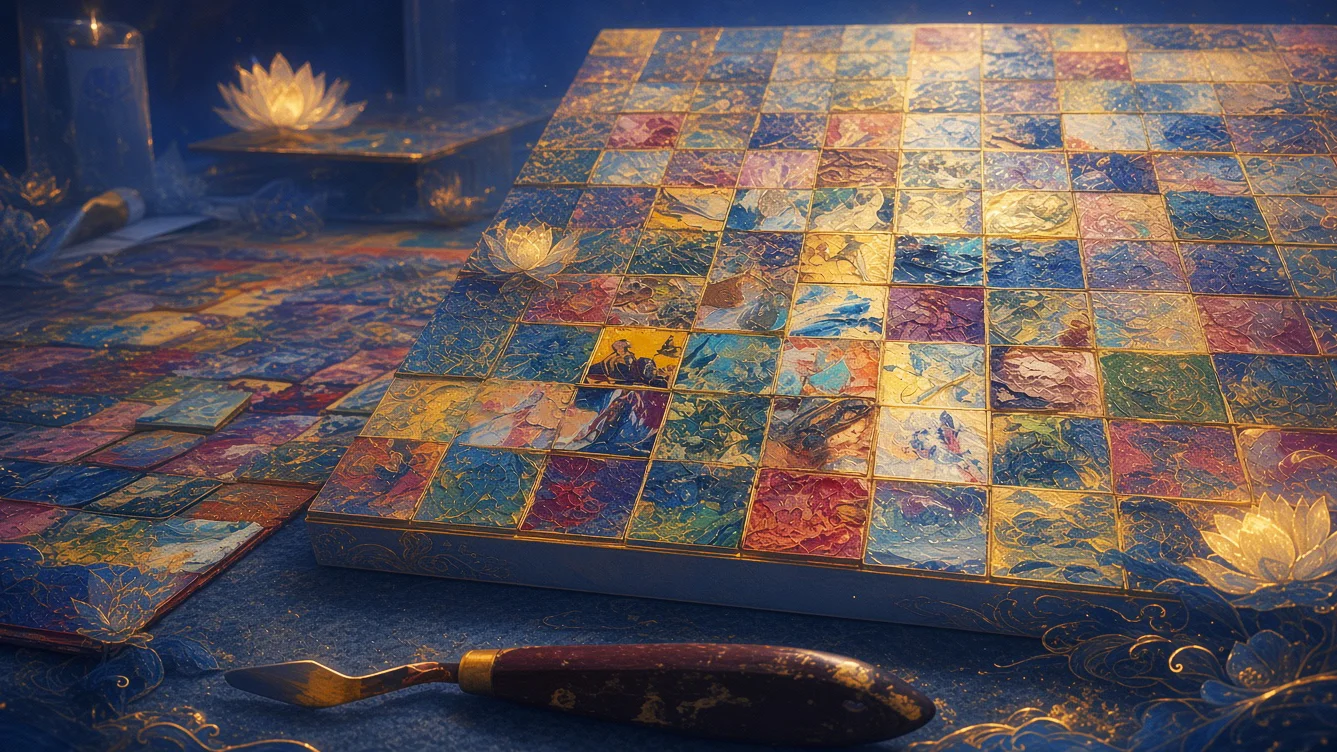
This generative logic reaches its most rigorous expression in his Mosaics series. Here, cured mother canvases and painted skins are hand-cut into hundreds, and in monumental works, thousands of individual tiles. Each tiny square or irregular polygon is already a complete micro-painting, containing its own compressed layers of sand, oil, and ink-wash fiber. Vegh then reassembles these hand-cut units into vast, breathing matrices.
The discipline required to execute a thousand-plus-tile assembly is formidable. Unlike ceramic tiles of uniform factory thickness, each of Vegh’s hand-cut canvas and paper tiles has its own sculptural relief. Assembling them demands a sensitivity to both color harmonics and physical elevation, ensuring that the thousand tiny portals converse with one another across the grid while locking together into a single rhythmic whole.
Relics, Medallions, and Cross-Cultural Ground
As Vegh’s architectural appetite has expanded, his canvases have grown increasingly sculptural, evolving into multi-layer assemblies that incorporate hand-carved, gilded relief medallions set directly into the painted field. These medallions act as gravitational anchors within the composition, drawing the eye toward ancient civilizational memories while remaining firmly rooted in the language of Abstract Portalism.
What moves me most as a curator is the breadth of historical and natural reverence across his distinct series. In his Jinsha and Sanxingdui bodies of work, the gilded relief medallions and gold-dusted strata commune with the mysterious bronze and gold masks of ancient Sichuan. Having spent years studying Chinese cultural heritage, I find Vegh’s approach deeply respectful. He does not copy archaeological artifacts as static museum illustrations. Instead, by burying and revealing carved gilded forms within layers of sand, structural paste, and Xuan paper, he recreates the sensation of unearthing a sacred sun-bird or bronze mask from the damp alluvial soil of the Chengdu plain.
A similar geological weight informs his Tenochtitlan and Aztec series, where the carved medallions and mosaic structures echo the sun stones, stepped temples, and turquoise-inlaid masks of Mesoamerica. The gold dust and heavy stone-like impasto catch the gallery light like weathered temple masonry emerging from lake mist.
Then, turning homeward to the northern wilderness, his Canada Wildlife series, anchored by works such as the beloved Penny Beaver, translates the same material gravity into an homage to native fauna and numismatic heritage. In Penny Beaver, the warm metallic lustres of copper and gold reliefs meet the rugged, woody textures of knife-built oil, turning a familiar national emblem into an enduring totem of the landscape.
The Quiet Studio and the Invisible Archive
An artist who cuts thousands of mosaic tiles by hand, carves gilded relief medallions, and wrestles daily with wet plaster techniques, oils, and delicate Xuan paper lives a life of intense physical labor. When collectors ask how Vegh maintains such a prolific, disciplined output across multiple complex series without sacrificing the slow curing times that oil and layered paper demand, the answer lies in how he protects his studio hours.
Every working artist knows the administrative tax that accompanies international recognition. Cataloguing hundreds of individual works, tracking the lineage between a mother canvas and its offspring, verifying exhibition histories, and maintaining bulletproof provenance records can easily consume half a painter's week. Vegh has solved this through a clear, principled division of labor. He employs agentic artificial intelligence strictly to manage the archival infrastructure, provenance tracking, and documentation behind the scenes.
This distinction is vital to state plainly. No machine touches the art. No algorithm guides the palette knife, selects the pigment, cuts the mosaic tile, or presses the Xuan paper into the wet oil. Every portal, every relief medallion, and every square inch of surface is entirely hand-made through physical sweat and studio intuition. By delegating the ledger and the archive to an Agentic autonomous digital clerk, Vegh reclaims those hours for the easel and the carving bench. For the collector, this brings a dual assurance: the painting on the wall possesses an uncompromised human soul, while its provenance, series genealogy, and archival record are maintained with institutional precision.
Late in the afternoon at his studio and digitally, at his "Living Art Project" Eternal Gardens, when the sun drops low enough to rake across the gallery walls at an oblique angle, Matt Vegh’s paintings undergo a quiet transformation. The valleys between the palette-knife ridges fill with long shadows. The hand-carved gilded medallions catch the amber light, and the semi-transparent strata of Chinese ink-wash paper seem to glow from within. I often stand near the threshold of the room and watch visitors lean in, pausing a few inches from the surface as they discover a tiny, unannounced world tucked beneath a ridge of sand and oil. In those moments, the distance between East and West, and between ancient relic and contemporary wall, simply disappears into the paint.