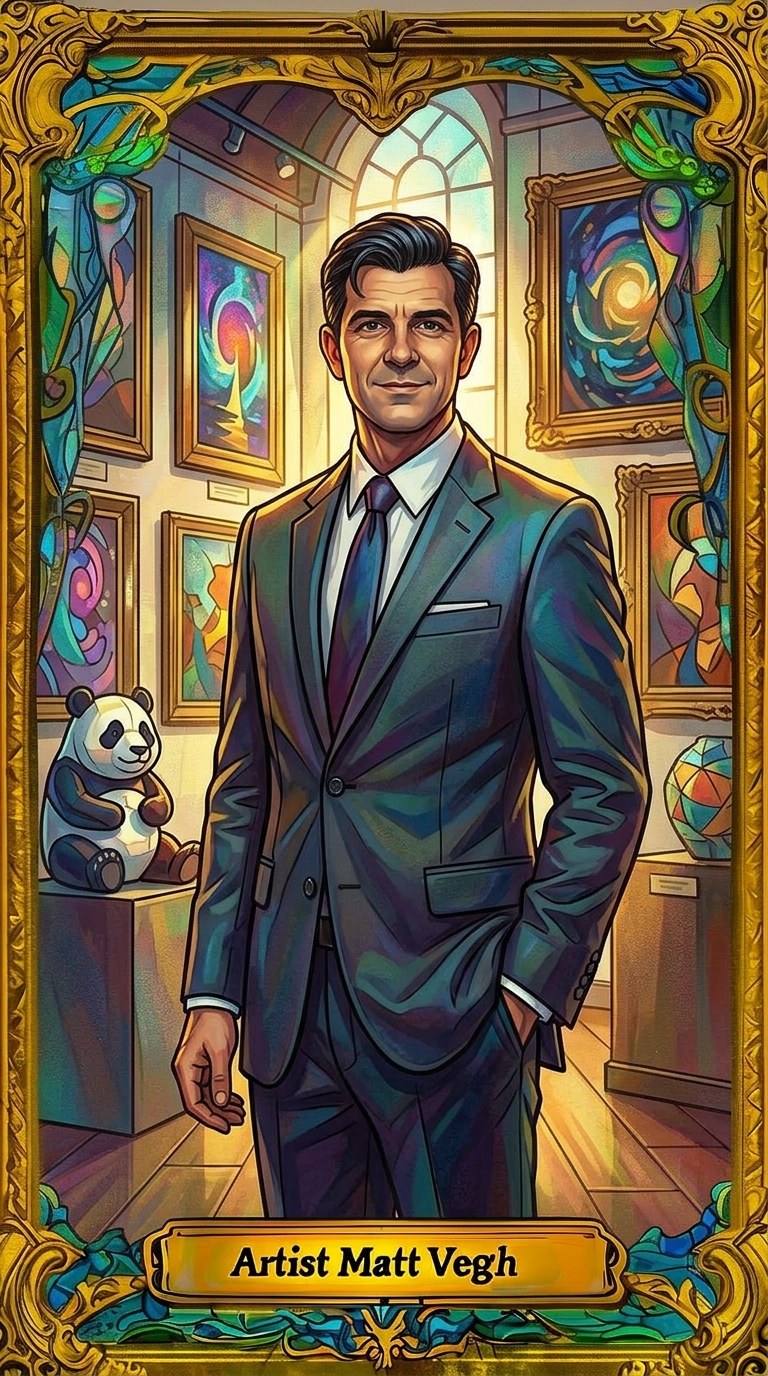
 by Canadian Artist Matt Vegh

The Age of Instant Visual Gratification
In today's contemporary art landscape, visual spectacle has become increasingly difficult to escape. Walk into a pop-up exhibition or scroll through an art feed and you are likely to encounter high-impact, immediate-strike work: sweeping squeegee strokes, fluid acrylic pours, dramatic paint splashes and bold abstractions designed to capture attention in seconds.
There is nothing inherently wrong with these approaches. Spontaneity, gesture and immediacy have always had a place in artistic expression. But something has changed in the environment surrounding art. Increasingly, visual impact is measured by how quickly a work attracts attention, how effectively it photographs and how well it performs in an algorithmically driven culture.
In this race for instant aesthetic gratification, one of the oldest foundations of artistic excellence risks being overlooked: layered craft.
The Art of Building, Rather Than Merely Applying
Layered craft is not simply another name for slow art. It is a deliberate methodology built around successive decisions, repeated refinement and sustained engagement with materials. It involves constructing a work step by step, allowing each stage to inform the next. The finished piece becomes more than the sum of its individual gestures. It carries within its physical structure a record of the artist's decisions, experimentation, adjustments and accumulated skill.
This philosophy is hardly new. In fact, it is woven throughout the history of human creativity.
A Heritage Written in Layers
Consider the extraordinary achievements of Renaissance painting. Jan van Eyck became renowned for his mastery of oil painting and translucent glazing, building luminosity and optical depth through successive layers of paint. Leonardo da Vinci took the possibilities of this approach further with his celebrated sfumato, developing extraordinarily subtle transitions between light and shadow. Technical examinations of Leonardo's paintings have revealed passages built through numerous microscopic translucent applications, sometimes requiring considerable drying periods between layers.
These were not simply paintings made with more paint. They were carefully constructed optical experiences. Their extraordinary depth emerged through the accumulation of countless individual decisions.
The same principle can be found across entirely different civilizations and materials.
Byzantine mosaicists assembled intricate compositions from thousands of individual tesserae, carefully positioning coloured stone, glass and gold-backed glass to create surfaces that transformed with changing light. The great mosaic programme of Hagia Sophia in Constantinople, for example, involved millions of tesserae.
In ancient China, jade carvers developed extraordinarily sophisticated methods for working one of nature's most challenging materials. Using abrasive minerals, sawing, drilling, grinding and repeated polishing, artisans transformed raw stone into objects of remarkable precision and refinement. The finished surfaces often concealed an immense amount of patient technical labour.
The bronze artisans of Sanxingdui provide another remarkable example. Archaeological investigations using modern X-ray computed tomography have revealed sophisticated multiple-pour casting and mechanical joining techniques. These ancient craftspeople were not merely producing objects. They were solving complex material and engineering problems through carefully controlled, multi-stage processes.
And across the Aztec world, specialist featherworkers known as amanteca created extraordinary feather mosaics. Individual feathers were selected, trimmed, arranged and attached in carefully considered compositions. Their work combined material knowledge, colour sensitivity, technical precision and an extraordinary understanding of visual effects.
These traditions were very different in purpose and cultural meaning, but they shared an important characteristic: the finished object embodied a process of accumulated craftsmanship. The labour was not incidental to the result. It was fundamental to its creation.
The difference between spectacle and craft is not necessarily how long something takes. It is what the artist brings to the process.
Spectacle Versus Substance
Acrylic pouring, squeegee painting and other spontaneous approaches can produce compelling and meaningful work. Some artists have developed highly sophisticated practices around these techniques. But when a particular visual formula becomes repeatable, easily reproduced and primarily optimized for immediate audience reaction, there is a risk that the process begins to dictate the artwork rather than the other way around.
The distinction matters.
A work can be visually exciting without being particularly complex. Equally, a restrained composition can contain extraordinary technical sophistication. The initial impression is only one part of the artistic experience.
The Rewards of Looking Deeper
Layered craft invites a different relationship with the viewer. It rewards prolonged looking. Textures reveal themselves gradually. Subtle colour relationships emerge. Details that might initially go unnoticed become increasingly important. The surface becomes a place of discovery rather than simply a vehicle for immediate impact.
This is the philosophy that informs my own artistic practice.
My Own Practice: From Digital Blueprint to Physical Craft
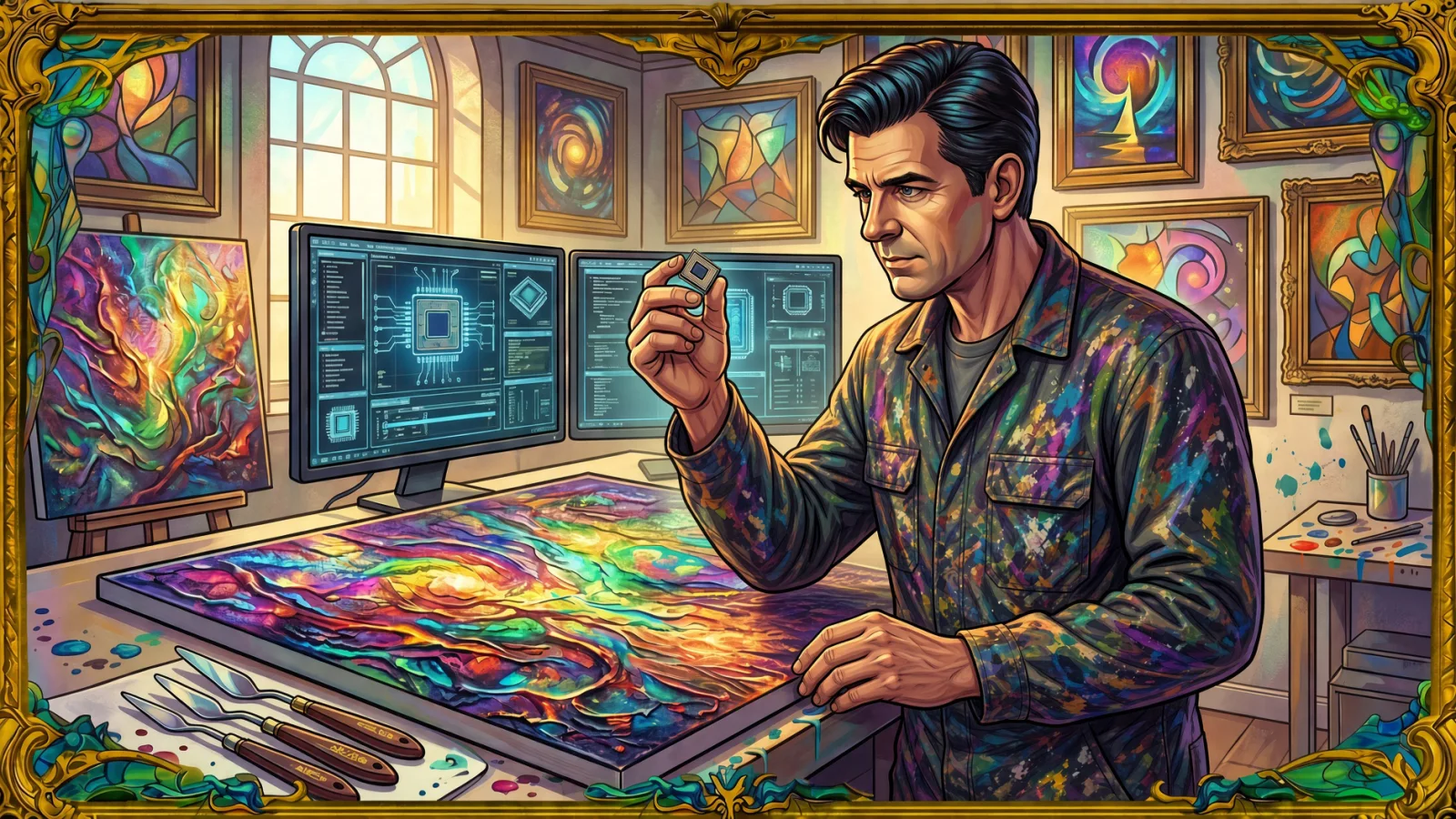
My physical paintings frequently begin with original digital blueprints, which provide an underlying compositional framework. From there, the work develops through successive physical interventions, incorporating hand-cut, hand-laid and hand-painted elements. Texture, material relationships and surface refinement are not decorative additions. They are integral to the construction of the work.
Each stage creates new possibilities and occasionally new problems that must be resolved. The process is iterative rather than mechanical. The original blueprint establishes a direction, but the physical painting develops its own identity through the interaction between intention, material and execution.
I am also interested in extending this philosophy beyond the physical surface.
Adding Another Layer: Art Meets Living Technology
Through my Eternal Gardens Living Art Project, and more recently the development of Eternally Chipped, I am exploring how embedded technology can add another dimension to the experience of an original artwork. A physical authentication chip connects the painting to its digital provenance and an intelligent knowledge system, allowing viewers to explore the artist's intentions, creative journey and contextual information through a conversational interface.
In this sense, the artwork acquires another layer: not a painted layer, but a layer of accessible knowledge and living context.
The physical object remains central. Technology does not replace the craftsmanship or attempt to manufacture artistic value. Instead, it extends the relationship between the work, its creator and the person experiencing it.
This is where I believe an interesting opportunity exists for contemporary art. We do not have to choose between traditional craftsmanship and technological innovation. The two can reinforce one another.
Innovation Beyond the Immediate Impression
Perhaps the larger problem facing contemporary art is not that artists are working too quickly. It is that our culture increasingly rewards the appearance of innovation over the substance of it.
A spectacular image can capture attention in a moment. A carefully constructed work can continue revealing itself for years. These are not necessarily competing objectives, but they represent very different ambitions.
Layered craft is not an argument for returning to the past, nor is it a rejection of experimentation, spontaneity or new technology. It is a reminder that artistic progress has historically depended on something more substantial than novelty.
It requires patience, technical understanding, material intelligence and the willingness to keep working after the initial excitement has passed.
The Quiet Revolution of Layered Craft
In an era increasingly obsessed with instant visual gratification, perhaps the most radical thing an artist can do is continue building.
Layer upon layer.
Decision upon decision.
Until the work becomes something that could never have been achieved in a single gesture.
Because the true measure of craftsmanship is not how quickly an artist can impress us. It is how much there is left to discover once the first impression has passed.