
 With Artist Matt Vegh
There are moments in life when something happens that causes you to stop and reflect, not necessarily because you have received an award or recognition, but because the moment brings together so many experiences, relationships, challenges and years of effort that you suddenly see the bigger picture.
On November 8, 2026, I experienced one of those moments.
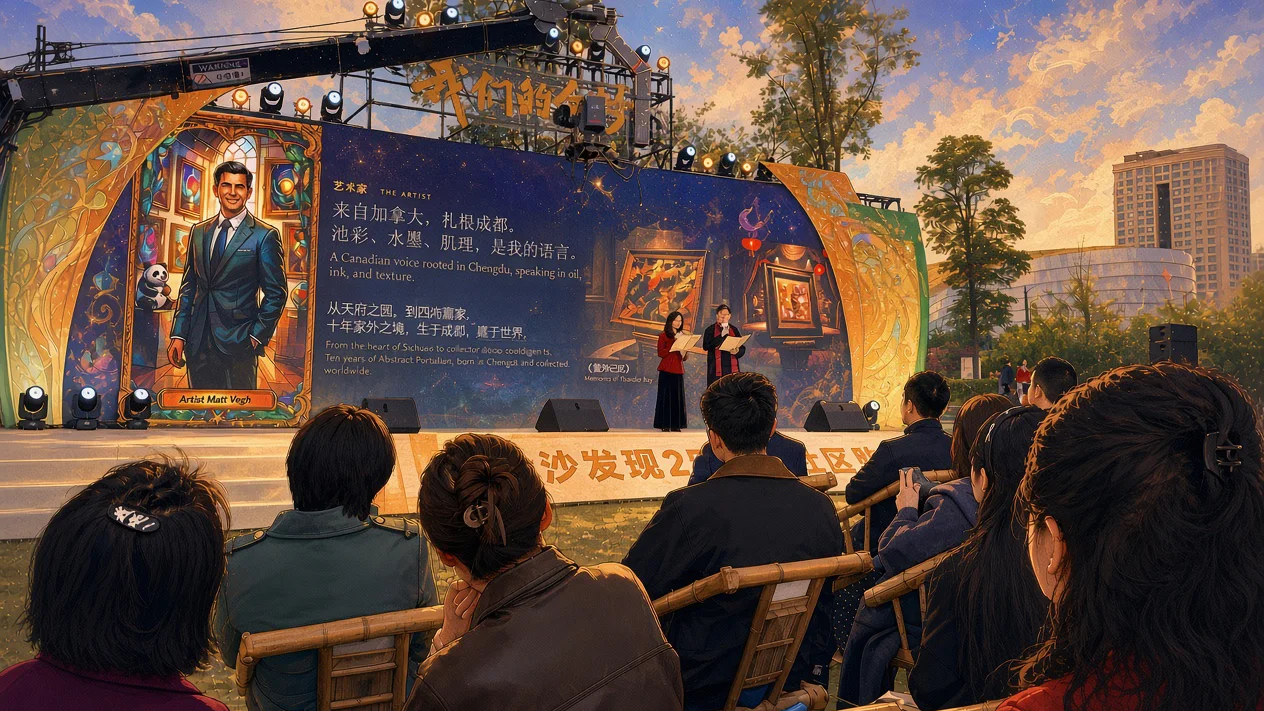
I was invited to participate in the 25th anniversary celebration of Chengdu's Jinsha Site Museum, one of the institutions dedicated to preserving and presenting the extraordinary cultural heritage of the ancient Shu civilisation. During the ceremony, I was honoured with an official designation from the Museum, bearing the title Most Beautiful Guardian (最美守护者).
The accompanying inscription expressed appreciation for my efforts in safeguarding Jinsha's cultural heritage and contributing to the continuing story of ancient Shu. It was a genuinely touching gesture. But what made the occasion particularly meaningful was that it represented something much larger than a single award. It brought together approximately 25 years of experiences, relationships, creative endeavours and contributions that I could never have anticipated would culminate in this way.
A Journey That Was Never About Recognition
I have always believed that the most interesting things in life tend to happen when you are concentrating on doing something rather than trying to achieve a particular recognition. My journey has taken me through several very different worlds. Entrepreneurship, publishing, education, cultural projects, writing, technology and, eventually, a rather all-consuming relationship with painting.
Long before I became known primarily as an artist, I was involved in building businesses and developing projects that connected people, ideas and cultures. My years in China brought opportunities to work in publishing, including newspaper and publishing ventures, bilingual graphic-novel projects, travel publications and online communities. I became increasingly interested in the cultural history of Sichuan and the extraordinary stories that lay beneath the surface of its contemporary cities.
I was particularly fascinated by the ancient Shu civilisation, including the discoveries at Sanxingdui and Jinsha.
These were not simply archaeological subjects to me. They represented a remarkable cultural inheritance, one that deserved to be understood, communicated and carried forward. Over the years, I explored these themes through writing, publishing and creative projects, including screenwriting concepts connected with the Sanxingdui and Jinsha stories.
I never approached these activities with the expectation that they would eventually lead to some formal recognition. I pursued them because I found them interesting, worthwhile and creatively rewarding. Looking back, I can see that the relationships and interests developed during those years formed an important part of the foundation for everything that followed.
Finding a Different Language Through Painting
In 2015, I began a particularly intensive chapter of my creative life: painting.
What started with a palette knife and a desire to explore texture, colour and material gradually developed into a substantial artistic practice. I gravitated towards a process that was physical, exploratory and increasingly distinctive. My work evolved through layering, texturisation, impasto and the interaction of different visual languages.
My approach, which I describe as Abstract Portalism, developed through experimentation rather than adherence to an established artistic formula. I have always preferred to discover what a painting can become through the process of making it. I don't employ assistants to produce my paintings. The physical act of creating each work is central to the practice.
Over time, the output became considerable.
By November 2026, I had not only produced, but sold more than 1,000 original paintings. The museum chose to make this achievement a central part of its presentation during the anniversary ceremony. One of the most memorable moments was seeing the enormous stage screen filled with images of my paintings. Beside this extensive visual collection appeared the words:
“From the first palette-knife stroke in 2015 to over a thousand original works.”
The figure 1,000+ was displayed prominently.
It was a remarkable experience to see so much of my artistic journey presented in one place. Each painting represented a decision, an experiment, a period of concentration and a little piece of the journey. Individually, they were paintings. Together, they represented eleven years of sustained creative production. I suspect that was the first time I had seen the entire trajectory communicated so clearly in a single visual presentation.
A Relationship With Chengdu That Grew Over Time
There is something special about developing a relationship with a city over many years. You begin by discovering its people, places and history. Gradually, you become more familiar with its cultural character, its traditions and the things that make it distinctive.
For me, Chengdu has been much more than a place to live or work. It has been an environment in which many of my personal and professional interests have developed.
Its history is extraordinary. The ancient Shu civilisation provides a cultural depth that is difficult to communicate adequately to someone who has never explored it. The discoveries at Jinsha offer a particularly fascinating window into that world. The museum's work in preserving and presenting this heritage is therefore something I have come to appreciate deeply.
Cultural heritage is not simply about protecting objects from the past. It is about maintaining a connection between generations, ensuring that the achievements, knowledge and creative expressions of earlier civilisations remain accessible and meaningful to people today.
I have always felt that artists have a role to play in this process.
Art can provide another way of communicating history and culture. It can create curiosity, encourage dialogue and introduce people to ideas they might otherwise never encounter. My own artistic practice has increasingly reflected this interest in cultural exchange, particularly through projects that connect Chinese cultural references with contemporary artistic expression.
An Unexpected Moment on the Main Stage
The anniversary celebration was a substantial event, lasting approximately two and a half hours. I was particularly honoured that the organisers chose to devote a dedicated introductory video to my work, followed by a presentation featuring my paintings. I was then invited to deliver a speech of approximately two minutes. My artwork remained displayed on the enormous screen behind me, providing a visual backdrop to the address.
My speech came at the conclusion of the ceremony's programme, with the Museum Director himself appearing immediately afterwards. It was a rather extraordinary setting in which to reflect on the journey that had brought me there. The event also received coverage from CCTV, Sichuan TV and Chengdu TV, extending its reach beyond those physically present at the celebration.
The certificate itself was beautifully presented, with the museum's official seal and a personal inscription addressed to me. The designation, Most Beautiful Guardian, was not something I had ever pursued or even imagined receiving.
That is precisely what made it so meaningful.
What Does It Mean to be a Guardian of Cultural Heritage?
The word guardian carries a responsibility that I find particularly interesting.
A guardian is not necessarily the person who owns something, controls it or even created it. Rather, a guardian is someone who recognises its value and contributes, in whatever way they can, to ensuring that it continues to matter. In the context of Jinsha, that responsibility extends far beyond any individual.
The archaeological discoveries and cultural legacy of ancient Shu belong to a much larger human story. Their preservation and interpretation are ongoing responsibilities shared by museums, researchers, historians, artists, educators and the wider community.
I am an artist, not an archaeologist. My contribution comes through a different set of abilities and experiences.
But I believe that cultural preservation benefits from having many different voices involved.
An artist can interpret, communicate and create new connections. A writer can introduce unfamiliar histories to new audiences. A publisher can help ideas travel. Technology can create new ways for people to engage with cultural knowledge. These activities may appear quite different, but they can all contribute to keeping cultural heritage alive.
That is one reason I appreciate the spirit of the recognition I received.
It acknowledges participation in something larger than oneself.
The Value of Doing the Work Without Expecting an Outcome
There is a temptation, particularly in professional life, to measure everything against an eventual reward. We build businesses to achieve financial results. We create art hoping that someone will appreciate it. We publish writing hoping that it will reach an audience. We undertake projects with objectives and milestones.
There is nothing wrong with ambition. I have certainly never lacked it. But I think there is another dimension to a fulfilling life that is sometimes overlooked.
Some of the most worthwhile contributions are made without knowing whether they will ever be formally acknowledged.
You develop relationships because you value the people involved. You explore cultural subjects because they fascinate you. You make paintings because you feel compelled to create. You contribute to a community because you believe that doing so is worthwhile.
Then, occasionally, something happens that brings all those seemingly unrelated efforts together. For me, the Jinsha ceremony was one of those occasions.
I did not spend 25 years trying to become a Most Beautiful Guardian. I spent those years pursuing interests, building projects, creating things and developing relationships that mattered to me. The recognition arrived independently of any expectation.
Perhaps that is why it feels particularly genuine.
Looking Forward
I don't regard this recognition as the conclusion of anything. If anything, it provides another reason to continue exploring the relationship between art, culture, history and technology.
My artistic practice continues to evolve. My interest in cultural storytelling remains strong, and my work on new approaches to digital provenance and living artistic legacies reflects a belief that technology can create entirely new ways of connecting people with creative work.
There are still paintings to make, ideas to explore and projects to develop.
I also hope to continue contributing to the cultural conversation surrounding Chengdu and the remarkable history of Sichuan.
I am grateful to the Chengdu Jinsha Site Museum and the people responsible for organising its 25th anniversary celebration. To be included in such an important occasion, to have my work presented on that stage and to receive this personal recognition is something I will remember for a very long time.
Ultimately, I think the most meaningful recognition is not necessarily the one you set out to obtain. It is the one that arrives after years of simply doing what you believe is worthwhile. Twenty-five years is a long time. Eleven years of painting is a substantial journey in its own right. More than a thousand original works represent an enormous investment of creative energy.
But none of these numbers tells the whole story.
The real story is the accumulation of experiences, relationships, ideas and contributions that make a life what it is.
I never expected a designation from the Jinsha Museum.
I am very pleased to have received one.
And tomorrow, as always, there will be more work to do.