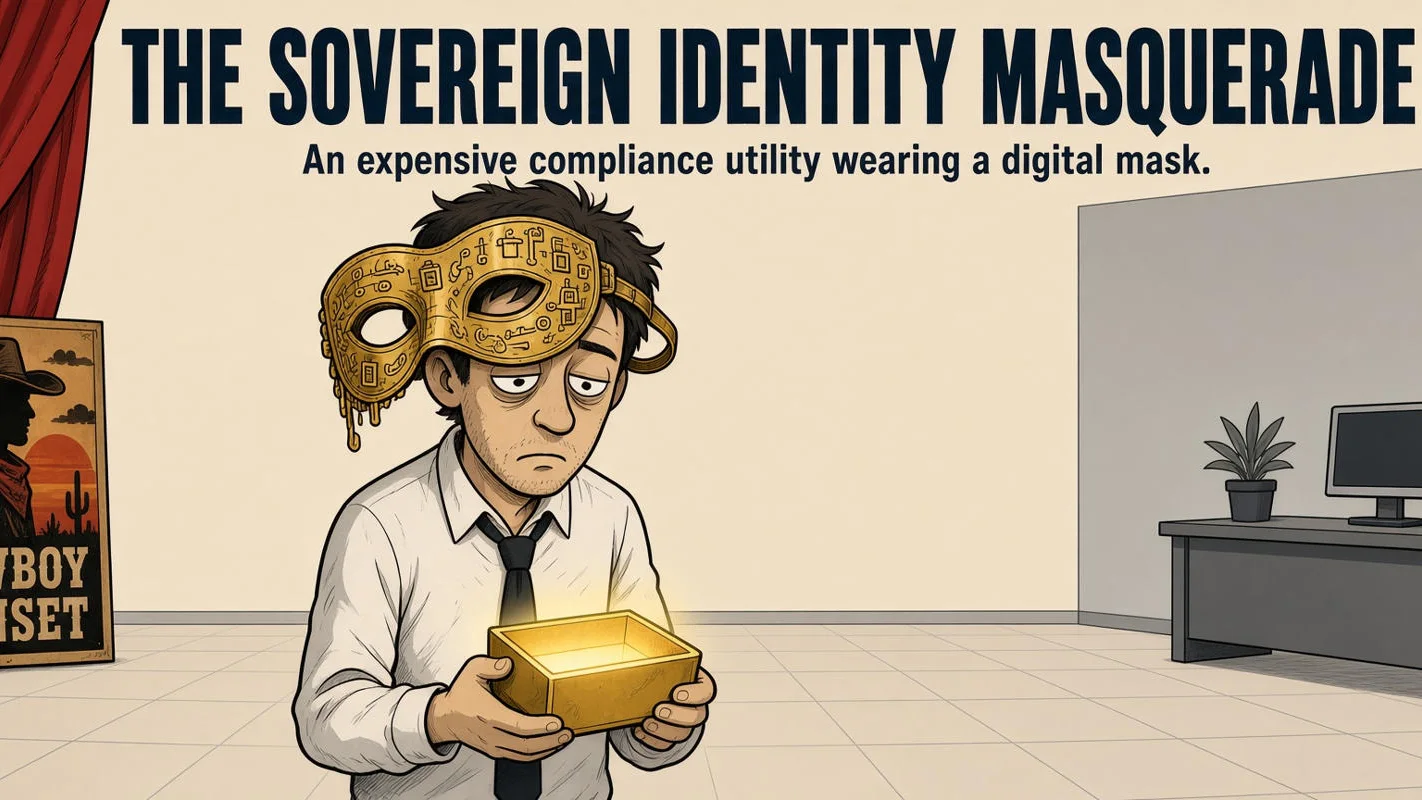
A man who tells you he can live in the civilized world without leaving a footprint is either selling snake oil or renting a costume. In the wilder territories of digital finance, this impulse has dressed itself up in the crisp terminology of self-sovereign identity. The sales brochure reads like a frontier romance: you walk untethered through the great digital expanse, carrying your deeds, degrees, and credit rating tucked neatly into your own cryptographic pocket. No corporate overseer holds your keys. No government bureaucrat rubber-stamps your existence. You are your own registrar, your own fortress, your own man.
It is an intoxicating bedtime story. Yet a balance sheet cannot survive on romance, and whenever I look past the rhetoric to inspect the underlying ledger, the numbers tell a much drabber tale. The entire production strikes me as little more than regulatory arbitrage in stage makeup, an attempt to sell ordinary administrative plumbing at the valuation of an empire.
The High Cost of an Unpaved Bridge
Consider the basic economics of building one of these sovereign identity networks. The initial capital expenditure is staggering. You must build out zero-knowledge proof engines, arrange complex consensus networks across disparate servers, hire auditors at extortionate hourly rates to comb through every cryptographic seam, and engineer foolproof key-recovery tools so an ordinary shopkeeper does not lose his entire life savings because he dropped his phone into a creek.
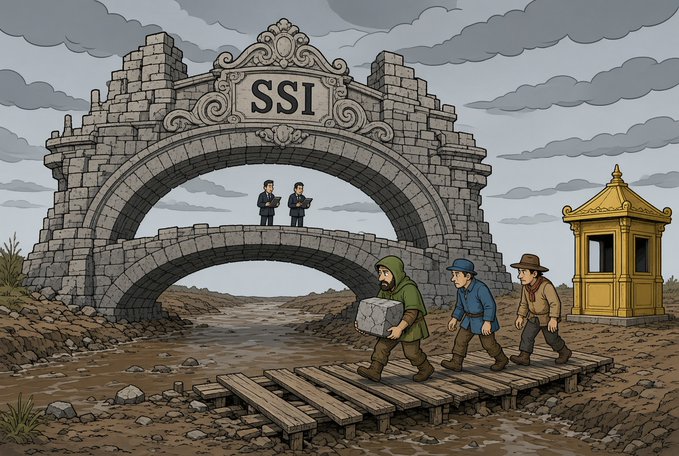
In the physical world, when you sink that much capital into a bridge, you erect a toll booth. You secure a right-of-way, you build heavy stone abutments, and you protect your margin because nobody can easily throw down a competing bridge five yards downriver. You have an economic moat.
In self-sovereign identity, that moat evaporates into thin air. The foundational philosophy demands open standards and portability. If a user can pack up their decentralized identifiers and walk over to a competing wallet in thirty seconds without dropping a cent, the operator has zero pricing power. You have constructed an extraordinarily complex, expensive bridge where the travelers cross for free and carry away your planks whenever the wind changes. High fixed costs paired with zero switching costs is not the blueprint of a commercial titan. It is the quickest way to empty a treasury.

The Sheriff Always Collects His Recourse
Even if an identity network manages to fund its plumbing through speculative token distributions, it eventually has to meet the town sheriff. That meeting happens the very instant someone attempts to conduct real commerce.
Modern commerce does not run on mathematical certainty; it runs on legal liability. When a bank lends half a million dollars for a brick-and-mortar storefront, or an insurance underwriter covers a maritime shipment, they do not care about the elegant poetry of a cryptographic signature. They care about jurisdiction. They demand to know who can be subpoenaed, whose assets can be attached, and who goes to court when the funds vanish in the dead of night.
You can drape an identity token in all the revolutionary rhetoric you please, but commerce requires a neck to put the noose around when a contract is broken.
The moment these sovereign networks touch a mortgage office, a municipal bond desk, or an international money transfer, the cold reality of anti-money laundering and know-your-customer statutes comes crashing through the window. The decentralized project discovers that its anonymous, sovereign users cannot actually borrow, lend, or transact with anyone who has something to lose.
What happens next is entirely predictable. The founders quietly retain legacy verification vendors to act as trusted bridges. They bolt on identity checkers, contract with traditional credit agencies, and submit to state oversight. Before the ink is dry, the fearless decentralized republic has quietly incorporated itself as an ordinary compliance subcontractor, complete with the standard corporate reporting obligations.
The Valuation Crash from Kingdom to Janitor
None of this implies that better cryptography is useless. Reducing identity theft, avoiding centralized honeypots where millions of social security numbers sit waiting for an overseas burglar, and giving individuals cleaner control over their digital breadcrumbs are genuine technical improvements. A well-designed deadbolt is a splendid thing.
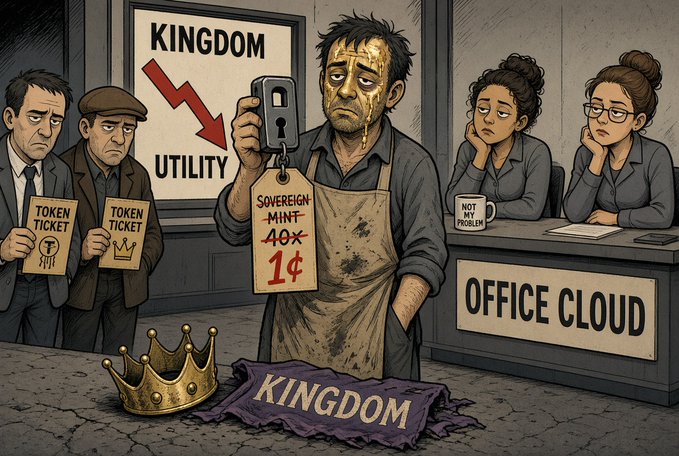
The trouble comes when the locksmith tries to price his deadbolts as though they were shares in the sovereign mint. Once you strip away the decentralized premium, what remains is an unglamorous, low-margin identity utility. Utilities do not command forty-times earnings. They grind along on fraction-of-a-cent fees, facing fierce competition from old-line credit bureaus and software giants who view identity not as an asset to be monetized, but as a loss leader to lock customers into their enterprise clouds.
The speculators who bought into the token sales believed they were financing a new form of human liberty. In the end, they funded an experimental research lab for the very compliance officers and institutional clearinghouses they swore to displace. When the dust settles and the stage makeup washes away, the ledger always balances itself against reality.