
The Lifting of the Digital Fog
It is often said that the truth is a slow traveler, but it arrives eventually, usually just as the last of the lanterns have burned out and the party-goers are nursing their headaches. Bankless' David Hoffman’s recent admission in his article, "ETH is Money Was Always a Longshot" (https://www.bankless.com/read/eth-is-money-was-always-a-longshot?ref=bankless.ghost.io), is a welcome, if tardy, moment of clarity. For those of us who prefer a ledger to a crystal ball, this isn't so much a revelation as it is a return to gravity.
For years, the digital corridors have been filled with the shouting of men trying to convince the world that a volatile, high-tech fuel could somehow serve as a steady store of value. It was a grand tale, told with the fervor of a tent revival, designed to keep the speculators from realizing they were buying into a utility company rather than a sovereign mint. Now that the fog is lifting, we can see the landscape for what it truly is.
The Yardstick vs. the Fuel
Money, in its most honest form, is a quiet and dependable yardstick. It is the boring constant by which all other things are measured. It does not require a software update to maintain its status, nor does it need a sophisticated marketing campaign to explain why it is valuable today compared to yesterday. If you have to spend your afternoons watching a flickering screen to see if your "money" is still worth a loaf of bread, you don't have a currency; you have a gamble.
Comparing Ethereum to a gold sovereign is like calling a bucket of coal a precious coin simply because you can trade it for a meal at the local tavern. The coal has value, certainly, as it provides warmth and powers the engines of industry, but it is a commodity, consumed in the process of its use. Ethereum is the fuel for a global computer, a necessary resource for those who wish to navigate the digital river. That makes it useful, but it does not make it money.
The Toll Bridge Reality
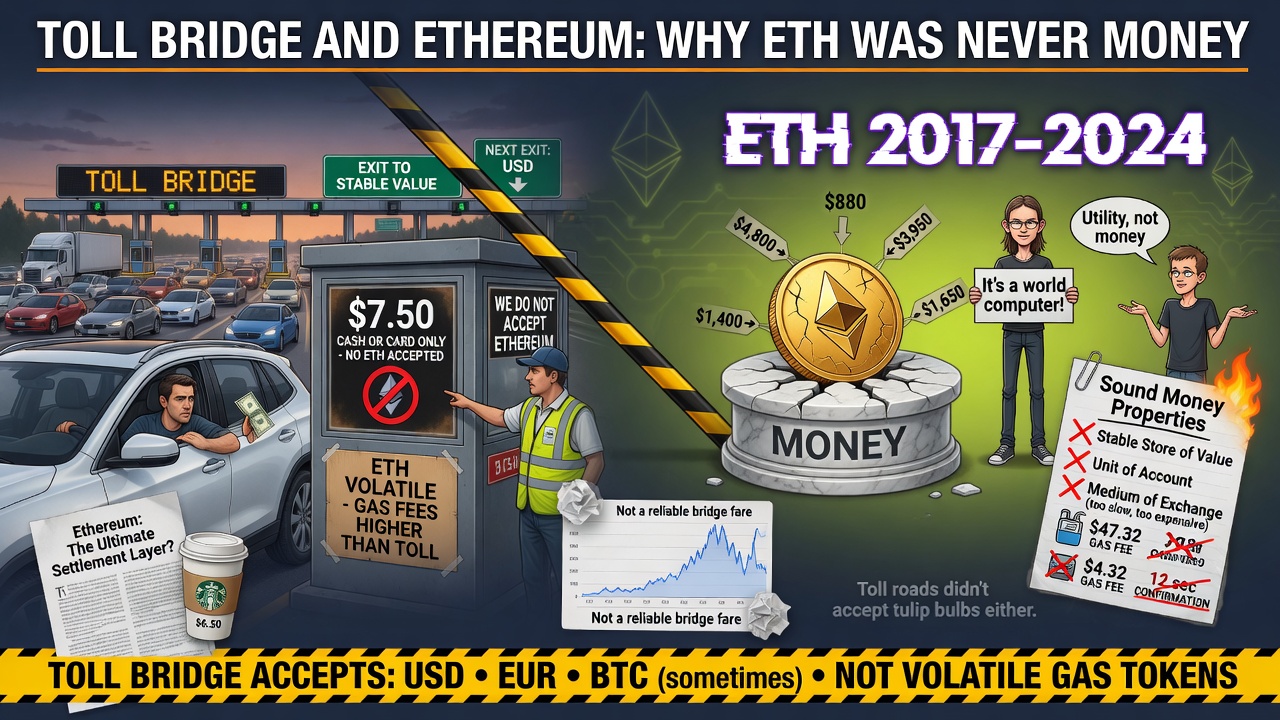
If we strip away the jargon and the breathless Twitter threads, Ethereum is best understood as a toll bridge. It is a piece of digital infrastructure that folks need to use to get their data and their assets from one side of the blockchain to the other. To cross that bridge, you must pay a fee in ETH. If you help maintain the stones of that bridge in what the tech-minded call "staking" you might even earn a little dividend for your trouble.
This is a perfectly respectable business model. In the physical world, we call these regulated utilities or infrastructure trusts. They are the backbone of commerce, and they can be very profitable for the patient investor. But no one goes around claiming that a share in a municipal water works or a stake in a turnpike is a global reserve currency. The value of a toll bridge is tied to how many people want to cross it, not to its aspirations of replacing the dollar.
The Cost of Marketing Over Math
The danger of the "ETH is Money" narrative was always the gap between the hype and the ledger. When you market a utility as a currency, you attract a class of person who isn't interested in the bridge, but in the hope that the bridge will somehow turn into a mountain of gold overnight. This leads to the wild swings and the "rug pulls" that have become the hallmark of the digital age.
"Ethereum is a toll bridge. It’s got real utility because folks need it to get across the digital river, and it even pays a little dividend if you help maintain the stones. But as a currency? That was always a tall tale."
When the narrative fails, the speculators flee, leaving the true believers to wonder why their "money" is suddenly worth half of what it was last Tuesday. It is better to be a good, sturdy bridge that provides a reliable service than a failing currency that no merchant in their right mind would accept for a long-term contract.
A Return to Tangible Value
It is time we stop chasing the phantom of digital sovereignty and start looking at these assets for what they actually provide. If Ethereum can settle transactions, host contracts, and provide a secure environment for digital trade, that is enough. It does not need the crown of "money" to be valuable. In fact, the sooner it sheds that ill-fitting garment, the sooner it can be judged on its actual merits: its cash flow, its usage rates, and its reliability.
In the end, we must remember that a mint produces value by decree, but a utility produces value by service. Ethereum has a chance to be a very fine utility indeed. Let the dreamers keep their digital gold; I’ll keep my eyes on the bridge and the tolls it collects. It’s better to own the road than to pray for the rain to turn into coins.