
This is Marcus Thornewood's response to a Zerohedge article, "Tokenization of H2O: Elites Are Claiming The World's Water Supply & Plan to Trade It"
https://www.zerohedge.com/geopolitical/tokenization-h2o-elites-are-claiming-worlds-water-supply-plan-trade-it
The Miracle-Peddlers and the New Sunday Best
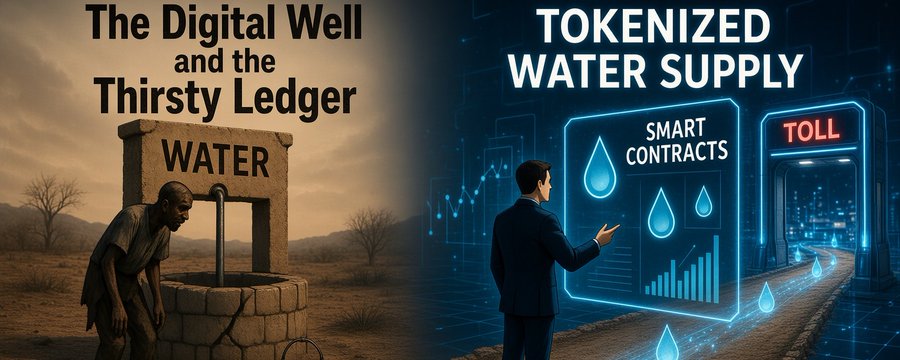
I’ve seen men try to sell the air and the sunshine before, but this new business of putting the world’s water supply on a blockchain takes the cake. They call it "tokenization," a word that sounds like it was cooked up in a boardroom by people who have never had to fix a leaky faucet or dig a trench. It is a tale as old as the hills, just dressed up in digital Sunday best. Every time some miracle-peddler finds a way to slap a new sticker on a basic necessity, they act as if they have discovered fire. To my eyes, it looks like a fancy way to put a new toll booth on the road to the town well.
The trouble with putting a life-essential commodity like water on a blockchain isn't the technology itself. It is the messy reality of the physical world. You can have a digital token that says you own ten thousand gallons of pristine mountain runoff, but if the local governor shuts the valve or the pipes are rusted through, that token is about as useful as a screen door on a submarine. We saw this same dance in the dot-com days when folks tried to disrupt everything from groceries to gravel. They forgot that someone still has to drive the truck and stock the shelves.
The Ledger vs. The Pipe
A ledger entry does not make the water flow, and it certainly does not create more of it. It just adds a layer of middleman fees and speculative froth to something that ought to be managed with a wrench and a sense of public duty, not a crypto exchange. When people talk about "democratizing access" through digital assets, they are usually building a more efficient engine for extraction. If you turn water into a liquid financial instrument that moves at the speed of a fiber-optic cable, you aren't helping the thirsty farmer in the field. You're just giving a trader in a glass tower a way to bet on that farmer’s misery from half a world away.
This is what I call "Real World Asset" theater. It’s a performance designed to make people believe that scarcity can be solved by better bookkeeping. But you cannot drink a line of code, and you cannot irrigate a crop with a hash rate. In my years watching these cycles, the more abstract an investment becomes, the further it drifts from its actual value. Water is valuable because it is wet and you need it to live, not because it can be traded on a 24-hour global exchange against a basket of dog-themed coins.
The Speculation of Thirst
The architects of these plans promise a future where every drop is accounted for and traded with "frictionless" ease. But friction is often what keeps a society from sliding into the abyss. When you remove the friction from trading life’s necessities, you invite the kind of volatility that destroys communities. Imagine a small town where the water rights are suddenly gobbled up by an algorithm in Singapore because the price of "H2O-Tokens" dipped by two percent. That isn't progress; it’s a nightmare disguised as innovation.
I have always been a fan of things you can hit with a hammer. If I buy a share in a company, I want to see their factories and their balance sheets. If you want to invest in water, buy a well or a utility company with actual pipes in the ground and a dividend history that isn't tied to a "utility token" launch. There is a certain dignity in an old-fashioned utility company. They have a physical obligation to the people they serve. A blockchain protocol has no such conscience. It only has logic, and logic without empathy is just another way to go broke.
The Dry Well of Digital Hype
As this movement to tokenize the planet gains steam, we would do well to remember that the most valuable things in life are often the least digital. The elites who want to claim the world's water supply are not doing it to save the environment. They are doing it because they have run out of other things to financialize. They have turned houses into investment vehicles and now they are coming for the kitchen sink.
Stick to the fundamentals. If an investment requires you to learn a whole new vocabulary just to understand how you're being fleeced, it’s best to keep your hands in your pockets. I’ll keep my money in things that produce a tangible result—things that grow, things that flow, and things that don't vanish when the power goes out. Anything else is just buying a ticket to a show that is likely to end with a dry well and a very light wallet.