
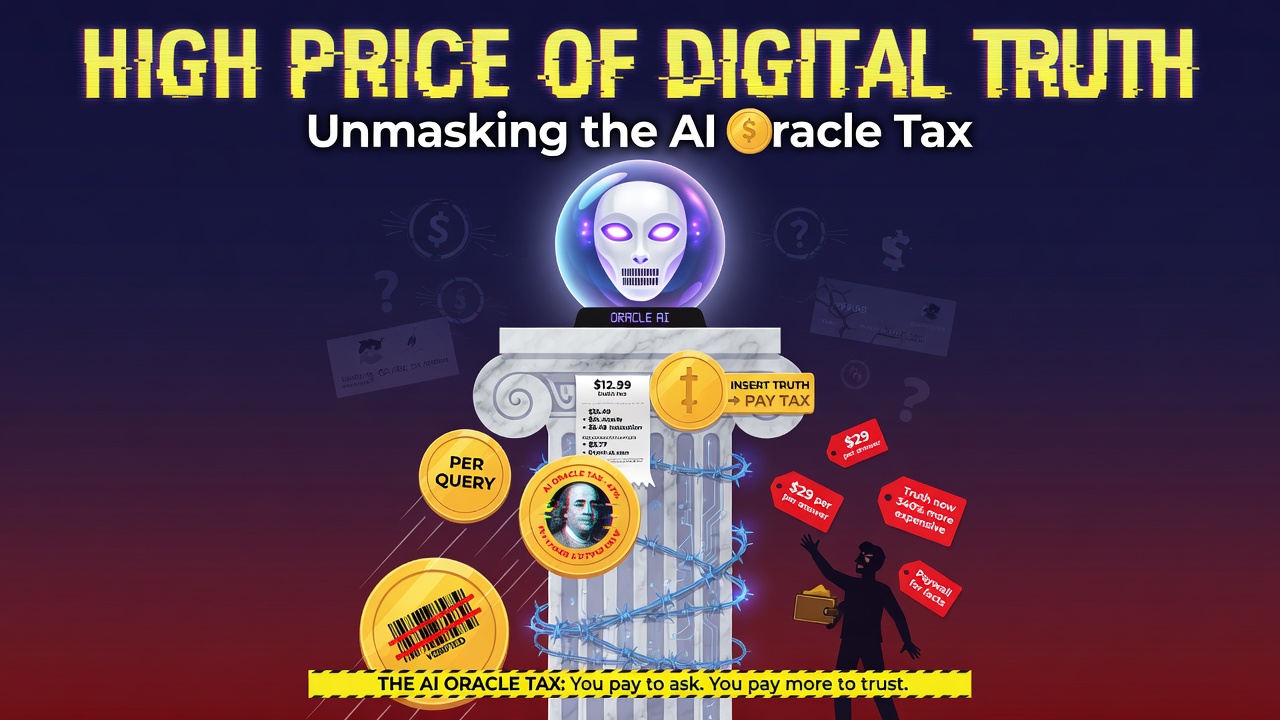
Well now, the miracle-peddlers have found a new way to dress up an old bill. They’re hollering about "AI x Crypto" like they’ve finally figured out how to turn a spreadsheet into a soul, but if you peel back the shiny foil, you’ll find something much more mundane: a utility bill. You see, the grand promise of a blockchain was that it was an immutable "source of truth." But a blockchain, in its heart of hearts, is really just a very expensive, very stubborn ledger. It doesn't know the price of wheat in Kansas, the humidity in a London warehouse, or who won the ballgame unless someone tells it.
Now that the industry is trying to shove complex AI models into smart contracts, we’ve collectively realized that the blockchain isn't nearly smart enough to do the math itself. We have to outsource that "thinking" to off-chain models. It’s a classic case of the spirit being willing but the hardware being weak. This brings us to what I call the "AI Oracle Tax", a surcharge on reality that most projects are currently hiding behind a thick fog of venture capital and token-fueled subsidies.
The Verifiable Compute Surcharge
If you want a smart contract to act on an AI’s output, you have to prove that the AI didn't just make it up, or worse, that some developer didn't tweak the dial to steal your lunch money. This is where "verifiable compute" and Zero-Knowledge (ZK) proofs come in. To the uninitiated, it sounds like digital sorcery. To an old-school investor, it sounds like hiring a private investigator to watch your watchman. It’s technically impressive, certainly, but it’s a heavy, slow, and remarkably expensive way to run a railroad.
"We are essentially turning every 'decentralized' app into a high-margin subscription service. In the traditional world, we call this the "Bloomberg Tax". It's the high price you pay for reliable data.
These ZK-proofs move with the speed of cold molasses and eat up compute cycles like a hog in a cornfield. Every time a contract asks for an AI-generated insight, someone has to pay for the massive computational effort required to prove that the calculation was honest. Currently, we’re pretending this is a "feature," but once the subsidies run dry, it becomes a line-item expense that could bankrupt a project faster than a bad harvest.
The Incentive Problem: Bribes vs. Reputation
The incentive problem is even thornier than the technical one. An oracle provider, the entity that delivers the "truth" from the outside world to the blockchain, is only as honest as the cost of their reputation. If a smart contract is guarding a hundred million dollars, and the cost to bribe the oracle or manipulate the off-chain compute is only ten million, you don’t need a degree in high finance to see where the "truth" is going to land.
In the traditional markets, we have regulators and centuries of contract law to keep the data providers honest. In the digital wild west, we have math. But math is expensive, and as we’ve seen with every speculative bubble in history, people will happily trade accuracy for a quick profit if the price of verification is too high. The risk of manipulation remains the elephant in the room that no one wants to talk about while they're busy printing new tokens.
Finding the Margin of Safety among the Plumbers
If you’re looking for a margin of safety in this fog, stop looking at the "visionaries" and start looking at the plumbers. The only folks who’ll be left standing when the hype-train derails are the infrastructure providers with actual revenue models. They are the ones charging real fees for real compute, not just printing "utility tokens" that have all the lasting value of a soap bubble. They behave like a proper utility company, collecting payment for a service rendered rather than hoping for a miracle. Chainlink, Akash Network and Arweave are examples of these plumbers.
In my recent observations within the pages of Digitally Deluded, I’ve noted that the Confluence Agentic Systems ecosystem stands out as one of the few places attempting to merge these digital assets with real-world value and tangible assets. They seem to understand that if a project can’t survive without a constant pump in its token price to pay its own electricity bill, it isn't a revolution; it's just another house of cards waiting for a breeze.
Red Flags for the Skeptical Investor:
- Token-Only Revenue: If the project pays its bills by selling its own printed tokens rather than collecting fees from users, the clock is ticking.
- Opaque Verification Costs: If they won't tell you what it costs to generate a proof, it's because the cost is higher than the value provided.
- The "Magic" Narrative: Any project that uses the word "seamless" to describe AI-blockchain integration is likely hiding a massive, expensive manual process or an unscalable subsidy.
In conclusion, the intersection of AI and blockchain isn't a free lunch. It's an expensive, high-stakes game of verifying the unverifiable. Until we see infrastructure that can reliably provide truth without the "truth tax" eating the entire profit margin, I’ll keep my feet planted in the world of tangible returns and real-world assets. Stick to the plumbers who know how to keep the pipes from leaking, and let the dreamers drown in their own digital fog.
*** - none of the mentioned companies represent financial advice. DYOR.