



The Lunar Fracture
There had always been a distance between the Earth and the Moon.
Not emptiness. Not truly.
There was gravity there. There was orbit. There was mathematics. There were numbers that generations of children had learned before they learned the names of nations. Distance. Mass. Period. Velocity. Things that could be written down, checked, trusted.
For most of human history, the Moon had been the simplest promise in the sky.
It rose.
It changed.
It returned.
Then the ruptures came.
At first, people had tried to name them as if naming could contain them. Local metric failures. Spatial discontinuities. Temporal drift zones. Geometric collapse events. Each term sounded cleaner than the footage that followed: roads folding into rivers that had dried a century earlier, apartment towers opening into foreign deserts, trains arriving before they departed, children speaking with the voices of their older selves.
The public called them ruptures.
That word stayed because everyone understood it. Something had torn.
For years, the ruptures had been disasters of cities and borders. They appeared in streets, factories, farms, mountain passes, refugee corridors, abandoned military zones. They swallowed neighborhoods and left behind impossible rooms. They turned maps into suggestions. They made rescue teams carry clocks that could no longer agree with one another.
Humanity adapted, because humanity always adapted.
There were sirens now for metric instability. Schools taught children how to recognize a ghost path. Every major city had rupture shelters below its transit stations. Insurance contracts contained collapse clauses. Newscasters spoke of Stability Indexes with the same tired seriousness their ancestors had once reserved for storms.
But the Halo was different.
The Halo did not appear in a street.
It did not consume a district, or a battlefield, or a forgotten laboratory sealed beneath the old world.
It appeared in the sky.
Around the Moon.
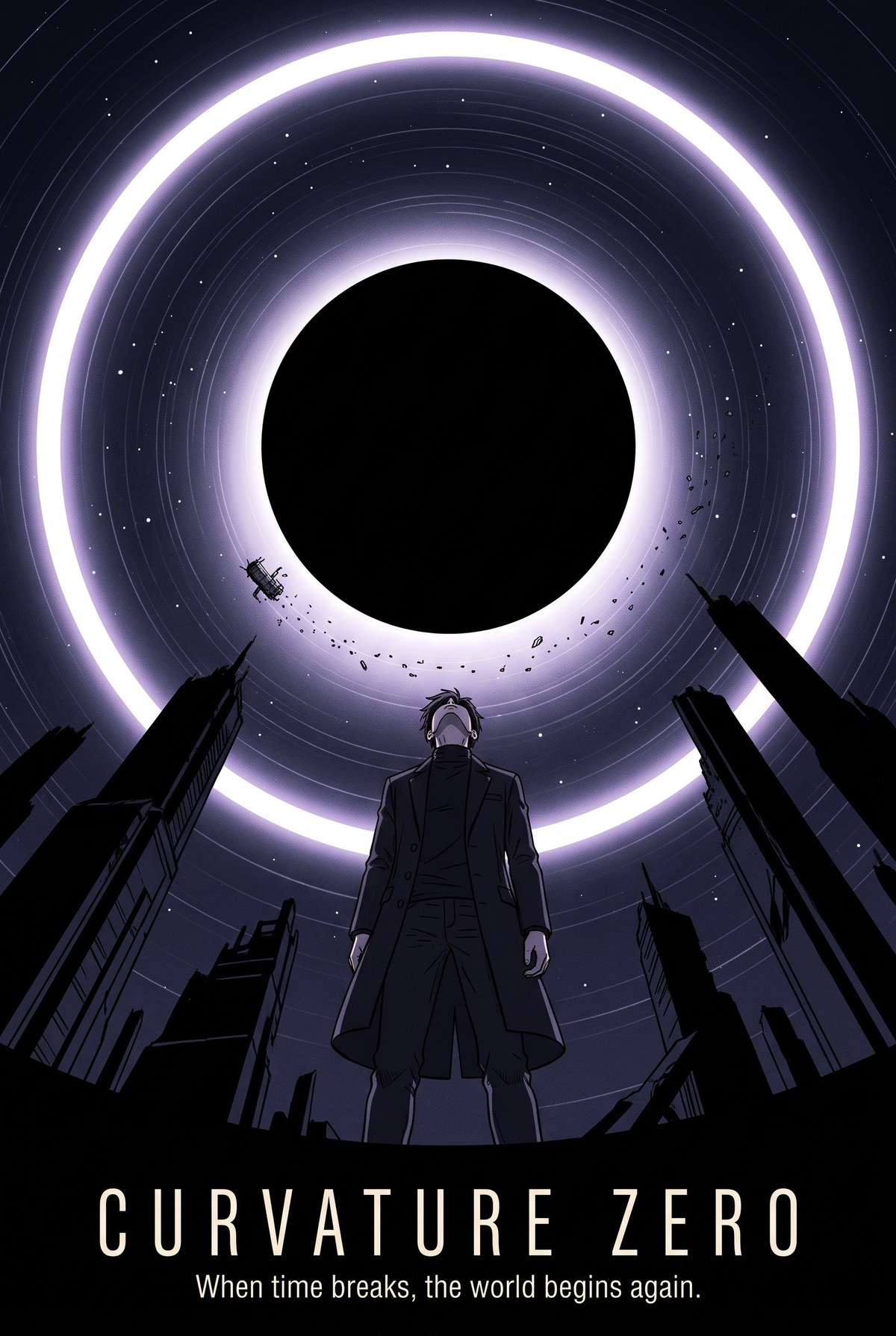
The Moon was no longer a silver coin above the Earth. It had become a fractured eye, surrounded by a swirling iris of distorted light. Some nights it looked almost beautiful. Other nights people refused to look up at all.
The official designation was the Lunar Fracture.
No one called it that outside government briefings.
The world called it the Halo.
It was stable enough to be watched. Large enough to dominate the night. Strange enough to unsettle the planet. Important enough that even the great powers, suspicious and wounded after the war, had agreed to send a mission.
Not a military strike.
Not yet.
A mapping mission.
The ERV Kepler carried no warheads, no kinetic rods, no experimental containment weapons. It carried old pressure hulls, refurbished life-support systems, chemical engines, sensor masts, gravity interferometers, quantum timing arrays, external probe drones, and a crew of twelve scientists, pilots, engineers, and mission specialists who had been told the same thing in six different languages:
Observe.
Measure.
Return.
The Kepler was not a miracle of the new age. It was a relic made useful again: a narrow, patched-together orbital research vessel assembled from surviving pre-war modules, old launch hardware, rugged computers, stripped emergency systems, and a handful of experimental rupture instruments bolted wherever the engineers could make room. Its engines were chemical. Its displays flickered. Its escape module was a desperate thing, built to survive reentry, not spacetime collapse.
Humanity had not come to the Halo as master of the heavens.
It had come with damaged tools, incomplete science, and the stubborn belief that looking away would be worse.
Kai Neumann stood at the forward observation panel with one hand resting lightly against the frame.
He was twenty-three years old, a doctoral candidate from the Northern Accord, and the youngest person aboard by nearly a decade. He had finished school early, moved through university faster than was healthy, and earned a place on the mission because his models had done what older systems could not: they had described the Halo without pretending it was ordinary.
He was still new enough to space that part of him felt ashamed by how beautiful it was.
Earth curved below them in blue and white, wrapped in cloud bands and storm scars. The continents were partly hidden beneath weather systems, but Kai could still trace the old shapes. North America, where the Northern Accord had rebuilt its research cities from the bones of colder nations. The drowned coasts. The inland lights. The thin glimmer of orbital debris fields that had once been satellite constellations before the Halo began pulling at them like loose threads.
Ahead, the Moon waited.
No, Kai thought.
Not waited.
Watched.
The thought was irrational, so he dismissed it. Then he watched the Halo bend a line of background stars into a crescent and felt the thought return.
“Kai,” said a voice behind him. “You’re staring again.”
He turned.
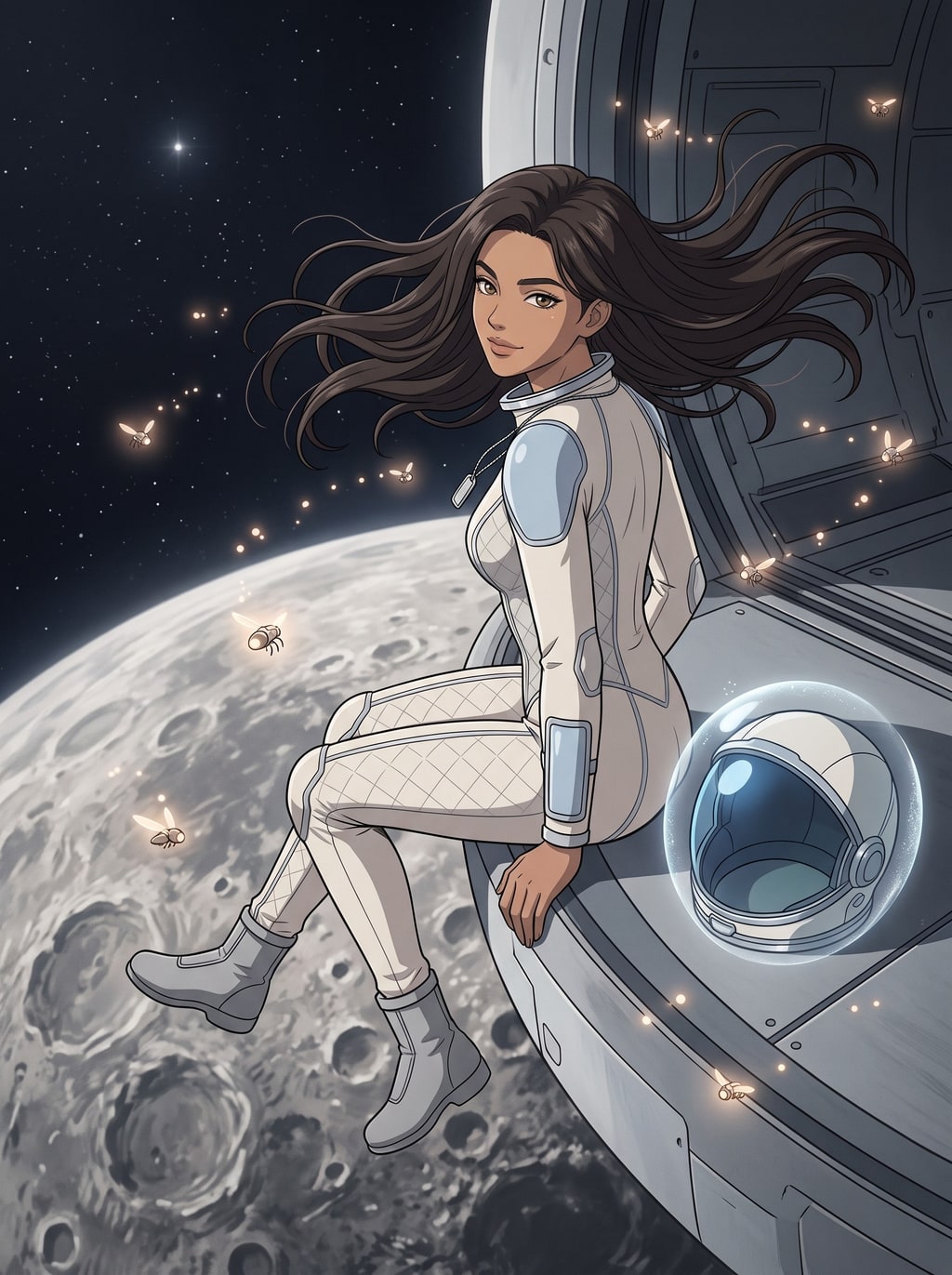
Lucy Serrano floated near the central console, one boot locked under a restraint, a tablet braced against her forearm. Her dark hair was pulled tight against her head in the practical style everyone used in low gravity, though several strands had escaped and drifted around her face.
She was smiling, but her eyes were on the telemetry.
“I’m observing,” Kai said.
“That is what people say when they’re staring.”
“I wrote three papers on gravitational lensing. I’m professionally allowed to stare.”
“Three papers and one extremely unpopular mission proposal.”
“It became popular eventually.”
“Only because command decided the alternative was admitting they were afraid of the Moon.”
Kai looked back toward the observation panel.
The Moon filled more of the view than it should have. Not physically. The range numbers still placed it safely beyond the hazard boundary, but the visual field disagreed. Its surface shimmered behind layers of distorted light. Craters stretched, contracted, vanished, then returned slightly displaced, as if the eye could not decide where its own scars belonged.
Around it, the Halo rotated without rotating.
That was the phrase Kai had used in his private notes. It was not scientific. It was not even precise. But it was the closest language had come to what he saw.
The ring did not spin like a wheel. It did not pulse like plasma. It did not behave like a gravitational lens, an accretion structure, or an electromagnetic storm.
Parts of it moved before other parts had moved. Arcs of light appeared to cross the ring, then arrived at the place they had crossed from. The interior shadow changed angle without reference to the Sun. Once every few minutes, the entire structure seemed to flatten into a line so thin it should have disappeared, only to unfold again into depth.
A wound pretending to be geometry.
“Telemetry is slipping again,” Lucy said.
Kai pushed himself from the window and drifted back toward his console. “By how much?”
“Three seconds on array four. Seven on array two. Array six says negative two.”
“That’s timestamp drift, not telemetry slip.”
“I know what timestamp drift is.”
“I know you know.”
“Then don’t use your teaching voice.”
Kai caught the edge of his station and pulled himself into the restraint. The console recognized his palmprint, then opened into layered displays: local gravity gradients, optical distortion maps, neutrino noise, signal delay, hull stress, clock divergence, external drone positioning.
The data should have been difficult.
Instead, it was impossible.
Across the screen, the Halo’s boundary resolved into a set of nested curves that refused to share a center. The ship’s distance from the Lunar Fracture changed depending on which sensor reported it. One array placed the Kepler outside the caution perimeter. Another placed it inside. A third insisted that the ship had already crossed the boundary nine minutes ago.
Kai’s fingers moved quickly.
“Run a reconciliation pass,” Lucy said.
“Already running.”
“Use the Accord model?”
“The Accord model assumes continuous metric deformation.”
“So use the Atlantic one.”
“The Atlantic one assumes hostile interference.”
“Eastern Coalition?”
“That one assumes we are already dead.”
Lucy glanced at him.
Kai did not smile.
The bridge lights dimmed once, then returned.
At the command station, Captain Osei’s voice came calm over the internal channel.
“All stations, report.”
“Navigation holding,” said Pilot Karim. “But inertial reference is drifting.”
“Life support nominal,” said Engineer Volkov.
“External drones one through twelve are awake,” Lucy said. “Thirteen through twenty are waiting on launch authorization.”
“Science station?” Osei asked.
Kai studied the curves.
For one strange second, he had the sensation that the console was not showing the Halo. It was showing a shadow cast by something behind the Halo. A pattern too large to fit into the measurements, pressing itself into data the way a hand might press against cloth.
“Science station,” Osei repeated.
Kai swallowed.
“Boundary behavior is outside all three models,” he said. “Not unstable yet, but non-classical.”
There was a pause across the bridge. Everyone aboard knew what non-classical meant. It was the polite word used when physics had not failed, but had stopped speaking in familiar grammar.
Captain Osei turned slightly in his chair.
“Are we safe to continue?”
Kai looked at Lucy. She had stopped smiling.
He looked back at the telemetry.
The mission rules were clear. If the Stability Index dropped below threshold, they would abort. If gravity shear exceeded tolerance, they would abort. If communication latency crossed the hard limit, they would release probes, reverse burn, and leave.
All their thresholds assumed the ship and the rupture existed in the same kind of space.
That assumption had begun to feel sentimental.
“We are safe to continue for one mapping pass,” Kai said carefully. “But we should not go closer.”
Osei nodded once.
“Navigation, maintain distance. Lucy, prepare external drones. Neumann, you have one pass.”
The bridge became motion.
Commands moved from station to station. The Kepler adjusted orientation with short, soft bursts from its maneuvering thrusters. Twelve external drones detached from the hull and spread forward in a crescent, their tiny engines flickering like fireflies against the dark.
Kai watched their signals populate the map.
Probe One: stable.
Probe Two: stable.
Probe Three: stable.
The Halo brightened.
Not in visible light. Not exactly. The observation panel darkened automatically, then corrected, then darkened again. A violet sheen passed through the ring, followed by a cold silver flicker that made the Moon’s fractured surface look wet.
“Did anyone else see that?” Lucy asked.
“Yes,” said Karim.
“No spike in radiation,” Volkov said. “No thermal event.”
“Optical only?” Osei asked.
Kai enlarged the drone feed.
Each probe saw a different Halo.
Probe One showed the ring as an almost perfect circle.
Probe Two showed it as a spiral.
Probe Three showed nothing at all, only the Moon, whole and untouched, as it had looked before the first rupture.
Kai felt the hairs rise along his arms.
“Probe Three is compromised,” Lucy said.
“No,” Kai said quietly.
She turned toward him. “No?”
“It’s not compromised. It’s seeing a different solution.”
“A different what?”
“A different geometry.”
On the main display, Probe Three’s view flickered. The whole Moon remained visible for another heartbeat, silver and calm, untouched by fracture. Then something moved across it from the inside.
A shadow opened where no shadow should have been.
Probe Three vanished from the map.
No explosion.
No debris.
No warning.
Just gone.
The bridge fell silent.
Then every alarm on the Kepler began screaming at once.
“Gravity shear!” Karim shouted. “We’re being pulled off attitude!”
“We are not moving,” Volkov snapped. “Thrusters show zero drift.”
“Navigation says we are!”
“Navigation is wrong!”
“Both of you,” Osei said. “Report what you know, not what you think.”
Kai locked both hands against the edge of his console as the ship groaned.
The sound moved through the hull like an animal waking up.
On the display, the Halo expanded.
No. Not expanded.
The distance between the Kepler and the Halo was decreasing while neither object moved. The space between them was folding inward, reducing itself in steps. One moment they were at safe range. The next, they were closer. Then closer again.
Distance did not mean what it used to.
“Kai,” Lucy said.
“I see it.”
“Can we model it?”
“No.”
“Can we survive it?”
He did not answer quickly enough.
The ship lurched.
For a moment, the bridge became longer than it should have been. Kai saw Captain Osei’s station stretch away from him down a corridor of repeating lights. Lucy stood only three meters away, but the space between them seemed to contain a dozen reflections of the same room, each slightly delayed.
In one reflection, Lucy was turning toward him.
In another, she was already shouting.
In another, her station was empty.
Then the bridge snapped back into place.
A crew member screamed.
Kai twisted in his restraint.
Engineer Volkov’s right hand was still on the life support panel. The rest of him was not.
No blood. No torn suit. No impact.
His hand floated there, fingers still curved around the rail, ending at the wrist in a clean absence that was more horrifying than injury.
Someone vomited.
Osei’s voice cut through the panic.
“Abort mission. Navigation, reverse burn. Lucy, retrieve surviving drones. Neumann, find me a vector out.”
Kai tried to move, but his hands had gone cold.
Volkov had been there.
Volkov had been speaking.
Volkov had been a person, and then the universe had edited him out.
“Kai!” Lucy shouted.
He forced his eyes back to the console.
The ship’s map had become a flower of impossible routes. Some vectors led back toward Earth. Some led into the Moon. Some led to locations that had no coordinates. One route began behind the ship, curved through the Halo, and ended at the ship’s present position before it had started.
Kai killed the display and rebuilt it from raw timing data.
The clocks were useless.
He killed those too.
“What are you doing?” Lucy asked.
“Removing everything that assumes sequence.”
“That’s all of navigation.”
“Yes.”
He stripped the model down to signal coherence, hull strain, local acceleration, and the last stable drone pings. If time could not be trusted, perhaps relation could. If distance could not be trusted, perhaps distortion could. Not where were they, but how badly were they being bent.
The answer formed slowly.
A narrow valley of lower shear opened beneath the Halo’s leading edge. Not safe. Not stable. But less impossible than the rest.
“There,” Kai said. “Vector twelve degrees below lunar plane, burn against the shear, not away from the Halo.”
Karim stared at the numbers. “That points us closer.”
“It points us through the fold.”
“That is closer.”
“No. Closer is not a useful word anymore.”
Osei did not hesitate.
“Execute Neumann’s vector.”
Karim’s hands moved.
The Kepler fired its engines.
For half a second, nothing happened.
Then the universe bent.
Kai’s body pressed hard into the restraint. The bridge lights stretched into white lines. The Moon slid sideways without moving. Earth vanished from the observation panel, replaced by a black plane filled with points of light arranged in a grid too perfect to be stars.
Something looked back through the Halo.
Kai did not see a face.
That would have been easier.
He saw intention.
A shape without shape. A darkness structured like thought. A vast pressure behind the wounded light, folding matter and signal and mind toward itself because it did not know the difference between touching and consuming.
The Presence.
He would not name it for years. Not in reports. Not in testimony. Not even to himself.
But some part of him named it then.
The thing inside the Halo noticed the Kepler.
And reached.
The forward half of the bridge disappeared.
Captain Osei vanished mid-command.
Karim’s chair folded inward with him still strapped to it. The main display became a vertical ocean of light. A wall panel opened onto a childhood bedroom Kai had never seen. Somewhere, someone was singing in a language that had not been spoken for two hundred years.
Lucy grabbed Kai’s harness and pulled.
“We have to go!”
“The data core,” Kai said.
“Kai!”
“The data core!”
“If you stay, you die with it!”
He looked at her.
For a heartbeat, she was not his colleague. She was the only human thing left in a room being taken apart by a god that did not know it was killing them.
Then she punched the emergency release on his restraint.
Pain cracked across his shoulder as the harness snapped open. Lucy dragged him free and kicked toward the aft hatch.
Behind them, the observation panel showed the Halo opening wider.
Not like a door.
Like an eye.
The corridor beyond the bridge had become too long. Emergency lights repeated into darkness. The floor curved up where it should have continued straight. A pressure door halfway down the passage opened and closed in slow, silent rhythm, revealing not the next compartment but a field of gray dust under a black sky.
The lunar surface.
Lucy did not slow.
“Don’t look,” she said.
Kai looked anyway.
On the dust beyond the door, a figure stood in an old pressure suit, facing away from them. The suit bore the mission patch of a space program that had ended before Kai was born.
The figure raised one hand.
The pressure door slammed shut.
Lucy shoved Kai into the escape module.
The module was not meant for this. It was a short-range rescue craft, barely more than a pressurized shell with emergency thrust, heat shielding, and a beacon. It could return them to low orbit if launched from the proper angle.
They were no longer at the proper angle to anything.
Lucy strapped him in with shaking hands.
“What about you?” Kai said.
“I’m right behind you.”
“Lucy.”
“I’m right behind you.”
The module hatch began to close.
Kai reached for her.
The ship groaned again, louder this time. Metal screamed somewhere beyond the hatch. The corridor behind Lucy folded into a bright, impossible line. For one instant, Kai saw the bridge, the Moon, Earth, the inside of the Halo, and a city street burning in rain, all occupying the same narrow slice of space.
Lucy looked back.
Something in her expression changed.
Not fear.
Recognition.
“Kai,” she said, and her voice was suddenly very calm. “When you get home, don’t let them call it random.”
The hatch sealed between them.
“No,” Kai said.
He struck the release. It did not open.
The module’s emergency systems took over. Bolts fired. The rescue craft tore free from the Kepler with a violence that drove the breath from his lungs.
Through the small rear viewport, Kai saw the ship.
For a moment, the ERV Kepler hung whole against the Halo, a small human shape before the broken Moon.
Then the ring opened around it.
The Kepler stretched, not into pieces, but into moments. Its bow existed seconds ahead of its stern. Its engines burned before its fuel lines ignited. Its sensor mast became a thread of light. Deck by deck, frame by frame, it was drawn into the dark geometry inside the Halo.
The rescue module spun.
Kai glimpsed Lucy’s beacon.
One pulse.
Then another.
Then the signal bent backward and arrived before it had been sent.
The last thing he saw before losing consciousness was the Moon, fractured and watching, surrounded by its iris of impossible light.
For the first time in history, humanity had touched the Halo.
The Halo had touched back.
Not emptiness. Not truly.
There was gravity there. There was orbit. There was mathematics. There were numbers that generations of children had learned before they learned the names of nations. Distance. Mass. Period. Velocity. Things that could be written down, checked, trusted.
For most of human history, the Moon had been the simplest promise in the sky.
It rose.
It changed.
It returned.
Then the ruptures came.
At first, people had tried to name them as if naming could contain them. Local metric failures. Spatial discontinuities. Temporal drift zones. Geometric collapse events. Each term sounded cleaner than the footage that followed: roads folding into rivers that had dried a century earlier, apartment towers opening into foreign deserts, trains arriving before they departed, children speaking with the voices of their older selves.
The public called them ruptures.
That word stayed because everyone understood it. Something had torn.
For years, the ruptures had been disasters of cities and borders. They appeared in streets, factories, farms, mountain passes, refugee corridors, abandoned military zones. They swallowed neighborhoods and left behind impossible rooms. They turned maps into suggestions. They made rescue teams carry clocks that could no longer agree with one another.
Humanity adapted, because humanity always adapted.
There were sirens now for metric instability. Schools taught children how to recognize a ghost path. Every major city had rupture shelters below its transit stations. Insurance contracts contained collapse clauses. Newscasters spoke of Stability Indexes with the same tired seriousness their ancestors had once reserved for storms.
But the Halo was different.
The Halo did not appear in a street.
It did not consume a district, or a battlefield, or a forgotten laboratory sealed beneath the old world.
It appeared in the sky.
Around the Moon.
The Moon was no longer a silver coin above the Earth. It had become a fractured eye, surrounded by a swirling iris of distorted light. Some nights it looked almost beautiful. Other nights people refused to look up at all.
The official designation was the Lunar Fracture.
No one called it that outside government briefings.
The world called it the Halo.
It was stable enough to be watched. Large enough to dominate the night. Strange enough to unsettle the planet. Important enough that even the great powers, suspicious and wounded after the war, had agreed to send a mission.
Not a military strike.
Not yet.
A mapping mission.
The ERV Kepler carried no warheads, no kinetic rods, no experimental containment weapons. It carried old pressure hulls, refurbished life-support systems, chemical engines, sensor masts, gravity interferometers, quantum timing arrays, external probe drones, and a crew of twelve scientists, pilots, engineers, and mission specialists who had been told the same thing in six different languages:
Observe.
Measure.
Return.
The Kepler was not a miracle of the new age. It was a relic made useful again: a narrow, patched-together orbital research vessel assembled from surviving pre-war modules, old launch hardware, rugged computers, stripped emergency systems, and a handful of experimental rupture instruments bolted wherever the engineers could make room. Its engines were chemical. Its displays flickered. Its escape module was a desperate thing, built to survive reentry, not spacetime collapse.
Humanity had not come to the Halo as master of the heavens.
It had come with damaged tools, incomplete science, and the stubborn belief that looking away would be worse.
Kai Neumann stood at the forward observation panel with one hand resting lightly against the frame.
He was twenty-three years old, a doctoral candidate from the Northern Accord, and the youngest person aboard by nearly a decade. He had finished school early, moved through university faster than was healthy, and earned a place on the mission because his models had done what older systems could not: they had described the Halo without pretending it was ordinary.
He was still new enough to space that part of him felt ashamed by how beautiful it was.
Earth curved below them in blue and white, wrapped in cloud bands and storm scars. The continents were partly hidden beneath weather systems, but Kai could still trace the old shapes. North America, where the Northern Accord had rebuilt its research cities from the bones of colder nations. The drowned coasts. The inland lights. The thin glimmer of orbital debris fields that had once been satellite constellations before the Halo began pulling at them like loose threads.
Ahead, the Moon waited.
No, Kai thought.
Not waited.
Watched.
The thought was irrational, so he dismissed it. Then he watched the Halo bend a line of background stars into a crescent and felt the thought return.
“Kai,” said a voice behind him. “You’re staring again.”
He turned.
Lucy Serrano floated near the central console, one boot locked under a restraint, a tablet braced against her forearm. Her dark hair was pulled tight against her head in the practical style everyone used in low gravity, though several strands had escaped and drifted around her face.
She was smiling, but her eyes were on the telemetry.
“I’m observing,” Kai said.
“That is what people say when they’re staring.”
“I wrote three papers on gravitational lensing. I’m professionally allowed to stare.”
“Three papers and one extremely unpopular mission proposal.”
“It became popular eventually.”
“Only because command decided the alternative was admitting they were afraid of the Moon.”
Kai looked back toward the observation panel.
The Moon filled more of the view than it should have. Not physically. The range numbers still placed it safely beyond the hazard boundary, but the visual field disagreed. Its surface shimmered behind layers of distorted light. Craters stretched, contracted, vanished, then returned slightly displaced, as if the eye could not decide where its own scars belonged.
Around it, the Halo rotated without rotating.
That was the phrase Kai had used in his private notes. It was not scientific. It was not even precise. But it was the closest language had come to what he saw.
The ring did not spin like a wheel. It did not pulse like plasma. It did not behave like a gravitational lens, an accretion structure, or an electromagnetic storm.
Parts of it moved before other parts had moved. Arcs of light appeared to cross the ring, then arrived at the place they had crossed from. The interior shadow changed angle without reference to the Sun. Once every few minutes, the entire structure seemed to flatten into a line so thin it should have disappeared, only to unfold again into depth.
A wound pretending to be geometry.
“Telemetry is slipping again,” Lucy said.
Kai pushed himself from the window and drifted back toward his console. “By how much?”
“Three seconds on array four. Seven on array two. Array six says negative two.”
“That’s timestamp drift, not telemetry slip.”
“I know what timestamp drift is.”
“I know you know.”
“Then don’t use your teaching voice.”
Kai caught the edge of his station and pulled himself into the restraint. The console recognized his palmprint, then opened into layered displays: local gravity gradients, optical distortion maps, neutrino noise, signal delay, hull stress, clock divergence, external drone positioning.
The data should have been difficult.
Instead, it was impossible.
Across the screen, the Halo’s boundary resolved into a set of nested curves that refused to share a center. The ship’s distance from the Lunar Fracture changed depending on which sensor reported it. One array placed the Kepler outside the caution perimeter. Another placed it inside. A third insisted that the ship had already crossed the boundary nine minutes ago.
Kai’s fingers moved quickly.
“Run a reconciliation pass,” Lucy said.
“Already running.”
“Use the Accord model?”
“The Accord model assumes continuous metric deformation.”
“So use the Atlantic one.”
“The Atlantic one assumes hostile interference.”
“Eastern Coalition?”
“That one assumes we are already dead.”
Lucy glanced at him.
Kai did not smile.
The bridge lights dimmed once, then returned.
At the command station, Captain Osei’s voice came calm over the internal channel.
“All stations, report.”
“Navigation holding,” said Pilot Karim. “But inertial reference is drifting.”
“Life support nominal,” said Engineer Volkov.
“External drones one through twelve are awake,” Lucy said. “Thirteen through twenty are waiting on launch authorization.”
“Science station?” Osei asked.
Kai studied the curves.
For one strange second, he had the sensation that the console was not showing the Halo. It was showing a shadow cast by something behind the Halo. A pattern too large to fit into the measurements, pressing itself into data the way a hand might press against cloth.
“Science station,” Osei repeated.
Kai swallowed.
“Boundary behavior is outside all three models,” he said. “Not unstable yet, but non-classical.”
There was a pause across the bridge. Everyone aboard knew what non-classical meant. It was the polite word used when physics had not failed, but had stopped speaking in familiar grammar.
Captain Osei turned slightly in his chair.
“Are we safe to continue?”
Kai looked at Lucy. She had stopped smiling.
He looked back at the telemetry.
The mission rules were clear. If the Stability Index dropped below threshold, they would abort. If gravity shear exceeded tolerance, they would abort. If communication latency crossed the hard limit, they would release probes, reverse burn, and leave.
All their thresholds assumed the ship and the rupture existed in the same kind of space.
That assumption had begun to feel sentimental.
“We are safe to continue for one mapping pass,” Kai said carefully. “But we should not go closer.”
Osei nodded once.
“Navigation, maintain distance. Lucy, prepare external drones. Neumann, you have one pass.”
The bridge became motion.
Commands moved from station to station. The Kepler adjusted orientation with short, soft bursts from its maneuvering thrusters. Twelve external drones detached from the hull and spread forward in a crescent, their tiny engines flickering like fireflies against the dark.
Kai watched their signals populate the map.
Probe One: stable.
Probe Two: stable.
Probe Three: stable.
The Halo brightened.
Not in visible light. Not exactly. The observation panel darkened automatically, then corrected, then darkened again. A violet sheen passed through the ring, followed by a cold silver flicker that made the Moon’s fractured surface look wet.
“Did anyone else see that?” Lucy asked.
“Yes,” said Karim.
“No spike in radiation,” Volkov said. “No thermal event.”
“Optical only?” Osei asked.
Kai enlarged the drone feed.
Each probe saw a different Halo.
Probe One showed the ring as an almost perfect circle.
Probe Two showed it as a spiral.
Probe Three showed nothing at all, only the Moon, whole and untouched, as it had looked before the first rupture.
Kai felt the hairs rise along his arms.
“Probe Three is compromised,” Lucy said.
“No,” Kai said quietly.
She turned toward him. “No?”
“It’s not compromised. It’s seeing a different solution.”
“A different what?”
“A different geometry.”
On the main display, Probe Three’s view flickered. The whole Moon remained visible for another heartbeat, silver and calm, untouched by fracture. Then something moved across it from the inside.
A shadow opened where no shadow should have been.
Probe Three vanished from the map.
No explosion.
No debris.
No warning.
Just gone.
The bridge fell silent.
Then every alarm on the Kepler began screaming at once.
“Gravity shear!” Karim shouted. “We’re being pulled off attitude!”
“We are not moving,” Volkov snapped. “Thrusters show zero drift.”
“Navigation says we are!”
“Navigation is wrong!”
“Both of you,” Osei said. “Report what you know, not what you think.”
Kai locked both hands against the edge of his console as the ship groaned.
The sound moved through the hull like an animal waking up.
On the display, the Halo expanded.
No. Not expanded.
The distance between the Kepler and the Halo was decreasing while neither object moved. The space between them was folding inward, reducing itself in steps. One moment they were at safe range. The next, they were closer. Then closer again.
Distance did not mean what it used to.
“Kai,” Lucy said.
“I see it.”
“Can we model it?”
“No.”
“Can we survive it?”
He did not answer quickly enough.
The ship lurched.
For a moment, the bridge became longer than it should have been. Kai saw Captain Osei’s station stretch away from him down a corridor of repeating lights. Lucy stood only three meters away, but the space between them seemed to contain a dozen reflections of the same room, each slightly delayed.
In one reflection, Lucy was turning toward him.
In another, she was already shouting.
In another, her station was empty.
Then the bridge snapped back into place.
A crew member screamed.
Kai twisted in his restraint.
Engineer Volkov’s right hand was still on the life support panel. The rest of him was not.
No blood. No torn suit. No impact.
His hand floated there, fingers still curved around the rail, ending at the wrist in a clean absence that was more horrifying than injury.
Someone vomited.
Osei’s voice cut through the panic.
“Abort mission. Navigation, reverse burn. Lucy, retrieve surviving drones. Neumann, find me a vector out.”
Kai tried to move, but his hands had gone cold.
Volkov had been there.
Volkov had been speaking.
Volkov had been a person, and then the universe had edited him out.
“Kai!” Lucy shouted.
He forced his eyes back to the console.
The ship’s map had become a flower of impossible routes. Some vectors led back toward Earth. Some led into the Moon. Some led to locations that had no coordinates. One route began behind the ship, curved through the Halo, and ended at the ship’s present position before it had started.
Kai killed the display and rebuilt it from raw timing data.
The clocks were useless.
He killed those too.
“What are you doing?” Lucy asked.
“Removing everything that assumes sequence.”
“That’s all of navigation.”
“Yes.”
He stripped the model down to signal coherence, hull strain, local acceleration, and the last stable drone pings. If time could not be trusted, perhaps relation could. If distance could not be trusted, perhaps distortion could. Not where were they, but how badly were they being bent.
The answer formed slowly.
A narrow valley of lower shear opened beneath the Halo’s leading edge. Not safe. Not stable. But less impossible than the rest.
“There,” Kai said. “Vector twelve degrees below lunar plane, burn against the shear, not away from the Halo.”
Karim stared at the numbers. “That points us closer.”
“It points us through the fold.”
“That is closer.”
“No. Closer is not a useful word anymore.”
Osei did not hesitate.
“Execute Neumann’s vector.”
Karim’s hands moved.
The Kepler fired its engines.
For half a second, nothing happened.
Then the universe bent.
Kai’s body pressed hard into the restraint. The bridge lights stretched into white lines. The Moon slid sideways without moving. Earth vanished from the observation panel, replaced by a black plane filled with points of light arranged in a grid too perfect to be stars.
Something looked back through the Halo.
Kai did not see a face.
That would have been easier.
He saw intention.
A shape without shape. A darkness structured like thought. A vast pressure behind the wounded light, folding matter and signal and mind toward itself because it did not know the difference between touching and consuming.
The Presence.
He would not name it for years. Not in reports. Not in testimony. Not even to himself.
But some part of him named it then.
The thing inside the Halo noticed the Kepler.
And reached.
The forward half of the bridge disappeared.
Captain Osei vanished mid-command.
Karim’s chair folded inward with him still strapped to it. The main display became a vertical ocean of light. A wall panel opened onto a childhood bedroom Kai had never seen. Somewhere, someone was singing in a language that had not been spoken for two hundred years.
Lucy grabbed Kai’s harness and pulled.
“We have to go!”
“The data core,” Kai said.
“Kai!”
“The data core!”
“If you stay, you die with it!”
He looked at her.
For a heartbeat, she was not his colleague. She was the only human thing left in a room being taken apart by a god that did not know it was killing them.
Then she punched the emergency release on his restraint.
Pain cracked across his shoulder as the harness snapped open. Lucy dragged him free and kicked toward the aft hatch.
Behind them, the observation panel showed the Halo opening wider.
Not like a door.
Like an eye.
The corridor beyond the bridge had become too long. Emergency lights repeated into darkness. The floor curved up where it should have continued straight. A pressure door halfway down the passage opened and closed in slow, silent rhythm, revealing not the next compartment but a field of gray dust under a black sky.
The lunar surface.
Lucy did not slow.
“Don’t look,” she said.
Kai looked anyway.
On the dust beyond the door, a figure stood in an old pressure suit, facing away from them. The suit bore the mission patch of a space program that had ended before Kai was born.
The figure raised one hand.
The pressure door slammed shut.
Lucy shoved Kai into the escape module.
The module was not meant for this. It was a short-range rescue craft, barely more than a pressurized shell with emergency thrust, heat shielding, and a beacon. It could return them to low orbit if launched from the proper angle.
They were no longer at the proper angle to anything.
Lucy strapped him in with shaking hands.
“What about you?” Kai said.
“I’m right behind you.”
“Lucy.”
“I’m right behind you.”
The module hatch began to close.
Kai reached for her.
The ship groaned again, louder this time. Metal screamed somewhere beyond the hatch. The corridor behind Lucy folded into a bright, impossible line. For one instant, Kai saw the bridge, the Moon, Earth, the inside of the Halo, and a city street burning in rain, all occupying the same narrow slice of space.
Lucy looked back.
Something in her expression changed.
Not fear.
Recognition.
“Kai,” she said, and her voice was suddenly very calm. “When you get home, don’t let them call it random.”
The hatch sealed between them.
“No,” Kai said.
He struck the release. It did not open.
The module’s emergency systems took over. Bolts fired. The rescue craft tore free from the Kepler with a violence that drove the breath from his lungs.
Through the small rear viewport, Kai saw the ship.
For a moment, the ERV Kepler hung whole against the Halo, a small human shape before the broken Moon.
Then the ring opened around it.
The Kepler stretched, not into pieces, but into moments. Its bow existed seconds ahead of its stern. Its engines burned before its fuel lines ignited. Its sensor mast became a thread of light. Deck by deck, frame by frame, it was drawn into the dark geometry inside the Halo.
The rescue module spun.
Kai glimpsed Lucy’s beacon.
One pulse.
Then another.
Then the signal bent backward and arrived before it had been sent.
The last thing he saw before losing consciousness was the Moon, fractured and watching, surrounded by its iris of impossible light.
For the first time in history, humanity had touched the Halo.
The Halo had touched back.