






 by Zenna LoneStar

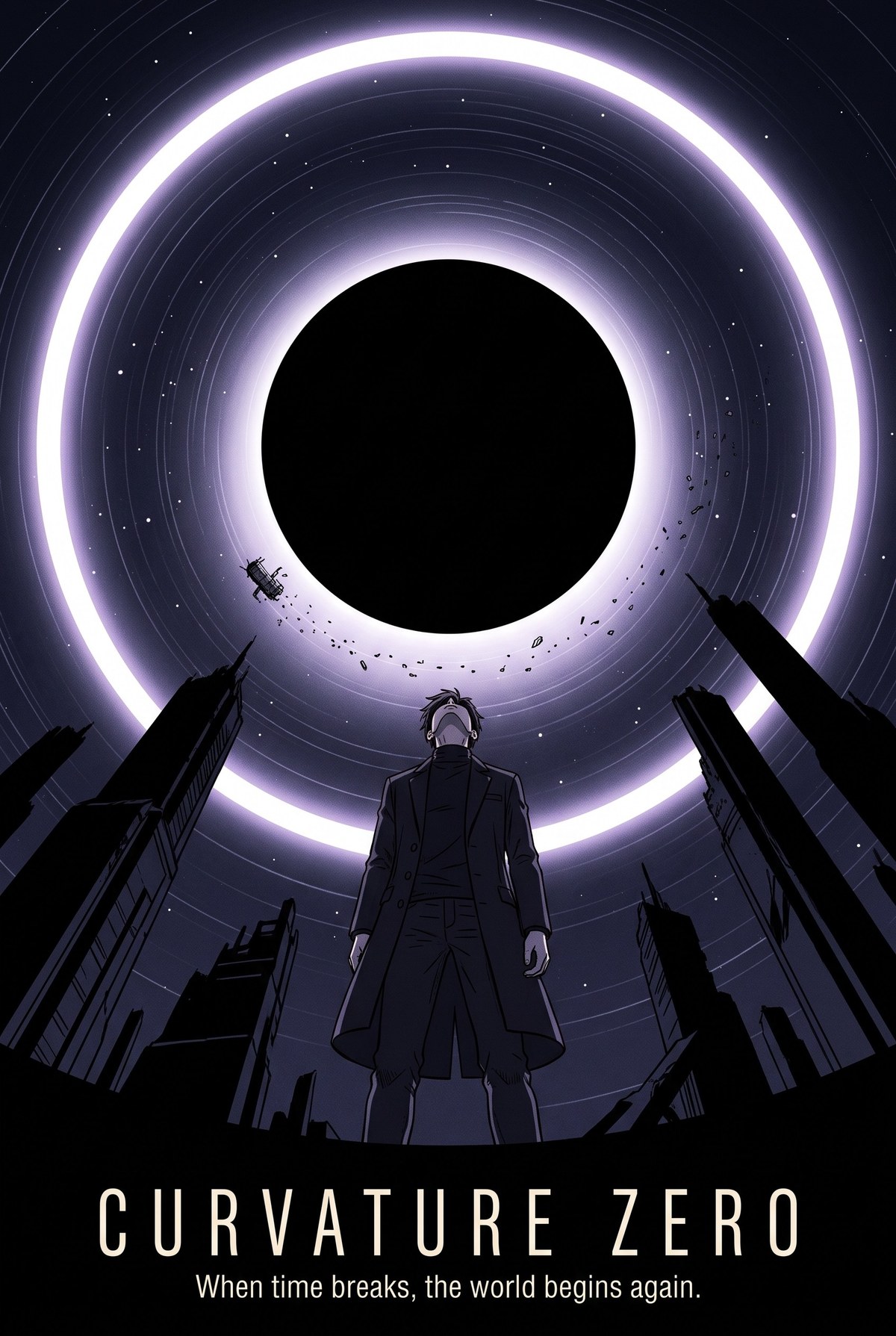


"The rupture does not advance; it insists. It is the arrival of an elsewhere that was already here."
From The Kepler Inquiry: Closed Depositions, Accord Ministry of Defence, 2121
The recovery cutter found Module Three on the twenty-second day, riding a swell in the North Atlantic with its parachute trailing behind it like a drowned sheet. By then had played 's three pings back to himself some four hundred times. He had worked out that the third one arrived 1.2 seconds before the second was sent, and that no fault in a beacon could do that. He had stopped eating on the thirteenth day because there was nothing left to eat.
The hearings took three months. They were held in rooms without windows in Geneva and Halifax, and officials from three governments sat behind long tables and asked him to describe things their own instruments refused to confirm. He kept coming back to the clocks. The ones at the front and back of the ship had disagreed by 0.37 seconds on the first pass and by three full minutes at the end, yet both tested perfect on the bench afterwards. Then he told them about the fold he had steered the ship into, and the bridge that had grown longer while the gauges on the hull read nothing at all, and Volkov's hand on the rail.
On the sixth day a Coalition rear admiral with a pen he never wrote with asked whether the crew had panicked.
"No, sir."
"Your pilot reversed thrust toward the anomaly. Toward it, Dr. Neumann."
"On my instruction. There was a channel under the front rim where the pull cancelled out. It was the only way out."
"You were twenty-three, a doctoral candidate, and you were giving the pilot instructions." The admiral looked down the table at the Accord delegate, who looked at her water. "And how did you know where this channel was, with every clock on the ship in disagreement?"
"I stopped using the clocks."
"I see." He made the pen click. "And the Serrano woman. Specialist Serrano. Did she panic?"
told him about at the hatch: the staging lever, the two berths, her face turning toward the light. Then he repeated her last sentence word for word, because it was evidence, and because nobody else in the room had heard it.
The stenographer typed it. Nobody looked up. The admiral turned a page and asked about the engine logs.
When the inquiry published, the finding had four parts: catastrophic mission failure, unrecoverable crew loss, instrumental inconsistency, survivor trauma. The newsfeeds put it more briefly and called it a disaster and a cover-up, and then, when would not stop talking about clocks, they called him mad. The committees preferred uncertainty. Uncertainty did not accuse any procurement board of buying forty-year-old hulls, or any ministry of sending twelve people to look at something nobody understood. Random meant the dead could remain dead, instead of becoming evidence.
He had one thing they had not taken from him, because it had been in his pocket the whole time: an old Canadian five-dollar gold piece, struck in 1912, with the King's face worn soft. His grandfather had kept it in a tobacco tin on a shelf above the stove, and had given it to at fifteen with the instruction never to spend it on anything he could eat. It had gone to the Moon and back in the thigh pocket of his flight suit. In the hearing rooms he held it while he talked, because it was the only object in Geneva that had been there.
Back in Montreal, after everything he had been through, the McGill physics department was ready to let him take a gentler road. His supervisor, Dr. Chen, said as much in the first week of 2121, standing in the door of the basement clock laboratory with his coat still on: a careful study of the old pre-mission predictions would be more than enough for a doctorate, and nobody would think less of him for it. tried it for six weeks. Then he deleted the drafts and started again from what had survived in the module's storage banks.
It was very little. Damaged readings, a few broken pings from the lost probes, hull stress figures that spiked and then dropped below zero, which no metal can do, and four seconds of 's emergency signal bent through time so badly that three Accord signal laboratories had catalogued it as junk. thought it was wounded. That was not an engineering term, so he never wrote it in a margin.
He built the doctorate on one question. If the Halo was random, why had the instruments failed in the same order twice? On the way out, and again on the mapping pass, the cameras and then the hull's heat gauges had picked up the same faint 1.4-megahertz ripple, in the same order and at the same spacing, before anything else went wrong. 's signal had bent along a curve that matched the path of Drone Four, which had died forty seconds earlier and three kilometres away. Pure chance does not repeat itself step for step. This one had, and the pattern underneath was faint and ugly and full of holes, and it was not noise.
On the morning of the defence the committee nearly sent it back. One examiner called it reckless. Another pointed out that three of his main results rested on data the Accord had stamped unverified artifact. The third was an older physicist who had lost two students on the space platforms in the war, and he took his spectacles off before he spoke, which had learned meant he was about to be kind and it was going to be worse.
"Dr. Neumann. Is it possible you have mistaken the burden of having survived for an empirical result?"
had his hands flat on the lectern. He had spent his anger in Geneva and had none left for a man who was asking honestly.
"The numbers do not care why I survived, sir," he said. "They only record that the door stayed open for twenty-one seconds. I am trying to measure the hinge."
Dr. Chen asked the hardest technical questions in the room that morning, three of them, each one a gap in the proof that had not quite closed. Afterwards he stayed behind for two hours with a red pencil and closed them with him. That was how McGill was kind: nobody said anything. His office was left unlocked after hours. An administrator misfiled a budget query twice so his stipend would not lapse during the committee's deadlock. On a Tuesday night in February, when the snow was up against the basement windows and he had forgotten whether he had eaten, someone left a tin of green tea beside his terminal and did not sign it.
The dean asked whether he would amend the abstract to describe the strange readings as simple measuring errors. said no. The faculty senate changed the title twice until it was dull enough to pass: Non-Classical Correlation Structures in Lunar Fracture Mission Telemetry. He was twenty-five when they gave him the doctorate. A year later the name on the door at the end of a third-floor corridor read Dr. K. Neumann, Assistant Professor of Metric Instability and Applied Spacetime Systems, and someone he never identified had put a jade plant on the sill.
By then he was teaching. He taught first-years the names of the rupture types, because names gave fear a fence around it: drift, overlap, collapse, shear, dead zones, ghost paths, echoes. His students wrote Ruptures 101 on the spines of their notebooks and were frightened of him for about three weeks, until they worked out that he never mocked a wrong answer and answered email at three in the morning. He did not tell them he was awake anyway.
At night he worked on his prediction system. For the first month the project was called LUCY. In the second month he renamed it, because he did not want to turn her into a machine that failed every night. The name he settled on was colder: MECN-7, the Metric Event Correlation Network, seventh architecture. It ran on borrowed computer time and on old machines that colleagues carted up the stairs, and its cables were labelled with masking tape in his small handwriting.
Every lab on Earth had tried to predict ruptures by feeding computers earthquake records, air pressure and gravity readings. Every one of them could explain a rupture beautifully after it happened, and none could see one coming. stopped asking where the next rupture would open. He asked where the world had already begun to disagree with itself. A caesium clock in a bunker in Bern running six milliseconds slow with nothing wrong with it. Two weather buoys in the Atlantic whose radio link arrived a fraction of a beat out of step, which should have been impossible. An intensive care ward in Sendai where four monitors lost network sync at precisely 03:14:02, and the hospital logged it as a power fault. Each one was the kind of glitch any sensible system throws away. Together, he thought, they might be a grammar: the language the world spoke before it tore. He wrote one phrase on the slate in the corner of the office and never rubbed it out: prediction as listening.
For two years MECN-7 listened and heard nothing. It found patterns everywhere and none of them came true.
In the second autumn it flagged a grain dome in southern Alberta at 68 percent, onset between four and five in the afternoon. He did not tell the Anomalies Desk. He flew to Lethbridge on his own money, rented a car with a cracked windscreen, and stood in a stubble field four hundred metres from the dome with a borrowed parka zipped to his chin and three clocks in a foam case at his feet. At half past three the farmer came out in a pickup, looked at the clocks, and asked him what he was waiting for.
"A rupture," said. "Possibly."
"Here?"
"Possibly."
The farmer considered the dome, which held eleven thousand tonnes of his wheat. "If it's possibly," he said, "do I move the truck?"
did the arithmetic on sixty-eight percent and a man's livelihood and found he could not give him an answer that was worth anything. "Move the truck," he said.
The farmer moved the truck. At five the sun went down behind the dome, and at six the farmer came back with a thermos of coffee and two cups and stood with him while the clocks agreed with each other to the nanosecond, and the dome went on being a dome. Neither of them said anything about it. In the morning flew home, rebuilt the system from the bottom, threw out four months of bad records, and lost three weeks of Coalition data to a dead drive. He swore once, very quietly, into a coffee cup.
On the night of the seventeenth of March, 2126, he was grading second-year exams. The question he had set was the one he set every year: Define a ghost path and explain why civilian entry is prohibited even when the visible boundary appears stable. Most of the students copied the Accord safety code back to him, word for word. One had written in blue ballpoint: Because a road that goes somewhere impossible may not bring you back to the same version of home.
looked at it for half a minute and gave it full marks.
At 02:14 MECN-7 chimed. He had chosen the tone himself, two pure notes at 880 and 1,320 hertz, the kind of sound a library might make, because he had heard enough klaxons for a lifetime. The centre monitor woke and drew North America, then the Southwest, then a pale red circle over an empty basin in New Mexico, sixty kilometres east of an old military exclusion zone and eleven kilometres from the nearest paved road.
MECN-7 had produced thousands of circles in two years. They flickered and died when he looked at them. This one held still.
He pulled the keyboard over and opened the feeds underneath it. Two weather stations in the high desert, eighteen kilometres apart, had drifted four milliseconds apart in three hours, though each one kept time by its own atomic clock. A satellite passing over the basin had lost sixteen lines of its picture. A dead fibre cable, cut fifty years ago in the riots, was sending back echoes from equipment that no longer existed. A deep borehole had recorded the ground shaking while nothing in it moved: energy, and no motion. None of it would have woken anyone at the Civil Anomalies Desk.
Predicted onset, 18 March, 03:40 to 03:52 local. Radius 112 metres. Small event, minor clock drift, civilian risk minimal. Confidence 61.8 percent.
Sixty-one point eight was nothing. Nobody in the Accord would sign anything on sixty-one percent, and , who had flown to Alberta on sixty-eight, knew exactly what it was worth. So he spent the next fifty minutes trying to kill it. He stripped out the amateur radio logs, and the confidence fell, then climbed back almost to sixty on the clocks and the cable alone. He deleted the satellite's lost lines, and the circle slid a few metres north-east, tightened, and held. He took out the borehole record. He reset every setting to the harsh standards the Geneva Institute's reviewers had demanded when they rejected his last grant. The program rebuilt itself, the screen went blank for a second, and the red circle came back in the same place.
At 03:09 he opened a channel to the Northern Accord Civil Anomalies Desk in Montreal and typed: Potential low-risk rupture. Uninhabited desert sector, New Mexico basin. No civilian warning recommended. Request passive observation only. He looked at the last sentence for a long time and deleted it. In its place he wrote: I may be wrong.
The system gave him a green tick. The desk handled fourteen thousand anomaly reports a day, from failing transformers to farmers who said the Moon spoke to them through their pipes, and nobody answered.
He opened the public satellite feed. It was grainy and forty seconds late and smeared with cirrus: an ash-grey basin of hardpan and creosote under moonlight, and a dry ditch running through it like a white wire. At 03:37 the image tore along a diagonal and recovered. He checked the log. No data had been lost. At 03:41 the shadow of a winding riverbed appeared across the clay where the survey maps from 1998 showed no watercourse at all.
At 03:43 the desert folded.
There was no flash on the feed and, he imagined, no sound in the desert. A circle of ground about a hundred metres wide simply ceased to be singular. The scrub darkened and paled and then showed two surfaces in one place: the dry basin under the Moon, and shallow clear water running over dark stones under a midday sun, with black birds low over it. For seven seconds both of them were there, pressed together and shivering. Then the water slid out through a crease in nothing, and the birds went with it, and the basin lay dry under the Moon with a fresh trench cut through it, its banks sheer and clean.
MECN-7 posted the update. Observed onset 03:43:18. Predicted window confirmed. Radius error 6.4 metres.
did not move for some time. On the floor by his left shoe lay the red pen he had been grading with; he did not remember dropping it. When he stood, he went to the window and put his forehead on the cold glass. The campus was buried in snow, the lamps making amber pools on drifts nobody had walked through, and above the cloud the broken Moon was dragging its ring around the world.
He had expected to feel vindicated. What he felt was the arithmetic. If MECN-7 worked, the Halo had a grammar, and the Kepler had died inside something that could have been read. Every committee that had found the word random so restful had been resting on eleven people.
At 08:10 his phone lit with a message from Dr. Chen, who had not written to him in four months: I saw the timestamps. Call me when you are ready.
He was not ready. He went home, slept four hours in his clothes, and came back.
The second and third circles appeared that afternoon, small and soon: one at an abandoned coastal defence site in the Atlantic Federation, one under a restored industrial district in the Eastern Coalition. The Federation event opened in a flooded bunker and closed before anyone arrived. The Coalition event shoved a maintenance tunnel three metres sideways and sealed two workers behind a wall of bedrock that had not existed the night before. They were dug out alive by nine in the evening. By then 's inbox held two hundred messages and he had stopped opening them.
He sat in the dark office with the desk lamp off and the light of three monitors on the ceiling. Beside the keyboard a mug of tea had gone cold with a skin on it. Snow went past the tall gothic window in long slants, and in the park below, under the lamps, a small crowd from the Folded Dawn stood in a circle in the snow, singing a hymn too thin to hear through the glass, faces turned up toward a Moon none of them could see.
The fourth priority call in an hour was from Ottawa. He took it.
The woman on the screen had not slept either. Her collar was undone, the Accord seal dull on her lapel, grey hair cut flat at the jaw. "Dr. Neumann. Ingrid Halvorsen, Research Directorate. Are you alone?"
looked round the office: the server towers, the jade plant, the map of the Halo curling off the wall where the tape had dried. "Yes."
"We need to know whether your system can reproduce these forecasts."
"It already has. Three times."
"Our request for the architecture went to your department this afternoon. The data, the code, the settings. The Ministry of Defence would like it classified before the Federation asks for it, and the Federation asked for it at noon."
"It's on an open repository," said. "It has been for two years. Nobody downloaded it."
She was quiet for a moment. He watched her decide whether that was arrogance or carelessness and settle, from long practice, on neither.
"Then I'll be blunt, since you're going to make me be. Three small events, Doctor, two of them where nobody lives, is a curiosity. Half the Directorate thinks you got lucky, and the other half thinks you got lucky three times. I need to know whether it works on something bigger."
There was a file he had not opened. It had arrived at 23:52 and had been pulsing amber in the corner of the centre screen while he watched the snow, and he had let it pulse because he had seen the size of the attachment. He opened it now.
The render drew itself over the Eastern Coalition. It was a city: a river with a hard bend in it, rail lines, elevated expressways, and the yellow shading that marked where people lived, loading block by block across towers and markets and schools. The red bloom that settled over the middle of it was not a hundred metres wide.
Confidence 74.3 percent. Estimated onset: seventeen days. Estimated population at risk: 412,000.
He pressed the back of his hand to his mouth.
"Dr. Neumann." Halvorsen leaned toward her camera. "What are you seeing?"
He thought about the room in Geneva and the stenographer's hands, and the admiral asking about the engine logs. He took his hand away from his mouth.
"I am seeing the next rupture," said.
Behind him the snow kept falling over Montreal, past the window and the singers in the park, and on the centre screen the red bloom over the river city went on loading, one block of people at a time.