
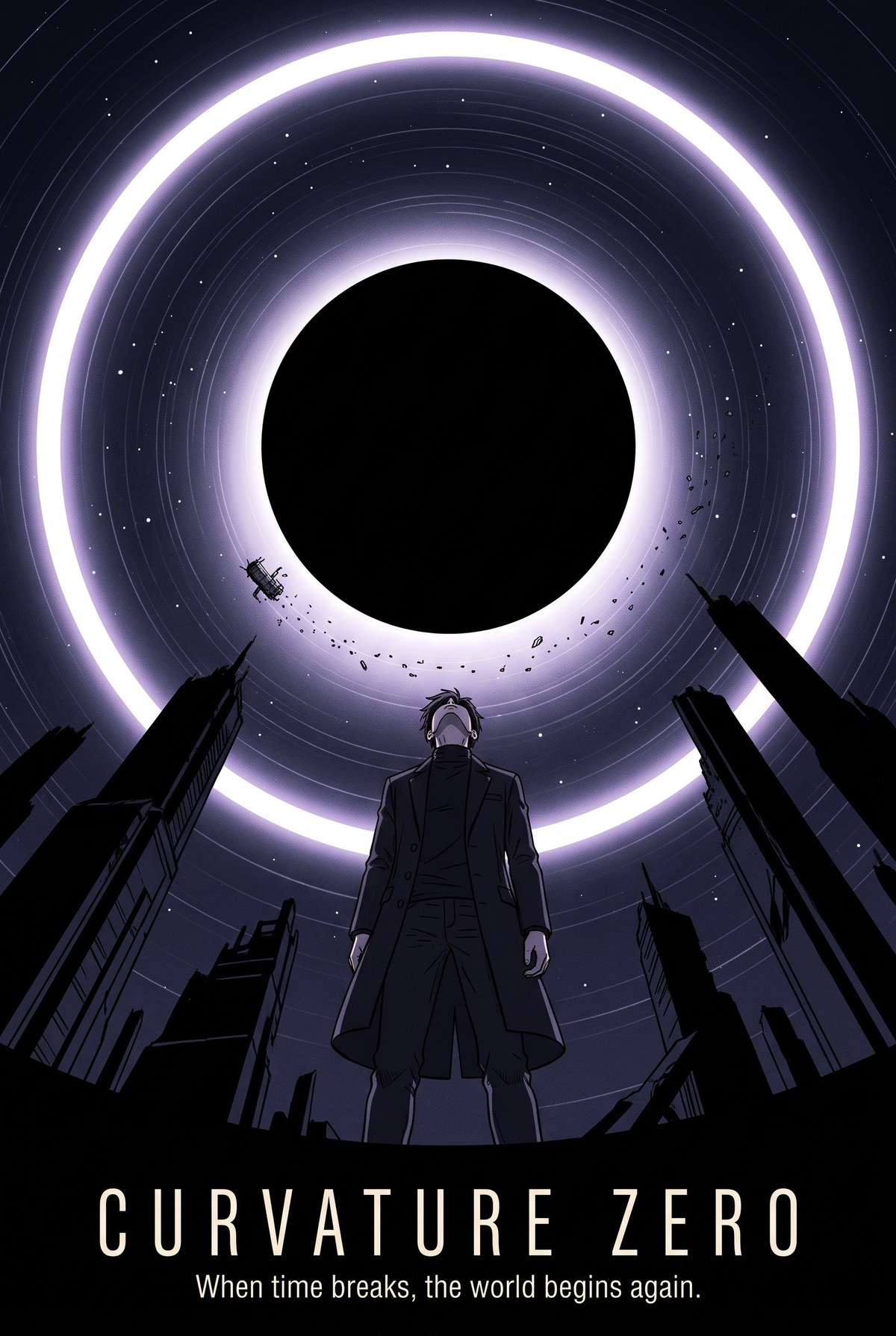



"An explosion is an excess of energy seeking an exit; a rupture is a deficit of geometry seeking an edge."
From Lectures on Non-Stochastic Curvature, Dr. Kai Neumann, McGill University Press, 2124
"Seventeen days," Director Halvorsen said.
"Sixteen now, Director." had the map open on the table between them, a river city drawn in white contour lines with a red stain spreading from its middle. "The fifth of April, eighteen hundred local. Xinhe, the Jiangbei sub-district, centred three hundred metres south of the third river span."
Ingrid Halvorsen had not sat down since he arrived. Outside, the Ottawa River was grey with slush behind the flood sluices, and the sleet coming down the window made the far bank waver. Deputy Minister Aris had sat down, and now had his forehead in his palm.
"Xinhe is four hundred and twelve thousand people, Dr. Neumann," Aris said. "It is the freight knot for the whole middle Yangtze. If the Accord asks the Coalition to empty three districts because a junior professor ran a variance check on some clocks, their Civil Stability Bureau will call it economic sabotage, and they will be entitled to."
"It isn't a variance check." touched the map, and the contour lines of the city gave way to the clock pairs underneath. "The atomic clocks at the Xinhe rail depot and the weather station four kilometres north have drifted thirty-two trillionths of a second apart in two days. Clocks like that should not drift at all. MECN-7 doesn't guess where a rupture will open. It finds the places where time has already stopped adding up."
"We asked their liaison desk for their ground-shaking records this morning," Aris said. "They sent us barge schedules. They tell us the Stability Index for Jiangbei is 0.92. Green."
"Their number comes from instruments in the bedrock that feel the rock move. By the time the rock moves, you don't have days. You have about eight seconds."
Halvorsen turned from the window. She had flown in from Geneva overnight; it was in the set of her shoulders. "You want me to take this to Cabinet. You want the Accord Council to petition the Coalition Council for an emergency evacuation of a sovereign city."
"Yes."
"On one forecast."
"On a system that has called three out of three this week."
"One in an empty desert, one in a bunker, one in a tunnel. Who has reviewed the Xinhe run? Zurich? Geneva?"
"Geneva still thinks the ruptures are thermodynamic failures," said. "They think the universe has bad weather. If you wait for Geneva, four hundred and twelve thousand people will discover that the universe has teeth."
Nobody spoke. Somewhere in the walls a baseboard heater ticked.
"No," Halvorsen said. "We'll transmit your paper through the bilateral exchange and flag it as an unverified high-consequence advisory. That is as far as the Accord can go without an economic incident."
"An unverified advisory sits in a queue for twelve weeks."
"Then you should pray your model is wrong," said Aris.
folded his slate and put it under his arm. "It is not wrong. That is the problem."
He was at the door when Halvorsen said, "Doctor." He turned. "The press office tells me you've booked the briefing room downstairs for two o'clock."
"I booked it last night."
"Under the Directorate's name."
"Under mine. Your clerk put it under the Directorate's because mine wasn't on the list."
She looked at him for a long moment, and he saw her weigh having him stopped at the lift against what the Federation would make of it by evening. "Global Horizon has asked to carry it live," she said. " is in the building. I'd think hard about that, if I were you."
"I've thought about it."
"Think harder," Halvorsen said, and turned back to her sleet.
The briefing room on the ground floor held sixty chairs and about forty people, most of them freelancers for the technical digests and wire services who had come because a man who called three ruptures in a week was a story, whatever else he was. Two cameras rode the ceiling rails. The red tally light on the left one meant that Global Horizon had the feed, and that whatever he said would be in New York, Lagos and Shanghai before he had finished saying it.
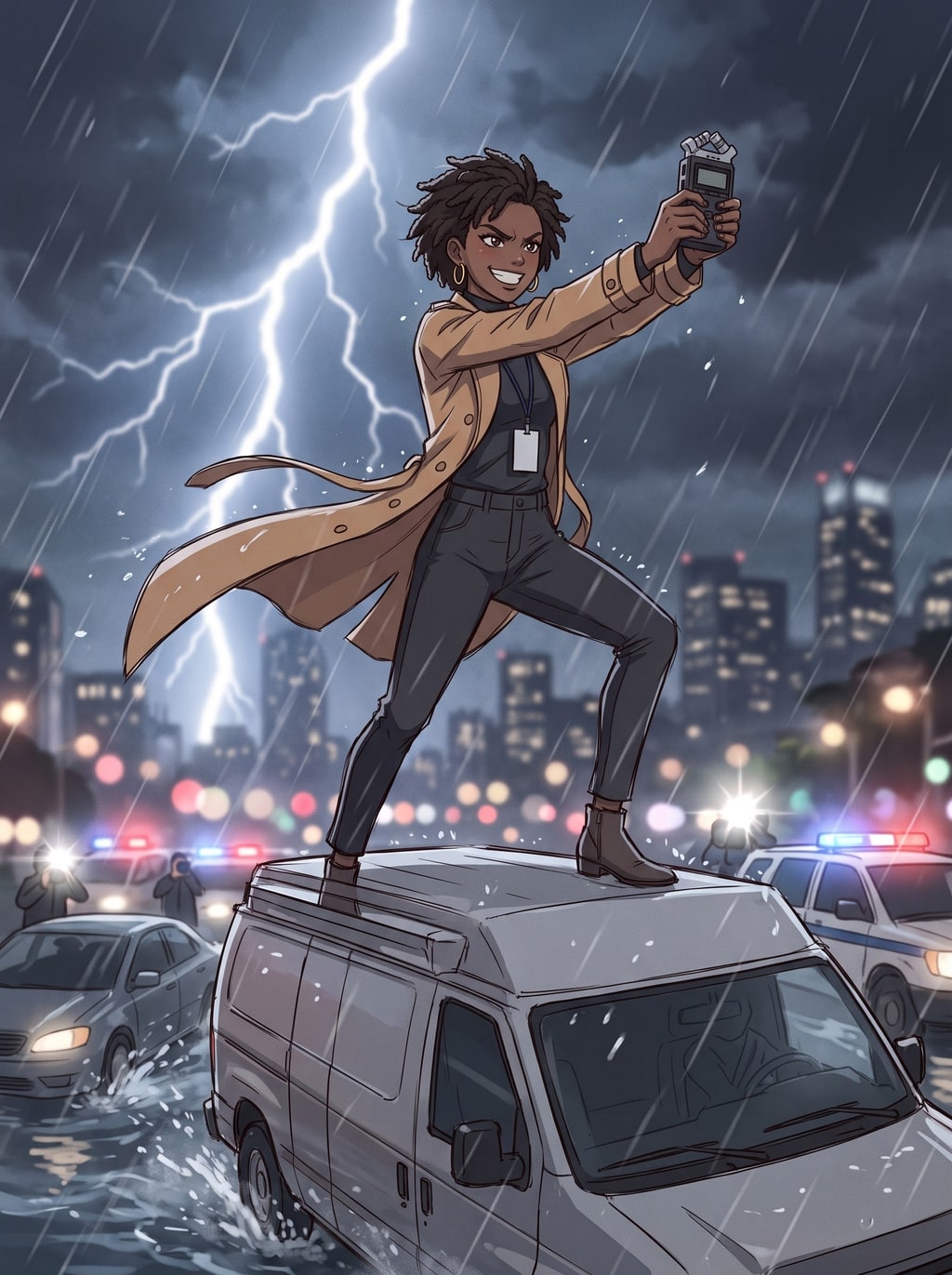
sat in the front row, in a camel trench coat with the belt left hanging, gold hoops, short twist-out, a stack of printed paper on her knee held together with a bulldog clip. She did not look at her phone. She looked at him with the patience of a woman weighing every noun against an invoice.
At the very back, by the door, a man in a dove-grey three-piece suit stood with his hands folded in front of him and a faint smile, as though he had paid for the seats and come to see whether the play was any good. He was mid-thirties, with dark-blond hair combed straight back and pale grey-blue eyes, and he wore no press badge.
stood at the podium in his black turtleneck and long coat, and found that his hands wanted to shake, and put them flat on the wood.
"My name is Neumann," he said. "I am an assistant professor of metric instability at McGill."
"Speak up," someone called from the back.
He did not raise his voice. He bent the microphone neck toward his mouth until it squeaked and said the rest at the same pitch. "In sixteen days, at eighteen hundred local time, a rupture will open in the Jiangbei sub-district of Xinhe, in the Eastern Coalition. For the first minute, two places will share the same ground. Within ninety seconds the ground will give way completely. Four hundred and twelve thousand people live inside the projected boundary. The Accord Research Directorate has declined to escalate the warning. I am releasing the data and the code now, to anyone, and I am asking the Coalition to clear the district."
The projection came up behind him: the clock pairs, the drift charts, the red stain on the river city. A few people photographed it. Most of them photographed him.
The first questions were the ones he expected. Was he the Neumann from the Kepler? He was. Hadn't the inquiry found that the pilot had lost his bearings? It had, and it was wrong, and the clocks in Xinhe did not care about the Kepler either way. Anyone could check the equations on the open repository. Several of the reporters wrote that down. One of them, a young man from a Montreal tech digest, asked him what the people of Xinhe should do tonight, and told him: pack, and go north of the river.
Then stood up, and the room changed temperature.
"Dr. Neumann. , Global Horizon." She did not need to say it; the camera on the rail had already swung to her. "I've spent the winter on the Accord's research grants, and yours is the largest in the physics directorate. I want to ask you about the foundation of it. Your 2122 dissertation." She lifted the stack of paper so the camera could see the McGill crest on the cover. "Non-Classical Correlation Structures in Lunar Fracture Mission Telemetry. Is that the paper MECN-7 is built on?"
"It's where it started," said.
"I had it re-audited last week by the applied physics faculty at Columbia. Equation fourteen. The boundary decay variable, lambda-sub-zero." She turned a page without looking down; she had marked it. "They found a mis-weighted correlation term, carried over from the Kepler's corrupted thruster-bus logs. It overestimates the local decay gradient by a factor of eight." She looked up. "In plain words, Doctor, your paper makes the danger eight times steeper than it is."
The reporters had stopped typing. At the back of the room the man in grey had stopped smiling and was simply watching, with interest.
knew the mistake. He had known about it since his second year at McGill, when the secret engine records were finally released and he had sat up one night and seen what he had done with it at twenty-four, in a hospital-white room, half asleep. The fourth version of his system had fixed it, and the seventh had thrown it out. He had never gone back to the dissertation, because going back to the dissertation meant reading it.
"The coupling constant in chapter three was a heuristic," he said. "A best guess. I corrected it in MECN-4 and replaced it in MECN-7. The system now runs on clock drift we can measure. None of the Kepler's engine data is in it."
"Did you file an errata on the dissertation?"
"No."
"So it sits in the McGill archive as written." She did not raise her voice. "That paper got you your chair, Doctor. It got you five million credits of cluster time to build the system you're asking the Coalition to evacuate a city on. And it contains an eightfold overestimate, written by a twenty-five-year-old who had just come out of three months of hearings after watching eleven of his colleagues die."
He could have said several things. That the errors in a doctoral heuristic had no bearing on clock drift in Xinhe. That the people who had given him the chair had read the paper and missed it too. That he had been twenty-four, not twenty-five, when he wrote it. All of them were true and every one of them would sound, on the feed, like a man sliding out from under his own mistake.
"I made a mathematical error in the heuristic," said. "I should have filed an official correction when the engine records were released, and I didn't. But MECN-7 doesn't run on that heuristic. The Xinhe forecast comes straight from the clocks. The atomic clocks are drifting, Ms. Whitlock. That drift is real."
She nodded, slowly. It was the most dangerous thing she had done so far, because it looked fair.
"Then let me ask you the question the people of Xinhe are going to ask," she said. "If you could misplace an order of magnitude while trying to explain how your crew died, why should the citizens of Xinhe abandon their homes because you see a ghost in their clock towers?"
"It was a factor of eight," said. "An order of magnitude is ten."
Someone laughed, short and appalled, and stopped. looked at him for a moment longer, and he saw her understand that he had meant it as a correction and not a joke, and saw that it did not help him in the least. She sat down. The Accord press officer, who had been standing by the flag with her hands clasped, stepped forward and thanked everyone for coming.
He took the service corridor because the lobby would be full of cameras. It was a long tiled passage that smelled of floor polish and ran under the stairs to the loading dock, and the man in the dove-grey suit was waiting halfway along it, leaning against the wall beside a fire-hose cabinet with the air of a man who had been there for some time.
"That was hard to watch," he said. His accent was East Coast Federation, unhurried. "She's very good. She'd built the whole hand before she sat down, and you played your best card into it. 'An order of magnitude is ten.' I nearly applauded."
"If you're from the network, I signed the release."
"Heavens, no." He pushed off the wall and held out a hand. ". Special envoy, Atlantic Federation Department of External Coordination."
did not take it. left it there a moment, without embarrassment, and then used it to take a card from his waistcoat pocket instead.
"The Federation doesn't send envoys to university press briefings," said.
"It does when someone starts reading the shape of space off a city's clocks. My government has an interest in your work, Dr. Neumann. A more serious one than Director Halvorsen's."
"Your government's broadcaster just took my dissertation apart on air."
"Ms. Whitlock is nobody's broadcaster. That's why people believe her." turned the card over in his fingers. "May I tell you something you'll find more interesting than my opinion of your dissertation? The Federation lost three unmanned sensor platforms in the Halo arc six months before your ship ever left high orbit."
stood still. The Kepler's mission briefing had been forty pages long, and it had said, in four languages, that no instrument had ever been sent within a hundred thousand kilometres of the Halo. He had read it on the launch pad. had read it aloud in a newsreader's voice to make Karim laugh.
"Nobody told the Accord," he said.
"Somebody told somebody," said. "Nobody told you. What happened to their clocks, before they went quiet, would interest you very much. It isn't mine to give you today."
"Then why tell me?"
"Because I'd like you to be curious about me." He reached over, took 's left hand, which was hanging at his side, and put the card into it, closing 's fingers over the corners with his own. His hand was dry and warm. "When Xinhe proves you right, the Coalition will want to bury you, and the Accord will want to apologise to them. You will need someone who owns faster ships."
"And if Xinhe proves me wrong?"
smiled. It was a pleasant smile and could not tell what was under it. "Then I've wasted a card," he said, and walked off toward the loading dock with his hands in his pockets, and did not look back.
The card was heavy cream stock with no crest and no title, only the name in raised black letters and, under it, twelve digits with no spaces between them. put it in his coat pocket, next to the coin, and went out into the sleet.
By midnight the news syndicates had the headline they wanted. The Man the Rupture Sent Back, it said, over the archive photograph from 2120: at twenty-three being lifted out of Module Three by a recovery crew under floodlights, his face black with scorched resin and his eyes fixed on something past the lens. They ran 's question under it, and his answer about orders of magnitude, which played everywhere as arrogance.
For three days, against all of it, people in Xinhe left anyway. The Coalition Foreign Ministry issued a furious denial within the hour, calling the forecast an Accord panic weapon aimed at the spring freight season, and the denial did what the forecast alone could not: it told a city of four hundred thousand that the government was frightened of something. Families tied mattresses to the roofs of their cars. The rail terminal sold out north for five days running. By the third night about forty thousand people had gone, through police checkpoints on the north ring road that were turning back anyone with a truck.
On the fourth day, Coalition state television began running 's segment on a loop on every transit screen in the province, dubbed into a calm Mandarin, under a banner that read Accord Academic Admits Flawed Mathematics. It ran every twenty minutes for two days.
watched the evacuees go home on a news feed in his flat near Mount Royal. The camera had stopped at a junction in Jiangbei in the rain, where a man in a yellow raincoat was untying a mattress from the roof of a small grey car while a girl of about six held the cord for him and his wife stood on the pavement with her arms folded, not helping. When the knot gave, the mattress slid off sideways into a puddle, and the man stood looking down at it, and the girl laughed, and the feed cut to a bond analyst in Shanghai. More than thirty thousand of the forty thousand were back across the bridges in two days.
The Directorate withdrew his advisory that afternoon. McGill's email arrived an hour later, three paragraphs long and very polite: he was placed on indefinite administrative leave, pending an ethics review of his 2122 doctoral archive. The jade plant was still on his office sill. He wondered who would water it.
MECN-7 ran on the desk by the window. Under Jiangbei, the bend in space had not eased. It had grown steeper. The clocks between Xinhe's central transit tower and the western embankment had drifted fifty picoseconds apart, and the onset window had narrowed from twelve minutes to four.
Nine days.
He thought about the man untying the mattress, and about the girl who had laughed. He thought about what had actually asked him: why should anyone leave home because he said so. She had been right about the error. She was right about that too. Nobody packed a car for an equation. He had watched forty thousand people do it for a government's fear and come home for a government's contempt, and he had not yet found the thing that would make the rest of them go.
He went through his accounts. His savings came to one economy fare from Montreal to Shanghai and a rail pass into the Coalition interior, with eleven credits over. He bought both. He packed a small bag: two shirts, warm socks, his slate, a portable clock, three sensor cylinders from the lab that he did not ask anyone's permission to take.
Then he opened the public channel on the repository where the code lived, the one nobody had read for two years and four million people had read that week, and typed three sentences.
The model has not changed. The metric collapse in Xinhe will occur on April 5 at 18:00 local time. I will be sitting directly on the predicted boundary line when it opens.