

"The metric field does not possess intention, but it possesses memory. Where mass once folded, it remembers how to fold again."
From Unit Nine Field Manual: Primer on Metric Rupture, Boundary Operations Command, Longwan
The folding chair cost forty-two Coalition credits at a hardware stall three blocks past the northern checkpoint. It had striped green-and-white webbing and an aluminium frame that rattled whenever he shifted, and the stallholder had thrown in a litre of white road paint and a brush for nothing, because, he said, he had seen the news and would rather not be paid by a dead man.
painted the line himself at noon, on his knees, with the surveyor's slate propped on the kerb to tell him where. It ran across all four lanes of Jiangbei Central Boulevard at the top of a long, shallow rise, where the road climbed a metre or so from the river before it levelled toward the northern districts, and by half past one it was dry enough to set the chair down on. He put the back feet on the tarmac to the north and the front feet against the paint, and sat, and looked down the slope toward the river at four hundred and twelve thousand people's empty street.
Six metres to his left, on the median kerb, an old man in a blue cotton apron sat on an upturned paint bucket, peeling water chestnuts with a short knife into a plastic tub of cold water between his boots.
"You should cross," said, in his careful Mandarin. "North of the line."
The old man did not look up. The blade went round the chestnut in small jerks of the wrist. "My shop is sixty paces behind you. The municipal bureau says the Accord lunatic is lying to drive down the housing bonds." A pale slice dropped into the tub. "Are you the Accord lunatic?"
"I am."
"Then if you run, I run. If you sit, why should I spoil thirty jin of chestnuts?"
"That is terrible logic."
"It is thirty jin," the old man said, and reached into the sack for another. After a while he added, "My daughter took my grandson north on Monday. To her husband's sister in Wuhan. The boy she could carry." He pointed the knife at himself without looking up. "Me, she couldn't lift."
Behind a barricade of orange water-filled hurdles, sixty municipal police stood in riot plate with their visors up against the heat. They had confiscated his passport at the rail terminal that morning, and read him the public disturbance ordinance three times from a laminated card. At half past four their lieutenant crossed the empty road and asked him, for the fourth time, to leave.
"I'll leave at a minute past six," said.
"If you are wrong, you will be arrested at a minute past six."
"If I'm wrong, Lieutenant, I'll walk to the station with you. Will you do something for me first?"
The lieutenant waited.
"Move your men back. Five metres, north of the cars. My forecast gives the edge a margin of error and I'd rather it was spent on tarmac."
The lieutenant looked at the paint, then at the chair, then at the cameras behind his barricade, and watched him work out that whatever he did next would be on every screen in the world. "My orders come from Longwan," he said, and walked back to his line, and did not move it.
Nobody had arrested . He understood why. Dragged away, he became the only man who had tried to warn them, silenced on camera. Left alone, and wrong, he became a joke by dinner. And if he was right, nobody wanted to have their hands on him when it happened.
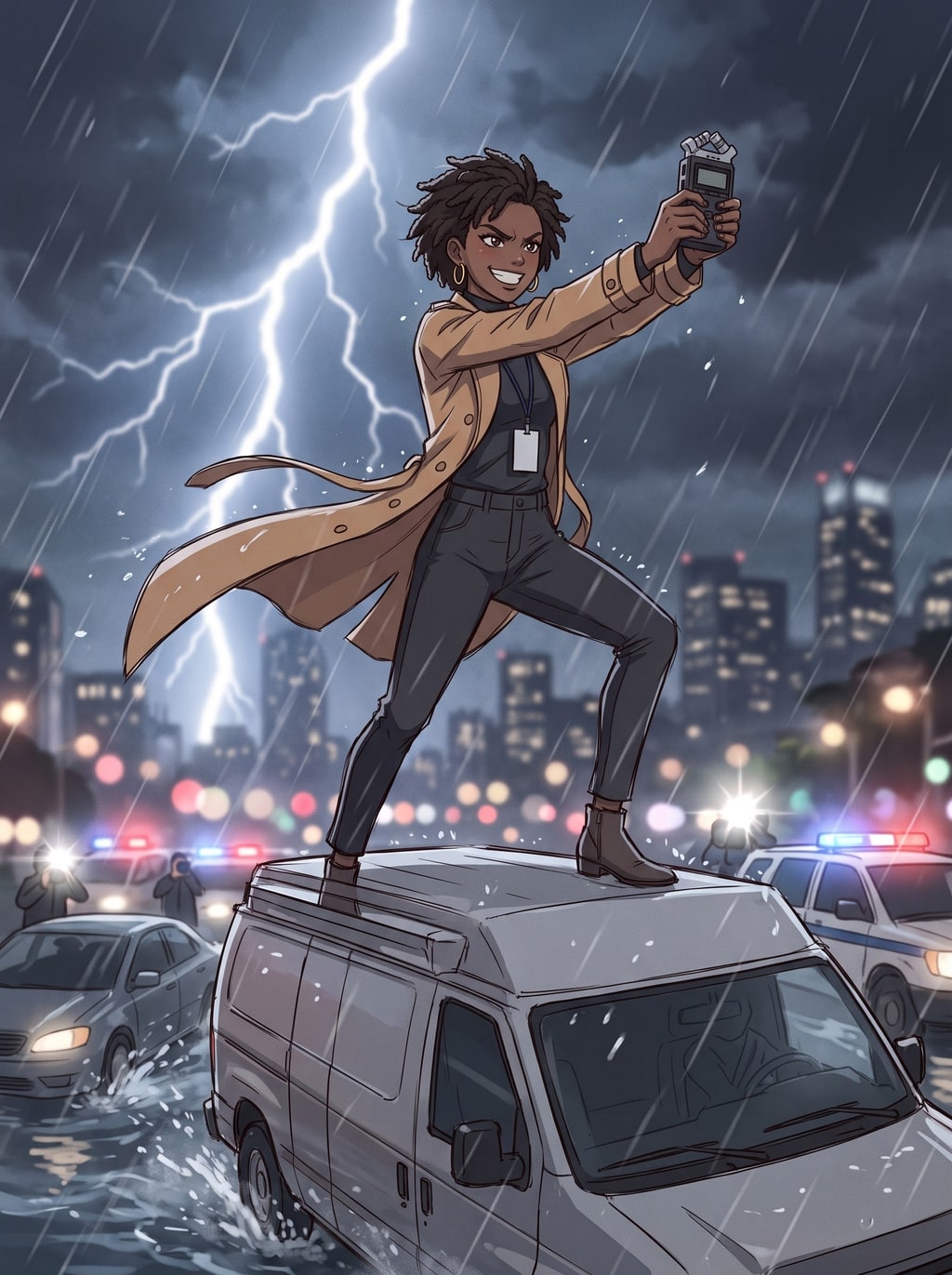
Beyond the barricade, three news vans had their dishes up. Four Atlantic Federation observers in charcoal coats stood apart from the reporters, and at the front of them stood with his hands in his pockets, who caught 's eye across sixty metres of empty road and inclined his head. Two paces from , at the cordon tape, was talking quietly into a microphone with the blue-and-gold shield of her network on it. She had ridden the same maglev out from the coast that morning, four rows ahead of him, and never once turned round.
Half the world was watching a four-lane road lined with sycamore saplings in steel grates, advertisements for electric cars, and one man on a lawn chair. Two hundred metres down the slope, toward the river, a red balloon shaped like a dragon had caught in the lower branches of a sycamore. A child had lost it at noon, when the warning sirens went off by mistake and the loudspeakers on the light poles had spent the next hour apologising for them. Readings are within normal seasonal limits. Return to your places of employment. By the time they finished, most of the district had stopped believing the loudspeakers and started walking north, and the police checkpoints had pinched the bridges shut behind them, and the city on the other side of the line had gone quiet.
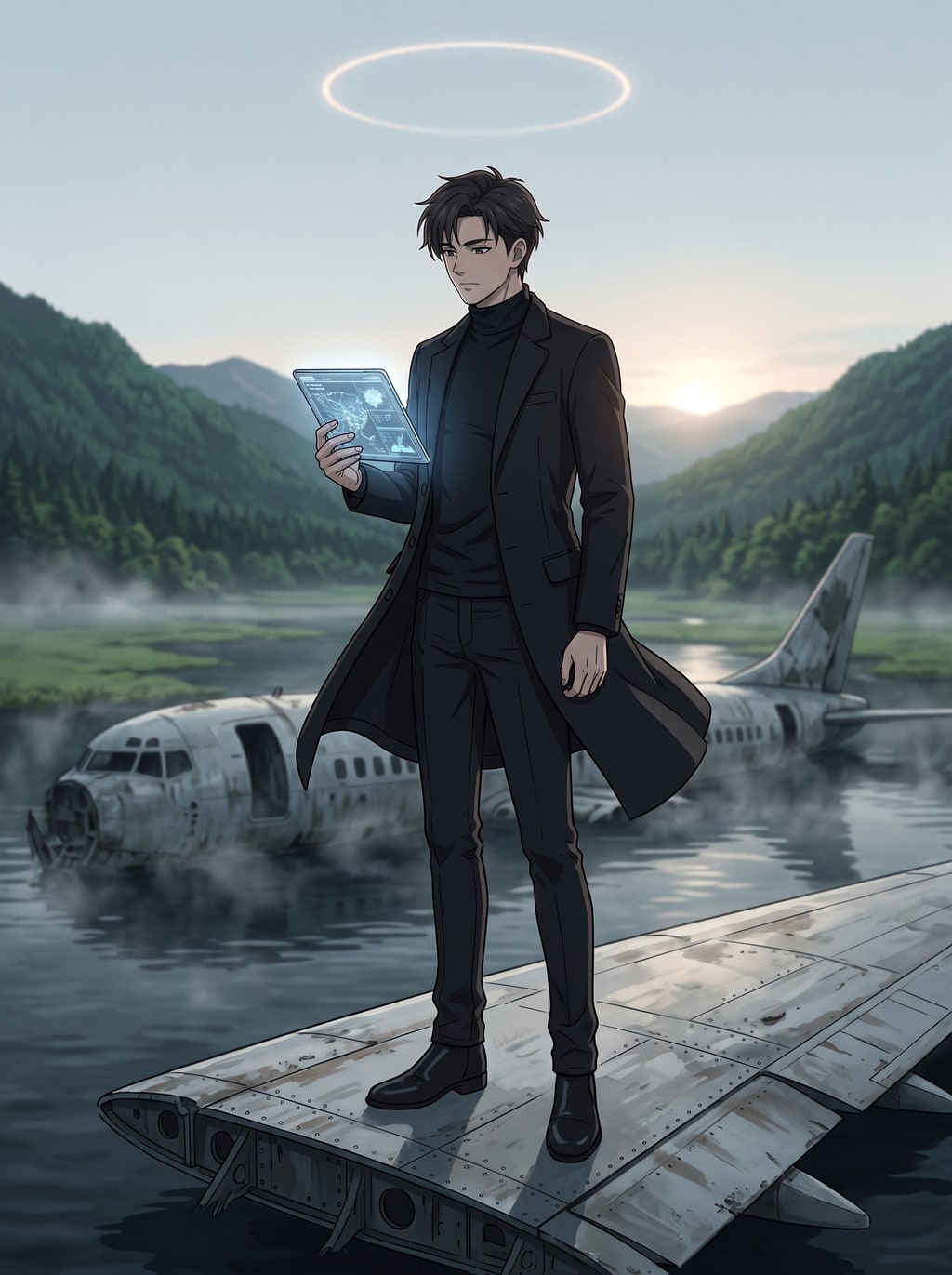
's slate showed the Stability Index for the Jiangbei zone at 0.14, and still falling. At zero the ground would be gone. Under it the slate gave the collapse gradient, 4.2 metres per second: how fast the edge would travel once it started to move. Those were the only two numbers that mattered now, and he had checked them so many times in seventeen days that he could see them with his eyes shut.
He put his hand in his coat pocket and closed it round the coin. The King's face was warm from his leg. He did not take it out.
At 17:41 a woman came up the slope from the south carrying two canvas bags, one in each hand, the straps cutting into her palms. She was forty or so, in a floral windbreaker and rubber-soled shoes grey with the clay of an unpaved lane, and she walked straight up the middle of the boulevard because there was no traffic to stop her. She stopped at the line and looked at in his chair, and then down at the paint.
"Is it safe on this side?"
"Yes," said. "Stay north of the white line."
"My sister lives in the district behind you." She looked back down the empty boulevard to where her own building stood, quiet, with its windows shut. "She took the three o'clock bus. I went back for the papers."
"Stay north," he said again. He did not point; pointing looked like panic, and panic moved faster than anyone could walk. "Sit on the kerb by the officer. Please don't go back."
She hesitated with her mouth half open around a name she decided not to say. Then she stepped over the line, and the toe of one rubber shoe caught the paint, which was dry on top and not quite dry underneath, and left a grey smear on the white. She sat on a transformer box five metres behind him with the bags tucked between her ankles and her fingers locked through the handles.
's voice came across the empty road, pitched for a transmitter. "Twenty minutes from the time Dr. Neumann's forecast has given. The municipal evacuation of Jiangbei was called off this morning after the provincial government declared the forecast an artifact of Accord satellite interference. And yet, as you can see behind me, the streets are empty."
His slate said the broadcast was reaching Geneva forty-two seconds late. In Geneva they were watching him breathe out a breath he had finished before she began speaking.
The skin on the backs of his hands had gone tight. He had felt that once before, in the last hours on the Kepler, a dry pulling across the knuckles, the air beginning to draw the water out of him. He spread his fingers on his knees and looked at them and they were steady. That surprised him more than anything had in a month.
At 17:55 the water in the old man's tub stopped shivering.
The generators on the news vans thirty metres away had been trembling its surface all afternoon. Now the trembling stopped, and the water lay flat and bright and dead, a disc of glass with chestnut slices hanging in it, though the air was still warm enough to make 's collar damp.
"Old friend," said.
The vendor's knife stopped halfway round a hull. Black juice was running down from the thumb of his left hand. "What?"
"Pick up your tub."
The old man looked down at the water and then at . He set the knife on the crate, took the wire handles of the tub, and dragged it a metre north, across the paint, with a scrape of plastic on bitumen. The bucket he had been sitting on he left where it was. He stood at 's right shoulder with his arms wet to the elbows.
"Why the line?" he said.
"The field has a floor under it," said. "The line is where the floor stops."
Across the road, the police had begun to move. Nobody had given an order; the lieutenant had his back to them and was talking into his collar. One officer stepped backward, and then the man beside him, and then the whole line had drifted five metres north to the cars, shields bumping, while every one of them went on looking straight ahead and pretending not to have moved.
At 17:58 the sound died.
The generators went first, and then the wind in the sycamores, and then the sound of his own breathing, and what replaced it was a pressure in the ears like sinking fast in deep fresh water. Across the boulevard the lieutenant turned round and shouted, and saw his mouth open and felt, in his own jaw, the dry click of the man's tongue, and heard nothing at all.
Two hundred metres down the slope, the dragon balloon snapped its string.
It did not go up. It slid sideways along the road, perfectly level, toward the junction with Fourth Bridge Road. Its foil tail stopped moving. Over the middle of the junction it stretched, a smear of red four metres long with no thickness to it, and then it went into a vertical crease in the air that had no width, and was gone.
Somewhere behind the police line a woman screamed. It came through the dead air thin and clipped, a needle through felt.
looked at the slate. The Index went through 0.08, then 0.02, then zero.
At zero, curvature did not flatten. Curvature turned inside out.
At 18:00:04 a line of blue light thinner than thread came down out of a clear sky into the asphalt ninety metres south of his chair, so bright that it left a violet burn in his eyes, and the boulevard folded.
It folded toward the line of light the way a sheet folds when someone presses a finger into the middle of it. The four-storey arcade on the left side of the road slid down along an angle that did not exist. watched its fourth floor pass through its second, brick through brick, without a crack, two storeys sharing one height while their shadows peeled off south. The glass in its windows was full of clouds that were not in the sky over Xinhe: high grey thunderheads from somewhere else, some other weather, some other age.
Where the bank on the corner had been stood a wall of grey-green water fifteen metres high, vertical, with nothing holding it. There was silt in it, turning slowly. Something long and dark moved inside it, a body six metres long with segmented ribs and fins as pale as lard, and it turned once, unhurried, and sank away through the floor of a lake that was occupying the same place as Jiangbei Central Boulevard. Behind the water, where the towers of South Xinhe had been, there was a valley, drowned and green, and above it, low on a sky that was the wrong colour, three faint suns.
Cold came up the slope at them. The air smelled of silt and wet slate.
Then the boundary started to move.
It came up the boulevard with a sound like tearing cloth, ten thousand bolts of it, and the road surface broke ahead of it into overlapping terraces, slabs of tarmac sliding over each other like slates off a roof. Twenty metres. A streetlamp leaned forward and its head came apart into a spray of orange sparks that hung in the air and did not fall. Ten metres. The vendor dropped the tub. Water slopped over 's shoes, cold as a well.
The old man's weight went back on his heels, and then forward. reached out with his left hand without looking and took a fistful of the blue apron.
"Stay right there," he said. "Do not lean."
Three metres.
The white line trembled. A skin of dried paint lifted from the edge of it and stood a centimetre off the tarmac, vibrating, like salt on a drum.
Then the boundary stopped.
It cut a groove into the road where it halted, ten centimetres deep, black and glassy where the asphalt had melted and set in the same instant. The edge of the groove lay eighty centimetres from the front left foot of 's forty-two-credit folding chair.
On the near side of it, between the groove and the chair, a dry sycamore leaf lay on the road, and did not move.
let go of the apron. He picked up the slate from his lap, where he had dropped it, and logged the time. 18:01:12. Offset from MECN-7 projection: 0.8 metres. He breathed out, and saw his breath go white in the cold air coming off the valley.
Beside him, the old man let himself down slowly onto his crate, reached to the ground, picked up a single chestnut, and wiped the grit off it on his knee.
"Eighty centimetres," he said.
"I missed the second-order derivative on the soil density," said. His voice came out dry. "There's more dolomite in the bedrock under the river than the provincial survey says. Hard rock. It held the edge back."
The vendor looked at him for some time with his mouth open. Then he looked down at the chestnut. "You missed."
"By eighty centimetres," said. "I am sorry about your bucket."
The noise came back all at once: radios, bullhorns, the generators, sixty officers and forty journalists trying to talk at the same time on signals that had suddenly found their towers again.
reached him first. He did not run. He walked through the gap in the hurdles before the police thought to close it, crossed the broken road in shoes that had cost more than 's flight, and stopped a metre short of the black groove to look down at it, and then at .
"Next time, call me before you sit down," he said. "The Ambassador had a bet on thirty metres. I took the under. Eighty centimetres is theatrical, even for you."
"Dolomite," said. "The bedrock was stiffer than published."
"I know." crouched to look at the groove more closely, and lowered his voice. "Our naval radar has been picking up deep harmonic pulses under this intersection for thirty-six hours, a knot of them. The Coalition wiped its own public readings to keep the bonds steady. Our people watched the knot tighten right under your chair. They let you sit here hoping you'd miss by a city block." He stood, brushing the knee of his trousers. "Instead you gave them a lake."
arrived out of breath, with her flying camera trailing her on its short leash, and stopped half a metre behind the chair. Her face had gone grey under the brown. She looked past at the wall of water, at the valley under the three suns where six banks and four apartment blocks had been standing three minutes earlier, and then down at the groove in the road. Her hand with the microphone in it was perfectly steady. The other one was not.
"Dr. Neumann," she said.
"Ms. Whitlock."
She was reading off a receiver at her wrist. "The State Council has suspended all rail traffic into the province. Longwan Command has declared a national emergency." She stopped reading and looked at him. "They had twenty thousand troops staged in Longwan to manage the riots after you were exposed."
He did not answer that.
"You knew," she said.
"The math knew. I only wrote the grammar."
"That isn't grammar, . That's forty blocks of another world in the middle of a provincial city."
"It's an overlap. Two places sharing the same ground." He stood up, and his knees cracked; he had been in the chair for four and a half hours without water. He folded the chair with one click of its hinges and held it by the frame. "It will stay open for about seventy hours before it starts to close. If anyone tries to pump that water out, the tear will spread into the rest of the district. Tell them. They must not touch the water."
"You tell them," said, and pointed north.
Three black tiltjets were coming down out of the haze over the rail line, low and fast, with the white trident of Boundary Operations Command on their flanks. Their downwash flattened the sycamores and blew dust and torn tape across the barricade, and the lead aircraft flared fifty metres away and put its gear down on the boulevard while its rotors were still swinging upright.
The rear ramp dropped before it touched. Soldiers in dark composite armour came down it in three files, with mirrored visors and the red slash of Horizon-class operators on their shoulders, carrying field emitters instead of rifles. They did not look at the water or the valley. Six seconds after the first boot hit the tarmac, they stood in an outward-facing ring around , the vendor and the chair, and the police on the far side of the road took another step back without being asked.
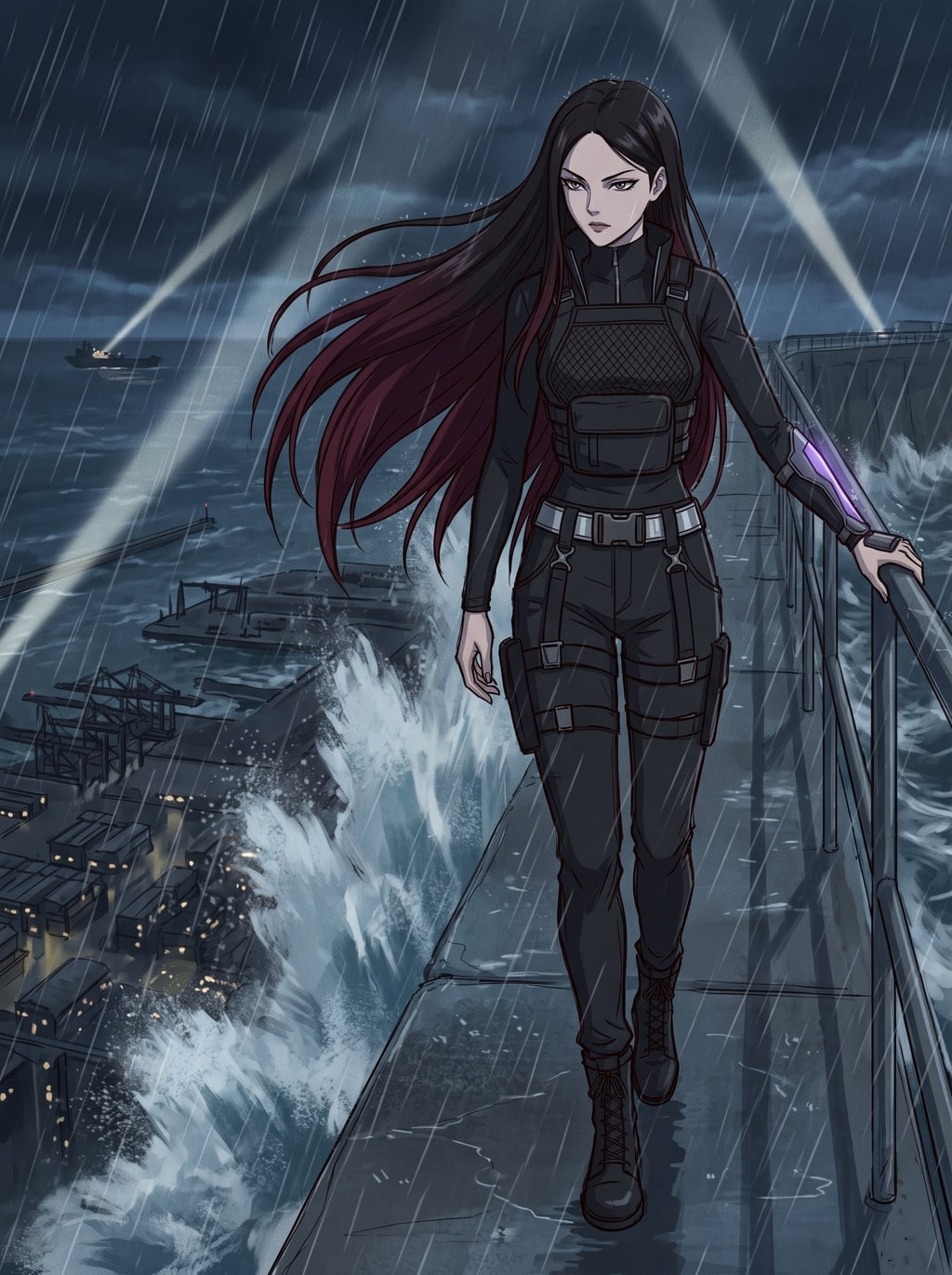
An officer came down the ramp last, in an unmarked field coat with the rank pins taken off. She was small and compact, and her very long black hair, burgundy through the lengths, was coiled tight under a soft field cap. A small old scar ran through one eyebrow. She did not look at the flying camera or at . She looked at the white line, then at the black groove, then at the folding chair, and then, last of all, at . Her eyes were grey-blue and gave nothing away.
"Dr. Neumann. I am , Boundary Operations Command, Unit Nine."
"Colonel."
"The Premier has authorised your extraction. The Accord mission in Shanghai has asked for you to be handed to them. You will be coming with me."
"I need my sensor packages." He nodded at the three black cylinders clamped to the lamppost behind the vendor's crate. "The clock readings from the last few minutes are the only record of what happened before the collapse. If the field springs back before I save them, they're gone."
moved two fingers of her left hand. A broad sergeant broke from the ring, went to the lamppost, twisted the three cylinders off one after another, and laid them in a lined case before had reached the end of his sentence.
"They are in the case," the Colonel said. "You have thirty seconds."
stepped up to the edge of the ring with the microphone raised. "Colonel . Does the Eastern Coalition now accept the validity of the Neumann model?"
did not turn her head. "The boulevard is thirty metres wide, reporter. The hole is two thousand metres deep. We have very little interest in academic validity at this hour."
She walked to the ramp. The downwash dragged his coat around his legs. At the foot of the ramp she stopped and looked back once at the groove in the road.
"He was off by less than a metre," she said, to no one in particular. "The Accord told us three kilometres."
"The Accord used the old lunar dataset," said. "It assumes the field is the same in every direction. It never is."
"Clearly," said.
The ramp came up behind him and sealed. The inside of the tiltjet smelled of hydraulic fluid and men who had been waiting five hours in armour. He strapped into a webbing seat against the bulkhead with the folding chair across his knees, because there had been nowhere to put it down and he had not thought to let go of it.
The sergeant who had taken the cylinders sat opposite, with the case between his boots. He was broad and young, with a short scar on his chin, and he looked at the chair, and then at , and grinned, and said nothing.
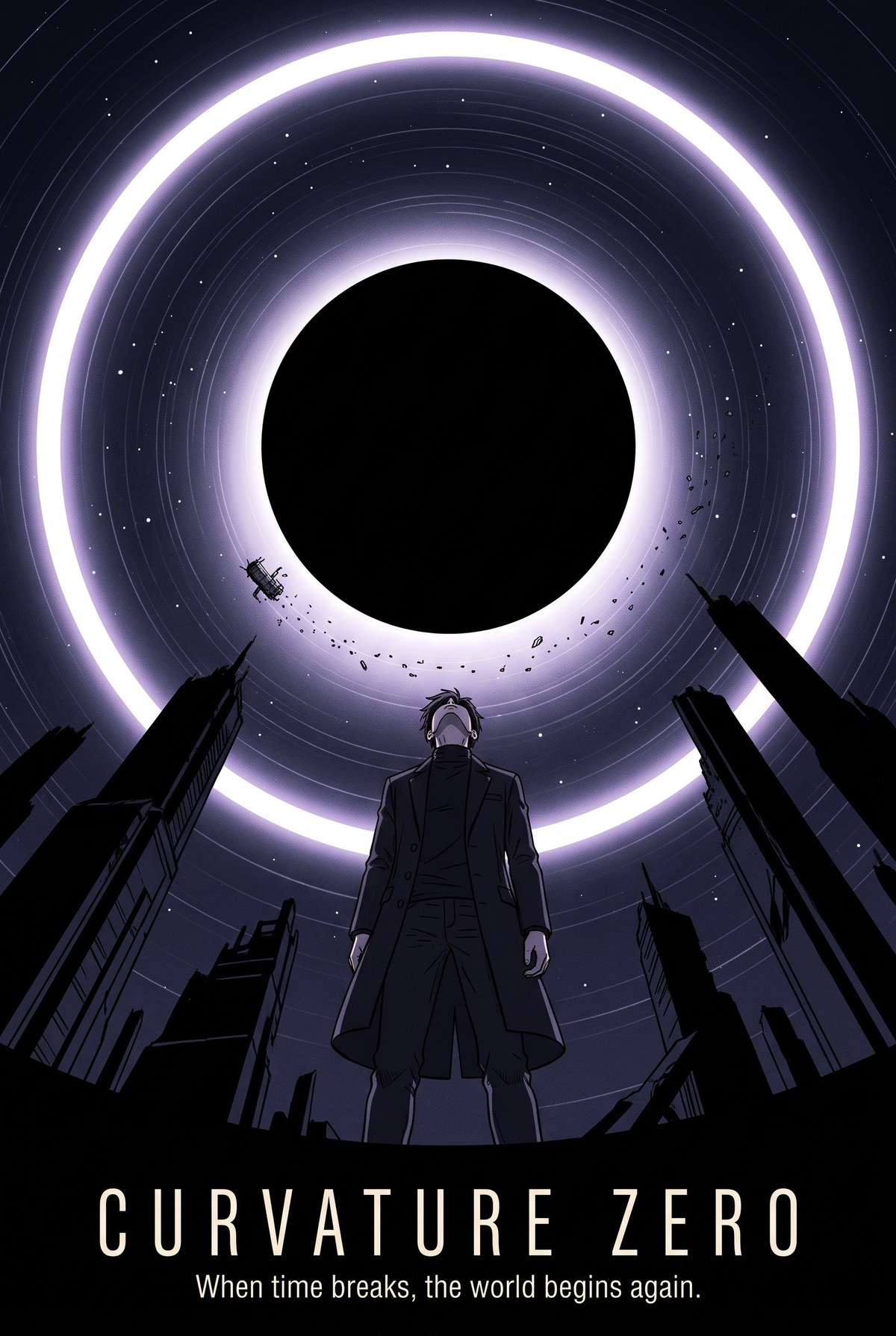
The tiltjet lifted and banked north. Through the narrow port, Xinhe turned below them: the grey curve of the Yangtze tributary, the blocks of the post-flood districts, the long empty boulevard with three vans and a vendor on it, and then, punched into the middle of the city where five avenues had met, the Overlap. It was a disc of dark, drowned green, a valley from some other time laid into the streets, with the towers standing around its rim. From the air it looked like an eye with no lid, open, looking straight up at them.
held on to the chair. The Colonel, strapped in by the cockpit door, watched him do it and did not say anything, and the city slid away under the wing.