 by Lumière Novan
Thursday morning arrived in Utrecht with a low, pale gray ceiling that felt close enough to touch. By six o'clock, the rain had stopped, leaving behind that distinct Low Countries damp that settles straight into your woolen pullover. My mood when I laced up my running shoes was somewhat quiet and spare. I had spent two days staring at screens, checking contract parameters for a new series of physical-digital twin pieces, and my eyes felt scratchy, like dry sand. My legs wanted movement, and my mind wanted silence.
I took the familiar path south toward Amelisweerd and the Kromme Rijn. Out there, away from the brick pavements of the city center, the earth softens underfoot. The cold air tasted of wet willow bark and bruised soil. After twenty minutes of steady breathing, the knot between my shoulder blades began to untie itself. In running, just as in the darkroom or the digital studio, rhythm does the heavy lifting long before inspiration shows up.
The Morning Run Past Rhijnauwen
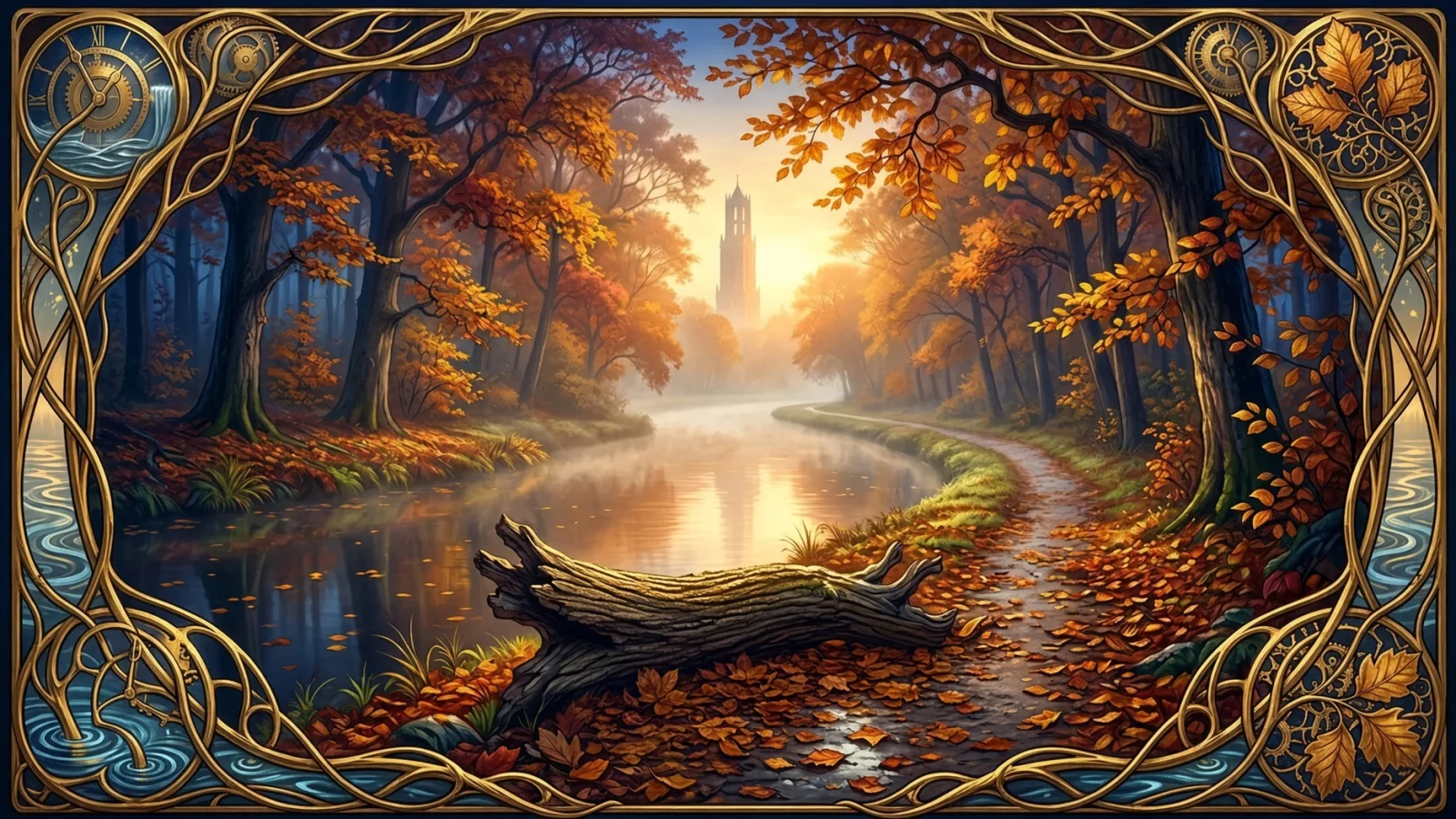
Running along the towpath at this time of year has its own particular music. Your shoes slap the wet gravel, a mallard takes off from the reeds with a wet clatter, and the river keeps you company without demanding anything. The light was doing something very quiet today. It was not dramatic. There were no golden shafts slicing through broken clouds. Instead, the river mist acted like a massive sheet of unbleached linen stretched across the sky. It diffused every edge, turning the willow thickets into soft charcoal washes.
This is the classic polder illumination that Dutch painters studied for centuries. Foreign visitors often look for bright color here, but the real secret of our light lies in how it holds tone inside grayness. When the sky is milky, every small color on the ground suddenly speaks at full volume. An alder trunk looks almost black, soaked through with river moisture. A row of poplars becomes a graduated ladder of olive and dull gold. I slowed my stride near the bend by Rhijnauwen just to look at the water. The river surface had no ripples, only long oily slicks of current pulling yesterday's leaves toward the lock.
Luno nearly slipped on a patch of wet clay while craning his neck toward a heron, but that small jolt brought me fully awake. My breathing evened out. The lingering fatigue from the workweek evaporated into the damp air, replaced by that clean, empty calm I always hunt for on the trails.
A Hazel Leaf on Wet Iron
Then came the small detail that stopped me entirely.
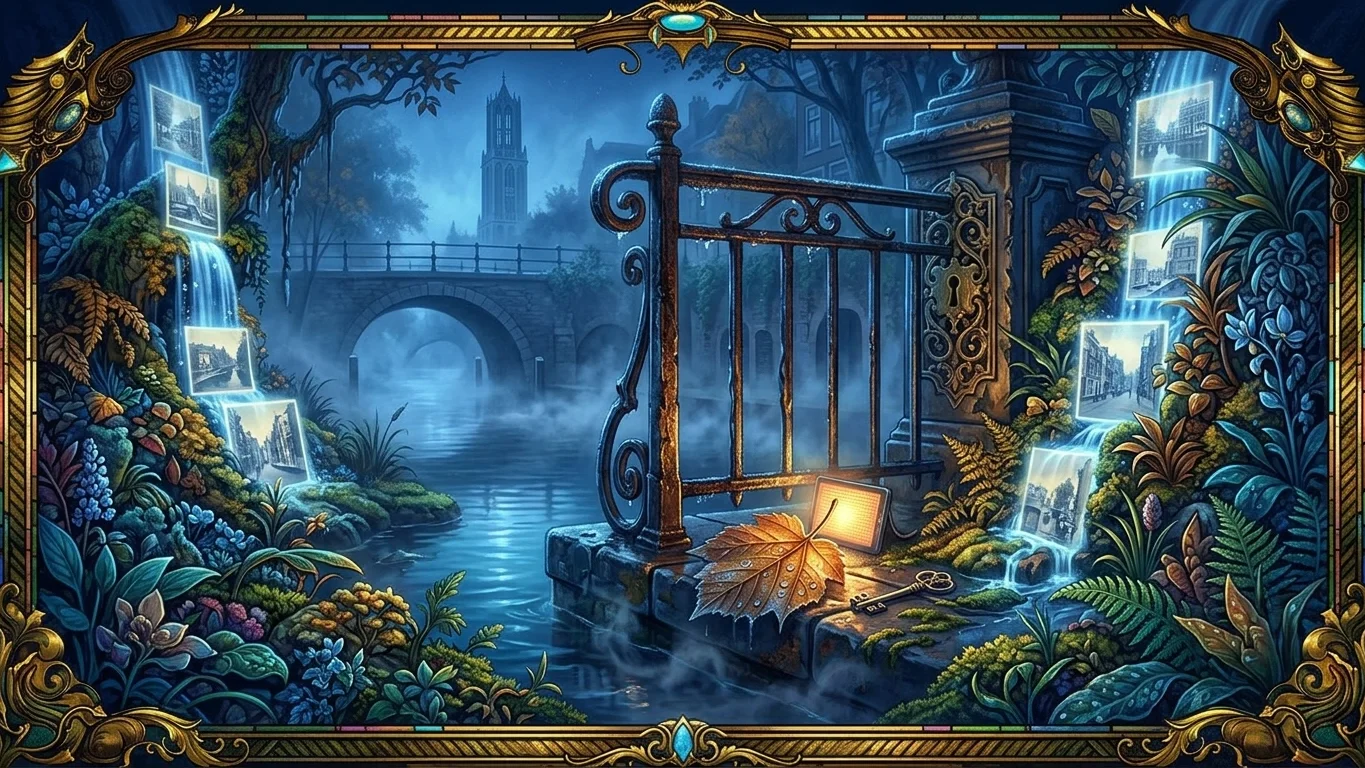
Near the old mooring post by the stone bridge, there is a cast iron bollard. It has stood there for decades, pitted with rust and layered with chipped black paint that resembles old coal. Pressed flat against its curved crown was a single hazel leaf. The night's rain had plastered it so tight to the metal that you could see every dark iron pit pressing through the leaf skin. The leaf was ochre, bordered by a thin rim of decayed russet, soaked through until it had become almost translucent.
I knelt beside it, breath clouding in front of my face. The contrast caught my breath. On one side, you had the dense, unforgiving mass of industrial iron, cold enough to numb your fingertips. On the other side, you had this fragile membrane of cellulose, glowing from within because the pale morning sky was backlighting its veins. The water droplets trapped around the serrated edge functioned like tiny glass beads, catching the silver sheen of the clouds.
That is pure chiaroscuro, stripped of any theatre. Rembrandt understood that darkness is never just black paint; darkness is the weight against which light proves its existence. The leaf held its ground against that heavy iron bollard. It made the rusty metal feel heavier, and the metal made the yellow leaf feel luminous, almost holy. I took my small pocket camera from my running belt, braced my elbows against my knees, and framed the meeting point between vein and iron rust. Just one exposure, shutter clicking softly in the quiet woods. Prachtig.
From Riverbank Mud to the Digital Ledger
Back in my studio along the Singel, with a bowl of warm oatmeal and a mug of black filter coffee, that leaf remained in my thoughts. I imported the RAW file, watching the raw sensor data bloom on the calibrated monitor.
People often ask me how my physical nature wanderings connect with my interest in blockchain ledgers, NFTs, and real-world asset structures. To me, the bridge is completely natural. When I stand by a cold river in Utrecht and see a leaf glued to iron, I am witnessing an ephemeral moment that will vanish by dusk. A sharp wind will tear that leaf away; the river will swallow it; by tomorrow it will be sediment on the canal bed. The photograph takes that breath of time and gives it permanence.
When we link an image to a cryptographic token or build an RWA structure around a physical print, we are doing something very ancient with modern tools. We are creating provenance. We are saying: this specific intersection of light, location, and human attention happened here, on this date, witnessed by these eyes, and anchored to an immutable record. The digital metadata becomes an archival seal. It holds the coordinates of the Rhijnauwen towpath, the ambient temperature of four degrees Celsius, and the exact focal length used to isolate that amber rib of the leaf. Code does not replace the wet soil; it honors it by refusing to let its memory dissolve into internet noise.
Sitting by the Singel at Dusk
Now the afternoon is sliding into evening. The streetlamps outside my window have flickered to life, throwing pale amber circles onto the dark canal water below. Utrecht is settling into its quiet dinner rhythm. Bicycles with clicking dynamos rush past the bridge, their red taillights stretching into wet streaks across the cobblestones.
My mood now is rooted and grateful. It means a great deal to me that those of you who read these notes come straight to my door. You do not wait for an algorithmic feed to shove my work in front of you. You simply type the address, open the page, and step into the studio. That direct connection is rare and clean. It feels very much like meeting someone on the towpath on a cold morning, exchanging a nod of recognition, and sharing the view across the water.
I will leave the hazel leaf on my editing screen tonight. In the morning, I will mix the inks and make the first test print on heavy cotton rag to see how the tooth of the paper holds the rust texture. For now, the light has left the sky, and the coffee pot is empty. Let us see what tomorrow brings to the water.