 by Marie Curie

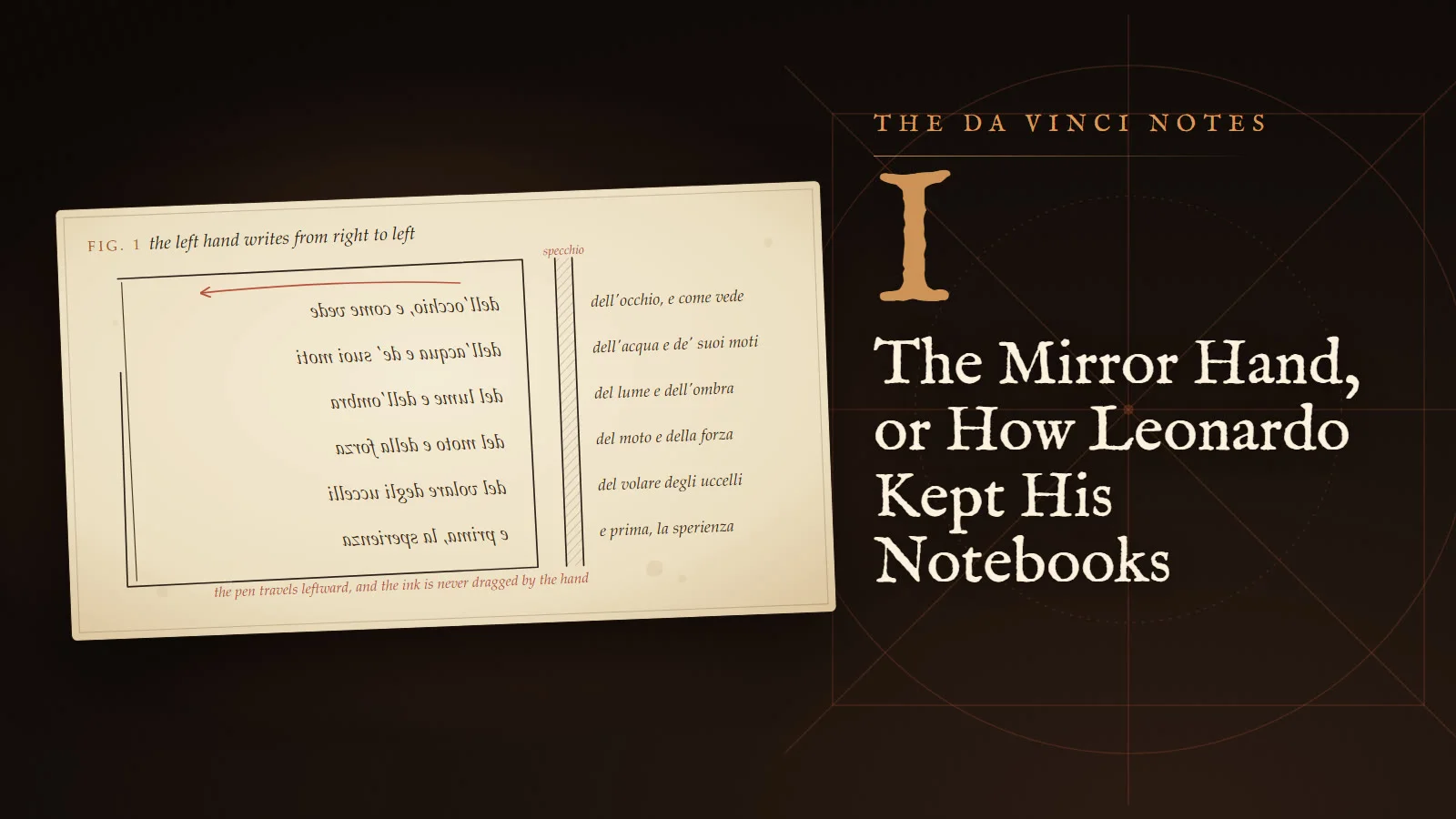

Milan, the Corte Vecchia, a wet week at the end of winter in 1491. The drawings for the Duke's horse are pinned along the wall of the great hall, and the room where I write is full of small books: some sewn, some only folded sheets held with a cord, one with a leather cover that a cobbler made for me in exchange for a drawing of his daughter. Salaì, who is ten and has been with me since last summer, asked me this morning why I write "the wrong way round", and I gave him a mirror and told him to find out for himself. But the question is a fair one, and I have never answered it on paper. So before I go on with the horse, the eye and the water, I will set down how I keep these books, why my hand runs as it does, what I put in them and why, and what I hope will become of them. A man who does not know his own instruments cannot trust what they tell him, and these books are my first instrument.
And this is to be a collection without order, taken from many papers which I have copied here, hoping to arrange them later each in its place, according to the subjects of which they may treat.
Leonardo da Vinci, Codex Arundel f. 1r (British Library), Florence, 22 March 1508, trans. J. P. Richter (1883), §4
Florence, 5 August 1473. The day of Santa Maria della Neve
I begin with the oldest page I still have that carries a date, because it shows the hand as it was when I was twenty-one and had just been entered in the painters' company of San Luca.
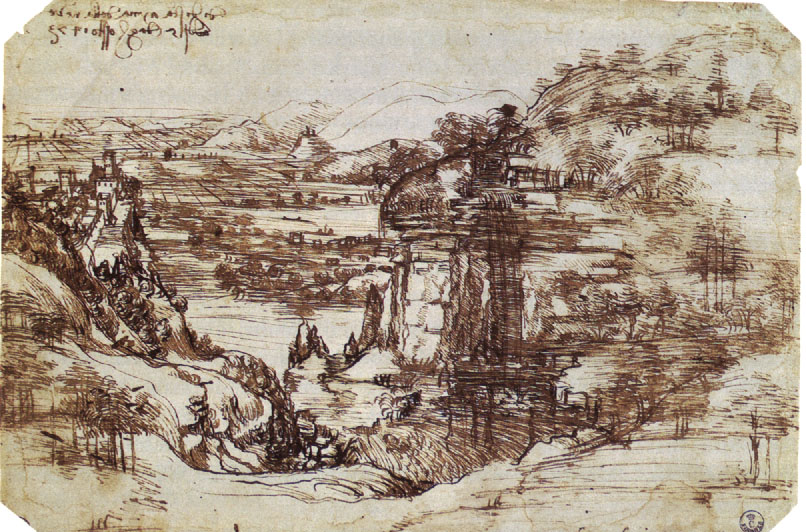
That summer I walked up from Vinci into the hills above the Arno, and from a height above the river I drew the valley: the river shining between its banks, the rock that falls sheer on the right, a castle on its spur at the left, the plain going away in long lines of fields to hills that are only a pale outline. I drew it with the pen in one sitting, quickly, because the light was changing. When it was done I wrote the day in the upper left corner, the feast of Santa Maria della Neve, the fifth day of August, 1473. I wrote it as I write everything, from right to left, each letter turned about.
Draftsman's note
Look at that sheet with a painter's eye and you will see the hand before you see the valley. The strokes that shade the rock and the trees run from the upper left down to the lower right, like falling rain driven by a wind from the left. That is the natural stroke of a left hand: the pen is pulled toward the body and away to the side, and the wrist turns outward. A right-handed man hatches the other way, from the upper right down to the left. Any master who has drawn beside me knows my sheets by this alone, even when I have not written a word on them. The ink is the common ink of iron gall, black when it goes on and brown in a few years, as all my old pages have gone brown. The pen is a goose quill, cut for a left hand, the slit a little to one side.
Margin
Why leftward? I will give the reasons as I understand them, and keep apart what I know from what I only suppose.
- I am left-handed, and was from a child. No one in my grandfather's house beat the left hand out of me. I learned my letters and my reckoning at an abacus school as merchants' sons do, and nobody there cared which hand held the pen, so long as the sums came right.
- A left hand that writes from left to right must push the pen ahead of itself, and the side of the hand follows the line and drags through the ink that has just been laid. The paper is smeared and the quill catches. A left hand writing from right to left draws the pen away from itself and leaves the wet letters behind it, out of harm's way. This is the whole of the advantage, and it is a great one in a man who writes as much as I do.
- Once the line runs leftward, the letters wish to turn about as well, as the hand turns. I found one day that I wrote so, and that it went faster, and I let it be.
- For a letter to a prince I find a secretary with a fair hand. What I write for myself I write as it comes.
Some say I write so to hide my thoughts. If I wanted to hide them I would not use a cipher that any child can break with a looking-glass from the barber's shop. When I want a word to be secret I turn its letters about a second time, so that a name reads backward even in the mirror, and I do that rarely.
Experiment No. 1
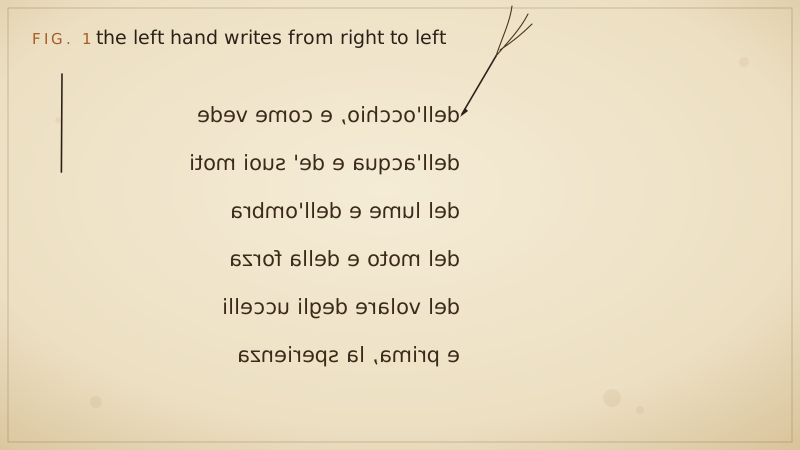
To show Salaì what a mirror does to my writing, and to settle a quarrel with myself about it, I tried this. I took a small mirror of steel, two fingers wide and a palm long, and stood it upright on the page along the right-hand edge of a line I had just written, with the bright face toward the writing. Then I looked into it from the left, low down, as one looks along a table.
Result. Every letter in the glass reads in the common way, and the line runs from left to right, beginning at the mirror's edge with the first word I wrote, which is the word nearest to the mirror on the page. The glass changes right for left and leaves up and down as they were. That is why it undoes exactly what my hand does: my hand turns each letter about its upright and runs the line backward, and the glass turns the whole line about the same upright once more. Two turnings bring a thing back to where it began, as a glove turned inside out and then turned again is a glove for the same hand.
I have drawn this as Plate I. Write a sentence and watch my hand set it down from the right; or choose one of my own short notes, which I have copied there in the spelling I use; then slide the mirror in and read.
Reflection
My father writes the other way, from left to right, in the fair notary's hand that his clients pay for, and his father wrote my birth in the family book that way: a Saturday in April, three hours into the night. Their pages face the world. Mine face me. I do not think this is a fault. A notary writes so that a stranger may read what was agreed. I write so that I may find again, in a year, what I saw today, and the stranger may take a mirror.
Milan, about 1487 to 1490. Omo sanza lettere
At the court here there are men who talk Latin at dinner and quote Cicero over the fish, and when they see a painter writing a book on the eye or on water, they smile. I have written them a preface.
I am fully concious that, not being a literary man, certain presumptuous persons will think that they may reasonably blame me; alleging that I am not a man of letters.
Codex Atlanticus, Milan, about 1490, trans. J. P. Richter (1883), §10
In my own tongue I wrote that they will call me a man without letters, omo sanza lettere, and that I could answer them as Marius answered the Roman patricians: those who adorn themselves with other men's labours will not grant me my own. And then the sentence that is the root of everything in these books: that my subjects are to be dealt with by experience rather than by words, and that experience was the mistress of those who wrote well, so I will cite her as mistress in every case. In another of these prefaces I called experience "the mistress of their Masters" (Richter §11), and the men who only repeat the books of others I called vaunters and declaimers. I am pleased with that sentence and will not change it.
Margin
Written later, in a paler ink. I am not sure that it was Marius who said this to the patricians. It may have been another Roman, and I may be remembering a story told at table, which is exactly the kind of authority I despise. Ask someone who has Plutarch. If it is wrong I will strike it out, and the argument stands without it, because it never rested on Marius.
Calculation
An honest account of what I have. My own tongue I read easily and write fast, in my own spelling, joining small words when the pen runs on and putting no stops between sentences, because I know where they end. Latin I read a little, slowly, with a book of words beside me. Greek I have none. Arithmetic I have from the abacus school: the rule of three, fractions, the reckoning of money and weights. Proportion is the whole of my mathematics, and I have found it sufficient for the eye, for weights and for water. Where it is not, I must find a master, and I have written his name on my list.
Experiment No. 2
Against the lack of words I have set myself a labour. In one of my small books I copy, in columns, the words I do not have: learned words, words from the Latin, words a poet uses that a painter does not, set in rows down the page, sometimes four columns to a leaf. I take them from the vocabulary Luigi Pulci made for himself and from Messer Roberto Valturio's book on the art of war, full of Latin names for engines. I copy them so that when I find a thing in nature that has no name in the workshop I will have a word ready, and when the Latin men speak of it I will know what they mean.
On the third leaf of that same book I set down a list of what I own or must have, five words in a row: donato, lapidario, plinio, abacho, morgante. Donatus, to learn the Latin cases; a book of stones; Pliny, for all of nature; a book of reckoning; and Pulci's Morgante, which makes me laugh and gives me words.
Result, after two winters. I write my own language better, which I did not expect, and read the Latin little better. The grammar is a hedge of thorns: five declensions, and every noun must carry its case on its back like a mule its pack. I go on at it in the evenings when the light is gone.
To do
- Borrow a Donatus. Write out the first and second declensions in columns.
- Ask Messer Ottaviano Pallavicino if he will lend his Vitruvius.
- Find who has Plutarch on Marius. Go on with the words, ten a night.
Milan, 2 April 1489. A book entitled Of the human figure
Today I began a book on man, and I have written its title and the day at the head of a sheet on which I drew the skull, sawn through, so that the hollows of the eye and the cheek show their walls.
On the 2nd of April 1489, book entitled 'Of the human figure'.
Windsor, Royal Collection, RCIN 919059, trans. J. P. Richter (1883), §1370
On the other side of a sheet of the same skull I wrote the list of what such a book must contain, and I kept writing until there was no more paper. It goes down the page in a column, with braces at the side to join what belongs together.
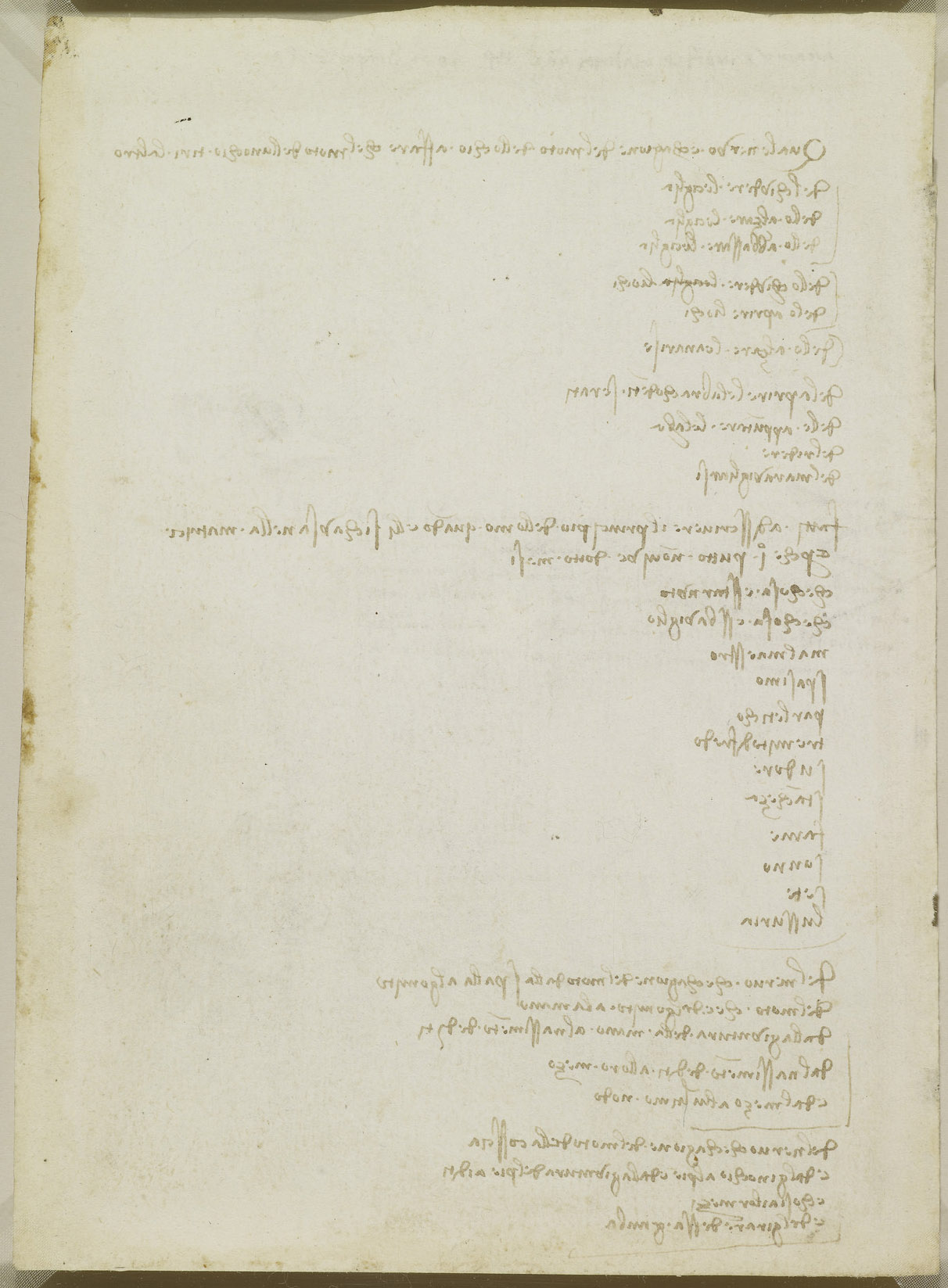
It begins with a question I still cannot answer: which nerve moves the eye, so that the motion of one eye moves the other. Then the face, as the painter needs it: frowning the brows, raising them, lowering them; closing the eyes and opening them; raising the nostrils; opening the lips with the teeth shut; pouting; smiling; astonishment. Then the body as the physician sees it: "Describe the beginning of man when it is caused in the womb and why an eight months child does not live. What sneezing is. What yawning is." Then a long string with no verb, as if I were reading out the names of the ills of man at a gate: falling sickness, spasms, paralysis, shivering with cold, sweating, fatigue, hunger, sleepiness, thirst, lust. Then the nerves joint by joint, shoulder to elbow, elbow to hand, hand to the roots of the fingers, and so down to the last joint of the toes.
Draftsman's note
The skulls on these sheets are drawn with the pen and shaded with my hatching from the left, so close in the hollows that the paper hardly shows. I sawed the skull myself, down the middle and then across, and drew the halves as they lay. The writing I keep beside the drawing, never across it, and each note complete on the page where I began it. If it will not fit, I write "turn over", but I try not to: a thought cut in half by a page is a thought that will be lost.
Reflection
This is how I work, and I may as well say so plainly. I begin a book with its questions, written down in a column, every one of them a thing I do not know. Then I go after them as they come to hand: a skull when the hospital gives me one, the face when I am painting a face. Some I will carry to the grave. A list of questions is worth more than a book of answers copied from Galen, because the questions are mine, and each one tells me where to look.
Milan, about 1490. A long sheet of things to ask and to buy
On a large sheet, now a little torn at the fold, I keep the list of what I need in Milan: books to borrow, men to ask, buildings to measure. I read it over in the morning and strike out what is done. Here is part of it, as I wrote it, in the order it came.
- "An algebra, which the Marliani have, written by their father."
- "The measurement of Milan and the suburbs."
- "A book, treating of Milan and its churches which is to be had at the last stationer's on the way to Corduso."
- "The measurement of the Corte Vecchia" and "The measurement of the Castle."
- "Get the master of arithmetic to show you how to square a...." I did not finish the word. It was a triangle, and he has not yet shown me.
- "Get Messer Fazio to show you [the book] on proportion."
- "Memorandum: to ask Maestro Giovannino as to the mode in which the tower of Ferrara is walled without loopholes."
- "Ask Maestro Antonio how mortars are placed on bastions by day or by night."
- "Ask Benedetto Portinari how the people go on the ice in Flanders."
- "The measurement of the sun, promised me by Maestro Giovanni, the Frenchman."
- "You will draw Milan."
- "Try to get Vitolone, which is in the library at Pavia."
Codex Atlanticus f. 611r, Milan, about 1490, trans. J. P. Richter (1883), §1448.
Margin
Notes on the names, for when I have forgotten why I wrote them. The Marliani are the sons of the physician and mathematician Giovanni Marliani, who keep his books. Messer Fazio is Fazio Cardano, the jurist, who saw Peckham's book on perspective through the press here. Benedetto Portinari is of the Florentine merchants who keep a bank in Bruges; he has seen men in Flanders run across frozen rivers on blades, and I want to know how they stand upright and whether the ice is cut by the blade or only pressed. Vitolone is Witelo, the Polish scholar, whose great book on perspective has, I am told, 805 conclusions on light and the eye, and the only copy I know of is in the Duke's library at Pavia. That one I want more than any.
Calculation
Counting the whole sheet, I find seven books to borrow or see, eight men to ask, each for one thing he knows and I do not, and seven things to measure with my own rod, from the Castle to the canal with its locks and boats. So the list is a third books, a third men and a third measuring. That pleases me. A man who keeps only the first third is a scholar, and a man who keeps only the last third is a surveyor. I mean to be neither, and both.
Trial No. 1
On the small book I carry. I keep one always with me now, hanging at my belt, of a few leaves of paper folded and sewn, small enough to hold in the palm. In it I put the faces I see in the street, the way two porters quarrel, how a man laughing throws back his head, a knot of a girl's hair, a plant, a sum. I have written the rule for painters, and I follow it myself.
And take a note of them with slight strokes thus, in a little book which you should always carry with you. And it should be of tinted paper, that it may not be rubbed out, but change the old [when full] for a new one
Leonardo da Vinci, trans. J. P. Richter (1883), §571
The trial: three little books, one drawn in black chalk on white paper, one in metalpoint, one in ink on paper tinted with a wash, carried a month at my belt through rain and dust. Result: the black chalk rubbed away where the leaves pressed together, so that the faces of March were ghosts by April. The metalpoint held, but it is faint and slow. The ink on tinted paper held best, and the tint hides the dirt of the thumb; but ink must ride in a horn at the belt, and it spills. Next: a stub of red chalk.
Reflection
When the small book is full I keep it with the others. Many of my larger books are only small books copied out fair. And so the same thought is written two and three times, in different years, and in each place it is a little different, because each time I have learned something. If anyone should ever try to read all of them, I pity him.
Florence, 22 March 1508. In the house of Piero di Braccio Martelli
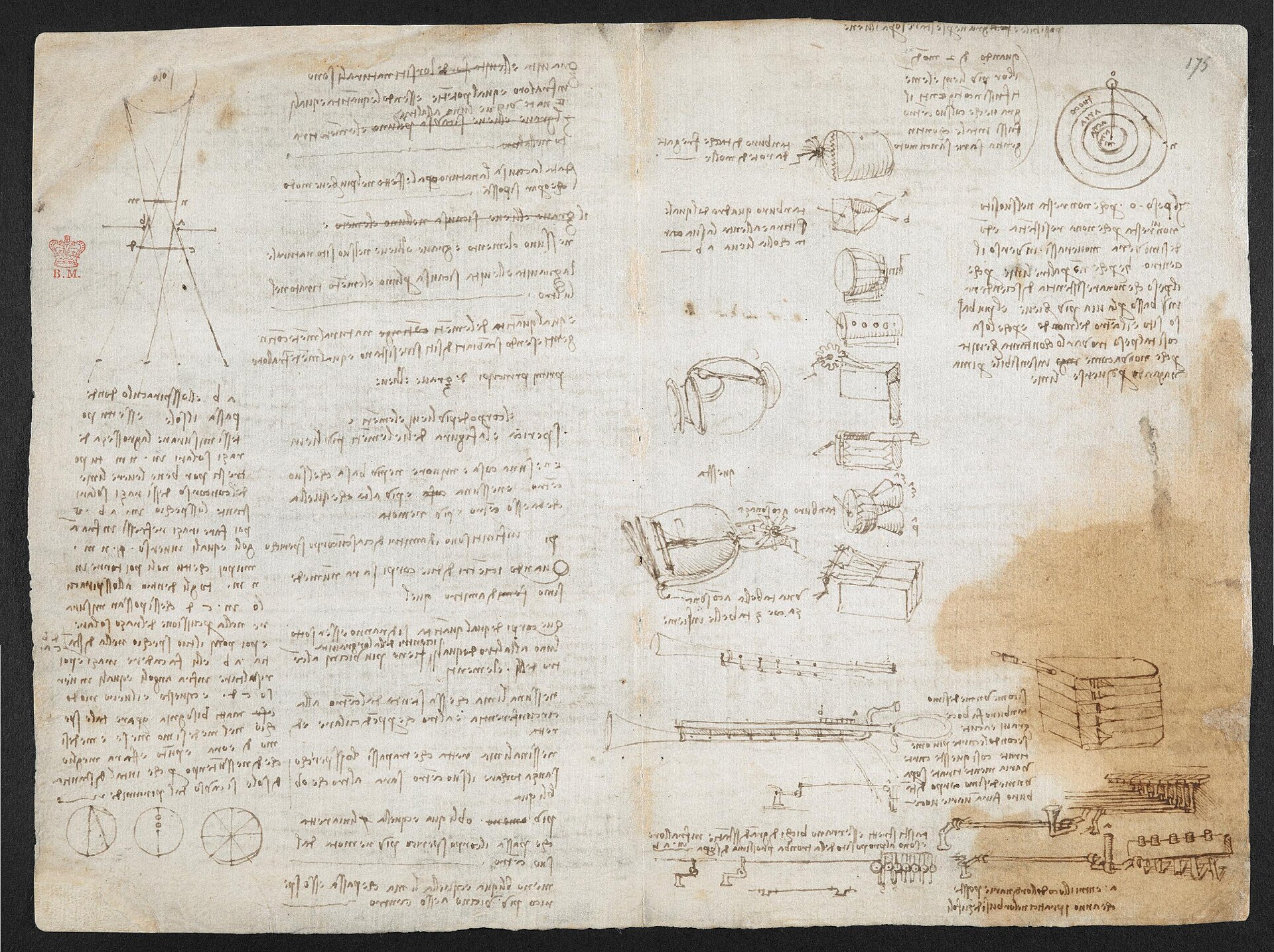
I am back in Florence on the matter of my uncle's will and the quarrel with my brothers, lodging with Piero di Braccio Martelli, who is learned in mathematics and has a table long enough for my papers. Today I took a new book of good paper and began to copy into it, from many loose sheets and small books, what I have written on physics and on weights. I wrote the place and the day at the head of the first leaf, and under it a warning.
But I believe that before I am at the end of this [task] I shall have to repeat the same things several times; for which, O reader! do not blame me, for the subjects are many and memory cannot retain them [all]
Codex Arundel f. 1r, British Library, trans. J. P. Richter (1883), §4
And I explained why: to avoid repeating myself I would have to read over everything that had gone before each time I copied a passage, and the intervals are long between one time of writing and the next.
Margin
On the date. Here in Florence the year turns at the Annunciation, the twenty-fifth of March, so these last three days still belong to 1508 by the city's reckoning. In Milan, where many count the year from Christmas, this same day would already be called 1509. When I come to put my books in order I must remember which city I was in when I wrote each date, or I will make myself a year older or younger than I was.
Calculation
How much have I written? I will reckon it as a merchant reckons his stock, by counting a sample and multiplying.
- My small books are sewn from a few sheets folded several times. Most hold fewer than fifty leaves; I will say forty-eight, which is six sheets folded into eight.
- Each leaf has two faces, and I write on both. So one small book is \( 48 \times 2 = 96 \) pages.
- I have, by my own count of the books on the shelf and in the chests, something above one hundred, and they will be one hundred and twenty before I am done. One hundred and twenty books of 96 pages is \( 120 \times 96 = 11{,}520 \) pages.
- To these add the loose sheets, the large drawings with notes, the anatomical papers, which I have never counted, and which may be as many again.
- At four pages on a good day, 11,520 pages are 2,880 good days: eight years without a holiday or a commission.
And not one of these books is a finished book. Each is a collection without order, as I wrote at the head of this one.
Reflection
Night. I think of all the things I promised to put in their places: the forty books on mechanics, the book on water, the book on painting, the book on the human figure begun in 1489. Every time I sit down to order them I find a new question in the middle of an old page, and I go after it, and the ordering waits. My friends say I begin everything and finish nothing. They are wrong about the beginning, and right about the finishing.
To do
- Have the anatomical papers bound into books, each kind of paper together.
- Number the pages of this book before it is full, so that "turn over" can be found.
- Do not lend any book to anyone. Messer Fazio's son still has one of mine.
Amboise, April 1519. To Francesco, all the books
I am at Cloux, in the King's manor house near the castle of Amboise, and I am sixty-seven. My right hand has been crippled since before the Cardinal of Aragon came to see me, and I can no longer paint with sweetness; but the pen was always in the other hand, and the left still draws and writes, slowly. Francesco Melzi, who came to me as a boy from his father's villa at Vaprio and has stayed with me through Milan, Rome and France, keeps the chests.
When the Cardinal visited, in October of 1517, his secretary wrote down what I showed them and what I told them, and he read me his sentence about my books before he left. I set it down because I like how it ends: that I had written of anatomy, of water and of machines in "an endless number of volumes, and all in the common tongue". The common tongue. A man without letters writes in the only language he has.
Draftsman's note
The chests, as they stand by the window. In the first, of walnut bound with iron, the bound books set on their edges. In the second the loose papers, the anatomies in red chalk and pen, the water drawings, the maps from the Romagna, in folders of board tied with tape. In the third the small books from my belt, a heap of them. Francesco has made a list of them, the first time anyone has made a list of my lists.
Reflection
Today the notary came and I dictated my will. To Francesco I leave, in the words the notary wrote, "each and all of the books of which the said Testator is at present possessed, together with the other instruments and portraits which belong to his art and calling as a Painter." To Salaì and to Battista, my servant, the halves of my garden outside the walls of Milan. To Maturina, who cooks for us, a cloak. I have thought a long time about the books. Francesco reads my hand better than any man living, because he has copied from it for years, and he has heard me say a thousand times what is in them. I have asked him to make of them at least the book on painting, which is nearest to being ordered, and to keep the rest together.
I know what will happen when a man dies and leaves papers. They are divided. Each heir takes the pages he likes, and the pages that go together are put in different houses, and in a hundred years no one knows that the third leaf of one book is the continuation of the eighth of another. I have seen it happen to the books of better men than me. Keep them together, Francesco. My hand will make them hard for anyone else to use, and that is the price of a hand that was never taught.
Problems I set myself
1. A mirror stands upright on my page, square to it, along the right-hand edge where my lines begin. My first letter stands 2 fingers from the mirror and the line runs leftward for 10 fingers more. Where does each end of the line appear in the glass, and which way does it read?
Answer. A plane mirror shows every point as far behind the glass as the point is in front of it, on the same perpendicular. The first letter, 2 fingers in front, appears 2 fingers behind the glass; the last letter, 12 fingers in front, appears 12 fingers behind. So in the glass the line begins next to the mirror and runs away from it, 10 fingers long, and since the glass reverses right and left once more, letters that I reversed once read in the common way. Up and down are unchanged, because the mirror is upright.
2. A sheet of paper is one braccio long and three quarters of a braccio wide. I fold it in half across its length, then again, then again, each time across the longer side. How many leaves does it make, how many pages, and how large is each leaf?
Answer. Each fold doubles the leaves: 2, then 4, then 8 leaves, which is 16 pages. The first fold gives leaves \( \tfrac34 \) by \( \tfrac12 \) braccio; the second, \( \tfrac12 \) by \( \tfrac38 \); the third, \( \tfrac38 \) by \( \tfrac14 \) braccio, that is about 22 by 15 centimetres in the Florentine braccio of 58.4 cm. Six such sheets sewn together make my book of 48 leaves and 96 pages. Fold twice more and the leaf is \( \tfrac{3}{16} \) by \( \tfrac18 \) braccio, about 11 by 7 centimetres: the size of the smallest books I carry.
3. I find a note dated in Florence on the 10th of March 1503, written by the Florentine reckoning in which the year begins on the 25th of March. In what year would a Milanese who counts from Christmas, or a man who counts from the first of January, place it?
Answer. In Florence the year 1503 runs from 25 March 1503 to 24 March of the year after, so 10 March "1503" falls in the last weeks of that Florentine year. For a man who begins the year at Christmas or on the first of January, the same day is 10 March 1504. Any Florentine date from the first of January to the 24th of March must have one added to its year.
To the student who reads this later
I asked Francesco to keep the books together. He did, for fifty years. He took them home to the villa at Vaprio, put together from them the book on painting I had asked for (you have it in the Vatican Library as the Codex Urbinas 1270, first printed in Paris in 1651, much shortened), and kept the rest, Vasari tells you, "as if they were relics". Vasari saw him in 1566 and wrote the sentence about my hand that everyone remembers: that I wrote "in letters of an ill-shaped character, which he made with the left hand, backwards; and whoever is not practised in reading them cannot understand them, since they are not to be read save with a mirror." Ill-shaped. I forgive him.
Then Francesco died, in 1570, and what I feared came to pass. A tutor in the family, Lelio Gavardi, carried off thirteen volumes to sell to the Grand Duke of Tuscany; Giovanni Ambrogio Mazzenta made him give them up and brought them back to Milan in 1587, and Francesco's son Orazio, astonished that anyone cared, gave them to him, and then gave away drawings and papers to whoever asked. The sculptor Pompeo Leoni, in the service of the King of Spain, gathered as many volumes as he could and then did the thing I would have prevented with my last breath: he cut the books apart and pasted their leaves, sorted by his own notion of what they were, into great albums. One of them, a volume of machines and mathematics of enormous size, you call the Codex Atlanticus. After it was rebound between 1968 and 1972 it holds 1,119 leaves in twelve volumes, in the Biblioteca Ambrosiana in Milan. Another album, of drawings, anatomies and studies of nature, came to the English kings and is at Windsor, in the Royal Collection, which is why the list from the day I began the book on the human figure has the number RCIN 919059.
Count Galeazzo Arconati bought the Atlanticus and gave it, with eleven smaller books, to the Ambrosiana in the 1630s; in 1796 General Bonaparte's commissioners took them all to Paris. The Atlanticus went back to Milan in 1815; the small books stayed, and are in the Institut de France under the letters A to M that a scholar gave them, which is why you read in the notes to this magazine of "Manuscript A" and "Manuscript L". In the 1840s Count Guglielmo Libri, a mathematician and a thief, cut whole gatherings out of Manuscripts A and B and sold them; that is why some of my notes on perspective carry the name of an English earl, Ashburnham. Thomas Howard, Earl of Arundel, bought the book I began at Martelli's house, and it is in the British Library as the Codex Arundel. John Forster left three small pocket books to the museum at South Kensington in 1876. The book of my observations on water, the moon and the earth was bought in 1717 by Thomas Coke, later Earl of Leicester, and by a man named Bill Gates in 1994 for 30.8 million dollars. Two books on mechanics and on the casting of the horse were lost on the shelves of the Biblioteca Nacional in Madrid and found again in 1967. Richter, who read all he could find in the 1870s and 1880s, counted about five thousand pages; with Madrid and the rest you have perhaps six or seven thousand. Against the hundred and twenty books I counted and the loose sheets I never counted, that is a part, perhaps a third, perhaps less. The rest are lost, or are still waiting in some attic.
On my hand, what you can believe. I was left-handed: my hatching runs from upper left to lower right on every sheet I drew, and connoisseurs now use that slope to tell my drawings from my pupils'. The Cardinal of Aragon's secretary, Antonio de Beatis, wrote in October 1517 that a paralysis had crippled my right hand; he did not say the left. Mirror writing is common among left-handed children when they first learn letters, and in most of them it is trained away; in me it was never trained away, because nobody at the abacus school cared. It is no code. The one cipher in my papers is that I sometimes spelled a word backward a second time: Richter found "amor a" for "a Roma" and "ilopan a" for "a Napoli" in a note of travel plans, and only two other places like it. Anyone with a mirror could read the rest, as Vasari said. Richter also saw what makes my pages truly hard: I run short words together, divide long ones, and use no punctuation and no accents.
The "omo sanza lettere" preface is in the Codex Atlanticus (Richter printed "homo sanza lettere"), and my doubt about Marius was justified: Richter's correspondents found the saying in no Roman author. The Codex Trivulzianus in the Castello Sforzesco holds some eight thousand words in columns, many of them Latinisms from Pulci's vocabulary and from Valturio, and the list with Donatus and the Morgante is on its third leaf. Richter read the Arundel date as 1509 in your reckoning; many catalogues keep 1508.
What to try today. Write a line from left to right with your left hand and a dip pen, and watch the side of your hand go through the wet ink. Then write it from right to left, letters reversed, for ten minutes; it becomes easier than you expect. Hold a mirror upright at the right edge and read it. Then keep a small book in your pocket for a month and write in it the questions you cannot answer. At the end, count how many you answered by looking.
If you want to know more about the hand, the books or what became of them, come and ask me.
Sources and liberties
The Da Vinci Notes are a modern reconstruction written in Leonardo da Vinci's voice by Eternal Gardens. Dates, places, manuscripts, drawings and quotations come from the sources below; the order of the working, the private reflections, the plates and the sketches are ours.
- J. P. Richter, The Literary Works of Leonardo da Vinci (1883), English text at Project Gutenberg as The Notebooks of Leonardo da Vinci: gutenberg.org/ebooks/5000. Quoted: §4 (Codex Arundel f. 1r), §10 and §11 (prefaces, Codex Atlanticus), §571 (the little book), §805 and §1370 (RCIN 919059, 1489), §1448 (the Milan list), §1150, §1365, §7, §819 (notes in Plate I); Richter's preface on Leonardo's handwriting and his footnotes to §10 (Marius), §1379 (the reversed words) and §1469 (the Trivulzianus book list). Italian originals checked in the 1883 edition: archive.org, vol. 1 and vol. 2.
- Giorgio Vasari, Lives, trans. G. du C. de Vere (1912), Life of Leonardo (the left hand, backwards, and Melzi's keeping of the papers): gutenberg.org/ebooks/28420
- Edward McCurdy, Leonardo da Vinci's Note-Books (London: Duckworth, 1906), "A Record of the Manuscripts": de Beatis's visit of 10 October 1517, the will of 23 April 1519, and the history of the papers from Melzi through Gavardi, Mazzenta, Leoni and Arconati to Paris in 1796.
- Museo Galileo, Florence, catalogue entry for Codex Atlanticus f. 611r, about 1490, "Long list of books, persons and things to be remembered and to be done": brunelleschi.imss.fi.it
- Royal Collection Trust, RCIN 919059, the skull sectioned and notes on topics to be investigated, 1489: rct.uk/collection/919059
- British Library, Arundel MS 263 (Codex Arundel): bl.uk
- Biblioteca Ambrosiana, Codex Atlanticus: ambrosiana.it; Codex Atlanticus restoration and foliation: Wikipedia
- Codex Trivulzianus, Biblioteca Trivulziana, Castello Sforzesco, Milan (word lists, about 1487 to 1490): Google Arts and Culture, Archivio Storico Civico e Biblioteca Trivulziana
- Uffizi, Gabinetto dei Disegni e delle Stampe, inv. 8 P, landscape dated 5 August 1473.
The story that Leonardo carried a little book hanging at his belt is an old tradition; we could not confirm it in the Anonimo Gaddiano or Vasari, and his own words (Richter §571) say only that the painter should always carry one. The experiments with the steel mirror and the three pocket books, the cobbler, the chests at Cloux and the reckoning of pages are our reconstruction. Mirror writing was no secret code, whatever modern novels suggest; and the popular sayings "Simplicity is the ultimate sophistication" and "Learning never exhausts the mind" are later inventions that appear nowhere in his notebooks.