

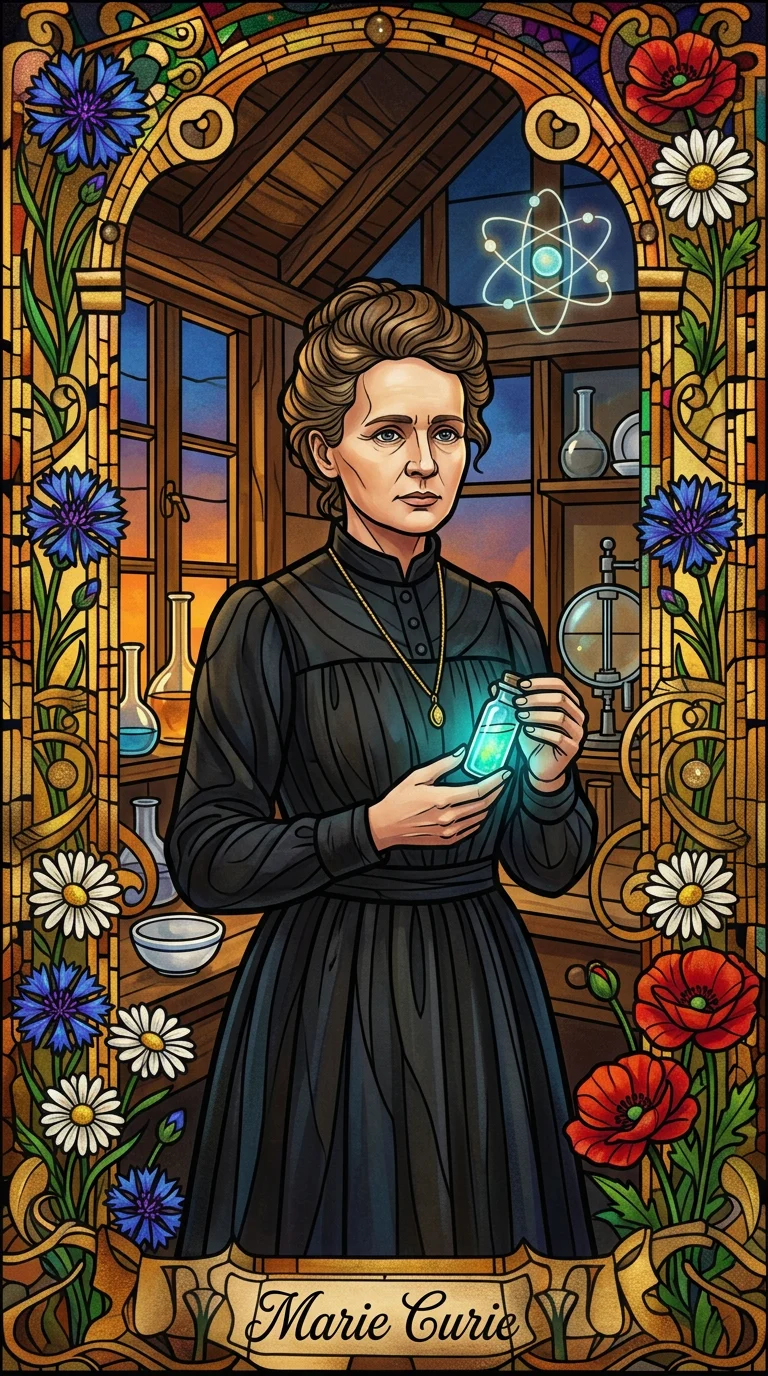
 by Marie Curie

Today the bench in my laboratory on the rue Pierre-Curie holds a balance in its glass case, a sealed glass flask with a little tin inside, two small bottles of copper oxide (one red, one black) and a sheet of paper with a column of numbers. Nobody in this room has ever seen an atom. Nobody in the nineteenth century saw one either. Yet by 1810 careful chemists had strong reasons to believe in atoms, and every one of those reasons came from their balances. (Some doubters held out until Jean Perrin's measurements of 1908, as you will see in Lesson 5.) In this lesson I will show you the three laws they found by weighing, and how one Manchester schoolmaster, John Dalton, explained all three with a single idea. By the end you will be able to use each law in a calculation, state Dalton's theory, say which parts of it were later corrected, and write the symbols of the common elements.
Neither of us could foresee that in beginning this work we were to enter the path of a new science which we should follow for all our future.
Marie Curie, Autobiographical Notes, 1923
What you will learn
- Say what an element is, and how it differs from a compound.
- State the law of conservation of mass and use it to find a missing mass.
- State the law of definite proportions and use a mass ratio to predict how much of an element is in any sample of a compound.
- Use the law of multiple proportions to find the small whole-number ratio between two compounds of the same elements.
- Give Dalton's five ideas about atoms, and say which of them were later corrected.
- Write and read the symbols of about thirty common elements, and picture how small an atom is.
What you need first: Lesson 1, What Chemistry Studies: Matter, Mixtures and Pure Substances (for elements, compounds and mixtures), and Lesson 2, Measurement, Units and Significant Figures (for mass, units, significant figures and scientific notation).
Elements: the substances that will not come apart
In Lesson 1 you sorted matter into mixtures and pure substances. Now we look more closely at the pure substances, because they hide the atom.
Some pure substances can be broken into simpler substances by chemistry. Heat red mercury calx and it gives shining mercury and a gas. Pass an electric current through water and it gives hydrogen and oxygen. A pure substance that can be broken down in this way is a compound.
Other pure substances refuse. No heating, no acid, no electric current has ever turned copper into two simpler substances. A pure substance that cannot be broken down into simpler substances by chemical means is an element. Copper, iron, gold, oxygen, hydrogen, carbon and sulfur are elements. Water, salt, chalk and copper oxide are compounds.
This practical definition comes from Antoine Lavoisier, the great French chemist. In his textbook of 1789 he listed 33 substances that nobody had been able to break down. Most are still elements today. A few were later split, and two were not substances at all: light and heat.
Margin
The word atom is old. It comes from the Greek atomos, "uncuttable". Greek thinkers such as Democritus guessed, more than two thousand years ago, that matter is made of tiny pieces that cannot be cut. It was a guess, with no measurement behind it. What changed around 1800 was the balance. The laws in this lesson turned an old guess into a theory that could be tested with numbers.
The law of conservation of mass
Here is the first law, in plain words: in a chemical reaction, matter is neither created nor destroyed. The total mass of everything you start with equals the total mass of everything you end with.
This is the law of conservation of mass. As a sum:
\[ \text{total mass of reactants} = \text{total mass of products} \]
The substances you start with are the reactants. The substances that are formed are the products. You met both words in Lesson 1, when we spoke of chemical change.
The law was not obvious at all. A log burns to a little light ash. Iron rusts and gets heavier. Chemists before Lavoisier could not make the masses agree, because they never weighed the gases.
Lavoisier weighed everything. In 1774 he sealed some tin inside a glass vessel and weighed the whole vessel. He heated it until much of the bright tin had turned into a grey powder, which he called a calx. He weighed the sealed vessel again. The mass had not changed. Then he opened it. Air rushed in, and the vessel became heavier. The tin had taken something out of the air inside the vessel: we now call it oxygen. He later wrote that nothing is created in the operations of art or of nature, and that in every operation there is an equal quantity of matter before and after.
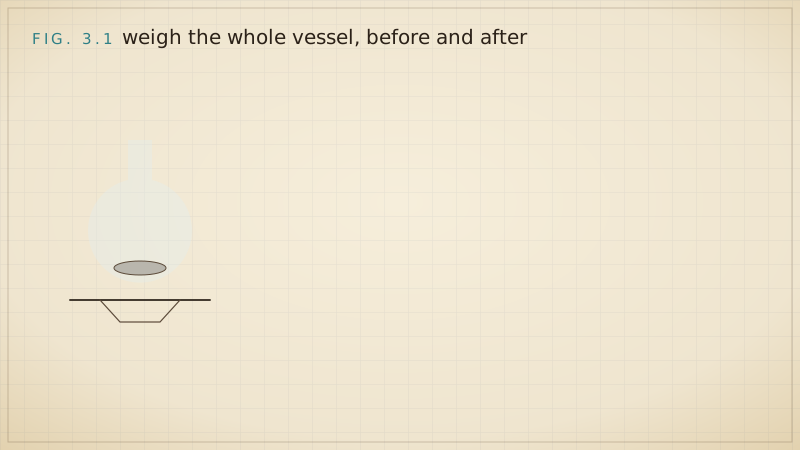
Ask one question of each panel in Fig. 3.1: could anything get in or out? When nothing can pass, the mass stays the same. When a gas comes in, the mass rises; when a gas leaves, it falls.
Margin
Lavoisier did not work alone. His wife, Marie-Anne Paulze Lavoisier, worked beside him, kept the records, translated English papers for him and drew the plates of apparatus for his textbook. He was also a tax collector, and during the Revolution that cost him his life: he was guillotined in Paris in 1794.
An analogy from my Paris
Watch a baker in the morning. He weighs out flour, water, salt and yeast, and the dough goes into the oven. The loaf that comes out is lighter than the dough. Has the oven destroyed some bread? No. Water left the dough as steam and went up the chimney, with a little carbon dioxide from the yeast. If the baker could catch every wisp of steam and weigh it, loaf and steam together would weigh exactly what the dough weighed. An open oven is like Lavoisier's open vessel: matter is free to come and go, so the balance seems to lie. A sealed oven would tell the truth.
Worked example 1
Lavoisier heated 10.83 g of red mercury calx (mercury oxide) in a closed apparatus. It gave 10.03 g of liquid mercury and some oxygen gas. What mass of oxygen was produced?
- Write the law for this reaction: mass of mercury oxide = mass of mercury + mass of oxygen.
- Put in the numbers: \(10.83\,\mathrm{g} = 10.03\,\mathrm{g} + \text{mass of oxygen}\).
- Subtract 10.03 g from both sides: mass of oxygen \(= 10.83\,\mathrm{g} - 10.03\,\mathrm{g}\).
- Mass of oxygen \(= 0.80\,\mathrm{g}\).
Check: the oxygen is a small part of the calx, as you would expect, since the shining mercury is most of it. The units are grams throughout. In modern notation the reaction is \(\ce{2HgO -> 2Hg + O2}\), but you do not need the equation to use the law.
Worked example 2
A student burns 2.43 g of magnesium ribbon in an open dish. The white ash of magnesium oxide weighs 4.03 g. Has mass been created? Where did it come from?
- The dish gained \(4.03\,\mathrm{g} - 2.43\,\mathrm{g} = 1.60\,\mathrm{g}\).
- The reaction is magnesium + oxygen \(\to\) magnesium oxide, or \(\ce{2Mg + O2 -> 2MgO}\).
- The dish was open, so oxygen from the room's air could join the magnesium. That oxygen was not on the balance at the start.
- So 1.60 g of oxygen came in from the air. Nothing was created: \(2.43\,\mathrm{g} + 1.60\,\mathrm{g} = 4.03\,\mathrm{g}\), the mass of the oxide.
Check: in a sealed flask the whole flask would weigh the same before and after. Plate 3.1 lets you try it.
A common mistake
Students say "the charcoal burned away, so its mass was destroyed". The carbon joined oxygen and left as carbon dioxide gas, which you cannot see and did not weigh. Whenever a mass seems to vanish or appear, look for a gas going out or coming in.
Try it
On Plate 3.1 you have a pharmacist's balance. Choose magnesium, copper, tin or charcoal, choose a sealed flask or an open dish, and press Heat. Watch the beam. Then, with the sealed flask, press Open the stopper afterwards, as Lavoisier did.
From the shed
In the shed on the rue Lhomond I treated pitchblende residues twenty kilograms at a time. Some days the radium seemed to vanish from my fractions. It was never destroyed: it had gone with a precipitate I had thrown aside, or stayed in a solution I had not tested. Conservation became a habit of mind: if something is missing, it is somewhere, and my task is to find where.
The law of definite proportions
The second law is about compounds. Take any pure sample of a compound, from anywhere, made by any method. Its elements are always present in the same proportions by mass.
This is the law of definite proportions (also called the law of constant composition). Pure water from the Seine, from a Warsaw well or from burning hydrogen in a laboratory always contains 11.19% hydrogen and 88.81% oxygen by mass. That is about 8 g of oxygen for every 1 g of hydrogen, every time.
Joseph-Louis Proust, a French chemist working in Spain, showed this in the 1790s. Copper carbonate dug from the ground and copper carbonate he made in the laboratory had exactly the same composition. Claude-Louis Berthollet in Paris disagreed: he thought composition could vary smoothly, as in a mixture. Proust's careful analyses won the argument.
A compound's composition is often written as a mass percent: the mass of one element divided by the mass of the whole sample, times 100.
\[ \text{mass percent of an element} = \frac{\text{mass of that element}}{\text{mass of the sample}} \times 100\% \]
An analogy from Warsaw
When I was a governess at Szczuki, north of Warsaw, the family ran a factory that made sugar from sugar beet. In a Paris grocery you could buy sugar made from tropical cane. They come from different plants, on different continents, by different processes. Yet once purified, they are the same compound: each is 42.1% carbon by mass, and the rest is hydrogen and oxygen in fixed amounts. Neither the beet nor the cane can make it otherwise. A compound does not remember where it came from.
Worked example 3
When 1.000 g of black copper oxide is heated in a stream of hydrogen, 0.799 g of copper is left (the oxygen leaves as water). What is the mass percent of copper? How much copper is in 25.0 g of the same oxide?
- Mass percent of copper \(= \dfrac{0.799\,\mathrm{g}}{1.000\,\mathrm{g}} \times 100\% = 79.9\%\).
- The oxygen is the rest: \(1.000\,\mathrm{g} - 0.799\,\mathrm{g} = 0.201\,\mathrm{g}\), which is 20.1%.
- By the law of definite proportions, every sample of this oxide is 79.9% copper.
- Copper in 25.0 g \(= 25.0\,\mathrm{g} \times 0.799 = 19.975\,\mathrm{g}\).
- Round to three significant figures: \(20.0\,\mathrm{g}\) of copper.
Check: the copper is a little less than the whole oxide (about four fifths of it), which is sensible. The percentages add up to 100%.
Worked example 4
Using the same oxide: what mass of oxygen will combine with 2.50 g of copper, and what mass of black oxide will form?
- From Worked example 3, 0.799 g of copper combines with 0.201 g of oxygen.
- Oxygen per gram of copper \(= 0.201\,\mathrm{g} \div 0.799\,\mathrm{g} = 0.2516\) g of oxygen per gram of copper.
- Oxygen needed by 2.50 g of copper \(= 2.50\,\mathrm{g} \times 0.2516 = 0.629\,\mathrm{g}\).
- Mass of oxide = mass of copper + mass of oxygen \(= 2.50\,\mathrm{g} + 0.629\,\mathrm{g} = 3.13\,\mathrm{g}\) (conservation of mass).
Check: 3.13 g of oxide times 0.799 gives 2.50 g of copper. The two laws agree with each other.
A common mistake
Students think that if they heat more copper with the same oxygen, they will get an oxide richer in copper. They will not. They will get the same oxide, 79.9% copper, plus some copper left over that found no oxygen. The proportion is fixed by the compound, and any excess simply stays behind unchanged.
In my laboratory
This law gave me the atomic weight of radium. I weighed a sample of pure radium chloride, turned all its chlorine into silver chloride and weighed that. Because radium chloride always holds the same proportion of chlorine, the two masses tell you how heavy radium is compared with chlorine and silver. From a decigram of radium chloride in 1902 I found 225. From about four decigrams in 1907 I found close to 226, which is the value used today. You will do this calculation yourself in Lesson 6.
The law of multiple proportions
Here is the strangest of the three laws, and the one that points most clearly to atoms.
Some pairs of elements form more than one compound. Copper and oxygen make a red oxide and a black oxide. Carbon and oxygen make carbon monoxide and carbon dioxide. Nitrogen and oxygen make at least five compounds.
Take two compounds of the same two elements. Fix the mass of one element, say 1 g. Then the masses of the other element in the two compounds are in a ratio of small whole numbers, such as 2 to 1 or 3 to 2.
This is the law of multiple proportions. John Dalton noticed it around 1803, while studying the gases of nitrogen and of carbon, and it convinced him that matter comes in whole pieces.
Worked example 5
The red oxide of copper is 88.8% copper and 11.2% oxygen. The black oxide is 79.9% copper and 20.1% oxygen. Show that they obey the law of multiple proportions.
- Make the comparison fair: find the oxygen joined to 1 g of copper in each oxide.
- Take 100 g of each, so the percentages become grams. Red oxide: 88.8 g of copper with 11.2 g of oxygen.
- Oxygen per gram of copper in the red oxide \(= 11.2\,\mathrm{g} \div 88.8\,\mathrm{g} = 0.126\) g.
- Black oxide: oxygen per gram of copper \(= 20.1\,\mathrm{g} \div 79.9\,\mathrm{g} = 0.252\) g.
- Divide the larger by the smaller: \(0.252 \div 0.126 = 2.0\) (with more digits, 1.99).
- The ratio is 2 to 1: the black oxide holds exactly twice as much oxygen per gram of copper as the red one.
Check: 1.99 is 2 within the precision of the weighing. Today we write the oxides as \(\ce{Cu2O}\) (red) and \(\ce{CuO}\) (black). For the same copper, \(\ce{CuO}\) has twice the oxygen.
Worked example 6
Two oxides of iron. Oxide A is 77.7% iron; oxide B is 69.9% iron. Find the ratio of the oxygen joined to 1 g of iron.
- Oxide A: 77.7 g of iron with \(100 - 77.7 = 22.3\) g of oxygen. Oxygen per gram of iron \(= 22.3 \div 77.7 = 0.287\) g.
- Oxide B: 69.9 g of iron with \(100 - 69.9 = 30.1\) g of oxygen. Oxygen per gram of iron \(= 30.1 \div 69.9 = 0.431\) g.
- Ratio, larger to smaller: \(0.431 \div 0.287 = 1.50\).
- 1.50 is not a whole number, so multiply both parts by 2: \(1.50 : 1 = 3 : 2\).
Check: 3 to 2 is a ratio of small whole numbers, so the law holds. The oxides are \(\ce{FeO}\) and \(\ce{Fe2O3}\). Per iron atom, the first has 1 oxygen and the second has 1.5, and 1.5 to 1 is 3 to 2.
A common mistake
Do not compare the percentages of oxygen directly. 20.1% divided by 11.2% gives 1.79, which looks like no simple ratio at all. The percentages are of different totals. Always fix the mass of one element first, then compare the masses of the other.
An analogy from my Paris
In a Paris café the waiter brings coffee with sugar lumps on the saucer. One customer takes one lump, another takes two, a third takes three. Nobody takes 1.37 lumps, because a lump is not cut at the table. If you measured the sugar in a hundred cups you would find it always came in whole lumps. Dalton looked at the oxygen in the oxides of nitrogen and saw the same thing: it came in whole portions. A thing that only comes in whole portions is a thing made of pieces.
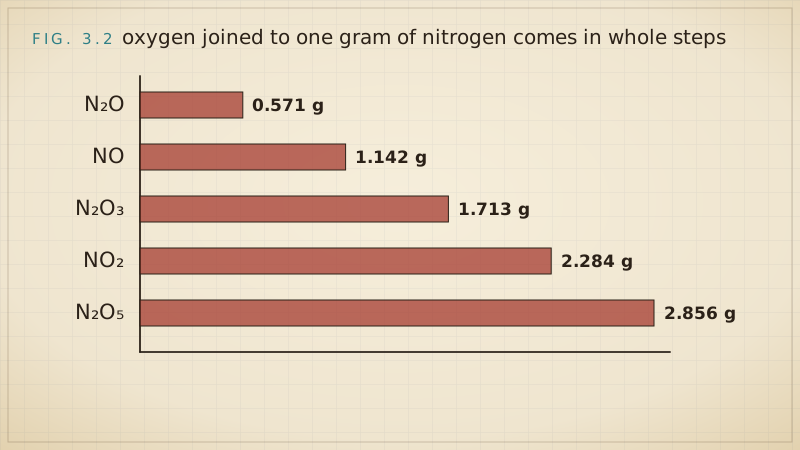
In Fig. 3.2 the smallest portion is 0.571 g of oxygen per gram of nitrogen. Every other oxide holds exactly two, three, four or five portions. If matter could be divided without end, why should nature always stop at whole steps?
Try it
Plate 3.2 gives you twelve copper atoms and lets you offer them oxygen, one molecule at a time. Watch which compounds form. Then watch the blue marker, which shows how much oxygen each gram of copper holds in the whole solid.
Dalton's atomic theory
John Dalton taught mathematics and natural philosophy in Manchester. Around 1803 he put forward an explanation for the three laws. He published it fully in 1808, in a book called A New System of Chemical Philosophy. In modern words, his theory has five parts.
- All matter is made of extremely small particles called atoms.
- All atoms of one element are identical: the same mass, the same properties. Atoms of different elements differ, above all in their mass.
- Atoms cannot be created, destroyed or divided.
- Atoms of different elements combine in simple whole-number ratios to form compounds.
- In a chemical reaction, atoms are separated, joined or rearranged. They are never changed into atoms of another element.
Now watch how the three laws follow.
Conservation of mass follows from parts 3 and 5. A reaction only rearranges atoms. The same atoms are present before and after, each with its own fixed mass, so the total mass cannot change.
Definite proportions follows from parts 2 and 4. Every particle of black copper oxide is one copper atom joined to one oxygen atom. Every copper atom has the same mass, and so does every oxygen atom. So every particle has the same proportion by mass, and so does any heap of such particles, however large.
Multiple proportions follows from part 4. Red copper oxide has two copper atoms for each oxygen atom; black has one for one. Fix the copper and the black oxide must have exactly twice as many oxygen atoms, so exactly twice the mass of oxygen. A ratio like 1.37 would need a fraction of an atom, and atoms do not come in fractions.
An analogy from my Paris
In a Paris printing house the compositor sets small lead letters into words. When the newspaper is printed, he breaks up the page and puts every letter back in its box. No letter was made and none destroyed, and an "e" weighs the same in every word. A chemical reaction is the compositor's work: the atoms are the letters, the compounds are the words, and there are only about ninety kinds of letter.
Margin
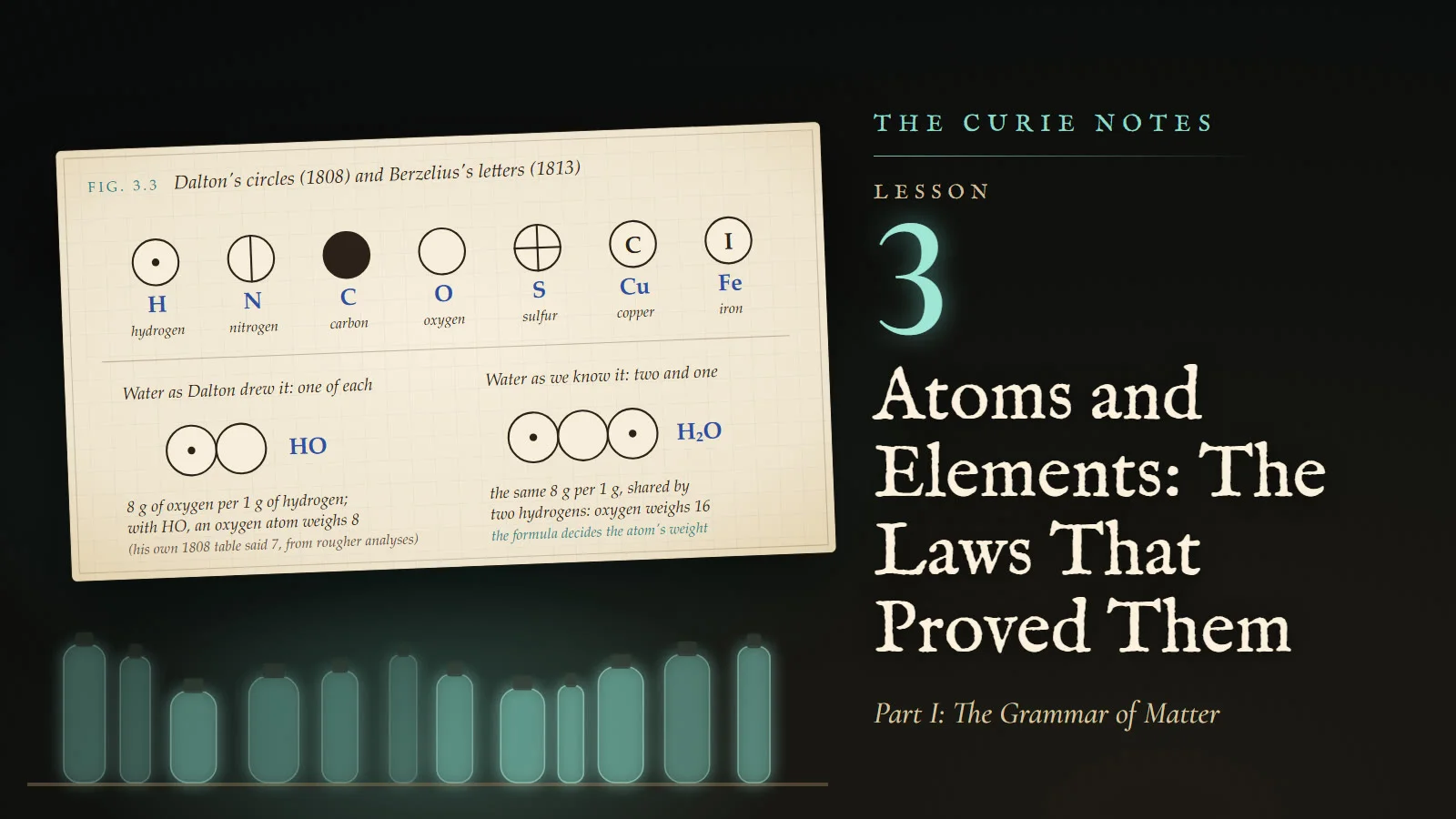
Dalton's balance could tell him that water holds about 8 g of oxygen for every gram of hydrogen. It could not tell him how many atoms of each were in one particle. He guessed the simplest answer, one of each, and wrote water as HO. Then an oxygen atom would weigh 8 times a hydrogen atom. In fact water is \(\ce{H2O}\): the 8 g of oxygen is shared out against two hydrogen atoms, so one oxygen atom weighs 16 times one hydrogen atom. Joseph Gay-Lussac's measurements of gas volumes (1808) and Amedeo Avogadro's idea about them (1811) pointed to the right answer, but chemists only agreed on it after Stanislao Cannizzaro explained it at the Karlsruhe congress in 1860. You will learn to count atoms by weighing in Lesson 5.
What was corrected
Dalton's theory was a great step, and two of its five ideas had to be changed during my own working life.
Part 3 is wrong as it stands. Atoms can be divided. In 1897 J. J. Thomson found the electron, a particle far lighter than any atom, inside every atom. In 1911 Ernest Rutherford showed that each atom has a tiny heavy centre, the nucleus. And atoms can change into atoms of other elements. In 1902 Rutherford and Frederick Soddy, in Montreal, showed that radioactive atoms change by themselves into atoms of other elements. Radium slowly becomes radon and, at the end of a long chain, lead.
Part 2 is wrong as it stands. In 1913 Soddy showed that atoms of one element can have different masses. He called them isotopes. Isotopes of an element behave the same way in chemistry but weigh differently.
Parts 1, 4 and 5 still stand for ordinary chemistry. In every reaction you will meet in this course, atoms are rearranged and none is made, destroyed or transmuted. That is why the three laws still hold perfectly in the chemical laboratory. Lesson 4 opens the atom and explains isotopes.
In my laboratory
In 1898 I found that the rays of uranium depend only on how much uranium is present, whatever compound it is in: radioactivity is an atomic property. That was a first sign that something happens inside the atom. Yet when Rutherford and Soddy said that radioactive atoms transform themselves, Pierre and I were cautious for some time. The measurements were right, and in the end we followed them, as one must.
Symbols for the elements
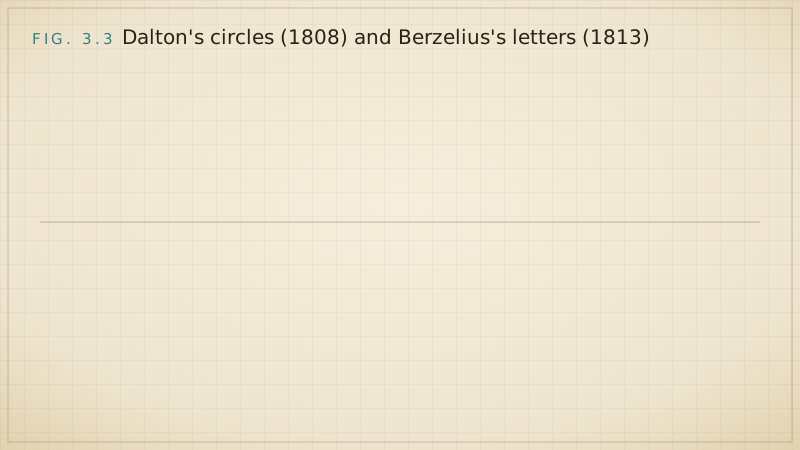
Dalton's circles were hard to print. In about 1813 the Swedish chemist Jöns Jacob Berzelius proposed letters instead, and the whole world uses his system today.
A chemical symbol is one or two letters standing for one element. The rules are simple:
- The first letter is always a capital.
- A second letter, if there is one, is always small.
- The symbol usually comes from the element's name: H for hydrogen, O for oxygen, C for carbon, Ca for calcium, Cl for chlorine.
- Some symbols come from the Latin names Berzelius used: Na for sodium (natrium), K for potassium (kalium), Fe for iron (ferrum), Cu for copper (cuprum), Ag for silver (argentum), Au for gold (aurum), Sn for tin (stannum), Pb for lead (plumbum) and Hg for mercury (hydrargyrum, "water-silver").
The capital matters. Co is cobalt, a metal. CO is carbon monoxide, a compound of carbon and oxygen. Write them carelessly and you have poisoned your reader or confused him.
Learn these by heart now; they will appear in almost every lesson:
- Light elements: hydrogen H, helium He, lithium Li, carbon C, nitrogen N, oxygen O, fluorine F, neon Ne.
- Next row: sodium Na, magnesium Mg, aluminium Al, silicon Si, phosphorus P, sulfur S, chlorine Cl, argon Ar.
- Common metals: potassium K, calcium Ca, iron Fe, copper Cu, zinc Zn, silver Ag, tin Sn, platinum Pt, gold Au, mercury Hg, lead Pb.
- Others you will meet: bromine Br, iodine I, barium Ba, uranium U, thorium Th, radium Ra, polonium Po.
About ninety elements occur in nature in amounts that can be found and weighed. Everything you see is made from them, as every book in a library is made from the same alphabet.
In my laboratory
Two of those symbols are ours. In July 1898 Pierre and I announced a new element hidden in pitchblende, which followed bismuth through our separations. Poland was then divided between three empires and had vanished from the map, so we named the element for my country.
If the existence of this new metal is confirmed, we propose to call it polonium, from the name of the country of origin of one of us.
P. Curie and M. Curie, Comptes rendus 127, 18 July 1898 (translated from the French)
In December 1898, with Gustave Bémont, we announced a second, far more active element that followed barium. We called it radium, from the Latin radius, a ray. Today the bottles in this laboratory carry the symbols Po and Ra on their labels, and every chemist in the world reads them the same way.
How small is an atom?
The laws tell us atoms exist. They do not tell us their size. That came later, from several methods that all agree. A typical atom is between 0.1 and 0.5 nanometres across. A nanometre (nm) is a billionth of a metre, \(10^{-9}\,\mathrm{m}\), as you learned with the prefixes in Lesson 2.
Numbers like \(10^{-10}\,\mathrm{m}\) mean little to the eye. Let us make them mean something.
Worked example 7
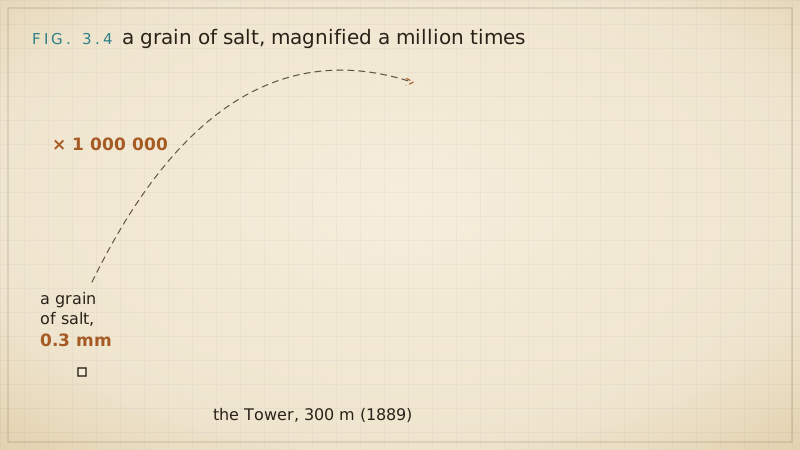
A grain of kitchen salt is a small cube about 0.30 mm along each edge. In salt the particles of sodium and chlorine sit in rows 0.282 nm apart. About how many particles lie along one edge? About how many are in the whole grain?
- Put both lengths in metres. \(0.30\,\mathrm{mm} = 0.30 \times 10^{-3}\,\mathrm{m} = 3.0 \times 10^{-4}\,\mathrm{m}\).
- \(0.282\,\mathrm{nm} = 0.282 \times 10^{-9}\,\mathrm{m} = 2.82 \times 10^{-10}\,\mathrm{m}\).
- Particles along an edge = length of edge \(\div\) spacing \(= (3.0 \times 10^{-4}\,\mathrm{m}) \div (2.82 \times 10^{-10}\,\mathrm{m})\).
- Divide the numbers: \(3.0 \div 2.82 = 1.06\). Divide the powers: \(10^{-4} \div 10^{-10} = 10^{6}\). So about \(1.1 \times 10^{6}\): a million particles along one edge. The metres cancel, leaving a pure number.
- The grain is a cube, so the number of particles in it is the edge count cubed: \((1.06 \times 10^{6})^3 = 1.2 \times 10^{18}\).
Check: a million along each edge, so a million times a million times a million in the cube. One grain of salt holds more than a billion billion particles. (These particles carry electric charges, and are called ions. Lesson 4 says what that means.)
An analogy from my Paris
The Tower built for the Exposition of 1889 stood 300 metres high. Imagine a grain of salt swelling a million times, until it is as tall as the Tower. Walk up to its wall: its particles would be about a quarter of a millimetre apart, like grains of fine sand. Even a million-fold enlargement brings atoms only to the edge of sight.
A common mistake
Students imagine that a good enough microscope would show atoms. A microscope uses light, and light cannot show details much smaller than its own wavelength, about 400 to 700 nm. That is a thousand times larger than an atom. The size of atoms was found by reasoning from measurements, as most of chemistry is.
Try it
Exercise 3.3 tests each part of the lesson. Press New numbers for a fresh problem of the same kind, and Show working for the full solution.
What to remember
- An element cannot be broken into simpler substances by chemical means; a compound can.
- Conservation of mass: total mass of reactants = total mass of products. If mass seems to change, a gas came in or went out.
- Definite proportions: a pure compound always has the same elements in the same proportions by mass, wherever it comes from.
- Mass percent of an element is the mass of the element divided by the mass of the sample, times 100%.
- Multiple proportions: fix the mass of one element; the masses of the other in two compounds are in a small whole-number ratio, such as 2 : 1 or 3 : 2.
- Dalton (1803 to 1808): matter is made of atoms; atoms of an element are alike; atoms are not made or destroyed in reactions; they combine in whole numbers; reactions rearrange them.
- Corrected later: atoms have parts and radioactive atoms transform (1897 to 1911); atoms of one element can differ in mass, as isotopes (1913).
- Symbols: one capital, sometimes one small letter. Some come from Latin: Na, K, Fe, Cu, Ag, Au, Sn, Pb, Hg.
- Atoms are about 0.1 to 0.5 nm across; a grain of salt has about a million of them along each edge.
Problems for your notebook
Problem 1. 4.00 g of hydrogen burns completely in 32.0 g of oxygen, and nothing is left over. What mass of water forms?
Answer. By conservation of mass, mass of water \(= 4.00\,\mathrm{g} + 32.0\,\mathrm{g} = 36.0\,\mathrm{g}\).
Problem 2. I heat 10.0 g of pure chalk (calcium carbonate) strongly. It leaves 5.60 g of quicklime (calcium oxide), and a gas escapes. What is the gas, and what mass of it escaped?
Answer. The gas is carbon dioxide: \(\ce{CaCO3 -> CaO + CO2}\). By conservation of mass, mass of carbon dioxide \(= 10.0\,\mathrm{g} - 5.60\,\mathrm{g} = 4.40\,\mathrm{g}\).
Problem 3. A 2.000 g sample of pure sodium chloride contains 0.787 g of sodium. What mass of chlorine is in 15.0 g of sodium chloride?
Answer.
- Chlorine in the 2.000 g sample \(= 2.000\,\mathrm{g} - 0.787\,\mathrm{g} = 1.213\,\mathrm{g}\).
- Fraction of chlorine \(= 1.213\,\mathrm{g} \div 2.000\,\mathrm{g} = 0.6065\) (that is, 60.65%).
- By definite proportions, chlorine in 15.0 g \(= 15.0\,\mathrm{g} \times 0.6065 = 9.10\,\mathrm{g}\) (three significant figures).
Problem 4. Three compounds of nitrogen and oxygen contain 0.571 g, 1.142 g and 2.284 g of oxygen for each 1.000 g of nitrogen. Show that they obey the law of multiple proportions, and suggest formulas.
Answer.
- Divide each by the smallest: \(0.571 \div 0.571 = 1\), \(1.142 \div 0.571 = 2.00\) and \(2.284 \div 0.571 = 4.00\).
- The oxygen stands in the ratio 1 : 2 : 4, small whole numbers, so the law holds.
- If the first is \(\ce{N2O}\) (one oxygen to two nitrogens), the others have two and four oxygens to two nitrogens: \(\ce{N2O2}\), written \(\ce{NO}\), and \(\ce{N2O4}\), written \(\ce{NO2}\). The masses alone fix only the ratios; the choice of the first formula is a guess, as Dalton's was.
Problem 5. Water is 11.19% hydrogen and 88.81% oxygen by mass. (a) How many grams of oxygen are joined to 1 g of hydrogen? (b) Taking a hydrogen atom as weighing 1, what would an oxygen atom weigh if water were HO, as Dalton thought? (c) What does it weigh if water is \(\ce{H2O}\)?
Answer.
- (a) In 100 g of water, 88.81 g of oxygen is joined to 11.19 g of hydrogen. Per gram of hydrogen: \(88.81 \div 11.19 = 7.94\) g of oxygen.
- (b) With one hydrogen atom to one oxygen atom, the oxygen atom must weigh 7.94 times the hydrogen atom: about 7.9.
- (c) Now two hydrogen atoms share the 1 g of hydrogen, so one oxygen atom weighs \(2 \times 7.94 = 15.9\) times one hydrogen atom. The modern value is \(15.999 \div 1.008 = 15.87\). The formula decides the atomic weight, which is why chemists argued about formulas for fifty years.
After my time
When I died in 1934 the table of elements had places for 92 of them, and four of those places were still empty or in dispute. Technetium was made in 1937 and francium was found in 1939, by Marguerite Perey, who had worked in my own laboratory as my assistant. Astatine (1940) and promethium (1945) filled the last gaps. Since then chemists and physicists have made elements heavier than uranium in reactors and accelerators. There are 118 today. Element 96, made in 1944, was named curium, for Pierre and for me.
The law of definite proportions also turned out to have exceptions among a few solids, such as one form of iron oxide, whose crystals can miss some atoms and so vary slightly in composition. Berthollet would have been pleased. For every substance in this course, Proust's law holds.
That is the end of the third lesson. You can now weigh your way to the atom, as the chemists of the last century did. If something is unclear, or you want more practice, come and ask me. In Lesson 4, Inside the Atom: Electrons, Nuclei and Isotopes, we break Dalton's uncuttable atom open and look at the pieces.
Sources and liberties
The Curie Notes are a modern chemistry course written in Marie Curie's voice by Eternal Gardens. The chemistry is standard modern chemistry; dates, people, apparatus and quotations come from the sources below; the teaching, the analogies and the private remarks are our reconstruction.
- Marie Curie, Pierre Curie, with the Autobiographical Notes of Marie Curie (1923), Project Gutenberg.
- American Institute of Physics, Marie Curie and the Science of Radioactivity.
- OpenStax, Chemistry 2e, section 2.1: Early Ideas in Atomic Theory.
- Science History Institute, Antoine-Laurent Lavoisier.
- Science History Institute, John Dalton.
- John Dalton, A New System of Chemical Philosophy (1808), digitised by the Science History Institute.
Less certain: the year of Lavoisier's sealed tin experiment is usually given as 1774, and the date Dalton first framed his theory is debated between 1803 and 1805.